Supplement brand marketing is a performance problem, a trust problem and a compliance problem at the same time. A supplement brand can have strong repeat-purchase economics, persuasive creator content and high search demand, but one unsupported health claim can create platform disapprovals, chargeback risk, regulatory exposure and long-term damage to trust.
The strongest supplement brands do not scale by making bigger promises. They scale by making narrower, substantiated claims, showing realistic routines, building a reliable creator pipeline, measuring contribution margin and retaining customers through products that people can understand and reorder.
TL;DR
- Supplement brand marketing has to start with claim review. Claims need substantiation, clear scope and alignment across ads, landing pages, labels, creator briefs and email.
- FDA and FTC rules affect the whole funnel. FDA covers labeling and supplement requirements; FTC covers advertising and the net impression created by ads.
- UGC is useful only when governed. Creator content should be briefed, reviewed and archived so testimonials do not imply unsupported outcomes.
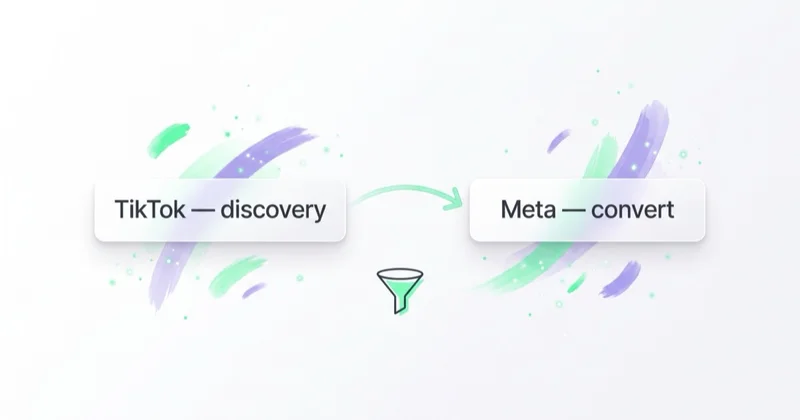
- Meta and TikTok need different creative roles. TikTok is often discovery and creator proof; Meta is stronger for conversion, catalog retargeting and testing at scale.
- First-order ROAS is incomplete. Supplements depend on repeat orders, subscriptions, bundles, churn and contribution margin.
- Conversion comes from trust. Ingredient clarity, third-party testing where available, transparent dosing, reviews, FAQs and realistic expectations often sell better than aggressive claims.
Why Supplement Marketing Is Different
Supplements sit between ecommerce, wellness, content and regulated health-adjacent communication. That combination changes how media buying should work.
First, the product is usually consumable. A customer may buy monthly, subscribe, reorder after finishing a bottle, try a bundle or add another SKU later. The economics can support higher acquisition cost than a one-time product, but only if retention and margin are measured correctly.
Second, the category is trust-sensitive. Customers evaluate ingredients, dosage, safety, reviews, certifications, manufacturing quality and whether the brand sounds credible. Overheated copy can lift click-through rate while lowering trust and increasing refunds.
Third, the claim environment is strict. The FDA says dietary supplements are not approved before marketing and that firms are responsible for ensuring products are not adulterated or misbranded. FDA guidance also distinguishes supplement labeling claims such as structure/function, health and nutrient content claims. The FTC covers advertising and expects health-related claims to be truthful, not misleading and backed by competent and reliable scientific evidence.
Fourth, platform policies can be stricter than general advertising law. Meta's health and wellness standards include age targeting requirements for some dietary, health or weight-loss products and prohibit negative self-perception tactics. Google monitors healthcare, medicines and unapproved supplement content. TikTok and marketplace policies also need review before launch because rules vary by product, market and claim type.
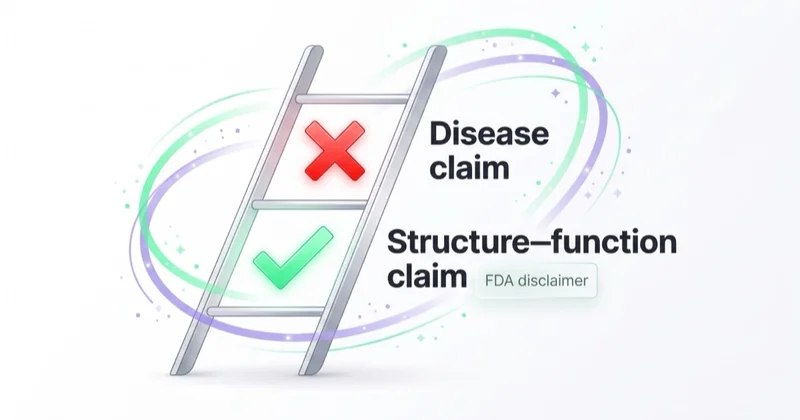
The Claim Ladder
Most supplement marketing problems start when the brand, creative team and media buyer do not share the same claim rules. A practical claim ladder helps keep the account scalable.
| Claim level | Typical use | Risk level | Required discipline |
|---|---|---|---|
| Ingredient fact | "Contains magnesium glycinate" | Lower | Ingredient label, dosage and sourcing accuracy |
| Use context | "Part of an evening routine" | Lower | Avoid implied medical outcome |
| Structure/function | "Supports normal muscle function" | Medium | Substantiation, disclaimer review and label alignment |
| General wellbeing | "Supports daily wellness" | Medium | Avoid broad implication beyond evidence |
| Comparative claim | "More [ingredient] than [competitor]" | Medium to high | Current proof, exact comparison and legal review |
| Disease-related implication | Any message suggesting disease prevention or management | High | Usually unsuitable for supplement ad funnels without specialist review |
| Result guarantee | Any certain or rapid outcome promise | High | Avoid in paid acquisition |
The safest creative system makes approved claims reusable. Every hook, creator script, landing page section, email and FAQ should map back to an approved claim library. If a creator, editor or agency cannot identify the approved claim behind a line, that line should not enter an ad test.
What FDA and FTC Mean for Ads
FDA and FTC responsibilities are not the same, but the practical marketing takeaway is simple: the full customer-facing funnel needs a claim review process.
| Area | Practical implication for marketing |
|---|---|
| FDA supplement framework | Product identity, Supplement Facts, ingredients, quality and labeling need specialist review |
| Structure/function language | Claims about normal structure or function require substantiation and label/disclaimer discipline |
| FTC advertising standards | Express and implied claims in ads must be truthful, non-misleading and substantiated |
| Net impression | Images, testimonials, product names, charts and copy can imply a claim even when the exact words are avoided |
| Influencer disclosures | Paid, gifted, affiliate or otherwise connected creator posts need clear disclosure |
This is why supplement ads should not be written in isolation. A claim may appear in a TikTok hook, image overlay, landing page headline, creator caption, product bundle name or email subject line. The claim review process has to cover all of those surfaces.
Meta and TikTok Channel Roles
Meta and TikTok can both work for supplements, but they usually do different jobs.
| Channel | Best role | What tends to work | Main failure mode |
|---|---|---|---|
| TikTok organic and paid | Discovery and creator-led demand | Native routines, ingredient education, founder explanations, Spark Ads | Over-scripted content or unsupported creator claims |
| TikTok Shop | Discovery-to-purchase where eligible | Product demonstrations, creator affiliates, clear offers, social proof | Weak margin control and insufficient claim moderation |
| Meta prospecting | Scaled conversion testing | UGC, catalog assets, offer tests, broad audiences, Advantage+ Shopping where suitable | Creative fatigue and policy disapprovals |
| Meta retargeting | Product consideration and reorder nudges | Product education, reviews, bundles, subscribe-and-save | Repeating the same claim until frequency hurts trust |
| Google Search and Shopping | Branded and category intent | Product feed accuracy, ingredient-led search, brand defense | Restricted content, unsupported claims and poor feed hygiene |
| Email and SMS | Retention and LTV | Onboarding, usage reminders, replenishment, education, winback | Over-messaging and discount dependency |
The channel mix should match product maturity. A new brand with no proof often needs creator testing and landing page work before heavy scaling. A mature brand with strong repeat rate can afford broader prospecting and value-based bidding. A brand with policy instability should slow down and fix claims before increasing spend.
UGC That Sells Without Overclaiming
Supplement UGC should feel specific and human without implying unsupported outcomes. The best briefs give creators a narrow lane:
- product format, taste, texture and routine;
- ingredient facts and approved claim language;
- who the product is intended for and who it is not intended for;
- what not to say;
- disclosure requirements;
- whether personal results are allowed and how they must be framed;
- visual restrictions, especially for weight, body image, medical or sensitive categories.
Useful creator angles include:
| Angle | Why it works | Claim guardrail |
|---|---|---|
| Routine integration | Shows habit fit and repeat use | Avoid promising an outcome from the routine |
| Ingredient education | Builds credibility | Do not overstate ingredient evidence |
| Founder or formulator explanation | Adds authority and transparency | Keep credentials and evidence accurate |
| Taste and format review | Reduces purchase friction | Keep sensory claims honest |
| Bundle explanation | Helps customers choose | Avoid implying combined products create stronger health outcomes without support |
| Replenishment reminder | Supports retention | Make timing practical, not medical |
Creator governance matters as much as creator volume. The brand should store briefs, approvals, raw footage, final edits, disclosures, claim notes and takedown decisions. That archive protects learning and reduces repeated compliance mistakes.
Landing Page CRO for Supplement Brands
The supplement landing page has to answer trust questions before the customer feels pressure to buy.
| Page element | Conversion purpose |
|---|---|
| Clear product identity | Explains what the supplement is, who it is for and how it fits a routine |
| Ingredient panel | Shows amounts, form, sourcing and function in plain language |
| Claim-safe benefit section | Connects approved claims to customer motivations |
| Third-party testing or quality proof | Reduces skepticism where available |
| Reviews and UGC | Adds social proof without unsupported result claims |
| Usage instructions | Reduces uncertainty and customer support load |
| Subscription and bundle options | Raises AOV and LTV without forcing a discount-only sale |
| FAQ | Handles safety, timing, compatibility and shipping questions |
| Disclaimer and policy content | Keeps expectations clear |
Good supplement CRO is often less about urgency and more about clarity. Customers need to know what is in the product, why it is there, how it is used, what evidence supports the claims and what result should not be assumed.
For ecommerce mechanics, the same fundamentals apply as in Shopify Google Shopping and Performance Max, ecommerce analytics and conversion rate optimization. Supplements simply add a stricter claim layer.
Subscription, Bundles and Retention
Supplements are naturally suited to repeat purchase, but subscription should not be treated as a checkout trick. The offer has to make sense for actual use.
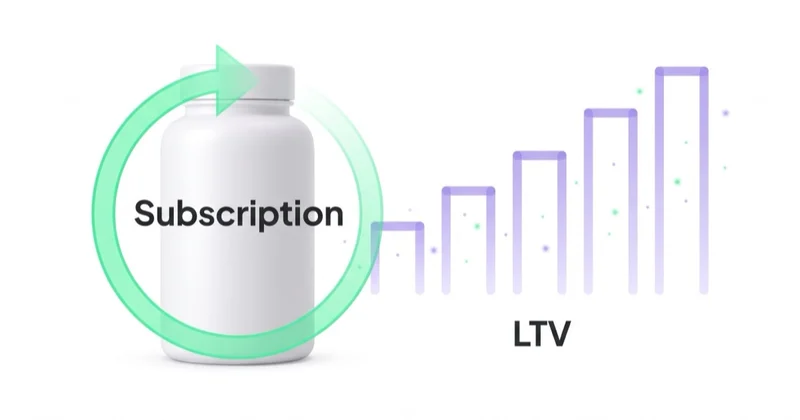
| Growth lever | What it improves | Watchout |
|---|---|---|
| Subscribe and save | Repeat revenue and forecastability | Churn if usage timing is wrong |
| Starter bundle | AOV and education | Confusion if the bundle is not clearly explained |
| Replenishment email | Second-order rate | Too many reminders can feel aggressive |
| Usage onboarding | Product understanding | Must stay within approved claims |
| Loyalty or referral | Repeat purchase and word of mouth | Incentives need disclosure and review |
| Cross-sell | LTV | Avoid unsupported "stack" implications |
The first 30 to 60 days matter. A customer who understands when to use the product, what it is meant to support and when to reorder is more valuable than a customer acquired through a dramatic one-time offer.
Measurement: Contribution Margin, Not Surface ROAS
First-order ROAS often misleads supplement brands. A product with repeat purchase may tolerate a higher CAC than a one-time SKU, but only if the repeat rate is real and contribution margin is known.
Track these metrics by channel, campaign and creative cohort:
- new-customer CAC;
- first-order contribution margin;
- second-order rate;
- third-order rate;
- subscription start rate;
- subscription churn;
- refund and chargeback rate;
- bundle attach rate;
- gross margin by SKU;
- LTV by acquisition source;
- claim or policy disapproval rate by creative angle.
For bidding and reporting, value signals should reflect margin and customer quality where possible. Meta Conversions API, server-side tagging, enhanced conversions and margin-based conversion value are especially relevant when platform-reported purchase value does not reflect refund, margin or repeat order reality.
Creative Testing Framework
Supplement creative should be tested by claim angle, use case and trust element, not only by hook.
| Test dimension | Examples |
|---|---|
| Claim angle | Ingredient fact, routine support, general wellbeing, product format |
| Persona | Busy professional, athlete, parent, frequent traveler, wellness beginner |
| Format | Founder video, creator routine, ingredient explainer, product demo, review montage |
| Offer | Single SKU, starter bundle, subscribe and save, variety pack |
| Trust proof | Testing, sourcing, manufacturing, reviews, expert involvement |
| Friction removal | Taste, texture, serving size, shipping, returns, subscription management |
Each test should have a claim note. That note explains why the creative is allowed, what evidence supports it and which wording is not allowed. This keeps the testing system fast without turning review into guesswork.
Common Mistakes
| Mistake | Better Approach |
|---|---|
| Treating compliance as a final copy check | Build an approved claim library before creative production |
| Letting creators improvise health outcomes | Provide strict briefs, required disclosures and review steps |
| Measuring only first-order ROAS | Measure contribution margin, repeat rate, subscription and LTV |
| Using vague ingredient claims | Match each claim to substantiation and product dosage |
| Scaling before policy stability | Fix disapprovals and landing page claims before increasing spend |
| Discounting subscriptions too aggressively | Improve onboarding, replenishment and product education |
| Ignoring refund reasons | Feed refund, chargeback and support data back into creative and product pages |
How Space Ads Approaches Supplement Accounts
Across 25+ client accounts audited daily and roughly 14 million monthly data points analyzed through Space Ads OS, supplement and wellness accounts usually fail in three places: unsupported claims, creative fatigue and misleading economics. The platform account may show strong revenue while the business loses money after COGS, discounts, refunds and short retention.
The Space Ads approach starts with the operating model, not the ad format. Claims are mapped before creative testing. Product pages are checked for trust, clarity and conversion friction. Meta and TikTok are given separate creative roles. Reporting moves from first-order ROAS toward contribution margin, new-customer quality, repeat purchase and subscription behavior. For an existing brand, a marketing audit should identify whether the account is limited by compliance, creative volume, tracking, offer economics or landing page trust.
30-Day Optimization Plan
- Days 1-3: build the claim library. Collect approved claims, evidence, prohibited wording, disclaimers and creator do-not-say rules.
- Days 4-7: audit the funnel. Review ads, landing pages, product pages, email, SMS, bundles and creator posts for claim consistency.
- Days 8-12: rebuild measurement. Add contribution margin, repeat purchase, subscription, refunds and SKU-level profitability to reporting.
- Days 13-18: refresh UGC. Produce creator briefs by approved claim angle, routine, ingredient education and trust proof.
- Days 19-24: improve CRO. Strengthen ingredient clarity, testing proof, FAQs, reviews, subscription logic and bundle explanation.
- Days 25-30: scale by value. Shift spend toward creatives and channels that produce profitable customers, not just first purchases.
FAQ
What is supplement brand marketing?
Supplement brand marketing is the system used to acquire, convert and retain customers for dietary supplement products. It includes Meta Ads, TikTok Ads, creator content, product pages, email and SMS, subscriptions, bundles, claim review and profit-based measurement.
What makes supplement marketing risky?
Supplement marketing is risky because advertising can imply health outcomes even when the copy seems cautious. FDA and FTC requirements, platform policies, influencer disclosures, testimonials, product labels and landing page claims all affect the same customer journey. The safest account has a documented claim library and a review process before creative goes live.
Can supplement brands use UGC?
Yes, but UGC needs governance. Creator briefs should include approved claims, prohibited claims, disclosure instructions, visual rules and review steps. Testimonials cannot be used as a substitute for substantiation, and creator content should not imply outcomes the brand cannot support.
Is Meta or TikTok better for supplement brands?
The better channel depends on product maturity, proof, margin and creative volume. TikTok often works well for discovery, creator content and native product education. Meta is often stronger for scaled conversion testing, catalog retargeting and broad creative optimization. Most growing brands need both, but with different creative roles.
Why is first-order ROAS weak for supplements?
First-order ROAS ignores repeat orders, subscription behavior, refunds, discounts, COGS and customer quality. Supplement profitability is usually clearer when campaigns are evaluated by contribution margin, second-order rate, subscription churn and LTV by acquisition source.
What should a supplement landing page include?
A supplement landing page should include clear product identity, ingredient amounts, approved claim explanations, usage instructions, quality proof, reviews, subscription logic, FAQs, shipping and returns, and disclaimer content. The page should reduce uncertainty rather than rely only on urgency.
How can supplement brands improve conversion without aggressive claims?
Conversion improves when the customer understands the product. Ingredient clarity, realistic routine content, transparent quality proof, relevant reviews, bundle guidance, easy subscription management and strong post-purchase onboarding often outperform dramatic claims while creating less compliance risk.
In Short
- Supplement brand marketing works best when claim discipline, UGC volume and retention economics are managed together.
- FDA and FTC rules affect labels, ads, landing pages, testimonials and creator content.
- Meta and TikTok can both work, but TikTok usually creates discovery while Meta scales conversion and retargeting.
- The best metric is contribution margin and LTV, not only first-order ROAS.
- Trust-building CRO usually beats aggressive health promises in a restricted category.
Sources
- FDA - Questions and Answers on Dietary Supplements
- FTC - Health Products Compliance Guidance
- FTC - Disclosures 101 for Social Media Influencers
- Meta Transparency Center - Health and Wellness ad standards
- Google Ads Help - Unapproved pharmaceuticals and supplements
- Google Ads Help - Healthcare and medicines policy
Continue Learning
- Skincare and beauty brand marketing: Meta, TikTok Shop and UGC
- TikTok Shop: what it is and how it works
- AI UGC ads: AI-generated creators and captions
- Shopify Google Shopping and Performance Max for DTC
- Ecommerce analytics: why it matters
- Meta Advantage+: what it is and how it works after the changes
- Meta Ads · TikTok Ads · Performance marketing
Continue reading

UGC Ads: How to Brief, Source and Run Creator Content That Performs
Creator-led ads can make a product easier to understand, but paid content must not masquerade as an independent customer opinion. Learn how to source, brief, contract, disclose and test creator content responsibly.
An Ad Creative Testing Framework That Actually Finds Winners
Creative testing should separate finding an ad that can scale from proving why it works. This framework covers hypotheses, controls, randomised experiments, primary metrics, sample size, conversion delay, decision rules, and iteration.
One Creative Won't Fit All: Ad Creative for Meta vs TikTok vs Google
A strong concept can travel across Meta, TikTok, and Google, but the same file may not suit every placement. Learn what to preserve, what to adapt, which specifications matter, and how to test cross-platform creative without relying on stereotypes.