Facebook and Instagram ads do not have a fixed price list. The advertiser sets a daily or lifetime budget and campaign objective; eligible opportunities enter Meta's auction. Delivery and cost depend on factors including the bid or bid strategy, estimated action rate, ad quality, audience, placements, competition and the outcome selected for optimization.
That means the question "how much do Facebook ads cost?" is really three questions:
- How much media budget is needed to buy enough impressions, clicks or conversions?
- What will the business pay per real result: qualified lead, purchase, booking, app install or customer?
- What is the full cost of running the channel, including creative, management, tracking and landing page work?
This guide explains Meta ad pricing, CPM, CPC, CPA, budget planning, the learning phase, creative cost and how to lower cost per result without simply cutting spend.
TL;DR
- Facebook ads have no fixed price. The advertiser controls the budget; Meta's auction sets delivery cost based on bid, estimated action rate and ad quality.
- CPM and CPC are diagnostic metrics. The business metric is cost per result: cost per lead, purchase, booking, qualified opportunity or customer.
- The auction uses several inputs. Creative, offer, landing experience and conversion data influence performance, but no single improvement guarantees a lower cost.
- Benchmarks are only rough context. Public averages vary by industry, country, objective, placement, season and sample. They should not replace account economics.
- Budget should be built from a decision. Expected CPA × required outcome range is a starting estimate, then adjust for uncertainty, duration, conversion lag and affordable downside.
- Do not turn “50 events” into a universal minimum. Meta recommends sufficient budget over at least seven days, but the evidence needed depends on the decision and variability.
- The full cost includes media, creative, management and measurement. Meta ads without fresh creative, Pixel/CAPI and a working landing page often become expensive even with low CPM.
- Daily spend can fluctuate. Meta says it may spend up to 75% above a daily budget on an individual day while keeping weekly spend within seven times that daily budget.
What "Facebook ads cost" actually means
Meta sells advertising across Facebook, Instagram, Messenger, Audience Network and other placements through an auction. The campaign may be optimized for reach, traffic, leads, purchases, app installs, messages, video views or another result. The invoice shows ad spend, but the business should evaluate cost per meaningful outcome.
The main cost metrics:
| Metric | Meaning | When it helps | Main risk |
|---|---|---|---|
| CPM | Cost per 1,000 impressions | Understand reach price and auction pressure | Cheap reach may be low quality |
| CPC | Cost per click | Compare traffic efficiency across creatives and placements | Cheap clicks may not convert |
| CTR | Click-through rate | Diagnose creative and message strength | Clickbait can raise CTR but reduce sales |
| CPA / CPL | Cost per recorded purchase, lead or result | Campaign optimization and diagnosis | A platform result may be duplicated, low quality or later reversed |
| Platform ROAS | Attributed conversion value ÷ Meta spend | Operating view inside Meta | Is not contribution or incremental return |
| MER | Total business revenue ÷ defined marketing spend | Blended company-level context | Includes demand not caused by the current Meta campaigns |
Start with the business ledger and contribution, then inspect qualified CPA, conversion progression and platform diagnostics such as CPM or CPC. A low CPC is not useful if the traffic never becomes a qualified lead, retained customer or profitable order.
How the Meta auction sets cost
Meta does not simply show the highest bidder. Its auction aims to deliver ads with the highest total value. In simplified terms, total value combines:
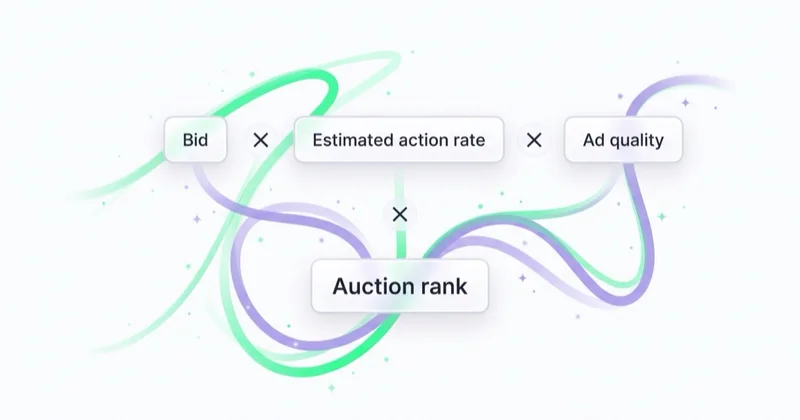
- the advertiser's bid or bid strategy;
- the estimated action rate, meaning how likely a person is to take the desired action;
- ad quality, including relevance, feedback and the expected user experience.
The highest bid does not automatically win. Better predicted response and ad quality can change delivery, which is why manual bid adjustments alone rarely explain account economics. Diagnose the entire system: proposition, creative, audience constraints, conversion event, landing page, post-click process and realized value.
Why Facebook Ads cost is different from Google Ads cost
The cost question looks similar to Google Ads cost, but the channel logic is different.
In Google Search, the user expresses intent by typing a query. In Meta, the ad appears in a content feed. The campaign must stop attention, explain relevance and create a reason to act before the user has searched.
That creates three differences:
- Creative has more weight. The first seconds of a video, product demonstration, hook, proof and offer often decide cost per result.
- CPM is not the whole story. Meta may buy impressions cheaply, but the business still needs clicks, form starts, product views, purchases or qualified leads.
- Creative fatigue is a real cost. A good ad can become expensive after repeated exposure because engagement drops, frequency rises and the audience stops responding.
In practice, Facebook Ads cost should be planned as a system: media, creative, tracking, landing page, campaign management and quality of the result after the click.
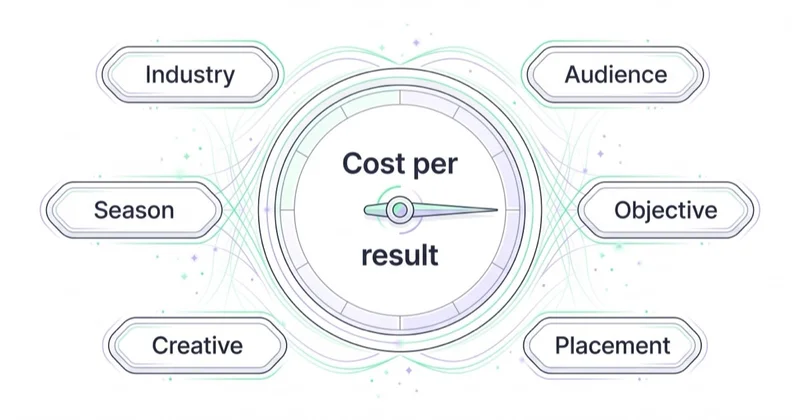
What drives Facebook ad costs
| Factor | How it affects cost |
|---|---|
| Industry and competition | Finance, legal, insurance, B2B and high-value services usually tolerate higher CPA and attract stronger competition |
| Objective | Reach and traffic are cheaper per surface metric; leads and purchases cost more because they require stronger intent |
| Creative quality | Strong hooks, proof and native formats improve response; fatigue raises CPA |
| Audience breadth | Very narrow audiences can limit learning; broad audiences need better creative and signal |
| Placement | Feed, Reels, Stories and other placements have different costs and user behavior |
| Seasonality | Q4, Black Friday, holidays and local peaks increase auction competition |
| Tracking quality | Pixel, Conversions API, deduplication and conversion values affect what the system learns |
| Landing page | Slow pages, weak forms, unclear checkout and message mismatch raise CPA |
| Offer | A weak proposition is expensive no matter how low the CPM is |
Some factors are controllable; auction competition, market demand and seasonality are not. “Facebook got expensive” is therefore too vague. Decompose the change into reach cost, response, post-click conversion, qualification, order contribution and customer mix before deciding what to change.
How to calculate a profitable cost per result
Start with unit economics.
For lead generation, the key question is: how much can a qualified lead cost if only a percentage of leads becomes sales? For e-commerce, the question is: how much can a purchase cost after margin, returns, discounts, shipping, payment fees and repeat purchase are considered?
| Business model | Useful formula | What it shows |
|---|---|---|
| Lead generation | allowable CAC × qualified-lead-to-customer rate | planning ceiling per qualified lead |
| E-commerce | expected first-order contribution before acquisition − required profit buffer | planning ceiling for first-order CPA |
| SaaS / subscription | cohort contribution available for acquisition within the payback limit | customer CAC ceiling, then derive trial or demo value |
| Local service | realized contribution per completed job × qualified-contact-to-job rate | planning ceiling per qualified contact |
Example for lead generation: if a customer is expected to produce $3,000 in contribution under a documented model and the business sets an allowable CAC of $750, a 20% qualified-lead-to-customer rate implies a planning ceiling of $150 per qualified lead. This is not a bid recommendation. Lower rates, longer payback or sales cost reduce the affordable amount; better realized contribution may increase it.
Example for ecommerce: a $120 order with $42 expected contribution before acquisition does not automatically support a $42 CPA. Finance may require part of that contribution for overhead, profit and cash risk. If the approved acquisition allowance is $17, use $17 as the planning target and track actual returns and fulfillment. Repeat-purchase value should come from mature cohorts, not an optimistic LTV assumption.
How much budget is needed?
A useful budget is large enough to answer a defined question and small enough that the downside is acceptable. There is no universal monthly minimum and no guarantee that spending a particular multiple of target CPA will make results stable.
Build the estimate in five steps:
- Define the primary decision. Are you testing a proposition, estimating qualified CPA, validating first-order economics or scaling a proven system?
- Set an expected CPA range. Use the account, funnel or comparable-market evidence, with downside—not a single benchmark.
- Choose the outcome range required. Ten purchases may expose obvious tracking failure; a small performance difference may require far more observations to distinguish from noise.
- Allow enough duration. Meta recommends sufficient budget over at least seven days so delivery can learn; longer sales cycles need a longer observation and maturity window.
- Set a loss and stop condition. State maximum spend, minimum quality, operational capacity and the result that triggers scale, revision or stop.
Planning media budget = expected CPA × desired number of observable outcomes
If CPA is expected to fall between $40 and $70 and the team wants 30 observed outcomes, the initial media range is $1,200–$2,100 before allowing for conversion lag and test design. Dividing $2,100 by $70 does not guarantee 30 outcomes; it only exposes the assumption.
Avoid multiplying campaigns and ad sets merely to create a neat matrix. Consolidation can give delivery more data, but it should not combine materially different markets, economics, conversion events or legal constraints. If the true business event is too rare, a higher-frequency proxy may be used only after proving that it predicts the downstream outcome.
Daily and lifetime budgets
A daily budget is an average, not a hard daily cap. Meta states that it may spend up to 75% over the daily amount on an individual day, while total weekly spend should not exceed seven times the daily budget. A lifetime budget can fluctuate by day while remaining within the campaign total. Plan cash and reporting around that behavior, and verify the current account settings before launch.
Budget by campaign goal
Different goals require different evidence.
| Goal | What the budget should prove | Main metrics |
|---|---|---|
| Creative testing | Which materially different proposition or format earns relevant attention | held views, clicks, landing-page progression and downstream response |
| Offer testing | Whether the proposition creates interest | CPL, form start rate, call quality, sales feedback |
| Lead generation | Whether leads are qualified and contactable | cost per qualified lead, contact rate, CRM stage, close rate |
| E-commerce sales | Whether purchases are profitable | CPA, ROAS, MER, margin, return rate, new customer rate |
| Remarketing | Whether follow-up adds incremental value | reach, frequency, qualified outcomes and holdout or lift where feasible |
| Awareness | Whether the brand reaches the right market | reach, frequency, brand search, direct traffic, lift tests |
The weakest test changes creative, offer, audience, landing page, price and tracking at once, then attributes the movement to whichever change the team prefers. With limited budget, define the hypothesis and the closest valid outcome. A creative screening test need not prove final ROAS, but a scaling decision must reach qualified economics.
How Advantage+ changes the cost discussion
Meta's current setup is automation-first. Advantage+ Sales can automate audience, placements, budget and creative decisions for sales, while Advantage+ Leads is the default experience for eligible leads campaigns. Advantage+ audience may treat marketer inputs as suggestions while preserving strict controls such as location, minimum age, language and exclusions where configured.
Automation reduces some manual segmentation; it does not remove responsibility. Confirm which settings are strict controls, define existing-customer exclusions or reporting groups correctly, review placement and creative suitability, and provide a conversion signal that represents business value. Meta's published performance averages describe selected advertiser populations and should not be copied into a forecast for an individual account.
The hidden cost: creative production
On Meta, creative is not a bonus line item. It is campaign fuel.
The platform competes inside feeds, Reels, Stories and other content environments. The ad needs to look native enough to earn attention and clear enough to move the user to action. A static banner adapted from another channel often underuses the platform.
Creative cost appears in three places:
- developing new concepts;
- adapting assets to placements and formats;
- refreshing ads when frequency rises and performance declines.
Creative fatigue may appear as a decline in response or rising cost alongside repeated exposure, but the pattern is not diagnostic on its own. Seasonality, audience composition, auction pressure, site performance and offer changes can produce similar movement. Validate new concepts—not merely cosmetic edits—through a controlled test where volume permits.
Full cost: media, creative, management, tracking and landing pages
Media spend is only one part of Facebook Ads cost.
| Cost item | What it covers |
|---|---|
| Media | Spend in the Meta auction |
| Creative | Production, editing, adaptation and refreshes |
| Management | Strategy, setup, optimization, reporting and testing |
| Measurement | Pixel, Conversions API, consent, deduplication, UTMs and conversion values |
| Landing pages | Form, checkout, speed, message match, CRO and analytics |
| Commercial overhead | Applicable taxes, currency conversion, payment terms and working-capital timing |
Agency pricing can be a flat retainer, a percentage of media spend, a hybrid model or a project fee for setup, audit or creative. Ask what is included: strategy, production, landing pages, analytics, server-side implementation and reporting are often separate scopes. Compare fully loaded cost with realized contribution, not media-only ROAS.
For lead generation, lead quality must be part of the cost. A low CPL is not success if the CRM shows poor contact rate, wrong location, no budget or unqualified enquiries. For e-commerce, margin, returns, average order value, new customer rate and repeat purchase play the same role.
How to lower Facebook Ads cost per result
Lowering cost per result is usually an efficiency problem, not a "spend less" problem.
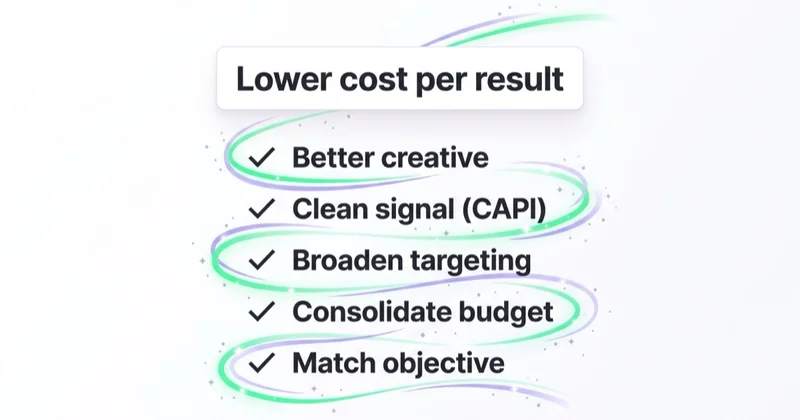
Practical levers:
- Improve creative. Better hooks, proof, product demos, creator-style formats and message clarity usually change cost more than bid tweaks.
- Fix conversion signal. Meta Pixel, Conversions API, deduplication and conversion values can improve connectivity. They do not bypass consent, privacy rules or Meta's terms.
- Consolidate where economics match. Too many small ad sets can split data, but do not merge different countries, margins or conversion meanings simply for volume.
- Use sufficient eligible reach. Over-narrowing can restrict delivery; keep strict geographic, age, compliance and customer exclusions where the business requires them.
- Match objective to goal. Traffic campaigns should not be judged like purchase campaigns, and awareness campaigns should not be expected to produce stable CPA.
- Improve the landing page. Faster load, clearer offer, better form, stronger proof and message match lower CPA without changing CPM.
- Watch frequency and fatigue. Refresh creative before performance decays.
- Return downstream quality. Optimize toward qualified or realized outcomes and adjust canceled or refunded orders where the implementation supports it.
A Facebook ads audit often reveals the easiest fixes: broken tracking, wrong objective, too many ad sets, stale creative, weak forms or reports that ignore lead quality.
How Space Ads approaches Meta Ads cost
At Space Ads, the cost discussion starts with the business result, not whether CPC looks high. We define the affordable qualified outcome, reconcile Meta events with CRM or commerce records, test Pixel/CAPI deduplication and review whether the landing journey converts the intended audience.
We then decompose cost into auction exposure, creative response, post-click progression, qualification and realized value. This prevents a rising CPA caused by checkout failure from being “fixed” with new audience targeting, or a margin problem from being hidden by platform ROAS.
For ecommerce, reporting considers contribution after discounts, returns and fulfillment, plus new-customer and cohort behavior. For lead generation, it connects Meta leads to contact, qualification, opportunity, sale and realized value. A marketing audit can identify whether the constraint sits in media, creative, measurement, page or economics. Ongoing execution sits under Meta Ads and broader performance marketing.
Common mistakes
| Mistake | Why it hurts | Better approach |
|---|---|---|
| Judging by CPM alone | Cheap impressions may not produce business results | Measure cost per result and result quality |
| Copying benchmarks as a budget | Benchmarks do not know margin, country, objective or offer | Calculate target CPA from economics |
| Treating 50 events as a guaranteed threshold | Confuses a planning heuristic with decision quality | Budget for the hypothesis, duration and uncertainty |
| Splitting a small budget across many ad sets | Each segment may produce inconclusive evidence | Consolidate where markets and economics match |
| Running one creative for months | Fatigue raises cost and lowers response | Plan a creative refresh cycle |
| Fixing cost only by raising budget | More spend amplifies weak inputs | Check creative, offer, tracking and landing page first |
| Treating CAPI as a privacy workaround | Creates policy and legal risk | Apply notice, consent, minimization and governance |
| Treating cheap leads as success | Low CPL can hide poor qualification | Measure contact rate, CRM stage and close rate |
FAQ
How much do Facebook ads cost per month?
Meta does not set a fixed monthly price. Estimate a range from expected qualified CPA, required observations, duration and affordable downside. A $5,000 budget divided by an assumed $50 CPA suggests 100 outcomes; it does not guarantee them. State the range and stop condition before launch.
Are Instagram ads more expensive than Facebook ads?
Instagram and Facebook placements participate in Meta's delivery system, but costs and response differ by market, audience, objective, format and season. Evaluate placement suitability, qualified outcomes and incrementality where feasible—not the platform label alone.
Do Facebook ads charge per click or impression?
Meta commonly buys delivery through impressions, but campaigns can optimize toward different goals such as leads, purchases, traffic or reach. The invoice reflects media spend; performance should be judged by cost per result: lead, purchase, booking, app install, qualified call or another business event.
How many conversions are needed for the learning phase?
Meta's delivery needs enough time and outcomes to learn, but “50 events in seven days” should not be treated as a universal budget law or guarantee of stability. Meta currently recommends a sufficient budget over at least seven days. The observation count required for a business decision depends on variance, conversion lag and the size of effect being tested.
Why are Facebook ads getting more expensive?
Common reasons include creative fatigue, seasonal competition, fragmented campaign structure, weak conversion tracking, landing page problems, poor offer clarity, over-narrow targeting or declining lead quality. In many accounts, new creative and better measurement lower cost faster than bid changes.
How much should a small business spend on Facebook ads?
Start from an affordable qualified outcome and a narrow decision. Estimate a CPA range, the number of observations required, at least a full learning window and the maximum acceptable loss. If the budget cannot test the final outcome, validate a predictive upstream step without pretending it proves sales economics.
How can cost per result be lowered?
Test materially different creative, repair event quality and deduplication, consolidate where economics match, keep necessary audience controls, improve the post-click journey and optimize toward qualified outcomes. Diagnose which stage changed before prescribing a fix.
Key takeaways
- Facebook ads have no fixed price; cost is determined by Meta's auction and the quality of campaign inputs.
- CPM and CPC help diagnose delivery, but budget decisions should use CPA, ROAS, MER or qualified lead cost.
- Budget should be planned from a decision, expected CPA range, observation needs, duration and affordable downside.
- The full cost includes media, creative, management, tracking and landing page work.
- Creative, signal, landing journey and offer should be diagnosed together; no single lever guarantees lower cost.
Sources and further reading
- Meta Business Help - About ad auctions
- Meta Business Help - About budgets
- Meta Business Help - About the learning phase
- Meta for Business - Budgets, costs and schedules
- Meta for Business - Advantage+ Sales campaigns
- Meta for Business - Advantage+ Leads campaigns
- Meta for Developers - Meta Pixel
- Meta for Developers - Conversions API
- Engineering at Meta - Meta Andromeda and Advantage automation
Continue learning
Continue reading
Facebook and Meta Ads Benchmarks by Industry (CPM, CPC, CTR, ROAS)
Meta ads benchmarks are only comparable when objective, performance goal, placement, market, audience, attribution, and period align. Learn how CPM, CTR, CPC, CVR, CPA, and ROAS connect—and where they do not.
What is PPC — The Ultimate Guide to Pay-Per-Click Advertising
PPC is performance advertising bought through auction-based platforms, but the real goal is not cheaper clicks. It is profitable demand, clean measurement and better business outcomes.
Why Your Meta Ads Stopped Working (and How to Diagnose It)
When Meta performance changes, diagnose the affected layer before editing campaigns. This guide covers delivery status, billing, event quality, funnel metrics, activity history, creative, offer, website and controlled recovery.