Inbound marketing is a strategy for attracting potential customers through useful content, search visibility, education, trust and helpful experiences instead of relying only on interruptive promotion. It is commonly associated with SEO, content marketing, social media, email, lead nurturing, CRM, automation and customer success.
Inbound does not mean "no paid advertising". Paid media can amplify useful content, promote lead magnets, retarget engaged users and accelerate learning. The difference is that inbound starts with customer problems, questions and decision support rather than with a sales message pushed to everyone.
TL;DR
- Inbound marketing attracts people by answering questions, solving problems and building trust before the sales conversation.
- The classic inbound model is often described as Attract, Engage and Delight.
- Useful channels include SEO, content, social media, email, webinars, lead magnets, CRM, automation and CRO.
- Inbound works best when buyers need education, comparison, trust or repeated contact before purchase.
- It is not only for B2B. Ecommerce, SaaS, education, services and local businesses can use it too.
- Inbound and paid media should work together: content creates value, paid distribution accelerates reach.
- In the AI Search era, inbound content needs expertise, clear answers, sources, original examples and strong topical depth.
- Success should be measured by qualified leads, pipeline, assisted revenue, retention and content influence, not only last-click conversions.
What is inbound marketing?
Inbound marketing is a value-first approach to growth. It helps the right people find the business when they are researching a problem, comparing solutions, looking for education or trying to make a decision.
Inbound can include:
- educational blog articles;
- SEO landing pages;
- comparison guides;
- case studies;
- webinars;
- newsletters;
- social content;
- short-form video;
- downloadable checklists;
- calculators;
- product guides;
- email nurturing;
- CRM workflows;
- customer onboarding content;
- help centres and knowledge bases.
The goal is not simply to publish content. The goal is to create a system that attracts, converts, supports and retains the right customers. A strong inbound system has a clear path from question to answer, from answer to next step, and from next step to a measurable business outcome.
The inbound methodology: Attract, Engage, Delight
HubSpot popularized the modern inbound methodology around three stages: Attract, Engage and Delight. The exact model can vary by company, but the logic is useful.
| Stage | Goal | Examples |
|---|---|---|
| Attract | Bring the right people into contact with the brand | SEO, social content, guides, videos, organic discovery |
| Engage | Help people evaluate and take a next step | landing pages, lead magnets, email, demos, comparison content |
| Delight | Support customers after conversion | onboarding, education, service content, retention campaigns |
The model is often described as a flywheel because satisfied customers, useful content and better experience create momentum over time.
Inbound vs outbound marketing
Inbound and outbound are different ways of creating demand and contact.
| Area | Inbound marketing | Outbound marketing |
|---|---|---|
| Main mechanism | Attract people through value | Reach people proactively |
| Examples | SEO, content, newsletters, webinars | cold email, paid reach, telemarketing, display campaigns |
| User state | The person is researching, searching or engaging | The brand initiates contact |
| Strength | Trust, education, compounding visibility | Speed, scale, market entry |
| Weakness | Takes time and needs consistency | Can be expensive or interruptive |
The best strategy often combines both. Inbound builds trust and owned assets. Outbound and paid media can accelerate distribution, test offers and reach new audiences.
Inbound vs content marketing
Content marketing is a major part of inbound, but they are not identical.
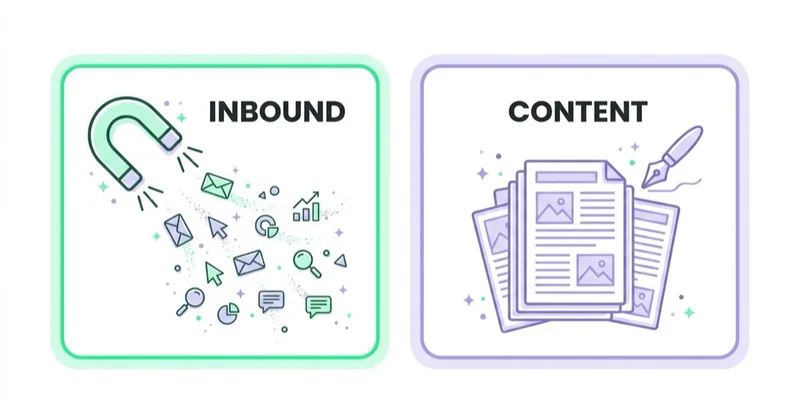
Content marketing focuses on creating and distributing valuable content. Inbound uses that content inside a broader system that includes conversion paths, CRM, email, sales alignment, customer experience and retention.
Example:
- A blog article is content marketing.
- A blog article that ranks in search, offers a relevant checklist, adds a lead to CRM, triggers a useful email sequence and helps sales understand the lead's problem is inbound marketing.
Why inbound matters in 2026
Buyers research across search engines, social platforms, YouTube, communities, podcasts, AI answer engines, reviews and direct recommendations. They often speak to sales later than companies would like.
This creates a practical problem: if the brand is absent while people research, compare and ask questions, paid campaigns may only reach them after competitors have shaped the decision.
Inbound helps by:
- making the brand discoverable;
- answering early and mid-funnel questions;
- building topical authority;
- creating reusable sales assets;
- reducing repeated sales explanations;
- supporting AI Search visibility with clear, source-backed content;
- nurturing leads that are not ready today;
- improving trust before a call or checkout.
For AI Search and answer visibility, content needs clear definitions, useful structure, sources and demonstrated expertise. See SEO audit guide for the technical and content quality foundation.
The core components of inbound marketing
1. Audience and intent research
Inbound starts with the people the business wants to attract.
Define:
- target segments;
- problems they experience;
- questions they ask;
- decision criteria;
- objections;
- preferred channels;
- buying triggers;
- stakeholders;
- sales cycle;
- post-purchase needs.
For deeper audience work, see Target audience: how to define who your customers are.
2. SEO and helpful content
SEO helps inbound content become discoverable. But content should not be written only to manipulate rankings. Google's guidance emphasizes helpful, reliable, people-first content.
Strong inbound content includes:
- direct answers;
- examples;
- comparisons;
- decision frameworks;
- original experience;
- clear author or brand responsibility;
- source links;
- current information;
- internal links;
- next steps.
For brand-level content positioning, see content marketing and professional brand image.
3. Lead magnets and conversion paths
A lead magnet is only useful if it solves a real problem.
Examples:
- checklist;
- template;
- calculator;
- audit form;
- webinar;
- report;
- comparison worksheet;
- email course;
- buyer guide;
- implementation plan.
The form should match the value. A simple checklist should not ask for ten fields. A high-value audit can ask for more context.
4. Email and lead nurturing
Not every visitor is ready to buy. Email and automation help continue the relationship.
Useful nurturing content:
- follow-up guide;
- case study;
- product comparison;
- objection answer;
- pricing explanation;
- implementation checklist;
- invitation to a webinar;
- reminder to book a consultation;
- onboarding content after purchase.
Automation should feel helpful, not like a sequence of generic pressure emails.
5. CRM and sales alignment
Inbound works better when marketing and sales share data.
Track:
- source;
- landing page;
- content consumed;
- lead magnet downloaded;
- email engagement;
- sales status;
- lead quality;
- deal stage;
- revenue;
- reason for loss.
If marketing celebrates lead volume while sales rejects the leads, the inbound system is not healthy.
6. CRO and user experience
Inbound traffic still needs a clear path to action.
Review:
- page clarity;
- mobile experience;
- forms;
- calls to action;
- trust signals;
- case studies;
- pricing visibility;
- loading speed;
- internal links;
- next-step alignment.
For conversion work, see conversion rate optimization.
Inbound content by funnel stage
Inbound content should not all have the same job.
| Stage | User question | Useful content |
|---|---|---|
| Awareness | What is the problem and why does it matter? | guides, definitions, explainer videos, checklists |
| Consideration | What are the options and trade-offs? | comparisons, frameworks, webinars, calculators |
| Decision | Why choose this provider or product? | case studies, service pages, demos, pricing explainers |
| Onboarding | How is success achieved after purchase? | welcome guides, implementation plans, tutorials |
| Retention | How can more value be created? | advanced education, best practices, customer stories |
This prevents the common mistake of writing only top-of-funnel articles. Awareness content can bring traffic, but decision and retention content often help revenue more directly.
7. Customer delight and retention
Inbound does not stop at acquisition. Customer education, onboarding and support can reduce churn and create referrals.
Examples:
- onboarding emails;
- help center articles;
- product education;
- customer webinars;
- renewal reminders;
- best-practice guides;
- community content;
- feedback loops;
- success stories.
The post-purchase experience can become a growth channel when customers trust the brand enough to return or recommend it.
Inbound for B2B
B2B inbound often works because decisions are complex and risky.
Useful B2B assets:
- problem guides;
- comparison pages;
- industry pages;
- case studies;
- ROI calculators;
- webinars;
- implementation plans;
- procurement support;
- stakeholder-specific content;
- technical documentation;
- sales enablement content.
B2B inbound should be measured with CRM data, not only analytics sessions. A smaller number of qualified leads can be better than high traffic from people who will never buy.
Inbound for ecommerce
Inbound is not only for B2B. Ecommerce brands can use inbound to reduce dependence on paid acquisition and support product discovery.
Useful ecommerce assets:
- buying guides;
- category education;
- product comparisons;
- size guides;
- material guides;
- care instructions;
- quizzes;
- UGC and reviews;
- newsletters;
- post-purchase education;
- loyalty content.
Example: a skincare store can create content around skin types, ingredient combinations and routines, then link naturally to relevant categories and products.
The same logic works outside classic ecommerce. A training company can publish course-comparison guides and preparation checklists. A local clinic can publish treatment explainers and recovery guides. A SaaS company can publish integration documentation, ROI calculators and use-case pages.
90-day inbound marketing plan
Days 1-15: Research
Review audience, sales calls, Search Console, paid search terms, CRM data, competitor content, FAQs and product or service objections.
Days 16-30: Content map
Build a content map by funnel stage:
- awareness topics;
- problem education;
- comparison and alternatives;
- decision support;
- conversion pages;
- post-purchase content.
Days 31-45: Conversion system
Create or improve landing pages, lead magnets, forms, CTAs, analytics events and CRM fields.
Days 46-70: Publishing and distribution
Publish priority content and distribute it through SEO, newsletter, social, sales outreach, remarketing and paid promotion where useful.
Days 71-90: Nurture and optimize
Build email sequences, review lead quality, update weak pages, improve internal links and connect content performance with CRM outcomes.
How paid media supports inbound
Paid media can make inbound work faster when it is used carefully.
Useful paid support:
- promote high-value guides to a relevant audience;
- retarget users who consumed comparison content;
- test headlines and offers before SEO work scales;
- distribute webinars or reports;
- support launches while organic visibility is still growing;
- bring qualified traffic to decision pages;
- use customer lists to re-engage known leads.
The mistake is using paid media only to push cold sales messages while the inbound system has no useful content, no lead nurture and no CRM feedback. Paid media should accelerate a useful journey, not compensate for the absence of one.
Inbound content for AI Search and answer engines
AI answer systems and LLM-assisted search raise the quality bar for inbound content.
Good inbound pages should:
- answer the main question early;
- define terms clearly;
- include practical examples;
- explain trade-offs and exceptions;
- cite reliable sources where factual accuracy matters;
- show first-hand expertise or operational experience;
- avoid vague generic advice;
- structure content with headings, tables and FAQs;
- link to related internal resources;
- keep dates and platform facts current.
The goal is not to "write for AI" instead of people. The goal is to make the answer so clear, useful and trustworthy that both users and answer systems can understand it.
How to measure inbound marketing
Useful metrics:
- organic traffic;
- impressions and clicks in Search Console;
- rankings by topic cluster;
- newsletter signups;
- lead magnet downloads;
- form completions;
- qualified leads;
- sales accepted leads;
- pipeline value;
- assisted conversions;
- email engagement;
- content-assisted revenue;
- customer retention;
- branded search growth;
- return visitors;
- content used by sales.
Inbound should not be judged only by last-click attribution. Many inbound touches influence decision-making before the final conversion.
How we approach this at Space Ads
Inbound and paid aren't rivals for us; each drives the other. Inbound's drawback is speed: content and Google rankings build over months. Paid is the remedy that compresses that timeline. The piece already holding its own organically gets a budget boost so it reaches wider; readers who didn't buy are picked up by remarketing; and ads buy reach here and now while the organic work matures. It cuts both ways: good content lowers the cost of acquisition from ads by handing over a warm audience and ready proof, while ads shorten the wait before inbound starts paying back. The question isn't "inbound or paid" but how to wire them so each reinforces the other.
Common inbound marketing mistakes
| Mistake | Impact | Better approach |
|---|---|---|
| Treating inbound as only blogging | Content does not convert | Connect SEO, offers, CRM and sales |
| Publishing without strategy | Traffic is unfocused | Map content to audience and funnel |
| No distribution | Good content stays unseen | Use email, social, paid and sales channels |
| Weak conversion paths | Visitors leave without next step | Build CTAs, forms and lead magnets |
| No lead nurturing | Leads go cold | Create helpful follow-up sequences |
| No sales feedback | Lead quality stays unknown | Connect CRM outcomes |
| Generic AI content | Low trust and weak differentiation | Add expertise, examples and sources |
| Expecting instant SEO results | Strategy gets abandoned too early | Measure leading indicators and iterate |
FAQ
What is inbound marketing?
Inbound marketing is a strategy that attracts potential customers through helpful content, search visibility, education, trust and useful experiences rather than relying only on interruptive outreach.
What are the main stages of inbound marketing?
The common model is Attract, Engage and Delight. It means attracting the right audience, helping them evaluate and convert, then supporting customers after conversion.
Is inbound marketing only for B2B?
No. It is common in B2B and SaaS, but ecommerce, education, local services, healthcare, finance and consumer brands can also use inbound principles.
Does inbound marketing replace paid ads?
No. Paid ads can support inbound by promoting useful content, retargeting engaged users and testing messages. Inbound and paid media often work best together.
How long does inbound marketing take?
It depends on the market, content quality, SEO competition, distribution and sales cycle. Some early lead magnets can work quickly, while organic search and authority usually require consistent work over months.
What is the difference between inbound and content marketing?
Content marketing focuses on creating valuable content. Inbound uses content inside a broader system that includes attraction, conversion, nurturing, CRM, sales and customer success.
How is inbound measured?
Measure qualified leads, pipeline, assisted conversions, content influence, email engagement, organic visibility, retention and customer quality, not only traffic.
What is the biggest inbound marketing mistake?
The biggest mistake is publishing content without a conversion, nurture or sales feedback system. Traffic alone is not an inbound strategy.
Can inbound work with a small budget?
Yes, but scope must be focused. Start with a narrow audience, high-intent topics, one strong conversion path and a simple email or sales follow-up process.
Conclusion
Inbound marketing works when a business becomes genuinely useful before asking for commitment. It helps people understand problems, compare options and trust the brand.
The strongest inbound systems combine helpful content, SEO, social distribution, conversion paths, email, CRM, sales alignment and customer education. In 2026, the quality bar is higher because search, social and AI answer systems reward clarity, expertise and usefulness more than generic volume.
Sources and further reading
- HubSpot: What is inbound marketing?
- HubSpot Academy: Inbound certification course
- Google Search Central: Creating helpful, reliable, people-first content
- Google Search Central: SEO Starter Guide
Continue learning
Continue reading
Content marketing, a way to build a professional image of the company
Content marketing is a long-term strategy for building trust, demand and search visibility through useful content. This 2026 guide explains strategy, topic clusters, E-E-A-T, AI search, distribution, measurement and practical use cases for e-commerce, B2B and services.
Is Google Trends Worth Using and What Are the Alternatives?
Google Trends shows relative search interest, not exact search volume. Learn when to use it, how to interpret the 0-100 scale and which alternatives work better for volume, SEO and sales.
What is evergreen content and why do you need it on your blog?
Evergreen content stays useful long after publication because it answers recurring questions. This 2026 guide explains evergreen topics, SEO and AI search value, refresh workflows, e-commerce use cases and common mistakes.