A marketing plan is a practical working document that connects business goals with audience, positioning, channels, budget, actions, responsibilities and measurement. It should help a team decide what to do, what not to do and how to judge whether marketing work is moving the business forward.
A good marketing plan does not need to be long. It needs to be specific, measurable and usable. A short plan that guides weekly decisions is more valuable than a polished presentation that nobody opens after approval.
TL;DR
- A marketing plan explains what should be achieved, for whom, through which channels, with what budget and how success will be measured.
- The strongest plans connect strategy with execution: goals, audience, value proposition, channel roles, budget, timeline, owners and KPIs.
- Goals should be measurable and linked to business outcomes, not only marketing activity.
- The plan should cover both demand capture and demand creation.
- Budget should include media, creative, content, landing pages, tools, analytics, testing and management.
- Ecommerce plans need margin, seasonality, stock, product feed, conversion rate, retention and returns.
- B2B plans need lead quality, pipeline, sales feedback, buying committee context and longer decision cycles.
- A plan should be reviewed regularly and updated when data changes.
What is a marketing plan?
A marketing plan is a structured working system for turning business priorities into marketing action.
It usually answers:
- What is the business goal?
- Who is the target audience?
- What problem does the offer solve?
- Why should the audience choose this company?
- Which channels will be used and why?
- What budget and resources are available?
- What campaigns, content and assets are needed?
- Who owns each action?
- Which KPIs will prove progress?
- What risks or dependencies could block execution?
- When will the plan be reviewed?
The plan can live in a document, spreadsheet, project board or strategy deck. Format matters less than usefulness. If the plan cannot guide campaign decisions, budget allocation, content priorities and reporting, it is not doing its job.
Marketing plan vs marketing strategy
Marketing strategy and marketing plan are related, but they are not the same thing.
| Area | Marketing strategy | Marketing plan |
|---|---|---|
| Main question | Where should the business compete and why? | What will be done, when, by whom and how measured? |
| Focus | Positioning, audience, value proposition, competitive angle | Campaigns, channels, budget, timeline, owners, KPIs |
| Time horizon | Usually longer | Usually quarterly, half-year or annual |
| Output | Strategic choices | Operational roadmap |
| Risk | Too abstract | Too tactical without strategic logic |
A plan without strategy becomes a task list. A strategy without a plan becomes a deck. The useful version connects both.
Why a marketing plan matters
Without a plan, marketing often becomes reactive. Teams publish posts, launch campaigns, change budgets and chase new ideas without knowing whether those actions support the same goal.
A plan helps:
- set priorities;
- protect budget from random ideas;
- align marketing and sales;
- choose channels based on role;
- assign responsibility;
- plan creative and content production;
- measure progress;
- decide when to stop, improve or scale an activity;
- avoid reporting vanity metrics as success;
- identify constraints before money is spent.
It also helps reveal when the problem is not advertising. Sometimes growth is blocked by unclear positioning, weak landing pages, poor tracking, stock issues, slow sales response, missing proof or low retention.
Step 1: Diagnose the current situation
Start with facts, not channel preferences.
Review:
- current revenue and lead sources;
- best and worst performing products or services;
- conversion rates;
- average order value or deal size;
- customer acquisition cost;
- customer lifetime value;
- sales cycle length;
- organic visibility;
- paid media performance;
- email and CRM data;
- website UX and speed;
- competitor positioning;
- customer objections;
- seasonality;
- operational limits;
- tracking gaps.
This diagnosis should be concise. The goal is not to collect every metric. The goal is to understand what must change.
Useful diagnosis questions:
| Question | Why it matters |
|---|---|
| Which products or services drive profit, not only revenue? | Budget should not scale low-value demand blindly |
| Which channels already create qualified demand? | Protect what works before adding new work |
| Where does the funnel leak? | Marketing may need CRO, tracking or sales fixes |
| Which audiences have the highest value? | Segmentation affects channel and message choices |
| What does the business not have capacity to deliver? | Demand without operations creates poor customer experience |
For a broader channel context, read What Is Digital Marketing and Why Is It Important?.
Step 2: Define measurable goals
Marketing goals should be tied to business outcomes. Avoid vague goals such as "increase visibility" unless they are translated into measurable indicators.
Good examples:
- increase qualified demo requests from 80 to 120 per month by Q4;
- grow non-brand organic traffic by 40% in 12 months;
- improve ecommerce conversion rate from 1.4% to 1.8% by the end of the quarter;
- reduce cost per qualified lead by 20% while maintaining sales acceptance rate;
- increase returning customer revenue by 15%;
- launch a new product category and reach 500 first purchases in 90 days;
- increase branded search demand after a brand awareness campaign;
- reduce checkout abandonment after a CRO sprint.
Each goal should have:
- metric;
- baseline;
- target;
- timeframe;
- owner;
- reporting source;
- decision rule.
For measurement foundations, read Enhanced Conversions in Google Ads: What They Are and How to Set Them Up and What Is a Conversion? Micro-Conversions and Macro-Conversions.
Step 3: Define the target audience
The plan must say who the work is for. This should go beyond demographics.
Useful audience fields:
- segment name;
- problem or need;
- trigger event;
- buying stage;
- decision criteria;
- common objections;
- preferred channels;
- value potential;
- proof required;
- sales or purchase process;
- retention potential.
For B2B, define the economic buyer, user, influencer and blocker. For ecommerce, define segments by behavior, category interest, purchase frequency, margin and customer value.
Examples:
| Business type | Segment example | Planning implication |
|---|---|---|
| B2B SaaS | Operations managers with manual reporting pain | Case studies, demos, implementation proof |
| Ecommerce | Returning customers buying seasonal products | Email, Customer Match, replenishment and bundles |
| Local service | High-urgency customers in a defined area | Search, landing page clarity, phone tracking |
| Education | Professionals comparing courses | SEO, webinars, proof, email nurturing |
Read Target Audience: How to Define Who Your Customers Are.
Step 4: Clarify the value proposition
A value proposition explains why the audience should choose the offer.
A useful value proposition should be:
- specific;
- believable;
- differentiated;
- relevant to the audience's problem;
- supported by proof;
- easy to repeat in campaign copy.
Weak value propositions often sound like "high quality service" or "individual approach." Stronger ones show a concrete outcome, audience and reason to trust.
Example structure:
| Part | Example |
|---|---|
| Target segment | For ecommerce teams spending over 50,000 per month on paid media |
| Problem | who cannot connect ad spend with product-level margin |
| Method | Space Ads audits tracking, feeds, campaigns and profitability data |
| Outcome | so budget can move toward products and channels that create contribution, not just revenue |
| Proof | using GA4, ad platforms, feed data and ecommerce reports |
The value proposition should influence ads, landing pages, email, sales decks and content. If every channel says something different, the plan becomes harder to execute.
Step 5: Choose channel roles
Do not list channels because they are popular. Assign each channel a job.
| Channel | Possible role |
|---|---|
| SEO | Capture informational and commercial demand over time |
| Google Search | Capture high-intent existing demand |
| Shopping / Performance Max | Scale ecommerce and feed-based sales |
| Meta Ads | Generate demand, test creative, remarket, collect leads |
| TikTok Ads | Drive discovery and creator-style demand |
| YouTube / Demand Gen | Educate visually and build assisted demand |
| Email / CRM | Nurture, retain and reactivate |
| Content | Answer questions, build authority and support sales |
| CRO | Improve the value of all traffic |
| PR / partnerships | Build trust, reach and authority outside owned channels |
The plan should include both demand capture and demand creation.
Demand capture channels reach people already searching, comparing or ready to buy. Demand creation channels educate, build memory and introduce the problem before the user searches.
For channel comparison, read Effective Online Advertising: Which Type of Advertising Works Best?.
Step 6: Plan budget and resources
The plan should separate media budget from total marketing budget.

Include:
- paid media spend;
- creative production;
- copywriting;
- content;
- landing pages;
- analytics and tracking;
- tools;
- testing;
- agency or team time;
- reporting;
- sales enablement;
- contingency.
Budget should follow the objective and economics. For ecommerce, margin and repeat purchase matter. For B2B, qualified pipeline and close rate matter.
Use How to Plan a Marketing Budget for Effective Digital Marketing for a deeper framework.
Step 7: Build the action plan
Translate strategy into work.
A useful action plan includes:
- campaign name;
- goal;
- audience;
- channel;
- message;
- landing page or asset;
- owner;
- launch date;
- budget;
- KPI;
- review date;
- dependencies.
Dependencies are important. A campaign may depend on product feed cleanup, new landing page copy, tracking verification, CRM fields, creative production, legal approval or sales follow-up capacity.
Example action row:
| Field | Example |
|---|---|
| Campaign | Q3 non-brand lead generation |
| Goal | 120 qualified demo requests per month |
| Audience | Mid-market ecommerce managers |
| Channel | Google Search + remarketing |
| Message | Reduce wasted spend through tracking and feed audit |
| Asset | PPC audit landing page and case study |
| KPI | Cost per sales-accepted lead |
| Dependency | CRM lead quality feedback |
Step 8: Define KPIs by funnel stage
Different goals require different KPIs.
| Funnel stage | Useful KPIs |
|---|---|
| Awareness | reach, frequency, video completion, brand search, direct traffic quality |
| Consideration | engaged sessions, return visits, content depth, email sign-ups, comparison page visits |
| Decision | conversion rate, CPA, ROAS, qualified lead cost, revenue, margin |
| Retention | repeat purchase, churn, reactivation, lifetime value, customer engagement |
Do not judge every channel by the same metric. A YouTube campaign and a Search campaign do different jobs. A blog article and a sales landing page should not be measured as if they had the same intent.
For funnel context, read What Is a Sales Funnel and How to Use It?.
Step 9: Create the timeline
A marketing plan should show when work happens.
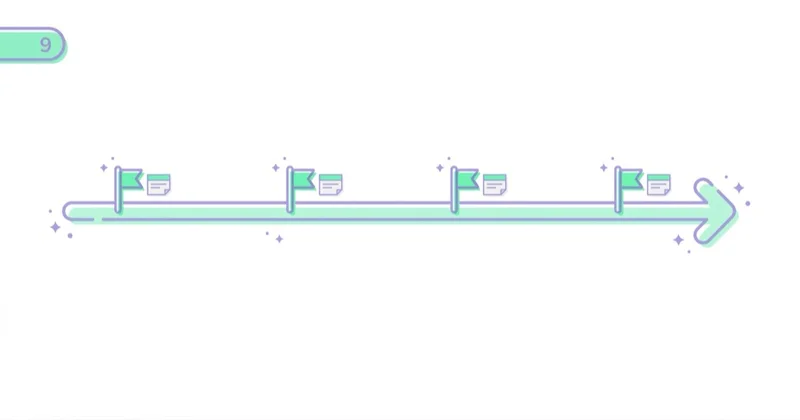
A simple quarterly structure can include:
- month 1: audits, tracking, landing pages, first campaign tests;
- month 2: content production, creative testing, channel expansion;
- month 3: optimization, budget reallocation, retention work and reporting.
For larger teams, use weekly sprints. For smaller teams, a monthly roadmap may be enough.
The timeline should include review points, not only launch dates. A plan with launches but no reviews tends to accumulate campaigns without learning.
Step 10: Set review rules
A plan should define how decisions will be made.
Review:
- which campaigns are scaling;
- which tests are inconclusive;
- whether tracking is reliable;
- whether lead or order quality is acceptable;
- whether budget pacing is on track;
- whether assumptions changed;
- whether new customer insights require message changes;
- whether sales and operations can handle generated demand.
Do not change strategy after every daily fluctuation. Do update the plan when evidence changes.
Useful review rhythm:
| Frequency | What to review |
|---|---|
| Weekly | budget pacing, campaign issues, major blockers |
| Monthly | channel performance, creative tests, lead/order quality |
| Quarterly | strategy, positioning, budget allocation, roadmap |
| Annual | market assumptions, category priorities, brand direction |
Marketing plan template
Use this structure:
| Section | Question |
|---|---|
| Business goal | What needs to change? |
| Current situation | What is working and what is blocking growth? |
| Audience | Who is the priority segment? |
| Problem | What need, pain or job is being solved? |
| Value proposition | Why choose this offer? |
| Channel roles | Which channels do what job? |
| Campaigns | What will be launched or improved? |
| Budget | How much is available and where will it go? |
| Assets | Which landing pages, creatives, emails or content are needed? |
| Measurement | Which KPIs and sources prove progress? |
| Owners | Who is responsible? |
| Timeline | What happens weekly, monthly and quarterly? |
| Risks | What could block execution? |
| Review rules | When will decisions be revisited? |
This template can fit into a spreadsheet or project board. The point is to make decisions visible.
Marketing plan for ecommerce
An ecommerce marketing plan should include more than traffic acquisition.
Add:
- seasonality;
- promotion calendar;
- category margin;
- stock and availability;
- product feed quality;
- Shopping and Performance Max structure;
- Meta and TikTok catalog readiness;
- category SEO;
- product page CRO;
- abandoned cart recovery;
- email and retention;
- returns and refunds;
- delivery promise;
- customer lifetime value;
- new vs returning customer targets.
The plan should connect marketing with merchandising. It is risky to scale ads for products that are low-margin, low-stock, high-return or poorly represented in the feed.
For ecommerce analytics, read What Is Ecommerce Analytics and Why Is It So Important?.
Marketing plan for B2B and services
B2B and service plans usually need longer buyer journeys.
Include:
- ideal customer profile;
- buying committee roles;
- sales cycle length;
- lead qualification criteria;
- CRM stages;
- sales follow-up SLA;
- case studies and proof;
- comparison pages;
- webinars or educational assets;
- remarketing and email nurture;
- pipeline and close-rate measurement.
A B2B plan should not optimize only for cheap leads. A higher-cost lead that becomes a qualified opportunity can be more valuable than many low-intent form fills.
How we approach this at Space Ads
The plans that actually work are rarely a forty-page document for the year. More often they're a short set of hypotheses and a rhythm for testing them. We plan in cycles: pick a few things that could genuinely move the result, decide up front how we'll measure them, launch, read the data and decide — double down or drop it. A plan like that leaves room for the market to answer differently than we assumed, because it usually does. The hardest part isn't the list of actions, it's how we'll know something is working — without that, a plan is just a wish list. So our plan document tends to be short, and most of the work goes into the loop: hypothesis, test, decision on the numbers, next hypothesis.
Common mistakes
| Mistake | Why it hurts | Better approach |
|---|---|---|
| Plan becomes a presentation only | It does not guide daily decisions | Turn it into a working roadmap |
| Goals have no numbers or dates | Progress cannot be judged | Define metric, baseline, target and timeframe |
| Channels are listed without roles | Budget gets scattered | Assign a job to each channel |
| No owner for actions | Execution stalls | Add responsibility and review dates |
| Budget covers media only | Creative, tracking and CRO are underfunded | Include total marketing resources |
| KPI does not match funnel stage | Channels are judged unfairly | Match KPIs to intent |
| No sales or operations input | Marketing creates demand the business cannot handle | Align before launch |
| No review rhythm | The plan becomes stale | Set weekly, monthly and quarterly reviews |
FAQ
What is a marketing plan in simple terms?
A marketing plan is a practical roadmap that defines goals, audience, channels, budget, actions, owners, timeline and KPIs. It turns marketing strategy into work.
How long should a marketing plan be?
It should be as long as needed to guide decisions. A one-page plan can work for a small company. A larger business may need a detailed spreadsheet, roadmap and reporting framework.
What should a marketing plan include?
It should include business goals, current situation, target audience, value proposition, channel roles, budget, campaigns, assets, KPIs, owners, timeline, risks and review rules.
How often should a marketing plan be updated?
Operational actions can be reviewed weekly or monthly. Strategic assumptions should usually be reviewed quarterly, and major market assumptions at least annually.
Is a marketing plan needed for a small business?
Yes, but it should be simple. Small businesses often need a plan even more because budget, time and attention are limited.
Should SEO and paid ads be in the same plan?
Yes. Users do not experience channels as internal silos. SEO, paid media, content, social, email, CRO and sales should support the same business goal.
What is the difference between a marketing plan and a campaign plan?
A marketing plan covers the wider strategy and roadmap. A campaign plan describes one specific campaign: audience, message, channel, budget, assets, launch date and KPI.
Key takeaways
An effective marketing plan connects goal, audience, message, channels, budget, execution and measurement. It should be concrete enough to guide daily decisions and flexible enough to respond when data changes.
The best plans are not the longest. They are the plans teams actually use: clear priorities, realistic resources, strong ownership, measurable goals and a review rhythm that turns marketing activity into learning.
Sources and further reading
- Google Ads Help - About conversion measurement
- Google Search Central - Creating helpful, reliable, people-first content
- Google Search Central - SEO Starter Guide
- Content Marketing Institute - What is content marketing?
Continue learning
- How to Plan a Marketing Budget for Effective Digital Marketing
- Target Audience: How to Define Who Your Customers Are
- What Is a Sales Funnel and How to Use It?
- Effective Online Advertising: Which Type of Advertising Works Best?
- What Is Brand Marketing and How to Use It?
- What Is Ecommerce Analytics and Why Is It So Important?
Continue reading
What Is 4P Marketing and How to Use It?
4P marketing maps Product, Price, Place and Promotion into one diagnostic view of the business, so underperforming campaigns are not blamed before the offer, margin, access and message are checked. This guide explains how to audit the marketing mix across ecommerce, services, B2B and SaaS, and how to turn the 4Ps into practical growth decisions.
What Is Blue Ocean Strategy and How to Use It?
Blue Ocean Strategy helps businesses create new market space instead of competing only on price and similar features. Learn value innovation, Strategy Canvas, ERRC Grid and practical examples.
Customer Acquisition Strategy: How to Scale Growth Without Wasting Ad Spend
A customer acquisition strategy explains where demand will come from, how channels work together, what a qualified customer is worth, and when paid media can scale without damaging margins.