App Store Optimization is the practice of improving an app's discovery and product-page performance in the Apple App Store and Google Play. It combines two related questions: whether the right audience can find or encounter the app, and whether the store experience gives that audience enough reason to install, open or pre-register.
Apple and Google document different metadata, discovery systems and experiments. Apple says App Store search uses the app name, subtitle, keywords and company name, while text relevance also includes the primary category and search can use in-app purchase metadata. Google Play says it uses developer-supplied information such as title, description, category and graphic assets, alongside characteristics of the app, ratings, reviews and engagement. Neither company publishes a simple formula or fixed field weights, so responsible ASO separates documented inputs from hypotheses tested in store data.
TL;DR
- ASO combines discovery and product-page conversion. Keywords are only one part of discovery, and assets can influence both understanding and conversion.
- Apple's name and subtitle allow 30 characters each; its hidden keyword field allows up to 100 bytes, not simply 100 characters in every language.
- Apple does not list the long description as an App Store search field. Apple does state that the description is used for web engine search results, so "not indexed anywhere" is inaccurate.
- Google Play uses the title, descriptions, category and graphic assets to understand an app, together with app characteristics and user feedback. Google does not publish a fixed keyword-density formula.
- Apple now also uses app tags in the US and lets eligible custom product pages appear for assigned keywords, so discovery is broader than a 160-character model.
- Paid search terms can inform ASO, but paid and organic overlap must be measured rather than assumed to be cannibalisation or uplift.
Visibility versus conversion
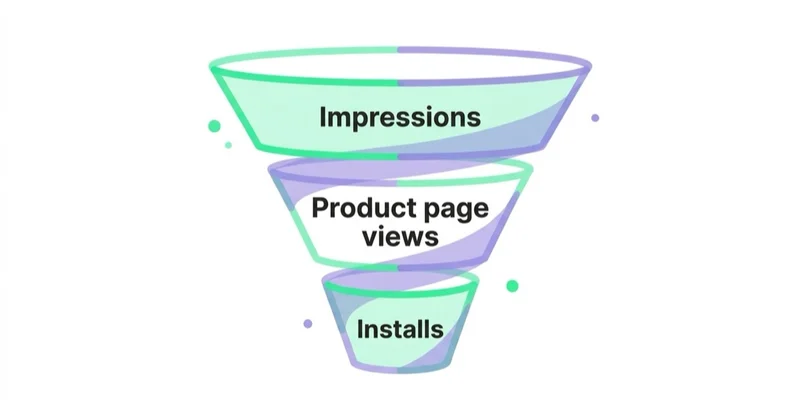
Everything in ASO belongs to one of two questions.
Will the app appear for the right audience? Influenced by query relevance, metadata, category, market and the store's behavioural or quality signals. Discovery also happens through browse, recommendations, editorial placements, tags and paid inventory, not only a typed search.
Will the visitor install? Determined by the icon, screenshots, ratings, first lines of the description and the app's apparent fit with what the person searched for.
These need different work and different measurement. A listing can gain search visibility and still convert poorly; it can also convert strongly among a narrow audience but lack qualified exposure. The priority should follow the constraint shown by store data rather than a universal rule that keywords or creative always come first.
What each store documents about discovery
The table separates confirmed platform guidance from common but unverified claims about field weight.
| Input | Apple App Store | Google Play |
|---|---|---|
| App name / title | Searchable; maximum 30 characters | Developer-supplied app information; maximum 30 characters |
| Subtitle / short description | Subtitle is searchable; maximum 30 characters | Short description describes the app; maximum 80 characters |
| Hidden keyword field | Searchable; up to 100 bytes; Apple only | No equivalent hidden keyword field |
| Long description | Not listed by Apple as an App Store search field; used for web engine search results | Part of the app information Google Play uses to understand content and functionality; maximum 4,000 characters |
| Company / developer identity | App is searchable by company name | Developer details appear on the listing; Google does not document an equivalent searchable company-name field |
| Category and additional discovery labels | Primary category contributes to text relevance; app tags can support US discovery | Category, tags and app characteristics help Play organise and present apps |
| In-app content | Search can use in-app purchase metadata; custom product pages can have assigned keywords | Store content and app characteristics vary by feature; no direct Apple-style keyword field |
| Behaviour and feedback | Apple cites downloads and the number and quality of ratings and reviews | Google cites ratings, reviews and engagement alongside relevance and quality |
Two practical consequences follow.
On iOS, the keyword field is a scarce resource — but it is not the whole discovery system. Apple advises avoiding duplicate words, plurals already covered by singular terms, category names, the word "app" and unnecessary special characters in the 100-byte field. App Store Connect also says the app is already searchable by app and company name, so those values should not be repeated in the keyword list. The subtitle, primary category, in-app purchase metadata, custom product pages and US app tags create additional discovery context.
On Play, the description helps Google understand the app. A clear title, short description and full description should explain genuine functionality in the language users recognise. Repetition for its own sake is not a strategy: Google warns that repetitive or irrelevant keyword use can create a poor experience and can lead to suspension. The listing should be written for relevance and comprehension, then evaluated through search and store-performance data.
Copying one text package across stores is still a mistake. The fields, limits, policies, layouts and discovery features differ, and each localisation needs its own research rather than a literal translation of the primary market.
How ASO differs from web SEO
The disciplines share the goals of relevance, discovery and useful user experience, but operate on different technical surfaces.
| Dimension | Web SEO | ASO |
|---|---|---|
| Search corpus | Pages and site content discovered by web crawlers | Store records, app information, store assets and platform-observed app or user signals |
| External signals | Links and broader web signals can affect discovery and ranking | No direct backlink analogue documented for store search; each store uses its own behavioural and quality signals |
| Content volume | More quality content generally helps | No content surface to expand; character limits are hard |
| Iteration speed | Site changes can often be published directly | Some store changes require review or a new version; others, such as Apple promotional text, can change independently |
| Conversion element | On your own page, fully controlled | On a store page with fixed layout and rules |
| Competitor terms | Usually usable | Trademarked names risk rejection |
A major difference is the controlled surface. A website can create new indexable pages and shape technical architecture; a store listing operates within platform fields, policy and presentation rules. ASO therefore prioritises not only keywords but also category, localisation, tags, product-page variants, screenshots, reviews and the quality of the underlying app.
Keyword research for app stores
Store research should reflect the store, market and app category rather than importing a web keyword list unchanged.
Sources worth using:
- Store autocomplete. What the store suggests reveals real query patterns.
- Competitor listings. Which terms competitors place in their name and subtitle indicates what they have concluded is valuable.
- Paid search term data. If Apple Ads is running, search-term reports connect real store queries with attributed outcomes. They remain paid-platform data and should be reconciled with App Store Connect rather than treated as perfect organic demand.
- Category vocabulary. How the store's own category structure describes the space.
- Support and product language. Reviews, onboarding searches, customer messages and in-app search can reveal needs that a store tool misses.
- Localisation evidence. Search behaviour, terminology and metadata capacity differ by market; literal translation is not research.
Then comes allocation. Relevance and clarity come before raw popularity because misleading metadata can reduce conversion or breach store policy. High-priority language may belong in the name or subtitle when it remains a natural, defensible description of the app. The Apple keyword field covers additional relevant terms, while Google Play copy should explain the app naturally across its allowed fields. Rankings, impressions, listing intent and downstream quality should be reviewed together.
Conversion: the half that moves more numbers
Once a listing appears, several elements influence whether the visit becomes an install or intent click.
Icon. A prominent identity asset across store contexts. It must remain recognisable at small sizes and comply with platform requirements.
Screenshots and previews. Apple notes that the first one to three screenshots can appear in search results when no app preview is shown. The opening assets should therefore communicate the app's value and real experience, not merely list screens. Caption text is part of the message and must remain truthful to the product.
Ratings and reviews. Both stores use user feedback in discovery or quality systems, and visitors also use it as evidence. Rating prompts should follow platform APIs and policies, avoid interruption at a fragile moment, and never gate functionality or reward a positive score.
Description and supporting facts. Apple's first sentence is important because users can read it without expanding the description. It should explain the app's unique functionality and value. On Google Play, the full description also contributes to how Google understands the app, but readability, accuracy and policy compliance matter more than mechanical repetition.
Glossary
- Keyword field: Apple's hidden metadata field of up to 100 bytes, used to help determine App Store search visibility.
- Short description: Google Play's visible summary of up to 80 characters and part of the developer-supplied listing information.
- Custom product page: an alternative App Store product page variant with different screenshots and messaging, usable as an ad destination.
- Product Page Optimization: Apple's built-in randomised test of eligible product-page treatments such as icons, screenshots and previews.
- Store listing experiment: Google Play's built-in A/B testing for listing assets.
- App tag: an Apple discovery label based on metadata, AI and human curation; currently displayed in the US and manageable in App Store Connect.
- Store conversion: a platform-defined ratio between a store exposure and an install-related outcome. Definitions changed on Google Play in 2026 and should be checked before comparing periods or stores.
ASO and paid: one surface, two levers
The same App Store query can contain an organic result and an Apple Ads placement. Their reported conversions may overlap with demand that already existed, but the size and direction of the incremental effect cannot be inferred from rank alone.
The productive relationship runs both ways:
- Paid informs organic. Search-term data shows which paid queries produce attributed taps, downloads and downstream events. It is useful evidence for relevance and messaging.
- Organic informs paid. Existing rank and App Store Connect traffic help identify overlap, but high organic position is not sufficient reason to remove ads without an experiment.
- Product pages align intent. Custom product pages can connect selected keywords or ad groups with more relevant screenshots, previews, promotional text and deep links.
How the paid side is structured is covered in the Apple Search Ads guide.
How Space Ads approaches ASO
The professional process starts by separating store, market and discovery route. We document the current metadata, search visibility, category, app tags, product-page variants, store traffic, conversion or intent metrics, ratings and post-install quality. This establishes whether the immediate constraint is qualified exposure, product-page persuasion or the app experience after acquisition.
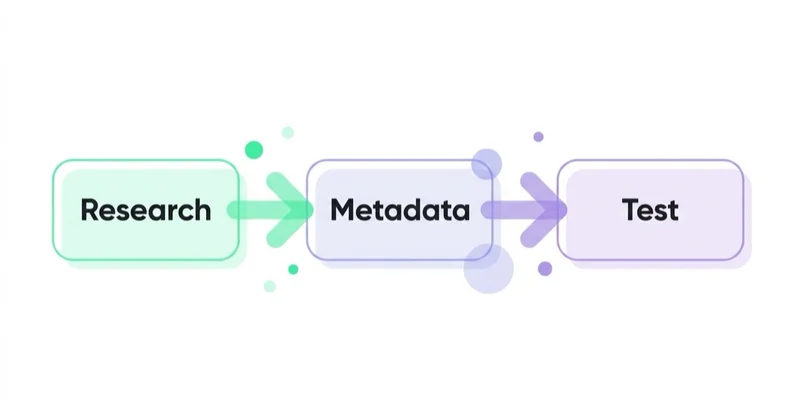
Research then produces a decision map rather than a keyword dump. Each proposed term or message has an intended field, market, audience and evidence source. Creative hypotheses are tested with Product Page Optimization or Google Play store-listing experiments where eligible; custom product pages are used to align specific audiences and messages, not mistaken for an A/B test by themselves.
Paid and non-paid performance are reviewed together, but claims of cannibalisation or uplift require an experiment. This protects the team from pausing useful coverage merely because organic rank is high, or crediting every paid download as demand that would not otherwise exist.
A practical ASO workflow
- Establish the baseline. Current rankings for target terms, product page conversion rate, ratings volume and average.
- Separate store and market. Build Apple and Google Play plans for each priority localisation instead of translating one universal listing.
- Allocate documented fields. Keep names natural and accurate, use Apple's keyword bytes efficiently, select the right categories and review eligible tags or custom product pages.
- Diagnose conversion. Review the opening screenshots or previews, icon, value proposition, ratings, app quality and the match between query and page.
- Keep a change log. Record metadata, creative, release, price, promotion and campaign changes so ranking and conversion movements have context.
- Use the correct experiment. Apple Product Page Optimization and Google Play store-listing experiments test variants. Custom product pages segment messages and destinations; they are not a randomised ASO test by themselves.
- Read downstream quality. A page treatment that raises installs but lowers activation or trial quality may not improve the business outcome.
Common mistakes
| Stop doing | Do instead |
|---|---|
| Using the same listing text on both stores | Adapt fields, limits, policies and messages by store and localisation |
| Repeating app or company names in Apple's keyword list | Use Apple's keyword-field guidance and preserve its 100-byte capacity for relevant additions |
| Writing keyword-stuffed descriptions | Explain real functionality naturally; Google warns against repetitive or irrelevant keyword use |
| Following a universal keywords-first workflow | Diagnose whether discovery, store persuasion or product quality is the current constraint |
| Selecting terms only by popularity | Balance relevance, business value, competition, conversion and policy risk |
| Prompting for ratings indiscriminately | Use platform APIs at a contextually appropriate, non-coercive moment |
| Assuming paid cannibalises a high organic rank | Use search-term evidence and incrementality tests before changing coverage |
FAQ
What is App Store Optimization? The practice of improving qualified discovery and store performance in the App Store and Google Play. It includes metadata, localisation, categories or tags, product-page creative, ratings, experiments and coordination with paid acquisition and product quality.
Is ASO the same as SEO? No. Both disciplines work with query relevance and user value, but the environments differ. ASO operates on store-controlled records, fixed fields, platform policies, app quality and store behaviour. Web SEO works with crawlable pages, site architecture, links and a much larger owned content surface.
Does the app description affect ranking? Google Play says the description is part of the information used to understand an app and informs discovery and ranking alongside other signals. Apple does not list its description as an App Store search field; it says the description is used for web engine search results. On both stores it must remain accurate, persuasive and compliant rather than mechanically stuffed with terms.
How many characters can be used for iOS keywords? The dedicated Apple keyword field allows up to 100 bytes. The app name and subtitle each allow up to 30 characters and are also searchable. Apple advises against duplicate words within the keyword field and says app and company names need not be repeated there.
How long does ASO take to show results? There is no universal duration. Metadata changes need processing and enough search exposure to evaluate, while creative experiments need sufficient traffic and effect size. Apple Product Page Optimization can label a treatment better or worse at 90% confidence, but low-volume tests may remain inconclusive. Evaluation criteria should be set before the change.
Should ASO run alongside Apple Search Ads? Yes. The same team does not need to execute both, but the data and test plan should be shared. Paid search terms offer valuable query and outcome evidence; store metadata and custom product pages improve message alignment. Organic rank alone does not prove that paid coverage is redundant, so overlap should be tested.
Key takeaways
- ASO connects qualified discovery with product-page conversion and downstream app quality.
- Apple search uses the name, subtitle, keywords and company name, while category, in-app metadata, tags and custom product pages also support discovery.
- Apple's keyword field is a 100-byte resource; its description is used for web engine results but is not listed as an App Store search field.
- Google Play uses listing information, app characteristics, ratings, reviews and engagement; it does not publish a simple density or weighting formula.
- Use built-in store experiments for creative decisions and evaluate downstream quality, not installs alone.
- Paid search terms inform ASO, but overlap and incrementality should be tested rather than assumed.
How we approach search visibility, including AI-driven surfaces alongside app store search, is on our AI SEO page.
Sources and further reading
- Creating your product page — Apple Developer
- Discovery on the App Store — Apple Developer
- Manage app tags — App Store Connect Help
- Custom product pages — Apple Developer
- Product Page Optimization analytics — App Store Connect Help
- App discovery and ranking — Google Play Console Help
- Create and set up your app — Google Play Console Help
- Run a store listing experiment — Google Play Console Help
- Apple Search Ads complete guide
Continue reading
Shopify SEO: The Checklist That Matches How the Platform Actually Works
Shopify handles several SEO basics automatically, but rankings still depend on the decisions it cannot make for you. Use this checklist to audit indexation, collections, products, filters, variants, performance and international stores in the right order.
What an ASO Service Should Deliver (and When You Do Not Need One)
ASO should deliver research, store-specific metadata, creative tests and a reusable learning system—not a promised ranking. Here is the scope, evidence and ownership to expect.
AI SEO Tools and Visibility Platforms: What They Do Not Fix
Six categories of AI SEO tools, what each one genuinely solves, and the decisions no visibility platform can make on your behalf.