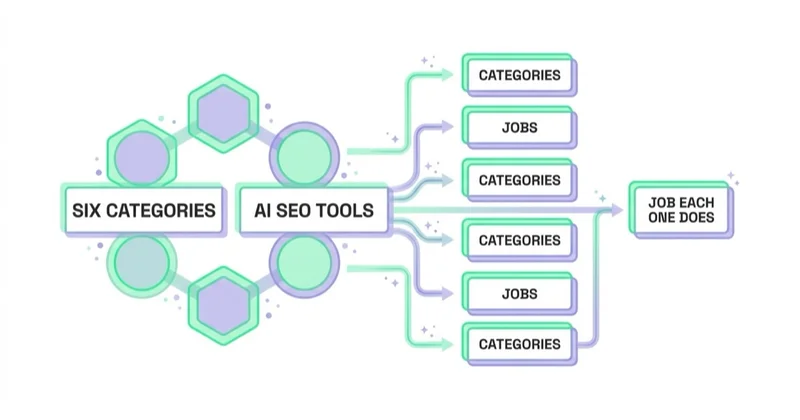
AI SEO tools measure or support brand visibility in AI-generated search experiences — Google AI Overviews and AI Mode, ChatGPT search, Perplexity, Gemini and other assistants. A useful way to evaluate the market is to separate six jobs: citation monitoring, server-log analysis, structured-data validation, technical auditing, question research and content-assisted production. A product may cover several of them. It can report evidence or accelerate work, but it cannot determine the commercial questions a business should prioritise, verify its own factual claims or make rights and risk decisions about crawler access.
That gap is the subject of this article. The tooling market around AI search is young and loud, and the fastest way to waste money in it is to buy a dashboard before deciding what the dashboard is supposed to prove. For the umbrella discipline these instruments serve, see AI SEO. This piece is about the instruments and their limits.
TL;DR
- "AI SEO tools" is a market label, not one capability. Evaluate products across six practical jobs: visibility monitoring, log analysis, structured-data validation, technical auditing, question research and content-assisted production.
- Monitoring platforms are sampling instruments, not rank trackers. Assistant answers vary by wording, market, session state and date, so the output describes a sample.
- Server and CDN logs show requests delivered to your infrastructure, but the user-agent string must be verified before it is treated as provider identity. Platform reports provide a different kind of first-party evidence about impressions and citations.
- Google does not require special AI markup. Search eligibility and snippet eligibility still matter, while a new Search generative AI control and dedicated performance report are rolling out to a subset of Search Console properties.
- Content generation has the highest governance risk here. It can accelerate a sourced workflow, but it cannot manufacture first-hand experience, validate a claim or decide whether a page adds value.
- Judge a monitoring platform on method: how prompts are chosen, whether runs repeat, whether region and login state are controlled, what counts as visibility.
- A versioned prompt set in a spreadsheet is a legitimate first instrument — it costs hours instead of licence fees and forces the decision no vendor can make for you.
What buyers actually mean by "AI SEO tools"
Three different jobs travel under this phrase, with opposite risk profiles. Measurement: someone wants to know whether assistants name their brand when a buyer asks a commercial question. Diagnosis: someone suspects a technical fault — pages not fetched, markup broken, rendering incomplete — and wants it located. Production: someone wants more pages, faster.
Measurement tools become misleading when the sampling method is unclear. Diagnostic tools are useful where they test deterministic conditions, but their findings still require verification and prioritisation. Production tools create risk when they add volume to a site whose problem was access, evidence or information architecture. A procurement conversation often mixes all three, so separate the intended decisions and outputs before comparing vendors.
The six categories and what each one solves
1. AI visibility and citation monitoring
These platforms run a set of prompts against one or more assistants on a schedule and record whether the brand appears in the answer, whether it is cited with a link, which URL was used, and which competitors and publishers were named alongside it. What they genuinely solve is the "we have no idea" problem: without repeated runs, a brand's view of its own AI visibility is one screenshot a colleague sent on a Tuesday.
What they cannot solve is that there is no position to track. Answers change with phrasing, market, language, personalisation, session state and time. Google's documentation frames eligibility rather than selection — to appear as a supporting link in AI Overviews or AI Mode a page must be indexed and eligible to be shown with a snippet, which is a condition, not a promise. So a monitoring platform produces a trend from a sample. Read as a trend it is useful; read as a rank it is misleading, and it will be quoted back to you in a board meeting as if it were a rank.
For how generated answers pick their sources, see AI Overviews and GEO; for why one buyer question becomes many machine queries, see Google AI Mode.
2. Log analysis and AI agent detection
Origin, CDN and edge logs answer a narrow question: which client claimed a given user-agent token, which URL it requested, when, and what response the infrastructure returned. That is direct evidence of request handling, not proof of provider identity; user-agent strings can be spoofed and should be checked against the provider's documented verification method where one exists. Robots directives state an intention, while logs show delivery. A 403 or challenge from bot protection can explain why a documented crawler did not receive a page even when the content itself is sound.
Agents worth separating in a log report (names as of July 2026 — providers rename and add agents, so check the documentation linked at the end before hard-coding rules):
| Provider | Search / retrieval agents | Training agents | User-triggered fetch |
|---|---|---|---|
| Googlebot (Search); GoogleOther is a separate generic product/research crawler | Google-Extended is a robots.txt product token, not an HTTP user agent; it controls specified Gemini uses and does not affect Search inclusion or ranking | Google documents separate user-triggered fetcher tokens for relevant products | |
| OpenAI | OAI-SearchBot (ChatGPT search); OAI-AdsBot separately validates ad landing pages | GPTBot | ChatGPT-User |
| Perplexity | PerplexityBot | — | Perplexity-User |
| Anthropic | Claude-SearchBot | ClaudeBot | Claude-User |
Two details change how a log file reads. Retrieval and training can use separate agents or control tokens, so "block AI bots" is not one switch. User-triggered fetchers also behave differently from scheduled crawlers — Perplexity states Perplexity-User generally ignores robots.txt, while OpenAI notes that robots.txt may not apply to ChatGPT-User visits. A hit from a user-triggered agent does not demonstrate that a scheduled-crawler rule is working.
3. Structured-data validators
Two free first-party tools cover much of this category: Google's Rich Results Test reports detected supported types and issues relevant to rich-result eligibility, while the Schema Markup Validator checks markup against the schema.org vocabulary. They are faster and more consistent than reading every property by eye, but a valid result does not guarantee a Google enhancement, indexing or correct business facts.
What they do not check is whether the markup is true. A validator will pass an Organization block with the wrong legal name, a service list the site no longer offers, or a sameAs pointing at a dead profile. Which facts are load-bearing for machine understanding is covered in entity SEO.
4. Technical audit and performance tools
Site crawlers, rendering checks and field-data tools cover indexability, canonicals, internal linking, response codes, JavaScript rendering and Core Web Vitals (LCP, INP and CLS). They enumerate repeatable conditions at a scale no manual review can match. A crawler can map reachable URLs and redirect chains; identifying truly orphaned pages requires another inventory such as a sitemap, analytics, Search Console, database or CMS export.
What they cannot supply is priority. A crawl report sorts defects by the tool's severity model, not by what those defects cost. Deciding that a slow category template matters more than four hundred thin tag pages requires knowing which pages earn money — the part of an SEO audit a tool feeds evidence into but does not perform.
5. Question and intent research
This category maps what people ask: query data from Search Console, question mining from suggestions and community sources, competitor coverage gaps. It supplies vocabulary — how buyers phrase the problem — which is raw material for page structure and for a prompt set.
Its limit is that prompts are not keywords. A buyer asking an assistant a long, contextual, multi-part question generates machine queries no keyword tool ever listed, and the assistant may answer without searching at all.
6. Content-assisted production — the highest governance risk
Generation tools produce drafts and can save time on outlining, transformation, summarisation and editing when the workflow includes reliable sources, subject-matter review and editorial accountability.
Used without governance, they can multiply pages that add no information beyond what is already public, repeat unsupported claims or describe the same service inconsistently. Search engines do not require content to be written without AI; the relevant question is whether the page is helpful, accurate and created for users. First-hand evidence — proprietary data, a documented method, a real implementation or accountable expert commentary — often gives a source a stronger reason to be selected, but it must come from the organisation or its research. A generation tool can structure that evidence; it cannot create the underlying experience or verify it.
Glossary
- Prompt set — a fixed, written list of questions used to test how assistants answer, kept word-for-word identical between runs so results are comparable.
- Citation — a linked source shown with a generated answer, as distinct from an unlinked brand mention inside the answer text.
- Retrieval fetch — a request made by an assistant to read a page in order to answer a question, as opposed to a crawl gathering training data.
- User-triggered fetch — a page request initiated by a person's question inside an assistant; providers document that these follow different rules from scheduled crawlers.
- Entity coherence — the degree to which a brand's facts agree with each other across its own site and third-party sources.
What no AI SEO tool will do for you
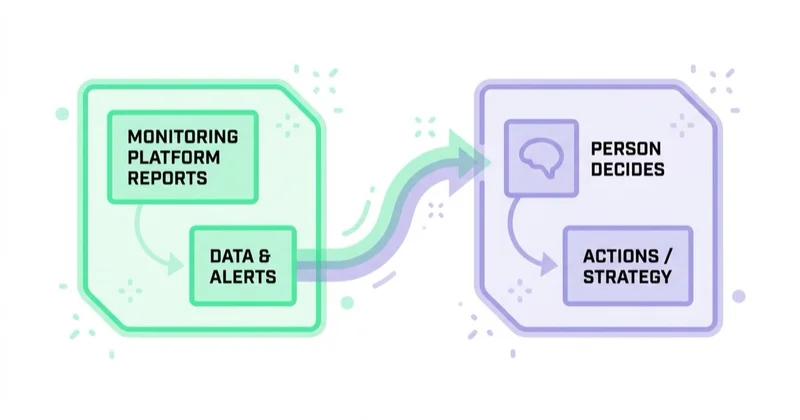
A tool reports a state. Someone still has to act on it, and the acting is where the cost sits.
| Problem | Is a tool enough? | What requires a person |
|---|---|---|
| "We do not know if assistants mention us" | Partly — for a defined sample | Choosing commercially relevant questions and interpreting the sample limits |
| "We are not cited on our main commercial question" | No — it shows the gap only | Deciding to own that question, then producing evidence a model can repeat |
| "The answer describes us as something we are not" | Partly — it detects the error | Correcting the facts on the site and at the third-party source the model leaned on |
| "Which AI agents should we allow?" | No | A commercial and legal decision on retrieval versus training, then implementation |
| "Our structured data has errors" | Yes | Deciding what the markup should say, so it matches reality |
| "We have thin and overlapping pages" | Detection only | Editorial judgement about what to merge, cut, rewrite or leave |
| "A competitor is cited instead of us" | Detection only | Judging whether their source is better, and what would make yours preferable |
Read the middle column honestly. Where a tool is sufficient, buy it and stop discussing it. Where it is not, a licence is a diagnostic expense rather than a solution, and the remaining work is technical implementation, editorial production and governance. Whether that sits with an in-house specialist, a contractor or an agency is a capacity question, not a philosophical one — our own AI SEO engagement models are an audit, a fixed project or a monthly programme, and the choice usually follows how much development and editorial capacity exists internally.
How to evaluate an AI visibility monitoring platform
Dashboard design is secondary to measurement design. Ask these questions before a trial and require the method to be documented well enough that another analyst can interpret the result.
| Question to ask | Why it matters | Answer that should worry you |
|---|---|---|
| How is the prompt set chosen, and can I freeze my own wording? | Comparability needs a stable instrument and a documented change history | Generated industry prompts with no review or version control |
| How many runs per prompt, and is raw answer text stored? | Without raw answers and known sampling depth you cannot audit the score | Only aggregated scores are retained |
| Can I control market, language and login state? | Answers differ by region and by whether a session is signed in | Region is "global" and login state unspecified |
| What exactly counts as visibility? | Unlinked mention, linked citation and domain-in-source-panel are three different things | One blended score with no breakdown |
| Can I export the full history, raw answers included? | You should own the measurement history if you change vendor | Export limited to charts or summary rows |
| Who defines the competitor set? | A vendor-chosen set flatters or panics you at random | The competitor list cannot be edited |
One rule holds across all six: if a vendor cannot explain how a number is produced, the number is not a measurement. That is not a reason to avoid the category — it is the criterion for choosing within it.
The in-house alternative: a versioned prompt set and a sheet
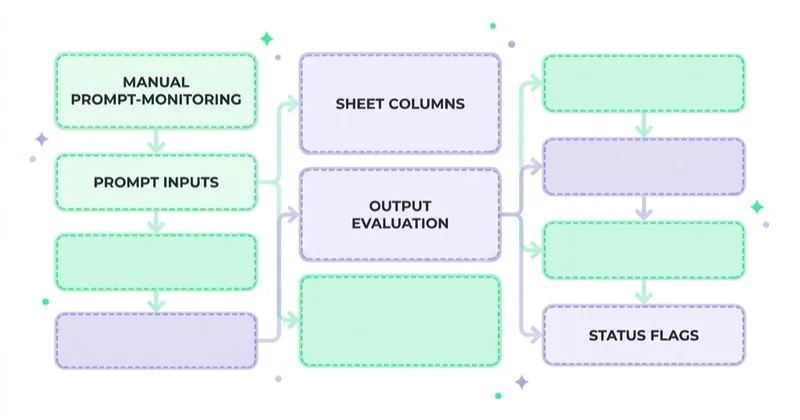
Before buying anything, a team can run this by hand, and there are good reasons to start there. The instrument is a spreadsheet with one row per run and these columns:
- date and time of the run;
- assistant used, plus mode or version where visible;
- the prompt, pasted verbatim;
- market, language, and signed-in or signed-out;
- brand mentioned in the answer text — yes or no;
- brand cited with a link, and which URL;
- how the brand was described, quoted exactly;
- competitors and other sources named;
- factual errors in the answer;
- the action this run implies.
Four rules make it a measurement rather than a scrapbook. Freeze the prompt wording and keep the list in version control, so changes to the instrument are visible and dated. Run the same set for two named competitors, because relative movement says more than your own line in isolation. Paste raw answer text, not a summary. Re-run on a cadence you can sustain, since irregular sampling produces trends that are artefacts of when you happened to look.
The reason to start manually is not frugality. Building the prompt list forces the decision a platform cannot make for you: which questions the business needs to be present in. Teams that skip to a licence end up monitoring the questions the vendor pre-loaded, which is how a brand acquires excellent visibility on definitional queries it will never win a client from.
| Manual sheet | Purchased platform | |
|---|---|---|
| Best when | A few dozen prompts, one or two markets, first baseline | Many markets and languages, weekly cadence, a client portfolio |
| Real cost | Someone's recurring hours | Licence plus the hours to validate the method |
| Weakness | Effort scales linearly and slips when the quarter gets busy | Opaque method, prompts you did not choose, history you may not own |
| What it does not do | Decide anything | Decide anything |
The last row is the point of this article.
How we approach this at Space Ads
Our method starts with the decisions the measurement must support. We define a versioned prompt set with the client, specify market, language, assistant mode and run cadence, and keep raw outputs so a score can be audited. Logs, crawls and validators are automated where they test repeatable technical conditions, while provider identity, factual accuracy and priority receive human review.
Reporting keeps sampled assistant presence, linked citations, Google Search Console's generative AI impressions where the report is available, Bing AI Performance citations, assistant referrals and qualified business outcomes as separate metrics. None is presented as a census of all AI answers or a guaranteed share of voice. The work that follows is tied to a diagnosed cause: crawler access, entity consistency, information architecture, source-worthy evidence or page quality. That is the substance of our AI SEO engagements.
A six-step plan before you buy anything
- Write a representative question set. Cover the decisions a buyer makes on the way to choosing a supplier, across the relevant markets and languages. This is the measurement specification, not a keyword list.
- Check access in the logs. Filter for documented AI fetchers, verify identity where the provider supports it and inspect responses on important pages. Correct an unintended bot-protection rule before commissioning content; the fix may still require engineering or security work.
- Run the deterministic checks. Rich Results Test and the Schema Markup Validator on key templates; fix what they flag, then confirm the markup matches what the page says.
- Baseline by hand. Run the question list manually across the assistants your buyers use, in the right market and language, recording raw answers in the sheet above.
- Only now evaluate a platform. Score vendors against the table above, using your own frozen prompts in the trial, and compare their output to your manual baseline.
- Write the crawler policy down. Decide per provider what you allow for retrieval and for training, implement it in robots directives, and set a review date, because provider terms and agent names change.
Common mistakes
| Common mistake | What to do instead |
|---|---|
| Buying a visibility platform before naming the questions that matter | Write the question list first; it is the procurement specification |
| Presenting a monitoring score as a ranking | Report it as a sampled trend with prompt set, market and dates attached |
| Assuming a crawl directive means a bot behaved | Verify in server logs, and treat user-triggered fetchers as a separate case |
| Treating "block AI bots" as one decision | Separate retrieval from training, provider by provider, in writing |
| Trusting a validator as a truth check | Validate syntax with the tool, then verify the facts against the page and reality |
| Scaling content generation to fix low visibility | Fix access and entity coherence first; add evidence rather than volume |
| Measuring only sessions | Track presence in answers and citations too, since a correct answer may produce no click |
FAQ
What are AI SEO tools?
AI SEO tools are software used to measure or support a brand's visibility in AI-generated search answers. The category covers six different jobs: monitoring brand mentions and citations in assistant answers, analysing server logs for AI crawlers and fetchers, validating structured data, auditing technical health and performance, researching the questions buyers ask, and generating content drafts.
What is the best AI SEO tool?
There is no defensible single answer, and any "best tools" list in this category ages within months as vendors launch, merge and reprice. The useful substitute for a ranking is a set of criteria: how a platform chooses prompts, whether runs are repeatable, whether market and login state are controlled, what it counts as visibility, and whether raw answers can be exported. Score candidates against those and the shortlist writes itself.
Do AI visibility platforms show a ranking?
No. Assistant answers vary by phrasing, market, language, personalisation, session state and date, so there is no stable position to track. A monitoring platform reports how often a brand appeared in a defined sample of runs, which is a trend indicator rather than a rank.
Can a tool tell me whether ChatGPT or another assistant fetched my site?
Server logs can, because they record the requesting user agent, the URL and the response code. Provider documentation lists the agents to look for and notes that user-triggered fetchers behave differently from scheduled crawlers — Perplexity states Perplexity-User generally ignores robots.txt, and OpenAI notes robots.txt rules may not apply to ChatGPT-User requests.
Do I need special markup or a special file to appear in AI Overviews?
No special schema type or llms.txt file is an entry condition. Google's technical guidance still centres on Search eligibility and snippet eligibility. As of July 2026, Google is also rolling out a Search Console control that lets a subset of properties include or exclude their links and content from generative AI features in Search and Discover. Inclusion is the default, but eligibility never guarantees selection.
How should AI search visibility be reported to management?
Report distinct evidence layers: sampled presence and citations for a named prompt set; provider-side visibility; referrals; and qualified business outcomes. Google's dedicated Generative AI performance report shows impressions from AI Overviews and AI Mode for properties in the rollout, with page, country, device and date dimensions; those impressions are also included in the overall Web performance data. Bing AI Performance reports citations, cited pages and sampled grounding queries across supported Microsoft AI experiences. Neither report is a universal measurement of all assistant visibility.
Should we block AI crawlers?
It should be a documented per-purpose decision rather than a default. Blocking a retrieval agent can remove one documented route by which an assistant discovers or cites the site; it does not necessarily remove every third-party source about the brand. Training access is a separate rights and risk decision. Google-Extended illustrates the distinction: it controls specified Gemini training and grounding uses and does not affect inclusion or ranking in Google Search.
In short
- The phrase "AI SEO tools" covers several different jobs; comparing vendors starts with the decisions and outputs you actually need.
- Monitoring platforms measure a sample of assistant answers — treat the output as a trend with a documented method, never as a ranking.
- Server and edge logs show delivered requests, but user-agent identity may require verification; retrieval agents and training agents must be analysed separately.
- Validators efficiently test machine-detectable rules; they cannot tell you whether the markup is true or guarantee a rich result.
- Content-assisted production needs the strongest governance because the tool cannot create underlying experience, validate claims or decide whether a page adds value.
- Start with a written question list and a manual prompt sheet; buy a platform against explicit criteria once volume demands it.
- The residual work after any tool — choosing the questions, fixing the entity, producing the evidence — is human, and that is where results come from.
Sources and further reading
Agent names and provider behaviour above are as of July 2026. Providers rename, add and retire agents, so verify against current documentation before implementing crawl rules.
- Google Search Central — AI features and your website
- Google Search Console — Generative AI performance report
- Google Search Console — Search generative AI control
- Google Search Central — Google's common crawlers, including Google-Extended
- Bing Webmaster Tools — AI Performance public preview
- OpenAI — Overview of OpenAI crawlers
- Perplexity — Perplexity crawlers
- Anthropic — Does Anthropic crawl data from the web, and how can site owners block the crawler?
- schema.org — Schema Markup Validator and Google — Rich Results Test
Continue learning
Continue reading

AI SEO: How to Optimize for Search Engines, AI Overviews and LLMs
AI SEO applies proven SEO principles to Google AI Overviews, AI Mode and answer tools. Learn what improves visibility, what Google says to ignore, how crawler controls differ and how to measure results without inventing an ‘AI ranking’.
Shopify SEO: The Checklist That Matches How the Platform Actually Works
Shopify handles several SEO basics automatically, but rankings still depend on the decisions it cannot make for you. Use this checklist to audit indexation, collections, products, filters, variants, performance and international stores in the right order.
What an ASO Service Should Deliver (and When You Do Not Need One)
ASO should deliver research, store-specific metadata, creative tests and a reusable learning system—not a promised ranking. Here is the scope, evidence and ownership to expect.