Creative fatigue is a gradual loss of response associated with repeated exposure to an ad within the same audience. It can contribute to lower click-through or video retention and a higher cost per result. It is not the only explanation for weaker performance: auction pressure, seasonality, measurement errors, product availability, an offer, or the landing page can produce a similar pattern.
Diagnose fatigue from several metrics over comparable periods and at the level of the relevant creative and audience. One frequency number or the age of an asset is not enough.
TL;DR
- Frequency is a signal, not a diagnosis. An average can hide the difference between many people seeing an ad once and a small group seeing it repeatedly.
- Look for a combination: exposure rises, reach among new people slows, response weakens, and cost per result deteriorates under comparable conditions.
- CPM is not proof of fatigue. Auction competition, seasonality, audience, and placement mix also affect it.
- Rule out other causes first: tracking, campaign changes, inventory, offer, site performance, conversion delay, and the auction.
- There is no universal frequency threshold or refresh schedule. The appropriate response depends on audience size, budget, objective, format, and new-user flow.
- Refresh the element that appears weak. That may be the opening, proof, format, offer, or complete concept—not automatically a full reshoot.
Why even great ads fatigue
An ad competes for attention. Once someone recognises the image, opening, and promise, they may skip it faster. Risk tends to increase when spend is high relative to audience size, delivery repeatedly reaches the same people, or too few distinct materials are active.
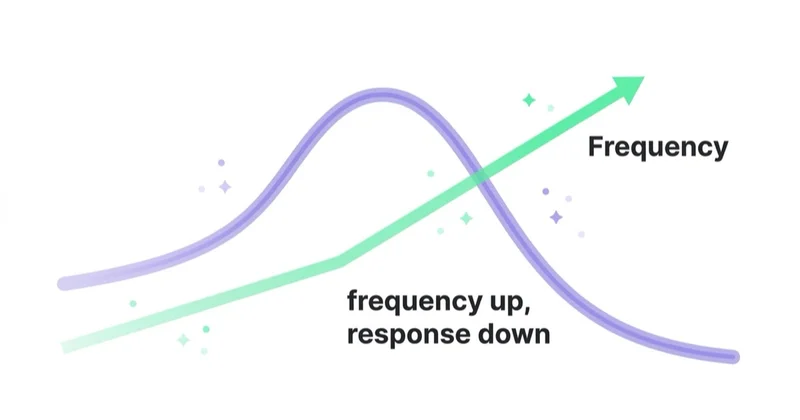
That does not mean every strong ad expires after a set number of days. An evergreen message can remain effective for a long time in a broad audience with a steady inflow of new people. A small retargeting audience may saturate much faster. Judge actual exposure and response, not file age.
The metrics that reveal fatigue early
Fatigue may appear as a pattern across several metrics. Reading them together helps identify the issue before the business outcome deteriorates materially.
- Frequency and its distribution — compare the same reporting interval and, where available, inspect how many people fall into repeated-exposure buckets. Google Ads, for example, reports frequency distributions because the average alone can conceal concentration.
- Reach and new users — slowing reach among new people while impressions continue can indicate audience saturation.
- Link CTR or destination rate — a sustained decline on one ad can indicate weaker response if audience, placements, and objective are stable.
- Video retention — compare the opening and later viewing milestones to locate where attention changed.
- Cost per click and cost per result — commercially important outcomes that are also influenced by auction cost, site conversion, and offer quality.
- CPM — useful context, but not a causal fatigue metric.
The stronger pattern is repeated exposure rising while response to the same creative and cost per result worsen in comparable conditions. Even then, treat fatigue as a hypothesis to verify rather than a certainty.
Tell fatigue apart from other problems
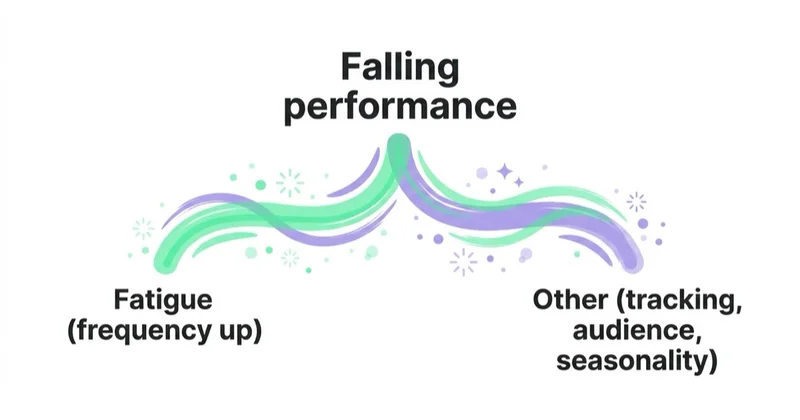
Not every performance drop is fatigue, and treating a different problem as fatigue wastes a creative refresh on the wrong fix. A quick differential:
| Symptom | More likely fatigue | More likely something else |
|---|---|---|
| Timing | Repeated exposure and response diverge over a meaningful period | Conversion delay, volatility, promotion ending, or campaign edit |
| Frequency | Rising in the same audience and interval | Average hides the distribution or audience mix changed |
| Scope | One creative weakens against comparable controls | Whole account changes: inspect tracking, site, auction, stock, and settings |
| Funnel | Ad response falls with downstream efficiency | CTR is stable but conversion falls: inspect traffic quality, page, and offer |
A sudden change does not rule fatigue out, and a gradual decline does not prove it. If the issue affects the whole account, begin with change history, measurement, conversion lag, site health, inventory, and auction conditions. See the full checklist in why your Meta ads stopped working.
Glossary
- Creative fatigue — performance decline caused by an audience seeing an ad too often.
- Frequency — average number of times each person in the audience has seen the ad.
- CTR — click-through rate; specify whether the report uses all clicks or link clicks.
- CPM — cost per thousand impressions, influenced by the auction and delivery mix.
- Video retention — the share or number of viewers remaining at defined points in a video.
- Creative refresh — a tested change intended to improve response, from a new opening to a new concept.
- Creative pipeline — a planned supply of new materials and hypotheses ready for testing.
When and how to refresh
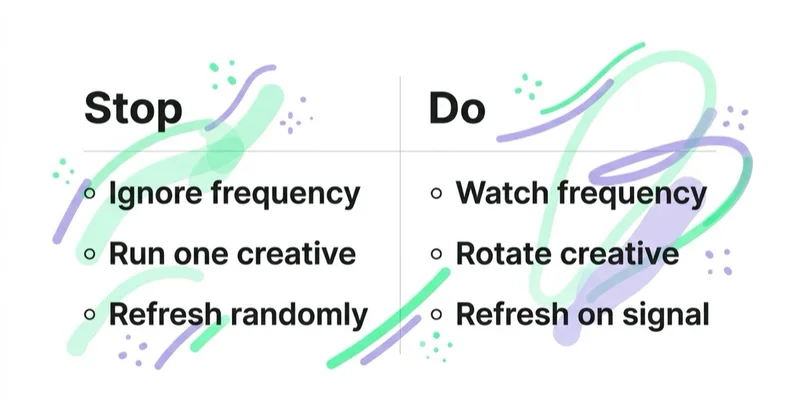
Do not use a universal “every seven days” rule or replace an ad solely because its frequency passed a borrowed threshold. Establish a baseline for the account and act when comparable periods show a durable deterioration in response and business outcome. At low conversion volume, extend the observation window so a few orders do not decide the result.
Match the change to the evidence. If viewers leave in the first seconds, test a new opening. If attention is healthy but belief is weak, add a demonstration, substantiated data, review, or objection handling. If several executions of one idea decline together, test a new concept. If CTR remains healthy and sales fall, investigate the offer or site first. A colour or copy change can be a valid test; it should not be assumed to “reset” fatigue. Use a creative testing framework and retain a suitable control.
How Space Ads approaches creative fatigue
At Space Ads, creative performance is reviewed in the context of objective, audience, spend, placements, offer, and landing page. We first establish whether the problem begins at the ad level. Only then do we decide whether to change the opening, proof, format, offer, or complete concept.
We also maintain a forward plan of materials so one declining ad does not stop the campaign. New variants are introduced in a way that preserves useful comparisons. We do not create a new ad group solely to “reset” creative unless campaign strategy provides another reason; TikTok's official guidance similarly recommends adding refreshed creative to the existing ad group rather than creating a new one only for refresh. This work sits inside ad creative and Meta Ads.
Stop doing / Do instead
| Stop doing | Do instead |
|---|---|
| Blaming the algorithm | Compare creatives, audiences, auction, settings, measurement, and site behavior |
| Diagnosing from average frequency alone | Read distribution, reach, response, and cost together |
| Replacing ads on a fixed calendar | Respond to a durable trend under comparable conditions |
| Changing everything at once | Test a defined change that can inform the next decision |
| Waiting without replacement options | Plan and test new materials continuously |
Common mistakes
Common errors include analysing too short a window, mixing audiences or placements, treating average frequency as a universal cap, and replacing ads without checking measurement or the site. Changing many elements at once also prevents the team from understanding why performance changed.
FAQ
What is creative fatigue?
Creative fatigue is a loss of response associated with repeated exposure to the same material within an audience. It may appear as lower CTR or video retention and a higher cost per result, but other causes must be checked before the diagnosis is accepted.
How do I know if my ads have creative fatigue?
Compare frequency and its distribution, new reach, link CTR, video retention, and cost per result for the specific creative. If repeated exposure rises while response and business efficiency worsen under comparable conditions, fatigue is plausible. No single metric proves it.
How often should I refresh ad creative?
There is no universal cadence. Refresh when a durable deterioration appears in the relevant creative and other causes have been excluded. The rate depends on spend, audience size, objective, format, and the flow of new users.
Does changing the colour or headline fix creative fatigue?
It may, but do not assume it will. If the audience already recognises the idea, a new opening, proof point, format, offer, or product demonstration may create a more meaningful difference. Test the change against a suitable control.
Is a performance drop always creative fatigue?
No. Auction conditions, seasonality, measurement, product availability, price, offer, landing page, and campaign changes can all reduce results. If ad response remains stable while conversion falls, investigate what happens after the click.
How do I prevent creative fatigue?
You cannot guarantee that an ad will retain performance indefinitely. Reduce the operational risk by maintaining diverse materials, reviewing creative-level trends, and preparing new hypotheses before a problem becomes urgent. Quality and meaningful variety matter more than a fixed number of assets.
Key takeaways
- Creative fatigue is one possible cause of weaker results, not the default explanation for every decline.
- Read frequency distribution, reach, response, and cost per result together.
- There is no universal frequency threshold or refresh schedule.
- Rule out measurement, auction, campaign, offer, inventory, and landing-page issues before replacing an ad.
- Maintain a plan of new materials and test changes in a way that produces reusable learning.
Sources and further reading
- Google Ads Help — Frequency distribution data
- Google Ads Help — Reach and frequency metrics
- TikTok Ads Help Center — Creative best practices and refresh guidance
- TikTok Ads Help Center — About Frequency Cap
Continue learning
Continue reading
Static vs Video Ads: Which Converts, and When to Use Each
Static and video ads can both sell. The useful question is which format communicates a specific idea in a specific placement at an acceptable total cost. This guide shows how to choose and test them fairly.
An Ad Creative Testing Framework That Actually Finds Winners
Creative testing should separate finding an ad that can scale from proving why it works. This framework covers hypotheses, controls, randomised experiments, primary metrics, sample size, conversion delay, decision rules, and iteration.
One Creative Won't Fit All: Ad Creative for Meta vs TikTok vs Google
A strong concept can travel across Meta, TikTok, and Google, but the same file may not suit every placement. Learn what to preserve, what to adapt, which specifications matter, and how to test cross-platform creative without relying on stereotypes.