An ad creative testing framework is a repeatable way to decide what to test, how to compare it, and what evidence is strong enough to change production or media decisions. Creative is an important controllable input, but it is not the only one: audience, offer, landing page, bid strategy, measurement, auction conditions, and conversion quality also affect results.
The first distinction is between screening and experimentation. Screening several ads in a normal campaign can identify promising executions under the platform's delivery system. A randomised A/B test with a control is better suited to estimating whether a specific change caused a different result. Both are useful; they answer different questions.
TL;DR
- Write the decision before the test. State the hypothesis, control, treatment, primary metric, audience, duration, and action for each possible result.
- Separate screening from causal testing. Uneven delivery inside a live campaign is useful for optimisation but does not create a clean A/B comparison.
- Prioritise meaningful differences. Concepts, offers, proof, and openings often deserve testing before minor design details, but expected impact should guide the order.
- Use a randomised platform experiment when the question matters. Meta, TikTok, and Google provide experiment tools for eligible campaign types.
- Plan for sample size and conversion delay. A fixed spend or number of days is not universally sufficient.
- Choose one primary business metric. Diagnostic video and click metrics explain the path; they do not automatically prove sales impact.
- Accept inconclusive results. “No detectable difference” is a valid outcome and should not be turned into a winner by preference.
Why a testing process matters
Automated bidding and delivery have changed how teams work, but they have not made media strategy, measurement, or commercial fundamentals irrelevant. Creative testing matters because it turns production into a learning process: each test should reduce uncertainty about an audience problem, promise, proof point, format, or execution.
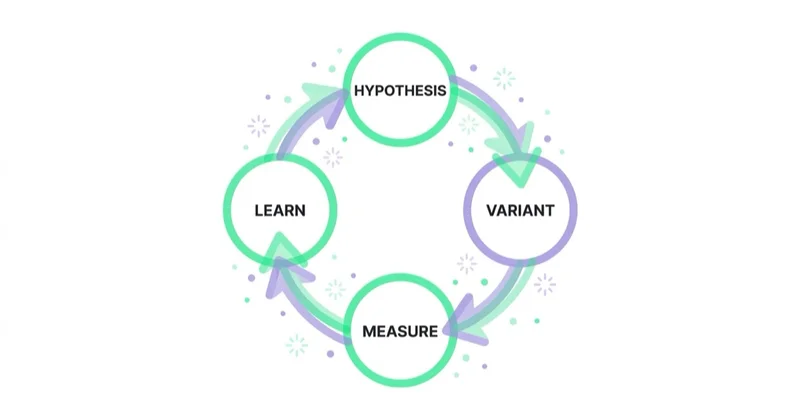
The system should also protect against false certainty. If a platform allocates more impressions to one ad, that does not by itself prove the ad would outperform under equal exposure. If a test produces three conversions in one arm and one in another, the apparent gap may be noise. A useful process records what was tested, how delivery differed, and how confident the team can be in the conclusion.
Test concepts before details
When a team has limited test capacity, it should prioritise questions that could materially change the result or production plan. A new audience problem, offer, demonstration, or proof point will usually teach more than a decorative change. But there is no universal hierarchy: a thumbnail can materially affect a YouTube ad, and a CTA can matter when the current one is unclear.
A useful hierarchy of what to vary, in order of impact:
- Audience problem and message — the need, promise, or objection the ad addresses.
- Offer and proof — price, bundle, trial, demonstration, evidence, testimonial, or risk reduction.
- Opening — the first line, frame, or seconds that establish relevance.
- Format and source — static, video, carousel, creator, customer, employee, animation, or studio production.
- Structure — order of proof, demo, offer within the ad.
- Details — copy wording, CTA, thumbnail, layout, colour, and captions.
Rank ideas by expected business impact, confidence, production cost, and the ability to act on the answer. This creates a test backlog rather than a collection of arbitrary variations.
Isolate the variable — or know you aren't
Two common modes serve different purposes. Randomised isolated testing changes one defined factor, splits eligible users or traffic between control and treatment, and measures a preselected outcome. This supports a causal conclusion when the setup and sample are adequate. In-campaign screening releases several distinct ads and lets the delivery system allocate impressions. This finds candidates that the system can use efficiently, but unequal delivery and selection make precise “why” conclusions weaker.
Changing several elements at once can still test a complete concept. The conclusion is simply limited to the package: treatment B outperformed treatment A under the test conditions. It cannot identify whether the opening, spokesperson, offer, or edit caused the difference. Label that limitation in the test log.
A test brief that prevents ambiguity
Before launch, document:
- Question and hypothesis: what change is expected to affect which outcome, and why?
- Control and treatment: exactly what remains the same and what changes?
- Eligible population and randomisation unit: who can enter, and is assignment by user, geography, campaign, or another unit?
- Primary metric: one decision metric tied as closely as possible to the business objective.
- Guardrails and diagnostics: margin, lead quality, unsubscribe rate, CTR, video retention, or landing-page conversion rate as relevant.
- Minimum detectable effect and power: what size of improvement would justify the cost, and can available traffic detect it?
- Duration and conversion lag: include complete conversion windows and relevant weekday or seasonal patterns.
- Decision rule: scale, iterate, stop, or declare the result inconclusive.
Give tests enough budget and time
Small samples produce wide uncertainty, and late conversions can make an early result look better or worse than the final one. Plan the test from the baseline conversion rate, practical effect size, desired confidence or power, traffic split, and conversion delay. The platform's forecast or an experiment calculator can help, but the commercial question comes first: what improvement would be large enough to change the decision?
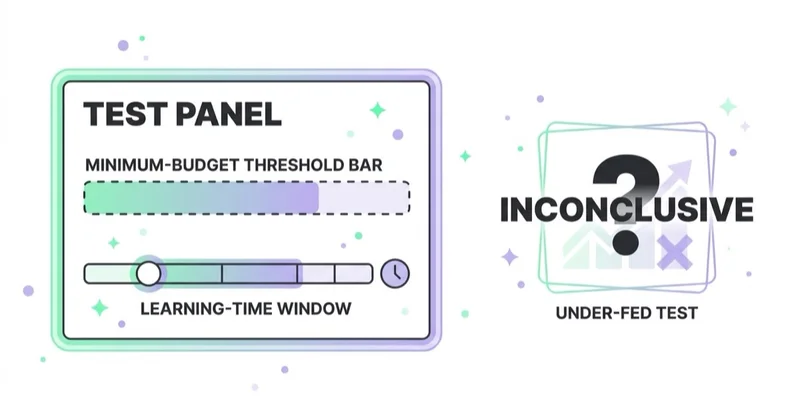
Do not stop because one arm is ahead after a day unless the protocol includes a valid sequential stopping rule or there is a safety issue. Do not extend a losing test indefinitely in search of significance either. Run to the planned endpoint, account for the conversion window, and report the interval around the estimated difference. Platform guidance varies by experiment type: Google, for example, recommends four to six weeks for some experiments, while TikTok's split-test tool estimates power and only declares a winner when its significance criteria are met.
Glossary
- Creative testing — a process for finding which ads work and why, repeatably.
- Concept — the core angle/idea of an ad; the biggest performance lever.
- Hook — the first 1-2 seconds or first line/image that earns attention.
- Isolated test — varying one element so the result is attributable to it.
- In-campaign screening — releasing multiple ads under normal delivery to find promising candidates without claiming a clean causal comparison.
- Primary metric — the outcome that determines the test decision.
- Minimum detectable effect (MDE) — the smallest difference the test is designed to detect reliably.
- Confidence interval — a range expressing uncertainty around the estimated difference.
Judge on the right metric
Select the primary metric before seeing the data. For a sales test, that might be conversion value, contribution margin, purchases, or cost per incremental purchase. For lead generation, include qualified leads or downstream revenue where the feedback loop permits. A campaign-level CPA can hide a decline in lead quality.
Video retention, CTR, landing-page views, and add-to-cart rate are diagnostic metrics. They can show where the path diverges, but their relationship with sales must be established for the account. A high-retention video may entertain without persuading; a lower-CTR ad may prequalify better buyers. If conversion volume is too low, using a proxy can support screening, but it does not prove the same result on purchases. This measurement discipline also applies to reading channels alongside blended business results.
Winners are inputs, not endpoints
A positive result is a candidate for replication and iteration, not a permanent law. Test a new opening on the successful concept, translate the proof into another format, or confirm the result in a different period or audience. Keep one stable control where practical so performance drift is not mistaken for creative improvement.
Do not invent a post-hoc explanation for every loss. The honest entry may be “inconclusive,” “treatment reduced purchase rate,” or “screening candidate received insufficient delivery.” Over time, the test library should store the brief, assets, setup, result, uncertainty, limitations, and next action. Guidance on diagnosing declining ads is covered in creative fatigue.
How Space Ads approaches creative testing
At Space Ads, every planned creative test is labelled as screening or experimentation. The brief records the hypothesis, assets, audience, setup, primary metric, guardrails, planned endpoint, and decision rule. This keeps production, media, analytics, and the client aligned on what the result can—and cannot—prove.
We use native experiment tools where eligibility, volume, and decision value justify them. Routine screening remains useful for finding viable ads, but we avoid presenting normal delivery reports as randomised evidence. Learnings feed the next creative brief and remain linked to the original data. The work lives in ad creative, Meta Ads, and TikTok Ads.
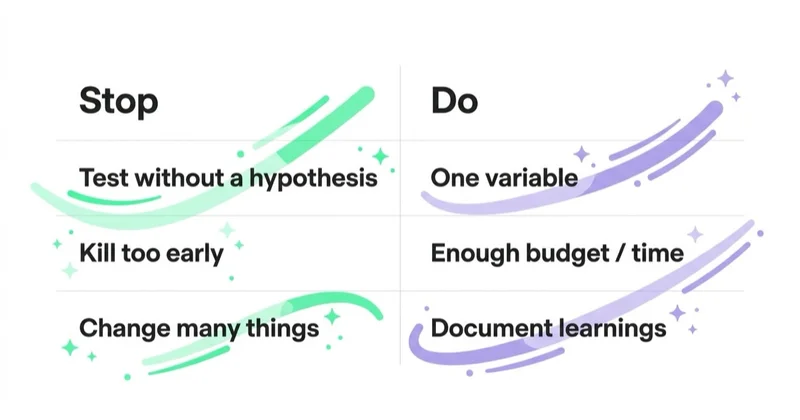
Stop doing / Do instead
| Stop doing | Do instead |
|---|---|
| Testing whatever is easiest to produce | Prioritise questions by expected impact, cost, confidence, and actionability |
| Calling normal multi-ad delivery an A/B test | Use randomised experiments for causal questions; label screening honestly |
| Checking results repeatedly and stopping when one leads | Set the endpoint and stopping rule before launch |
| Selecting a winner from several metrics after the fact | Choose one primary metric and predefined guardrails |
| Treating a proxy as proof of sales impact | Use diagnostics to explain results and validate their relationship with conversion |
| Forcing a winner from weak data | Report uncertainty and allow an inconclusive outcome |
Common mistakes
Common errors include changing the audience or bid strategy during the test, letting the arms overlap, choosing metrics after seeing the result, ignoring conversion delay, running many variants with too little traffic, and treating “not statistically significant” as “the control won.” Testing several ideas also increases the chance of a false positive; use the platform's experiment design or appropriate statistical adjustment rather than selecting the largest random fluctuation.
FAQ
How do I test ad creative properly?
Start with a written question, control, treatment, eligible population, one primary metric, sample plan, duration, conversion window, and decision rule. Use a randomised platform experiment when you need a causal answer. Use in-campaign screening to find promising candidates, but do not interpret uneven delivery as a clean A/B result.
How much budget do I need to test a creative?
There is no universal amount. Estimate it from the baseline result rate and cost, the minimum improvement worth acting on, the traffic split, desired statistical power, and conversion lag. If the required sample is commercially unrealistic, run a screening test on a clearly labelled diagnostic metric or prioritise a larger change that the available traffic can detect.
How long should a creative test run?
Run to the endpoint defined in the test plan and wait for the relevant conversion window. Include normal weekday patterns and avoid known events that affect only one arm. Some platform experiment types recommend longer periods; follow the current documentation for the tool you use rather than applying one duration to every campaign.
What metric should I judge creative tests on?
Choose one primary metric closest to the business decision: contribution margin, conversion value, purchases, qualified leads, or cost per result as appropriate. Use retention, CTR, landing-page views, and other engagement metrics to diagnose the mechanism. Do not switch the primary metric after seeing which one looks favorable.
Should I test one variable at a time or many?
If you need to identify the effect of one element, change one defined factor in a randomised test. If you need to compare complete concepts, changing several elements is valid, but the result applies to the package rather than any individual component. Normal in-campaign screening is useful operationally but provides weaker causal evidence.
What do I do after I find a winning ad?
Document the estimate, uncertainty, setup, and limitations; confirm that downstream quality and economics remain acceptable; then scale carefully or replicate. Use the successful concept as a basis for new hypotheses, while retaining a suitable control. Do not assume the result will transfer unchanged to another platform, audience, or season.
Key takeaways
- Creative is an important controllable input, but offer, audience, media, landing page, and measurement still shape the result.
- Separate in-campaign screening from randomised experiments and describe the strength of evidence honestly.
- Define the hypothesis, primary metric, MDE, sample, duration, conversion lag, and decision rule before launch.
- Diagnostic engagement metrics can explain performance; they do not automatically prove business impact.
- Record uncertainty and inconclusive outcomes, then turn supported findings into the next testable hypothesis.
Sources and further reading
- Meta for Business — Creative diversification and test-and-learn guidance
- TikTok Ads Help Center — About Split Testing
- Google Ads Help — About the Experiments page
- Google Ads Help — Monitor experiment results and confidence intervals
Continue learning
Continue reading
One Creative Won't Fit All: Ad Creative for Meta vs TikTok vs Google
A strong concept can travel across Meta, TikTok, and Google, but the same file may not suit every placement. Learn what to preserve, what to adapt, which specifications matter, and how to test cross-platform creative without relying on stereotypes.
Static vs Video Ads: Which Converts, and When to Use Each
Static and video ads can both sell. The useful question is which format communicates a specific idea in a specific placement at an acceptable total cost. This guide shows how to choose and test them fairly.

UGC Ads: How to Brief, Source and Run Creator Content That Performs
Creator-led ads can make a product easier to understand, but paid content must not masquerade as an independent customer opinion. Learn how to source, brief, contract, disclose and test creator content responsibly.