"Meta ads stopped working" can mean several different incidents: delivery stopped, cost rose, site response fell, attributed purchases disappeared or the business outcome weakened. Each points to a different layer.
Start by defining the affected metric, scope and time. Then protect agreed loss and customer guardrails, inspect delivery and event health, decompose the funnel and review account and business changes. This avoids editing several variables in response to normal volatility or an issue outside Ads Manager.
TL;DR
- Define the incident. Record when it began, affected campaigns, mature comparison window and commercial impact.
- Check delivery first. Review campaign, ad set and ad status, payment, schedule, spend limits, review/rejection and account access.
- Validate events end to end. Check Pixel/CAPI source, deduplication, event name, value, currency, order ID, consent and downstream status.
- Follow the funnel. Spend → impressions/CPM → clicks/CTR → landing views → qualified conversion → value and contribution.
- Use activity history. Meta records who changed budget, bid, audience, schedule and run status, including automated rules.
- Treat fatigue and saturation as hypotheses. Frequency or CTR alone cannot prove either; compare concepts, delivery and business outcomes.
- Recover with controlled changes. Fix confirmed defects immediately; test uncertain causes with guardrails and a rollback condition.
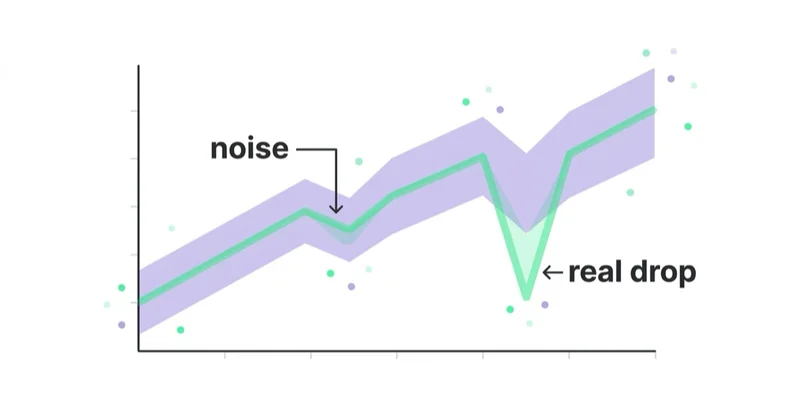
Rule one: confirm the drop is real before you react
Create an incident line such as: "From 15 July, purchase CPA in UK prospecting is 42% above the prior four complete weeks; spend and site availability are stable." Avoid "ads died," which cannot be tested.
Apply immediate controls if the landing page is unavailable, an invalid price or claim is live, stock cannot fulfil demand, spend is uncontrolled or a loss/policy guardrail is breached. Otherwise preserve a stable baseline while checking:
- campaign, ad set and ad delivery status at every level;
- payment method, account spending limit and scheduled end date;
- review, rejection, processing, error and warning states;
- automated rules and third-party tools;
- account permissions and unrecognised changes.
Meta's Delivery column distinguishes active, warning, error, review, preparing and learning states. "Active" means the item can run; it does not certify good commercial performance.
Validate measurement without assuming measurement is the cause
A sudden reporting change can come from tracking, but also from delivery, demand, stock, site release, offer expiry or payment. Validate both the business outcome and the event path.
For a representative order or lead, check:
- browser event and server event where used;
- event time, name, value and currency;
- stable order or event ID and deduplication;
- domain, dataset/pixel and campaign conversion location;
- primary optimisation event and any recent goal change;
- consent path and applicable disclosure;
- order cancellation, refund or CRM-stage handling.
Meta says Conversions API can create a more direct event connection and recommends considering it alongside the Pixel for web events. It is not designed to bypass iOS App Tracking Transparency, the ePrivacy Directive or other data-sharing rules. More event volume is not automatically better: send accurate, permitted events tied to the outcome you want to optimise.
Compare Meta with commerce, analytics, CRM and finance data, but do not expect totals to match. Stable total revenue does not prove Meta is healthy; another channel, promotion or returning customers may offset a decline. The signal setup is also discussed in choosing a Meta ads agency.
Recent edits and the learning phase
Meta states that significant edits can return an ad to preparing, and that performance can be less stable during learning. That makes the activity history an important source, not proof that the edit caused the commercial decline.
Review the timestamp of:
- budget, bid and bid-strategy changes;
- audience, location, placement or exclusion changes;
- optimisation event and attribution-setting changes;
- new, paused or replaced ads;
- catalog, product-set and destination changes;
- automated-rule actions;
- schedule, payment and run-status changes.
Compare the timing with the first affected delivery period and allow for conversion lag. Do not wait indefinitely for a learning label to disappear while a loss guardrail is breached. Conversely, avoid repeated edits that remove the stable observation window needed for diagnosis.
Follow the first metric that changed
Use comparable, mature periods and segment by market, campaign, customer type, product, placement and device.
| First material change | Investigate next |
|---|---|
| Spend or impressions fell | Delivery status, payment, limits, schedule, review, bid and audience eligibility |
| CPM rose | Audience/placement mix, season, bid, quality signals and auction conditions |
| CTR fell | Creative concept, message, offer, placement adaptation and delivery concentration |
| Clicks held but landing views fell | Page availability, redirect, consent, speed and link destination |
| Landing views held but qualified conversion fell | Traffic mix, product/offer, stock, page, checkout, payment or lead handling |
| Conversion count held but value fell | Product mix, AOV, discounts, currency, value event and new/returning mix |
| Business outcome held but attribution fell | Event/attribution change, conversion lag, consent, match and cross-channel shift |
CPM, CTR and landing-page views are diagnostic—not the business objective. A higher CPM can be acceptable if conversion quality improves. A higher CTR can attract low-intent traffic. Continue the chain to contribution or qualified pipeline.
Glossary
- Pixel / Conversions API — browser and server/CRM methods for sending permitted event data to Meta.
- Learning phase — a period in which the delivery system explores how to deliver an ad set; performance may be less stable.
- Creative fatigue — a hypothesis that an execution has lost effectiveness with the eligible audience over time.
- Frequency — average impressions per reached account in the selected scope and period; it hides the distribution.
- Activity history — Meta's record of what changed, when and by whom.
- Incrementality — outcomes caused by advertising beyond what would otherwise have occurred.
- Seasonality / auction pressure — external cost rises around peak periods and competition.
Auction, seasonality and audience saturation
Evaluate creative and audience without shortcuts
Rising average frequency plus falling CTR does not isolate creative fatigue. Frequency rises when reach growth slows, which may reflect audience size, budget, placement or delivery. CPM is influenced by auction and quality factors and is not a direct fatigue measure.
Review:
- spend and outcome concentration by concept and execution;
- reach and frequency over the same audience and period;
- first-time impression or new-reach indicators where available;
- placement-specific crops, safe zones, captions and destination continuity;
- negative feedback, comments and brand-safety issues;
- downstream conversion and customer quality, not click response alone.
Test a meaningfully different concept against a suitable control. Cosmetic edits do not establish a new message. Broader or Advantage+ audience can create more delivery room, but required legal, geographic, product and customer controls still apply; audience inputs may be suggestions rather than hard constraints. Test broadening instead of assuming it is the fix. More detail is in creative fatigue.
Check the offer, site and operation
Meta performance can change because the advertised proposition or fulfilment changed:
- price, discount, bundle or financing;
- stock, variant availability or feed accuracy;
- shipping cost, delivery date or returns policy;
- landing-page release, consent layer, checkout or payment;
- competitor or category event supported by evidence;
- sales response time, qualification or CRM routing;
- product reviews, service incident or seasonal demand.
Test the journey on real devices and with a test order or lead. Aggregate website conversion can also fall because traffic mix changed, so compare like-for-like segments before blaming the page.
The measurement illusion: maybe nothing broke
Platform attribution, analytics and finance answer different questions. Meta-attributed ROAS uses eligible events and its configured rules; MER compares total revenue with total spend; neither proves incrementality.
Reconcile these views and annotate known differences. For a high-stakes budget decision, use Meta's available lift testing or an appropriate geo/holdout experiment where feasible. A change in attributed ROAS can be real within the reporting model without representing an equal change in causal impact. See attribution for executives.
The diagnostic order
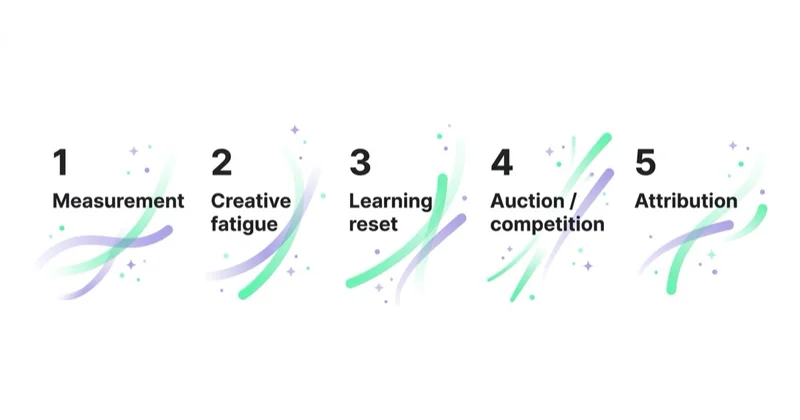
Use this order:
- Define incident and guardrails. Metric, scope, start time, mature comparison and maximum tolerated downside.
- Check delivery infrastructure. Status at all levels, billing, limits, schedule, policy, access and rules.
- Validate event quality. Test the full path, values, currency, IDs, deduplication, consent and downstream status.
- Find the first funnel break. Spend, CPM, CTR, landing views, qualified conversion, value and contribution.
- Read activity history. Align manual and automated changes with the affected period.
- Inspect creative, audience, offer and operation. Segment the contribution to change and gather evidence.
- Fix or test. Repair confirmed defects; test uncertain causes with one major change, an owner and rollback.
- Review after conversion lag. Record the outcome and update the operating playbook.
How Space Ads approaches a Meta performance drop
We use one incident record across Ads Manager, Events Manager and business data. It captures the baseline, guardrails, delivery status, event validation, activity history, funnel decomposition, segment contribution and business changes.
Confirmed defects receive an immediate owner. Uncertain causes become controlled tests with an expected result and rollback condition. The resolution is documented so future teams can distinguish a recurring integration issue from normal auction movement. This work lives in Meta Ads and the marketing audit.
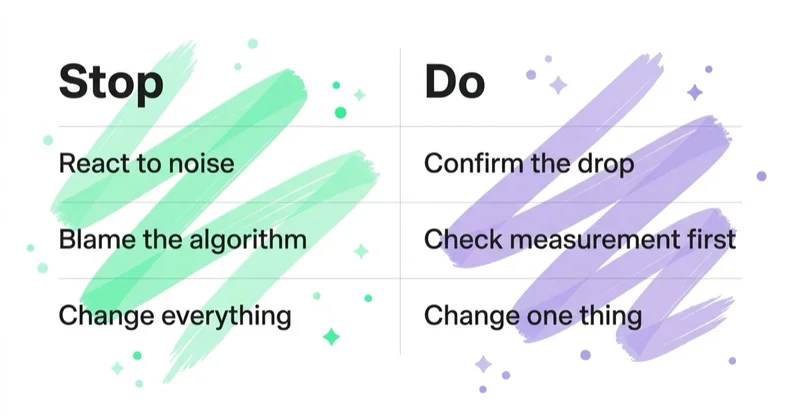
Stop doing / Do instead
| Stop doing | Do instead |
|---|---|
| Treating "ads stopped" as a diagnosis | Define the affected metric, scope, time and business impact |
| Editing campaigns before checking status | Review delivery, payment, schedule, policy and rules first |
| Assuming sudden means tracking | Validate events and the commercial journey without excluding other causes |
| Calling frequency plus lower CTR fatigue | Test a distinct concept and inspect downstream quality |
| Changing audience, budget and creative together | Isolate one major hypothesis with guardrails and rollback |
| Treating stable total revenue as proof Meta works | Reconcile channels and use incrementality evidence where feasible |
Common mistakes
Common failures include missing a rejected ad or payment limit, comparing immature conversions, and sending duplicate or incorrect purchase values. Teams also infer competition or fatigue from one metric, ignore a site or stock release and make several changes that destroy the baseline needed to learn.
FAQ
Why did my Facebook/Meta ads suddenly stop working?
Check whether delivery, spend or only attributed outcomes changed. Review status, payment, schedule and policy; validate Pixel/CAPI events; follow CPM, CTR, landing views, qualified conversion and value; then align activity history and business changes. The pattern alone does not identify the cause.
How do I know if it's creative fatigue or a tracking problem?
Validate representative events end to end and compare Meta with order or CRM status. For fatigue, compare concept-level delivery, reach/frequency, response and downstream quality, then test a distinct replacement. Sudden versus gradual timing is a clue, not a reliable classifier.
Why did my Meta ads get worse after I made changes?
Significant edits can return delivery to preparing and learning, where results may be less stable. Use activity history to verify the change and compare its timestamp with mature outcomes. Do not assume causality, wait through a breached loss limit or apply a universal number of days.
Do rising CPMs mean my account is broken?
No. CPM reflects auction and delivery conditions, including audience, placement, season, bid and quality factors. Check whether CTR, conversion quality and contribution changed too. Attribute the movement to competition only when external and account evidence supports it.
Can scaling budget make Meta ads stop working?
A budget increase can expose diminishing returns, alter delivery or coincide with learning and other changes. There is no universal safe percentage. Size the test from commercial risk and conversion volume, set a marginal contribution threshold and compare a mature result. See the Meta scaling guide.
What if revenue is fine but Meta says performance dropped?
Measurement is one possibility, but other channels, promotions or returning customers may offset weaker Meta performance. Reconcile attributed outcomes with analytics, commerce/CRM and finance data, inspect event changes and use an incrementality study where the decision and volume justify it. MER is context, not channel proof.
Key takeaways
- Define the incident and apply commercial, customer and policy guardrails first.
- Check delivery status, payment, rules and event quality before restructuring campaigns.
- Follow the first funnel metric that changed and segment its contribution.
- Use activity history and business changes to form hypotheses, not instant conclusions.
- Fix confirmed defects and test uncertain creative, audience or budget causes with controlled recovery.
Sources and further reading
- Meta Help Center — Campaign, ad set and ad delivery statuses
- Meta Help Center — Ads Manager activity history
- Meta Business Help Center — About Conversions API and its privacy limitations
- Meta for Business — Performance marketing: learning, creative, data and testing
Continue learning
Continue reading
Meta Advantage+ vs Manual Campaigns: When to Trust the Automation
Meta Advantage+ can automate audience expansion, placements and budget allocation, while manual settings preserve selected controls. This guide explains what each label actually means and how to test the right configuration for a business goal.
How to Choose a Meta (Facebook) Ads Agency in 2026
Choose a Meta Ads agency by examining its measurement, creative process, data governance, experimentation and commercial judgment. Use these questions and contract checks before granting account access.
Scaling Meta Ads Without Killing ROAS
Scaling Meta ads is a commercial decision, not a promise to preserve the same ROAS at a higher spend. Learn how to set a profitable ceiling, diagnose constraints and increase budget through controlled tests.