A creative concept can work across Meta, TikTok, and Google, but the same file will not automatically fit every surface. The platforms contain different formats and contexts: a Search ad answers a query, a Shopping ad depends on product data, and a vertical feed video competes for attention in motion. Even within one platform, Feed, Stories, Reels, Search, Discover, and YouTube Shorts impose different constraints.
The practical approach is to preserve the central idea—audience problem, promise, proof, and offer—while adapting the opening, format, copy, framing, sound, and call to action where the placement requires it. Sometimes the original asset will still win. Treat adaptation as a hypothesis to test, not a rule that every file must be remade from scratch.
TL;DR
- Start with placement, objective, and audience state. “Meta,” “TikTok,” and “Google” each contain several distinct ad experiences.
- Meta needs placement coverage. Prepare assets for Feed, Stories, and Reels, keep important content inside safe areas, and test static, video, and creator-led formats.
- TikTok recommends platform-first vertical video. Sound, people, readable text, safe zones, and native pacing are useful starting points—not guarantees of performance.
- Google requires more than Search copy. Search, Shopping, Performance Max, Demand Gen, Display, YouTube, and Shorts use different combinations of text, image, video, and product data.
- Preserve the claim and proof; adapt the delivery. Changing the format must not change what the brand can substantiate.
- Measure executions separately. Compare each version against a suitable control within its own platform before judging the concept.
Why the same creative doesn't travel
The same person can encounter an ad while searching for a product, watching short-form video, browsing a feed, checking Gmail, or viewing a YouTube tutorial. Their level of intent and available attention differ. So do the screen ratio, surrounding content, sound behavior, text limits, and call-to-action options.
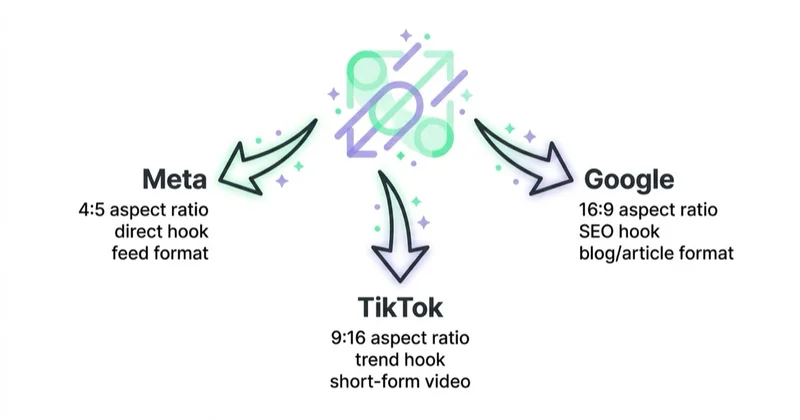
Cropping alone can hide a product, cut off subtitles, or leave key information behind interface elements. At the other extreme, assuming that polished work always fails on TikTok or creator footage looks wrong on Meta replaces analysis with a stereotype. Both platforms support a wide range of creative styles. The decision should come from the brand, audience, offer, placement, and test result.
What each platform's creative needs
| Meta (Feed/Reels) | TikTok | Google Search/Shopping | YouTube | |
|---|---|---|---|---|
| Typical context | Feed, Stories, Reels, Messenger | For You feed and other video placements | Active search or product comparison | Long-form video, in-feed, or Shorts |
| Main creative inputs | Image/video, primary text, headline, CTA | Vertical video, audio, on-screen text, caption, CTA | Search text or Merchant Center product data | Video, companion text, thumbnail/context |
| Useful starting point | Clear early value, placement-specific ratios, visible brand cues | 9:16, sound, people where relevant, safe-zone text, direct demonstration | Query relevance, accurate claims, complete assets or precise product data | State the value early, design for the selected inventory and screen |
| Common failure | One crop for every placement | Copying a trend without product relevance | Generic copy, incomplete assets, or inaccurate feed data | Reusing a slow edit without testing the opening |
Google cannot be reduced to Search and Shopping. Demand Gen uses image, video, and text across YouTube, Discover, Gmail, and other eligible inventory; Performance Max can combine assets across Google channels. Search still depends heavily on relevant text and landing-page alignment, while Shopping relies on accurate product data, including titles, images, price, availability, and identifiers.
Adapt the concept, don't copy the file
The workflow that works is to develop a concept — a core angle, message and proof — then execute it natively per platform:
- Meta: create ratios for the placements you intend to use, keep the key message legible without relying on audio, and add sound where it improves Reels or Stories. Test static, motion, product, and creator-led executions rather than declaring one format the winner in advance.
- TikTok: begin with a 9:16 version, keep text and key action inside the safe zone, use sound you have the right to use, and show the product or outcome early. Creator-style footage is one option; it is not mandatory for every brand.
- Google Search: translate the concept into relevant headlines, descriptions, business information, and assets that match the query and landing page. Respect editorial rules and character limits.
- Shopping: express relevance through accurate product titles, images, attributes, price, and availability. Promotional overlays in the primary product image can violate Merchant Center requirements.
- Demand Gen and Performance Max: provide diverse text, image, and video assets in the recommended ratios so the system has eligible combinations for more inventory. Review asset-level reporting with appropriate caution.
- YouTube and Shorts: adapt framing and pace to the selected inventory. Test the opening, but do not assume that a TikTok edit is automatically the right YouTube execution.
The goal is not a fixed number of executions. It is enough variation to preserve the idea while meeting the material differences between placements. Use the creative testing framework to compare adaptations against an unchanged control and learn whether the extra production work creates value.
Glossary
- Creative concept — the core audience insight, promise, proof, and offer behind an ad.
- Execution — the specific script, visual treatment, copy, ratio, edit, and CTA used to express the concept.
- Placement — the location and format in which an ad appears, such as Instagram Stories, TikTok's For You feed, Search, Discover, or YouTube Shorts.
- Asset coverage — the set of eligible text, image, and video assets available across ratios and placements.
- Concept vs execution — the reusable angle vs the platform-specific version of it.
- Aspect ratio — the frame shape (vertical, square); the minimum adaptation, not the whole of it.
Aspect ratio and sound are the floor, not the ceiling
Mechanical adaptation is the first quality-control layer: ratio, resolution, duration, text limits, captions, safe zones, and rights to music or creator content. Strategic adaptation considers why the user sees the ad, what decision they are making, and which proof fits that moment. Both matter.
Before launch, preview every placement and check whether the product, subtitle, logo, and CTA remain visible. After launch, compare delivery and outcomes by platform and placement. If the original asset performs as well as an adaptation, reuse it. Adaptation should earn its production cost.
How Space Ads approaches cross-platform creative
At Space Ads, a cross-platform brief separates the elements that must stay consistent—audience, offer, substantiated claim, proof, and brand cues—from the elements that may change: opening, spokesperson, ratio, pace, copy length, CTA, and product-data treatment. This prevents platform adaptation from turning into three unrelated brand messages.
We map each execution to its placements, preview it, and define the comparison before launch. Reporting distinguishes concept, execution, platform, and placement where the data allows it; blended business results remain the final check. This sits inside ad creative, across Meta Ads, TikTok Ads, and Google Ads.
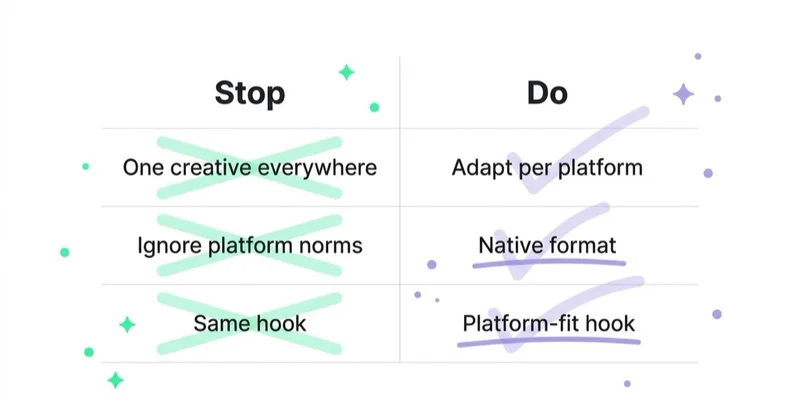
Stop doing / Do instead
| Stop doing | Do instead |
|---|---|
| Reposting one file across all platforms | Develop one concept, execute it natively per platform |
| Stopping at aspect ratio and captions | Change the creative's mindset, not just its dimensions |
| Assuming TikTok requires one visual style | Start with official format guidance, then test styles suited to the brand |
| Treating all Google Ads as Search | Plan text, image, video, and feed assets for the campaign type and inventory |
| Judging one creative against a cross-platform average | Judge per platform; expect a concept to win on one, lose on another |
Common mistakes
Common errors include using a single crop across placements, placing subtitles under interface elements, using music without advertising rights, changing the claim while adapting the format, treating Google as Search-only, and comparing platform results without accounting for different objectives, attribution, audiences, and spend. Another error is remaking every asset without a control, which makes the value of adaptation impossible to measure.
FAQ
Can I use the same ad creative on Meta, TikTok and Google?
Yes, when the asset meets the specifications, remains legible, and proves effective in that placement. Reuse the concept freely and test whether the file also travels. Adapt it when the context, ratio, sound behavior, copy limits, product data, or performance evidence gives you a reason.
What creative works best on TikTok versus Meta?
TikTok's official starting points include 9:16 video, sound, at least 720p resolution, safe-zone composition, and people where relevant. Meta supports many placements and recommends creative diversity and placement coverage. Creator-led, product-led, static, motion, and polished brand work can succeed or fail on either platform, so test the style against the objective and audience.
What counts as "creative" on Google Ads?
It depends on the campaign. Search uses headlines, descriptions, URLs, and other assets; Shopping relies on Merchant Center product data; Demand Gen and Performance Max can use text, images, and video; YouTube uses video across several formats. The landing page and accuracy of claims remain part of the experience in every case.
Is changing the aspect ratio enough to adapt creative?
Not always. Ratio and captions can solve eligibility and legibility, but the placement may also require a different opening, pace, amount of information, sound treatment, CTA, or proof. Preview and test the result rather than assuming either a crop or a full reshoot is necessary.
How do I keep brand consistency while adapting per platform?
Keep the concept consistent — the core angle, message and proof — and vary only the execution (hook, format, pacing, tone) to fit each platform. The brand story and claims stay the same across platforms; how they're delivered changes. That way a viewer gets a coherent brand impression whether they see you on Meta, TikTok or YouTube, while each version performs natively.
Should I expect the same creative to perform the same everywhere?
No. Delivery systems, audiences, auctions, placements, objectives, and attribution differ. Evaluate each execution against a relevant control on the same platform, then use blended business outcomes as a check. A weak result can reflect the concept, the execution, or campaign conditions; the data must distinguish them.
Key takeaways
- Platform names are too broad for creative planning; start with the campaign type, placement, objective, and audience context.
- Preserve the audience insight, offer, supportable claim, proof, and brand cues across executions.
- Adapt ratios, opening, pace, copy, sound, and CTA only where specifications, context, or tests justify it.
- Google creative includes Search text, Merchant Center data, images, and video across several campaign types.
- Preview every placement, keep a suitable control, and judge platform-level results alongside blended business outcomes.
Sources and further reading
- Meta for Business — Expand your ad creative strategy
- TikTok Ads Help Center — Creative best practices for performance ads
- Google Ads Help — Create effective Search ads
- Google Ads Help — Demand Gen asset specifications
- Google Merchant Center Help — Tips to optimize product data
Continue learning
Continue reading
An Ad Creative Testing Framework That Actually Finds Winners
Creative testing should separate finding an ad that can scale from proving why it works. This framework covers hypotheses, controls, randomised experiments, primary metrics, sample size, conversion delay, decision rules, and iteration.
Static vs Video Ads: Which Converts, and When to Use Each
Static and video ads can both sell. The useful question is which format communicates a specific idea in a specific placement at an acceptable total cost. This guide shows how to choose and test them fairly.

UGC Ads: How to Brief, Source and Run Creator Content That Performs
Creator-led ads can make a product easier to understand, but paid content must not masquerade as an independent customer opinion. Learn how to source, brief, contract, disclose and test creator content responsibly.