Static and video ads can both generate profitable sales. Format alone does not determine the result: the idea, offer, proof, execution, placement, landing page and audience all contribute. A clear product image can outperform an unfocused video, while a concise demonstration can explain in ten seconds what a still image cannot.
The right comparison is not "which format always converts better?" It is "which execution communicates this message in this placement, and what does each qualified outcome cost after production?" This guide provides a practical way to answer that question without forcing every campaign into one format.
TL;DR
- Start with the communication job. Demonstration, comparison, social proof, product detail and a price-led offer may need different treatments.
- Design for the placement. Aspect ratio, duration, safe zones, sound behaviour and image-format availability vary by platform and campaign type.
- Do not assign formats to a funnel stage by default. Either format can prospect, retarget or convert when the message fits.
- Include production in the economics. Compare media cost, production and adaptation—not the auction result alone.
- Measure qualified outcomes. Revenue, contribution, lead quality, returns and new-customer share can reverse a verdict based only on CTR or CPA.
- Test concepts and formats separately. Otherwise a stronger message may be mistaken for a stronger medium.
- Keep useful diversity. A mixed library gives delivery systems and people more relevant options, but every asset still needs a clear role.
The false rule "video always wins"
"Video always wins" usually compares labels instead of executions. A product demonstration, founder explanation and customer story are all videos, but they solve different problems. The same is true of a product image, comparison graphic, carousel and testimonial card.
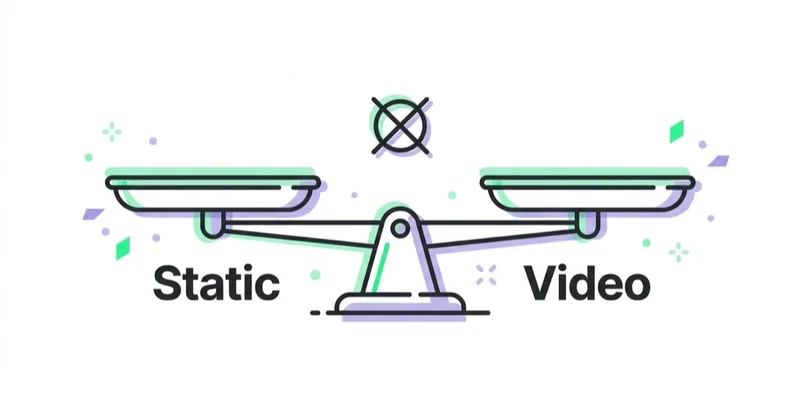
Video can show sequence, movement, scale and use. Static can present one idea immediately and let the viewer inspect it at their own pace. Neither automatically earns attention or emotion. Those outcomes depend on relevance and craft. Treat format as part of the concept, not as a quality ranking.
The comparison that matters
| Dimension | Static | Video |
|---|---|---|
| Communication job | One focused message, detail, comparison, offer | Sequence, movement, demonstration, spoken explanation |
| Viewer control | The complete frame is visible at once | Meaning unfolds over time; early clarity matters |
| Accessibility | Needs legible type, contrast and useful alt context where supported | Needs captions, readable overlays and meaning that does not rely only on sound |
| Production | Can be quick, but photography and design may be costly | Can be quick creator footage or a high-cost production |
| Adaptation | Crop, hierarchy and type need checking per placement | Aspect ratio, duration, captions, audio and safe zones need checking |
| Useful metrics | Qualified clicks, landing-page behaviour, conversion, contribution | Hold and completion as diagnostics; conversion and contribution as outcomes |
| Common failure | Too much text or a generic product packshot | Slow opening, unclear product, weak audio/captions or no payoff |
Production cost depends on the actual asset. A creator demonstration recorded on a phone may cost less than a location shoot for one premium still, while a scripted film may cost far more than a template-based graphic. Compare real briefs, revision rounds, usage rights and the number of usable placement variants.
Placement and objective shape the available formats
Meta supports a mix of formats across Facebook, Instagram, Messenger and WhatsApp, but availability depends on objective, ad type and placement. An image designed for Feed should not simply be stretched into Reels. Check how the crop, text, call to action and product remain visible in every selected placement.
TikTok's core experience is built around dynamic, sound-capable vertical content, and its advertising policy requires eligible video ads to be dynamic in many markets. However, TikTok Ads Manager also supports image formats, including carousel and certain catalog use cases. Availability varies by objective and placement. Therefore "TikTok only accepts video" and "static never works on TikTok" are both poor operating rules. Verify the current format and market specifications before production.
Funnel stage is a weak shortcut. A video testimonial can close a high-consideration buyer, while a strong static comparison can introduce a product to a new audience. Choose from the information the person needs next, not a rigid "video upper, static lower" map. Platform differences are explored further in TikTok vs Reels vs Shorts for ads.
How to run a fair static-versus-video test
A format test is useful only when the result can change a decision. Use this sequence:
- Name the decision. For example: which format should carry a product-demonstration concept in Meta prospecting?
- Hold the commercial proposition steady. Use the same product, price, audience, destination, optimisation event and offer.
- Build native executions. Do not compare a polished video with a resized presentation slide. Preserve the same core claim while allowing each format to communicate it properly.
- Separate concept from format. If possible, test more than one concept in both formats. One pair cannot prove that a medium is generally superior.
- Use a platform experiment where available. Randomised A/B delivery is stronger than comparing two ads that received different people, spend and auction conditions.
- Set the decision metric and window first. Allow for conversion delay and minimum useful volume. Do not stop when one variant briefly leads.
- Read the full economics. Add production and adaptation cost to media spend, then inspect qualified conversion, revenue, contribution and returns.
Static can be an efficient way to explore claims and visual territories, but a winning static concept is not guaranteed to win in video. Format and idea interact. The creative testing framework explains how to maintain a useful control and learning log.
Glossary
- Static ad — a still-image (or simple graphic) ad, no motion.
- Video ad — a moving-image ad that can combine sequence, demonstration, voice, text and sound.
- Hook — the first 1-2 seconds (video) or the primary visual/headline (static) that earns attention.
- Placement — the surface where an ad appears, with its own format and layout requirements.
- Qualified outcome — a sale or lead that meets agreed quality and commercial criteria.
- Total creative cost — production, usage rights, revisions and placement adaptations.
How Space Ads approaches format choice
We begin with a message matrix: audience need, claim, proof, objection, offer, placement and desired action. The format follows the communication job. A product requiring motion may need demonstration; a comparison may need a readable static or carousel; a founder explanation may work as a direct-to-camera video.
Every concept receives an acceptance checklist for claim accuracy, brand consistency, accessibility, crop, captions, rights and landing-page continuity. Tests use predefined business outcomes and record media plus production cost. The result is not a permanent "winning format" but evidence about a concept, audience and placement under specific conditions. This sits inside ad creative and video production.
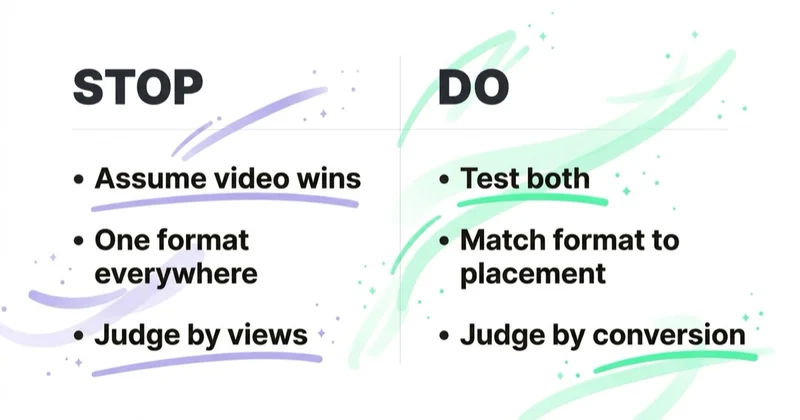
Stop doing / Do instead
| Stop doing | Do instead |
|---|---|
| Assuming video always beats static | Match the format to the message and placement |
| Calling a funnel stage a creative strategy | Define what information the person needs next |
| Comparing an adapted static with a native video | Build credible, placement-native versions of both |
| Counting every asset as a new concept | Separate a new idea from a cosmetic variation |
| Judging on CTR or platform CPA alone | Review qualified outcomes, contribution and total creative cost |
| Reusing one crop everywhere | Check safe zones, captions, type and product visibility per placement |
Common mistakes
Frequent mistakes include changing the concept and format at the same time, comparing unequal budgets, declaring a winner from CTR, ignoring view-through attribution differences and omitting production cost. Teams also resize assets mechanically, leaving interface elements over text or the product outside the crop. A final review should cover the real placement preview, not only the source file.
FAQ
Do static or video ads convert better?
There is no universal winner. Video may be a better vehicle for movement, sequence or explanation; static may communicate one claim or comparison immediately. Test credible executions under comparable conditions and decide from qualified conversion, contribution and total cost.
Is video always better on social media?
No. Social platforms support different objectives, placements and formats, and their capabilities change. Video is central to short-form feeds, but Meta supports mixed formats and TikTok Ads Manager also offers eligible image and carousel formats. Check the placement specifications and test the message rather than following a blanket rule.
When should I use static ads?
Use static when the complete message benefits from being visible at once: a product detail, price, comparison, review, chart or concise proposition. It can be useful in prospecting or retargeting. Confirm that type remains legible, the claim is supportable and the placement accepts the format.
When should I use video ads?
Use video when sequence or movement carries essential information: showing a product in use, explaining a process, answering an objection or presenting a credible person. Make the product and proposition clear early, add captions and ensure the message still works when sound is unavailable.
Is static cheaper than video?
Often, but not always. Template-based static can be inexpensive, while premium photography and design are not. A simple creator video may be inexpensive; a crew, location, talent, edit and usage rights can make video costly. Compare the actual scope and the number of usable variants.
How do I decide the static-to-video ratio?
Do not set a universal ratio. Build enough credible assets to cover the campaign's messages and eligible placements, then review delivery and qualified outcomes. Keep diversity where it adds reach or learning; remove assets that have no distinct role or sufficient evidence.
Key takeaways
- Neither static nor video wins universally; concept, execution and placement shape the result.
- Choose format from the communication job, then adapt it natively to each placement.
- Production economics vary—compare the actual scope, rights and adaptations.
- Test concepts and formats without changing every variable at once.
- Decide from qualified outcomes, contribution and total creative cost, not CTR alone.
Sources and further reading
- Meta for Business — Ad creative formats, placements and creative diversification
- TikTok Business Help Center — Advertising formats and placements in TikTok Ads Manager
- TikTok Business Help Center — Carousel ad specifications
- TikTok Advertising Policies — Ad format, quality and functionality
- Meta Business Help Center — About A/B testing creative
Continue learning
Continue reading
An Ad Creative Testing Framework That Actually Finds Winners
Creative testing should separate finding an ad that can scale from proving why it works. This framework covers hypotheses, controls, randomised experiments, primary metrics, sample size, conversion delay, decision rules, and iteration.
One Creative Won't Fit All: Ad Creative for Meta vs TikTok vs Google
A strong concept can travel across Meta, TikTok, and Google, but the same file may not suit every placement. Learn what to preserve, what to adapt, which specifications matter, and how to test cross-platform creative without relying on stereotypes.

How Many Ad Creatives Do You Need Per Campaign?
The right creative count depends on the platform format, objective, audience, budget and question being tested. Use this framework to plan coverage, testing and refreshes without manufacturing a magic number.