
Franchise marketing is not one funnel. It is usually two systems sharing the same brand.
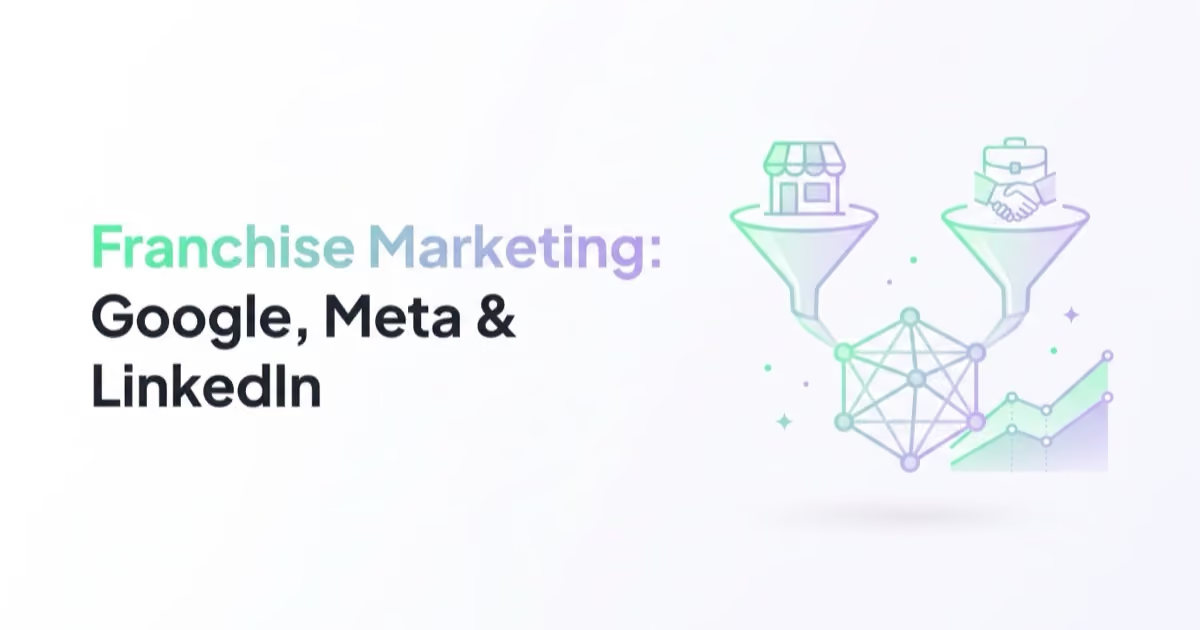
The first system creates consumer demand for existing locations: bookings, calls, online orders, walk-ins, appointments or quote requests in each local market. The second system is franchise development: recruiting people who may invest capital, sign a franchise agreement and operate one or more units. Those two systems have different buyers, different claims, different budgets and different sales cycles. When they are blended into one "lead generation" report, both become harder to manage.
This guide focuses mainly on franchise development, because that is where the phrase "franchise marketing" usually becomes commercially sensitive. A qualified candidate is not a cheap contact. It is a potential owner who fits the capital requirement, territory strategy, timeline and operating model. The campaign is therefore judged by qualified candidates, discovery-day attendance and awarded units, not by form volume.
TL;DR
- Franchise marketing has two funnels. Local consumer demand and franchisee recruitment should have separate budgets, pages, campaigns and reporting.
- Franchise development is a high-value B2B sale. A raw inquiry is only an early signal; the real outcome is an awarded franchise or a serious candidate moving through the development process.
- Compliance shapes the message. Investment, earnings and support claims need to stay aligned with the Franchise Disclosure Document and the franchisor's legal review.
- Google Search captures active ownership intent. Brand, category, investment-level and territory queries need different campaign structures and landing pages.
- LinkedIn fits qualified professional targeting. It is useful for reaching operators, executives, managers and multi-unit candidates when the offer is narrow enough.
- Meta is strongest for discovery and retargeting. It helps explain the concept, show franchisee proof and keep the brand visible during a long decision cycle.
- CRM feedback is the operating system. Offline conversion imports, call outcomes and stage-based reporting prevent ad platforms from optimizing toward weak leads.
The Two Franchise Funnels
The first decision is not channel selection. It is funnel separation.
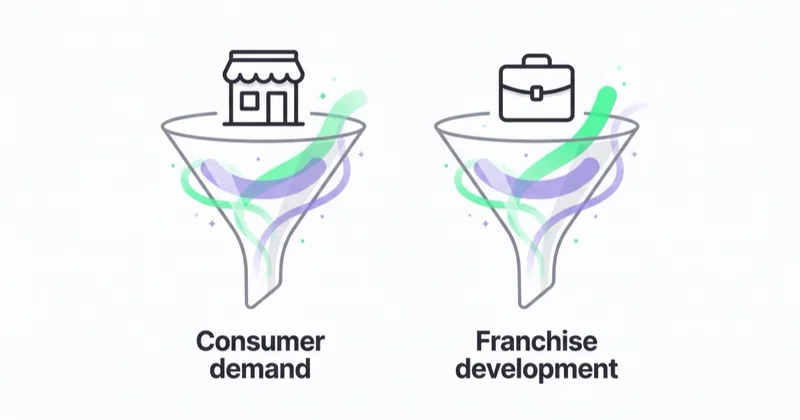
| Area | Local consumer demand | Franchise development |
|---|---|---|
| Audience | Customers near an existing location | Prospective franchisees or multi-unit operators |
| Search behavior | "near me", service, menu, booking, quote, location queries | "franchise opportunity", brand franchise cost, category franchise, territory queries |
| Main pages | Local landing pages, booking pages, ecommerce pages, location pages | Franchise opportunity page, investment page, process page, territory page |
| Primary channels | Google Search, Google Business Profile, Meta, local SEO | Google Search, LinkedIn, Meta, franchise portals, retargeting |
| Measurement | calls, bookings, orders, revenue per location | qualified candidates, FDD requests, discovery days, awarded units |
| Budget owner | brand, co-op fund, local operator or franchisee | franchisor development team |
| Main risk | inconsistent local execution | low-quality leads that consume development time |
The local side behaves like multi-location performance marketing. It needs clean location data, local pages, Google Business Profile management and reporting per market. Google's own local ranking guidance describes relevance, distance and prominence as core local ranking factors, so location quality and brand authority matter alongside paid media.
The franchise-development side behaves more like a long B2B buying journey. A candidate may discover the brand on Meta, search the investment range weeks later, attend a webinar, speak with the development team, review disclosure materials and only then move toward a decision. That journey cannot be optimized from a single top-of-funnel form event.
For related channel architecture, see Google Ads for local businesses and home services and demand generation vs lead generation in B2B.
Compliance And Claim Quality
Franchise marketing sits close to investment decision-making. In the United States, the FTC Franchise Rule requires franchisors to provide prospective franchisees with a disclosure document containing 23 specific items about the offered franchise, its officers and other franchisees. The practical marketing implication is simple: ads and landing pages should not outrun the disclosure materials or the legal review process.
This affects several types of copy:
- expected revenue or profitability;
- payback period and break-even language;
- owner lifestyle and time commitment;
- financing availability;
- territory availability and exclusivity;
- training, support and operating assistance;
- franchisee testimonials and case studies;
- comparisons with competing franchise concepts.
The safest marketing system has a claims library approved by the franchisor's legal or compliance team. Every ad, landing page and nurture email can then draw from approved language instead of inventing new claims for each campaign. If the franchisor uses financial performance representations, the campaign should point candidates toward the appropriate disclosure context rather than compressing complex financial information into an ad line.
Strong franchise marketing does not avoid proof. It uses proof carefully. Better proof includes founder interviews, operator stories, training footage, unit-opening process, territory maps, support infrastructure, brand history, product-market demand and realistic candidate expectations. Weak proof relies on vague independence slogans, lifestyle imagery and income implications that attract unqualified curiosity.
What Makes A Franchise Development Lead Qualified?
Franchise development lead quality is a business definition, not a platform definition. A platform can record a submitted form. It cannot know whether the candidate can fund the investment, operate the unit, fit the territory plan or pass the franchisor's process unless that information is captured and returned.
Useful qualification fields usually include:
| Qualification Area | Why It Matters | Example Field |
|---|---|---|
| Liquid capital | screens financial readiness | available liquid capital range |
| Net worth | supports funding and risk assessment | net worth range |
| Territory | connects demand to expansion priorities | city, state, region or market preference |
| Timeline | distinguishes curiosity from near-term intent | 0-3 months, 3-6 months, 6-12 months |
| Ownership model | clarifies fit | owner-operator, investor, multi-unit operator |
| Industry experience | indicates operating relevance | management, sales, retail, hospitality, home services |
| Funding plan | reveals readiness | self-funded, SBA, partner capital, other financing |
| Contactability | protects sales time | phone validity, email validity, preferred contact window |
Short forms increase volume, but they often hide quality problems. Long forms reduce volume, but they can suppress good candidates who are still researching. The practical middle ground is progressive qualification: capture enough information to route leads, then ask deeper questions during the call, webinar registration, application or nurture sequence.
For franchise-development accounts, the most important metric is not cost per inquiry. It is usually one of these:
- cost per qualified candidate;
- cost per completed introductory call;
- cost per FDD request or disclosure-stage candidate;
- cost per discovery-day attendee;
- cost per awarded unit;
- payback period based on franchise fee and expected royalty stream.
The exact metric depends on sales maturity. Early-stage franchisors may not have enough awarded-unit volume for stable bidding signals, so qualified lead and discovery-day data become intermediate optimization points.
Google Search For Franchise Marketing
Google Search captures people who are already exploring franchise ownership. The key is segmenting intent instead of putting every franchise term into one campaign.
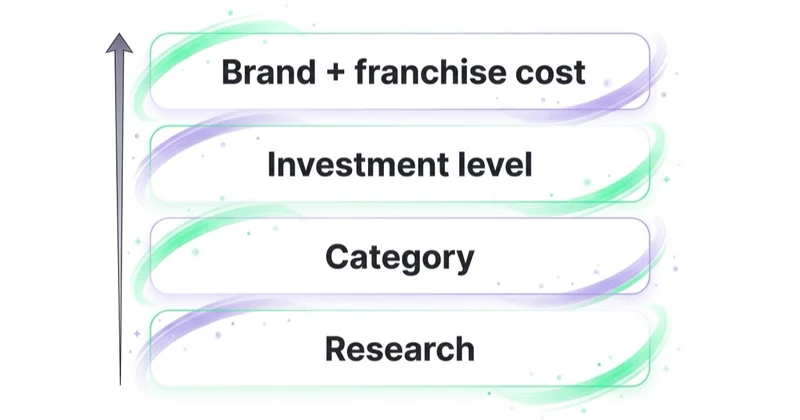
| Intent Type | Example Search Pattern | Better Landing Page |
|---|---|---|
| Brand-specific | brand franchise, brand franchise cost, brand franchise reviews | brand opportunity page with investment range and process |
| Category | fitness franchise, cleaning franchise, home services franchise | positioning, business model, differentiation, qualification |
| Investment level | franchise under a certain investment range, low initial investment franchise | transparent investment framing and candidate fit |
| Territory | franchise opportunities in a state, city or region | market availability, local demand proof, territory process |
| Research | how to buy a franchise, franchise vs starting a business | educational page with soft conversion |
| Comparison | brand vs category alternatives, franchise rankings, franchise costs | proof, model clarity and fair comparison language |
Brand-specific queries usually have the strongest intent. They should be defended because franchise portals, competitors and review sites can intercept candidates who already know the brand. Category and investment-level campaigns can scale, but they need stricter qualification and stronger negative keyword discipline.
Negative keyword work matters because franchise terms attract multiple irrelevant groups: job seekers, students, tax queries, resale buyers, existing franchisees looking for support, complaints research and people looking for free business ideas. The account should separate brand protection from non-brand acquisition so branded demand does not make the whole program look more efficient than it really is.
Search landing pages should answer the questions candidates actually bring to the page:
- What is the investment range?
- Which territories are available?
- Who is the ideal operator?
- What support does the franchisor provide?
- What is the application process?
- What happens before the FDD stage?
- What proof exists from current operators?
- What information requires formal disclosure materials?
The conversion can be an inquiry, a call, a webinar registration, an information-kit request or a scheduled consultation. For higher-investment concepts, a calendar booking often works better after a qualification step, not as the first interaction for every visitor.
LinkedIn For Franchisee Recruitment
LinkedIn is useful when the target franchisee profile can be described professionally. It is not a cheap reach channel. It is a way to reach people whose career history, role, seniority or industry experience suggests a stronger fit.
Common LinkedIn use cases include:
- corporate managers considering business ownership;
- sales leaders or operators with team-management experience;
- multi-unit retail, restaurant or service operators;
- professionals in adjacent industries;
- current business owners who may add another concept;
- webinar and discovery-event promotion;
- retargeting people who visited the franchise opportunity page.
The offer matters. A generic "request information" message is often too weak for LinkedIn costs. Better offers include an operator webinar, a territory availability briefing, a franchise model overview, a comparison guide, a founder-led session or a private candidate call for people who meet the capital threshold.
LinkedIn Conversion Tracking can connect valuable actions to campaigns and supports several data-sharing methods, including website tags and imported conversion data. That matters because the important outcome may not happen on the first website visit. The campaign should distinguish content engagement from qualification, then push stronger downstream events back into reporting where possible.
Meta For Discovery, Proof And Retargeting
Meta is usually not the final decision channel for franchise development. It is strongest when it makes the opportunity understandable, memorable and credible before the candidate begins deeper research.
Good Meta creative for franchise development usually shows:
- the actual product, location, team or service model;
- founder or leadership explanation;
- operator story with approved claims;
- day-in-the-life operational footage;
- training, support and opening process;
- territory and expansion narrative;
- webinar or discovery-event invitation;
- retargeting for people who visited investment and process pages.
Meta lead forms can create volume quickly, but qualification must be built in. Capital range, territory, timeline and ownership model questions are usually more useful than a frictionless form. Retargeting audiences should be segmented by depth: homepage visitor, opportunity-page visitor, investment-page visitor, video viewer, webinar registrant and abandoned form starter.
Creative also needs careful review. Franchise ads can look like career-change or income-opportunity ads if the copy leans too hard into lifestyle, autonomy or earnings. A better angle is business ownership, operating model, support structure and candidate fit, with claims checked against approved materials.
Landing Pages For Franchise Development
A franchise-development landing page has to sell clarity before it sells a call. The visitor is not buying a product; they are evaluating whether the business model deserves serious investigation.
Strong franchise pages usually include:
| Page Element | Purpose |
|---|---|
| Investment range | qualifies candidates and reduces wasted sales time |
| Ideal candidate profile | explains fit beyond enthusiasm |
| Available territories | connects interest to expansion strategy |
| Process timeline | shows what happens after the inquiry |
| Training and support | explains franchisor value without overclaiming |
| Unit model | clarifies staffing, location, equipment and daily operation |
| Approved proof | provides credible evidence without stretching claims |
| FAQ | handles legal, financial and operational questions |
| Compliance note | routes formal financial details to disclosure materials |
| Soft and hard CTAs | supports both researchers and ready candidates |
The page should not be a generic lead form wrapped in franchise language. It should help a serious candidate self-assess. That means some disqualification is good. A page that discourages poor-fit candidates can improve development-team productivity even if the visible form conversion rate falls.
For page structure, internal proof and conversion mechanics, see what a landing page is and how to build one.
CRM Stages And Offline Conversion Imports
Franchise campaigns need stage-based measurement because the sales cycle is too long for platform-reported form fills to tell the truth.
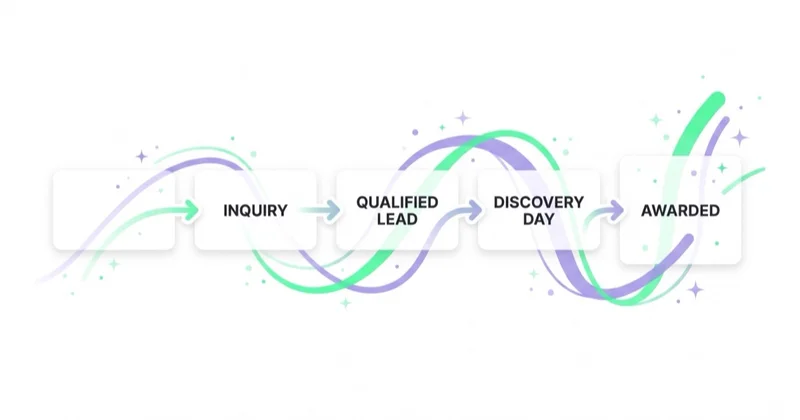
| Stage | Meaning | Platform Use |
|---|---|---|
inquiry |
form, call or lead ad submission | early signal only |
qualified_candidate |
passes capital, territory and timeline screen | stronger optimization signal |
intro_call_completed |
completed a development call | high-intent stage |
application_started |
submitted deeper candidate information | deeper intent |
fdd_requested |
moved toward formal disclosure review | late-stage signal |
discovery_day_attended |
attended a discovery event or visit | very strong signal |
awarded_unit |
agreement signed | true business outcome |
Google Ads offline conversion imports are designed for situations where an ad interaction starts online but the valuable conversion happens later, such as a signed contract. In franchise development, that maps naturally to deeper CRM stages: qualified candidate, discovery-day attendee and awarded unit. Enhanced conversions for leads can also use hashed first-party data to improve measurement accuracy when implemented correctly and with appropriate consent.
Calls deserve the same discipline. Google Ads call reporting can measure calls from call assets and call ads, including duration and connection data. For franchise development, raw call count is not enough; the CRM needs call outcome, candidate fit and next stage.
The operating rule is straightforward: optimize to the deepest reliable signal with enough volume. If awarded units are too sparse for bidding, use qualified candidate or discovery-day data. If qualified candidate definitions are inconsistent, fix the sales process before asking the platform to scale.
Local Consumer Demand For Franchisees
Franchise development recruits operators, but the brand still has to help existing locations generate customers. That local consumer system should not be an afterthought.
Local franchise marketing needs:
- consistent Google Business Profile governance;
- location-level landing pages with accurate NAP data;
- local Search campaigns by market;
- brand and non-brand separation;
- call tracking and booking attribution;
- offer governance so franchisees do not dilute the brand;
- reporting by location, region and ownership group;
- a clear model for co-op budgets and local contributions.
This is where multi-location discipline matters. A national brand can create the media framework, creative standards, tracking rules and reporting model, but local market conditions still differ. New locations may need launch campaigns, mature locations may need margin control, and underperforming markets may need local SEO, reviews, offer testing or sales-process work before increasing media spend.
The consumer funnel and development funnel should share brand strategy, but not the same campaign objective. A location campaign needs customers. A development campaign needs owners.
How Space Ads Approaches Franchise Accounts
At Space Ads, franchise work starts with the economics and the split between the two funnels. The first question is not "which channel should spend more?" It is "which business outcome is this campaign supposed to create?"
For development, that means mapping the unit economics, candidate criteria, territory priorities, CRM stages, call handling and disclosure-safe claims before scaling media. Google Search captures active demand and protects brand intent. LinkedIn reaches professional profiles that may fit the operator model. Meta builds awareness, educates the market and retargets candidates across a long cycle. The CRM decides which of those leads are worth more budget.
For consumer demand, the work is closer to local performance marketing: Google Ads, Google Business Profile, local landing pages, Meta demand creation and location-level reporting. The mistake is forcing both programs into the same cost-per-lead target.
This is why franchise accounts often need both execution and strategic control. A marketing audit can show whether the current spend is producing qualified candidates or just inquiries. Google Ads, Meta Ads and performance marketing cover execution. A fractional CMO engagement can help align development, consumer demand, CRM logic and reporting.
30-Day Optimization Plan
- Separate the two funnels. Isolate consumer-demand campaigns from franchise-development campaigns, budgets, landing pages and reports.
- Define qualified candidate criteria. Agree on capital range, net worth range, territory priority, timeline and ownership model.
- Audit claims and proof. Build an approved message library for investment, support, operator stories and financial references.
- Map CRM stages. Standardize inquiry, qualified candidate, call completed, FDD stage, discovery day and awarded unit.
- Fix measurement. Capture click IDs, lead source, call outcome and first-party identifiers with consent where required.
- Rebuild Search structure. Separate brand, category, investment-level, territory, research and comparison intent.
- Add LinkedIn selectively. Use it for specific candidate profiles, webinars and retargeting rather than broad cheap-lead acquisition.
- Use Meta for education and retargeting. Test approved operator stories, founder video, process explainers and event promotion.
- Review quality weekly. Compare sources by qualified candidate rate, call completion rate and stage progression.
- Review awards quarterly. Tie channel investment to discovery days, awarded units and expected long-term value.
Common Mistakes
| Mistake | Why It Hurts | Better Approach |
|---|---|---|
| Blending consumer and development media | local sales and owner recruitment have different economics | separate campaigns, budgets and dashboards |
| Judging by cost per raw lead | cheap inquiries can waste development time | measure qualified candidates and stage progression |
| Letting platforms optimize to shallow forms | bidding learns the easiest signal | import deeper CRM stages |
| Using vague lifestyle copy | attracts curiosity instead of fit | explain the operating model and candidate criteria |
| Making claims without approved support | creates legal and trust risk | use a reviewed claims library |
| Ignoring branded franchise search | portals and competitors can intercept active candidates | defend brand and measure non-brand separately |
| Treating LinkedIn as cheap lead gen | costs rise without qualification | use high-fit targeting and stronger offers |
| Sending all traffic to one page | different intents need different answers | build pages for brand, territory, investment and research |
FAQ
What is franchise marketing?
Franchise marketing is the set of activities that help a franchise brand grow. It includes consumer marketing for existing locations and franchise development marketing to recruit new franchisees. The two areas should be connected by brand strategy but separated in campaign structure, measurement and landing pages.
What is the difference between franchise marketing and franchise development?
Franchise development is the owner-recruitment side of franchise marketing. It focuses on generating and qualifying prospective franchisees, moving them through the development process and supporting awarded-unit growth. Consumer franchise marketing focuses on customer demand for existing locations.
Which channels work best for franchise development?
Google Search is strong for active ownership intent, especially brand, category, investment and territory queries. LinkedIn can reach professional candidate profiles and promote higher-commitment offers such as webinars or private briefings. Meta is useful for discovery, proof, video storytelling and retargeting during the long consideration cycle.
How should franchise leads be qualified?
Qualification should usually include liquid capital, net worth, territory interest, timeline, ownership model, funding plan and contactability. The exact criteria depend on the franchise model and expansion strategy. A lead is not truly valuable until it can be connected to candidate fit and stage progression.
How should franchise marketing performance be measured?
Raw lead volume is only an early metric. Better measures include cost per qualified candidate, completed introductory call, FDD-stage candidate, discovery-day attendee and awarded unit. Offline conversion imports and CRM feedback are needed because the final award often happens weeks or months after the first ad interaction.
Can franchise ads mention revenue or profit?
Any financial language needs legal and compliance review and should stay aligned with the Franchise Disclosure Document and approved financial performance representations. In practice, many campaigns work better by explaining the investment range, business model, support system and candidate process, then routing detailed financial questions through the formal disclosure path.
Should franchise brands use lead forms or landing pages?
Both can work, but they play different roles. Lead forms reduce friction and can support discovery campaigns. Landing pages provide more context, which is important for high-investment decisions. A strong program often uses landing pages for Search and retargeting, then tests lead forms with qualification questions on Meta or LinkedIn.
How does local franchise marketing fit into this?
Local franchise marketing drives customers to existing units. It uses local Search, Google Business Profile, local SEO, Meta and location pages. It should be measured by calls, bookings, sales or revenue per location, not by franchisee recruitment metrics.
In Short
- Franchise marketing has two jobs: local customer demand and franchisee recruitment.
- Franchise development should be optimized to candidate quality, discovery days and awarded units, not cheap inquiries.
- Google captures active ownership searches, LinkedIn reaches professional profiles, and Meta supports discovery plus retargeting.
- Claims, testimonials and financial language need a controlled review process because franchise decisions involve disclosure and investment risk.
- CRM feedback and offline conversion imports are what turn franchise media from lead volume into a growth system.
Sources
- Federal Trade Commission - Franchise Rule
- Google Ads Help - About offline conversion imports
- Google Ads Help - About call reporting
- LinkedIn Marketing Solutions - Conversion Tracking
- Google Business Profile Help - Improve local ranking on Google
Continue Learning
- Demand generation vs lead generation in B2B
- Google Ads for local businesses, home services and contractors
- Commercial cleaning marketing: B2B lead generation
- Staffing and recruitment agency marketing
- Call tracking for PPC and lead generation
- SaaS paid acquisition on Google and Meta
- Google Ads · Meta Ads · Performance marketing · Marketing audit
Continue reading

Real Estate Development and Property Developer Marketing
Property development marketing coordinates finite inventory, pricing, buyer information, sales capacity and long-cycle demand. This guide covers compliant pre-launch planning, paid media, CRM stages and measurement from enquiry to completion.
Marketing for Financial Services: Compliant Campaigns in a Restricted Category
Financial-services campaigns must satisfy the law in each target market and a separate set of platform rules. This guide explains Google's July 2026 EEA verification expansion, approval workflows, disclosures, measurement and the controls needed to scale without treating compliance as a final check.

B2B Lead Generation: How to Build a Predictable Pipeline From Paid Media and SEO
A predictable B2B pipeline is built from agreed stage definitions, cohort conversion rates and closed-loop feedback—not form volume. Learn how paid media, SEO, landing pages, CRM data and sales follow-up work as one measurable system.


































