A Demand Gen campaign in Google Ads is a visual, AI-powered campaign type designed to create and capture demand across Google visual surfaces such as YouTube, Discover, Gmail, the Google Display Network and other eligible placements. It is not Search, because it does not rely on keywords. It is not Performance Max, because it gives more control over audiences, creative and channel selection. In 2026, Demand Gen is especially important because Google is moving Display Ads into Demand Gen and making it a larger home for visual demand generation.
TL;DR
- Demand Gen replaced Discovery campaigns, but it is now broader. It supports images, video, product feeds, lookalike segments and more channel control.
- Google Display Network is now part of the Demand Gen story. Google announced that Display Ads are migrating to Demand Gen and that the process is expected to continue into 2027.
- Main surfaces include YouTube, Discover, Gmail and GDN. Google also describes Demand Gen as running across visual surfaces including Google Maps.
- It works before active search intent. Search captures demand. Demand Gen helps create interest, consideration and return visits before users search.
- Creative quality is central. Video, images, product feeds, hooks, formats and landing-page fit often decide whether Demand Gen works.
- First-party data matters. Customer lists, remarketing, YouTube engagement, high-value audiences and lookalike segments can make the campaign more precise.
- Do not judge it only by last click. Demand Gen can influence branded search, assisted conversions, remarketing, new users and full-funnel media efficiency.
What a Demand Gen campaign is
Demand Gen is a Google Ads campaign type for generating demand and engagement on visual surfaces. It is designed for people who may not be actively typing a search query yet, but who may be open to discovering a product, service, brand or offer.
That makes it different from Search campaigns.
Search is based on explicit demand: a person searches for something. Demand Gen is based on audience, creative and predicted interest: Google shows visual ads where people browse, watch, discover and return to topics.
Demand Gen can support:
- brand awareness;
- product discovery;
- lead generation;
- ecommerce consideration;
- remarketing;
- product-feed campaigns;
- creator-style video campaigns;
- reactivation of known audiences;
- prospecting from first-party lists.
It sits between social ads, YouTube Ads, Display, Discovery and Performance Max. That is why setup and measurement need more nuance than a simple keyword campaign.
Why Demand Gen matters in 2026
Demand Gen is no longer just the successor to Discovery Ads.
On May 26, 2026, Google announced that Google Display Ads is migrating to Demand Gen. Google said advertisers can now manage Google Display Network presence directly through Demand Gen campaigns and described Demand Gen as driving growth across YouTube and visual surfaces including Discover, Gmail and Google Maps, with channel controls for performance needs.
Google Help documentation also explains that in April 2025, Demand Gen expanded to include image inventory across the Google Display Network, and that channel controls let advertisers control where ads appear across YouTube, Discover, Gmail and GDN.
Practical impact:
- older Display-only planning is becoming less complete;
- Demand Gen should be part of visual campaign architecture;
- channel control is more important;
- creative needs to work across more environments;
- reporting should separate surfaces where possible;
- articles that describe Demand Gen only as YouTube, Discover and Gmail are now outdated.
Where Demand Gen ads can appear
Demand Gen can run across Google visual surfaces. Availability depends on campaign setup, formats, assets, account settings and current rollout.
Common surfaces include:
- YouTube: Shorts, in-stream, in-feed, Home, Watch Next and YouTube Search-related placements where eligible;
- Discover: mobile discovery feed in Google surfaces;
- Gmail: promotional and social-style placements;
- Google Display Network: sites, apps and image inventory when GDN is enabled;
- Google Maps and other visual surfaces where Google makes eligible inventory available.
Channel controls allow advertisers to choose all channels or select a smaller mix. This can be useful when a creative asset is designed for one environment, such as vertical video for Shorts. In many cases, however, broader channel coverage gives the system more room to optimise.
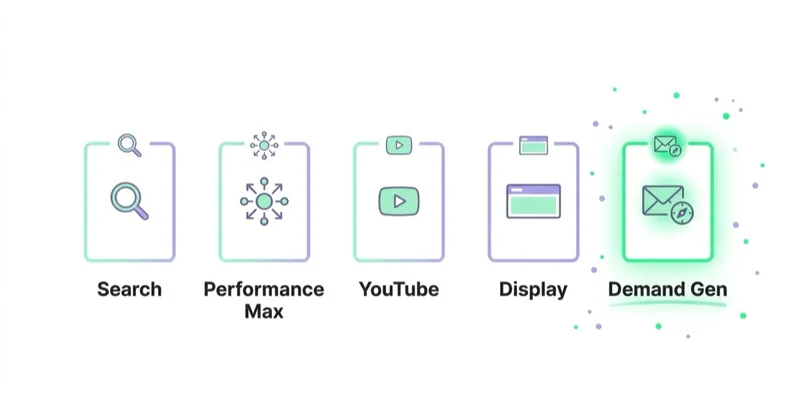
Demand Gen vs Search, Performance Max, YouTube and Display
| Campaign type | Primary role | Main input | Best use |
|---|---|---|---|
| Search | Capture active intent | Keywords, ads, landing pages | Users already searching |
| Demand Gen | Create and convert visual demand | Audiences, creative, first-party data, AI | Discovery, consideration, remarketing, video and image demand |
| Performance Max | Automated cross-channel performance | Assets, feeds, goals, audience signals | Sales and conversion scaling across Google inventory |
| YouTube campaigns | Video reach, views, consideration or conversion | Video creative and audience strategy | Video-first media plans |
| Display | Reach, remarketing and visual placements | Images, placements, audiences | Display-style inventory, now increasingly connected with Demand Gen |
Demand Gen and Performance Max often work together. PMax may close demand across Google channels. Demand Gen can build new demand, warm audiences and add visual influence before a user searches or returns to buy.
When Demand Gen is a good fit
Demand Gen is worth testing when:
- Search and Performance Max are already structured well;
- the account needs new demand, not only more harvesting;
- the brand has good image or video assets;
- first-party audiences are available;
- a product or service benefits from demonstration;
- remarketing needs more visual storytelling;
- YouTube and paid social creatives already exist;
- the team can measure assisted effects and new-user quality.
It is usually a poor first move when:
- conversion tracking is broken;
- there is no budget for learning;
- creative assets are weak or generic;
- the landing page does not match the ad promise;
- Search demand is already underfunded;
- business reporting cannot separate new customers from existing customers;
- the account will judge the campaign only by last-click ROAS after a few days.
Audience strategy and lookalike segments
Demand Gen has a specific role in first-party audience strategy.
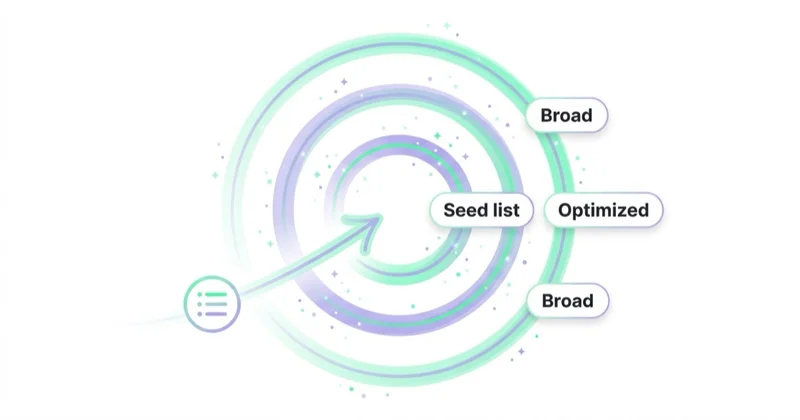
Google Demand Gen documentation includes lookalike segments. These are built from source lists such as customers, website users, app users or YouTube users where eligible. They are not the same as the old Similar Audiences feature that Google removed from many parts of Google Ads.
Good source lists:
- high-LTV customers;
- recent purchasers;
- qualified leads;
- closed-won opportunities;
- subscribers with strong engagement;
- product-category buyers;
- YouTube viewers with meaningful engagement.
Weak source lists:
- all website visitors;
- low-quality form leads;
- giveaway entries;
- old newsletter contacts with no engagement;
- mixed lists with no business meaning.
The quality of the source list affects the quality of the lookalike logic. A Demand Gen lookalike built from best customers is usually more useful than one built from every low-intent visitor.
Creative strategy for Demand Gen
Demand Gen is creative-sensitive. A campaign with strong audience logic and weak assets will usually underperform.
Useful asset types:
- vertical video for Shorts-style consumption;
- horizontal video for longer YouTube contexts;
- square and portrait images;
- product images;
- carousel-style assets;
- product feeds where relevant;
- strong headlines and descriptions;
- logos and brand elements.
Good Demand Gen creative usually does one of these jobs:
- show the product in use;
- explain a problem quickly;
- compare before and after;
- demonstrate a transformation;
- provide social proof;
- educate the audience before Search intent exists;
- re-engage users who already know the brand;
- turn paid social creative into Google visual inventory.
One generic image is rarely enough. Demand Gen needs concepts, not only assets.
Product feeds and ecommerce
For ecommerce, Demand Gen can use product feeds and shoppable creative where supported. This makes it useful for:
- product discovery;
- new collection launches;
- category education;
- seasonal promotions;
- remarketing with product context;
- video or image creative connected with feed products;
- lookalikes from high-value customers.
But Demand Gen is not a direct replacement for Shopping or Performance Max.
Ecommerce checklist:
- Merchant Center feed is clean;
- product availability and prices are correct;
- landing pages match ad promises;
- purchase value and currency are tracked;
- enhanced conversions are configured where appropriate;
- new customer and existing customer reporting is separated;
- margin and return rate are considered;
- creatives show the product in real context.
Demand Gen can generate strong interest, but the store still has to convert it profitably.
Lead generation and B2B use cases
Demand Gen can also work outside ecommerce.
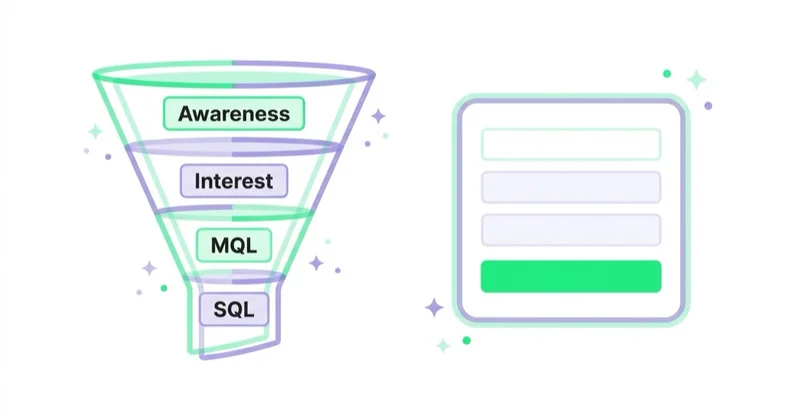
For B2B, education, SaaS and services, it can support:
- awareness before search demand exists;
- webinar or event promotion;
- report or guide downloads;
- demo-request remarketing;
- founder or expert video distribution;
- problem education;
- re-engagement of CRM audiences;
- nurture around high-value categories.
Lead-gen teams should avoid judging Demand Gen only by form volume. The better metrics are qualified leads, booked calls, attended demos, opportunity quality and eventual revenue.
If a campaign drives cheap leads that sales rejects, the creative or audience signal is wrong.
Bidding and budget
Demand Gen can use conversion-focused bidding strategies such as maximise conversions, target CPA or maximise conversion value where supported. The right choice depends on the role of the campaign and data volume.
Practical guidance:
- use realistic budgets for the learning period;
- avoid aggressive target CPA or target ROAS too early;
- do not change bids and assets every day;
- separate prospecting and remarketing if business logic requires it;
- use value-based bidding only when conversion values are reliable;
- compare results by surface and creative before cutting budget.
Google documentation for creating Demand Gen campaigns includes budget recommendations for target CPA, including a recommendation that daily budget should be at least 15 times the target CPA in relevant setups. The exact budget should still be adjusted to account size, conversion volume and business risk.
How to launch Demand Gen step by step
1. Define the campaign role
Choose one primary role:
- prospecting;
- remarketing;
- product launch;
- brand consideration;
- lead generation;
- ecommerce category push;
- video demand generation;
- customer reactivation.
A mixed role usually creates mixed signals.
2. Validate measurement
Before launch, check:
- Google Ads conversion actions;
- GA4 and Google Ads linking;
- enhanced conversions;
- Consent Mode where relevant;
- values and currencies;
- lead-quality import if lead generation;
- new customer reporting if ecommerce;
- backend comparison.
3. Prepare audiences
Use first-party lists where possible:
- customers;
- qualified leads;
- website users;
- app users;
- YouTube users;
- remarketing lists;
- excluded converters;
- high-value segments.
4. Build creative sets
Prepare multiple concepts, not one design in different sizes.
Minimum useful mix:
- product or service demonstration;
- problem-solution concept;
- proof or testimonial concept;
- education or comparison concept;
- remarketing-specific concept.
5. Choose channels intentionally
Use all channels when the assets are flexible and the goal is scale. Restrict channels when there is a clear creative, brand-safety or test reason.
6. Launch with a test window
Let the campaign collect data before heavy changes. Review early diagnostics, but judge business results over a realistic window.
7. Analyse beyond last click
Review:
- direct conversions;
- view-through conversions;
- assisted conversions;
- branded search movement;
- new users;
- remarketing pool growth;
- channel split;
- creative-level results;
- downstream lead or sales quality.
How we approach this at Space Ads
In practice Demand Gen works best as one piece of a wider Google Ads setup. The starting question is rarely "should we run Demand Gen?"; it's what the account is actually missing — new demand, remarketing, scale, video creative, first-party lists, or backup for Performance Max. We weigh it alongside Search, PMax, YouTube, remarketing, Merchant Center and GA4, so budget moves on a campaign's role across the whole journey rather than on one report read in isolation. A campaign that looks weak on last click may be opening the demand that Search later closes, which is exactly why we judge it in context and never on its own.
Common mistakes
| Mistake | Why it hurts | Better approach |
|---|---|---|
| Treating Demand Gen as old Discovery | Misses GDN, channel controls and newer inventory | Plan around the 2026 feature set |
| Using one weak creative | The campaign has little to learn from | Build multiple concepts and formats |
| Judging only last-click ROAS | Understates upper and mid-funnel value | Measure assisted demand and branded search |
| No first-party audiences | Prospecting starts with weak signals | Use customer, CRM and remarketing lists |
| Confusing Demand Gen with PMax | The roles are different | Use Demand Gen for visual demand and PMax for broader automation |
| Over-restricting channels | Limits learning and delivery | Restrict only with a clear reason |
| No feed hygiene in ecommerce | Product ads cannot compensate for bad data | Fix Merchant Center and landing pages |
| Optimising leads without quality feedback | Cheap leads can look successful | Import qualified leads or revenue stages |
FAQ
What is a Demand Gen campaign in Google Ads?
Demand Gen is a campaign type for generating and converting demand across Google visual surfaces such as YouTube, Discover, Gmail, GDN and other eligible placements.
Did Demand Gen replace Discovery campaigns?
Yes. Demand Gen replaced Discovery campaigns, but in 2026 it is broader than Discovery because it includes more visual inventory, channel controls, video, image assets, product feeds and GDN integration.
Is Demand Gen replacing Display campaigns?
Google announced that Google Display Ads is migrating to Demand Gen. The transition makes Demand Gen a larger home for visual and display-style campaign management, with the migration continuing into 2027.
What is the difference between Demand Gen and Performance Max?
Performance Max is broader and more automated across Google inventory. Demand Gen is more focused on visual demand generation, creative, audiences, lookalikes and channel control.
Does Demand Gen use keywords?
No. Demand Gen does not operate like Search campaigns. It uses audiences, creative, signals, product feeds, AI and conversion goals.
Does Demand Gen work for B2B?
Yes, when the creative and measurement are built for B2B. It can support awareness, education, webinars, reports, demo remarketing and CRM audience reactivation. Lead quality should be measured, not only form volume.
Does Demand Gen need video?
Not always. Demand Gen can use images and other assets. In practice, video usually expands creative options, especially across YouTube and Shorts-style environments.
How should Demand Gen be measured?
Use direct conversions, assisted conversions, view-through conversions, branded search movement, new-user quality, lead quality, revenue and channel-level reporting. Last-click alone is usually too narrow.
Key takeaways
Demand Gen is now a major Google Ads campaign type for visual demand generation. It should be planned as more than a Discovery replacement, especially after the Google Display Network integration and the 2026 announcement that Display Ads are moving into Demand Gen.
The strongest setups combine good creative, clean measurement, first-party audiences, intentional channel controls and business-level reporting. Demand Gen should not be used to replace Search demand capture. It should create and warm demand that Search, Performance Max, remarketing and sales processes can later convert.
Sources and further reading
- Google Ads Help - About Demand Gen campaigns
- Google Ads Help - Create a Demand Gen campaign
- Google Ads Help - Channel controls in Demand Gen campaigns
- Google Ads Help - Google Display Network integration with Demand Gen
- Google Ads Help - Demand Gen asset specs and best practices
- Google Blog - Google Display Ads is migrating to Demand Gen
- Space Ads - Google Ads service
Continue learning
Continue reading

Gemini Ad Formats: When the Ad Is Generated, Not Written
Google is testing and announcing Gemini-powered ad experiences across AI Mode and Search. Learn what each format does, what remains uncertain and how to prepare data, content and measurement.

Google Ads Experiments: Testing That Produces a Decision
A useful Google Ads experiment starts with a decision, an effect worth detecting and enough statistical power. Learn how to choose the test, split, metric and interpretation.

Google Ads Account Suspended: Why It Happens and What to Do
A Google Ads suspension requires evidence, not panic. Learn how suspension differs from a hold or pause, what the strike system covers and how to diagnose and appeal safely.