Marketing Mix Modeling has moved from boardroom research projects into the practical measurement stack of mid-market brands. For years, MMM sounded like something reserved for FMCG groups, TV-heavy advertisers and large media agencies. In 2026, that is changing. Google has made Meridian available as an open-source MMM framework, Meta continues to support Robyn, and privacy changes have made user-level attribution less reliable.
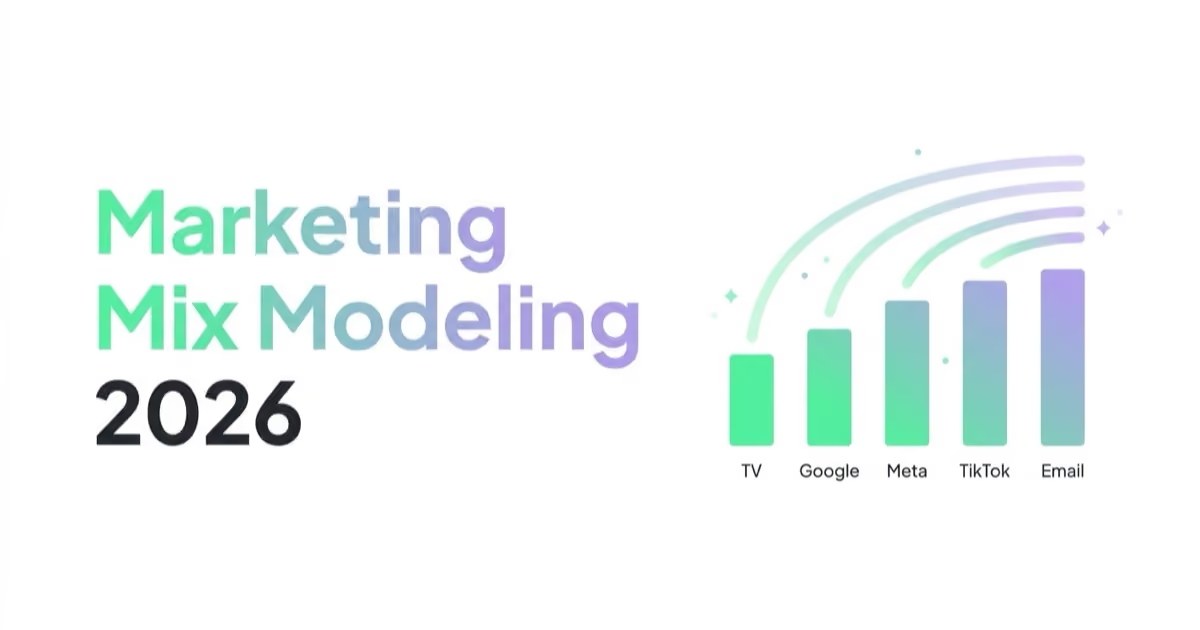
Marketing Mix Modeling, or MMM, is a statistical method that estimates how media channels, promotions, pricing, seasonality and external factors contribute to business outcomes such as revenue, margin or qualified leads. It is not a replacement for campaign reporting. It is a decision model for budget allocation.
For brands spending across Google, Meta, TikTok, marketplaces, email, SEO, retail media and offline activity, MMM can answer a question that platform dashboards cannot: which channels are actually moving the business, and where is the next budget increase likely to create marginal growth?
TL;DR
- Marketing Mix Modeling estimates how marketing channels and business factors influence outcomes over time.
- MMM works with aggregated data, so it is more privacy-resilient than user-level tracking based on cookies or device identifiers.
- Google Meridian is an open-source MMM framework made broadly available in 2025 and designed for modern media measurement.
- Meta Robyn is an open-source, semi-automated MMM package from Meta Marketing Science.
- MMM is strongest when combined with incrementality testing, geo experiments and business context.
- It needs clean data: spend, impressions, sales, seasonality, promotions, prices, stock and other control variables.
- It is not useful for every business. One-channel accounts, unstable tracking and tiny budgets should start with simpler measurement first.
- The output should be decisions: budget shifts, saturation points, marginal ROI and test priorities.
What Is Marketing Mix Modeling?
Marketing Mix Modeling is a statistical analysis of how marketing activity and business conditions affect a KPI over time. The KPI can be:
- revenue,
- contribution margin,
- orders,
- qualified leads,
- subscriptions,
- store visits,
- pipeline,
- app installs.
The model looks at aggregated time-series data rather than individual user journeys. It tries to estimate the relationship between inputs and outcomes.
Typical inputs include:
- media spend by channel,
- impressions, reach or clicks,
- pricing changes,
- promotions,
- discounts,
- seasonality,
- holidays,
- stock availability,
- competitor or category demand proxies,
- offline activity,
- regional data if available.
MMM usually models two important advertising effects:
- Adstock: media impact can continue after the spend occurs.
- Saturation: each channel has diminishing returns after a certain level of spend.
These two effects make MMM useful for planning. A platform can show a strong average ROAS, while MMM may show that the next additional dollar in that channel has weak marginal return.
Why MMM Is Back
Three forces pushed MMM back into relevance.
First, user-level tracking is less complete. Consent requirements, browser limits, iOS privacy changes and cookie restrictions all make deterministic attribution weaker.
Second, media buying is more automated. Performance Max, Advantage+, AI Max and marketplace algorithms decide more of the delivery. That makes manual interpretation of campaign-level attribution harder.
Third, platform dashboards are not neutral. Google, Meta, TikTok, Microsoft and marketplace retail media each measure the world from their own perspective. They can all claim credit for the same conversion path.
MMM does not solve every measurement problem, but it gives leadership a different layer: a business-level view of how spend, timing and market conditions relate to outcomes.
Google Meridian
Google Meridian is an open-source Marketing Mix Modeling framework from Google. Google describes it as a modern MMM built for privacy-durable measurement, transparency, actionability and budget planning.
Important Meridian features include:
- open-source code and methodology;
- Bayesian causal inference approach;
- support for geo-level data where available;
- ability to incorporate incrementality experiments as priors;
- stronger handling of performance media and search-related measurement;
- reach and frequency modelling for video;
- scenario planning and budget optimisation workflows;
- documentation, Colab examples and GitHub distribution.
Meridian is especially relevant for advertisers with significant Google Ads, YouTube, Search, Shopping and Performance Max activity. Google also highlights the role of Google media data and query-volume signals in improving lower-funnel measurement.
The practical caveat: Meridian is not a plug-and-play dashboard for marketers with no data support. The GitHub repository points to Python requirements and recommends GPU support for faster modelling. Most teams need an analyst, data scientist or measurement partner to make it useful.
Meta Robyn
Robyn is an open-source MMM package from Meta Marketing Science. Meta describes it as experimental, AI/ML-powered, open-sourced and semi-automated.
Robyn is popular because it helps package MMM into a more accessible workflow:
- ridge regression,
- hyperparameter optimisation,
- time-series decomposition,
- adstock and saturation curves,
- model selection,
- budget allocation,
- visual outputs.
Robyn can be a practical starting point for teams with R, analytics or BI capability. It can also help agencies build repeatable MMM pilots without creating every model from scratch.
The caveat is similar: automation does not remove responsibility. Robyn still requires clean data, reasonable assumptions, model review, business context and validation against reality.
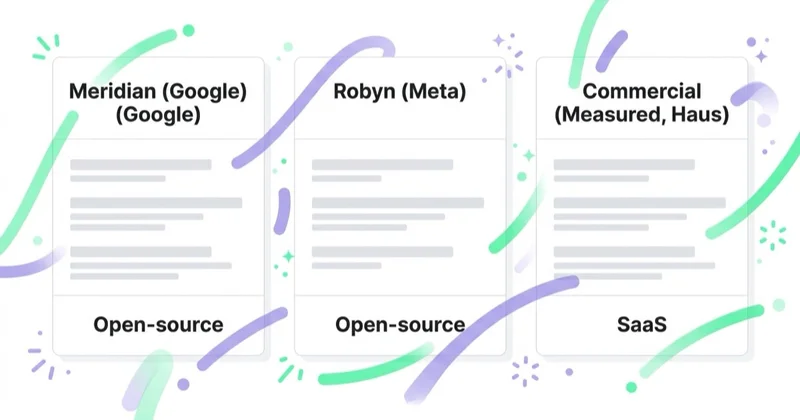
Meridian vs Robyn vs Commercial Tools
| Area | Google Meridian | Meta Robyn | Commercial MMM tools |
|---|---|---|---|
| Type | Open-source framework | Open-source package | Platform or managed service |
| Main ecosystem | Python / Google measurement | R / Meta Marketing Science | Vendor-dependent |
| Strength | Modern Google media, Bayesian approach, experiment calibration | Semi-automation, accessibility, community | UI, support, integrations, recurring workflow |
| Requirement | Technical modelling capability | Analytics capability and review | Budget and vendor fit |
| Risk | Complexity | Over-trusting automation | Black-box decisions and lock-in |
The right choice depends on the decision. Meridian is a natural candidate when Google media and YouTube are central. Robyn is a strong starting point for internal analytics teams exploring MMM. Commercial tools make sense when a company wants operational support, dashboards and recurring recommendations.
What Data Is Needed?
A useful MMM pilot needs more than ad spend and revenue.
Minimum dataset:
- daily or weekly KPI data;
- media spend by channel;
- media exposure metrics where available;
- campaign or channel grouping;
- promotions and discount periods;
- price changes;
- stock or availability issues;
- holidays and seasonality;
- major website or tracking changes;
- offline activity;
- regional data if geo modelling is planned;
- results from lift tests or geo experiments if available.
The model learns from variation. If a channel spent the same amount every week for two years, it is harder to estimate its impact. Budget changes, experiments, seasonality and regional differences make the model more informative.
When MMM Makes Sense
MMM is worth considering when:
- the brand spends across several channels;
- budget allocation decisions are meaningful;
- there is at least several months of reliable historical data, ideally more;
- revenue, margin or qualified lead data is available;
- media spend changes over time;
- leadership needs a business-level answer, not only platform ROAS;
- the company can act on recommendations.
Typical use cases:
- Google vs Meta vs TikTok budget allocation;
- YouTube impact on future search demand;
- brand search incrementality;
- marketplace ads vs direct store sales;
- Black Friday budget planning;
- retail media evaluation;
- online plus offline media mix;
- presenting marketing investment to finance.
For marketplace and search-heavy brands, MMM can be combined with Allegro Ads, Google Shopping, Performance Max and Microsoft Ads analysis.
MMM And Incrementality Testing
MMM and incrementality testing should work together.
Incrementality experiments provide stronger causal evidence, but they usually test a defined channel, campaign, region or time period. MMM gives a broader view across the media mix, but it is still a model. Combining both creates a better measurement loop:
- Run a lift test or geo experiment.
- Use the result to calibrate MMM assumptions.
- Use MMM to simulate budget allocation.
- Test the recommended change.
- Refresh the model with new data.
This is why incrementality testing and geo experiments are becoming part of the same measurement conversation as MMM.
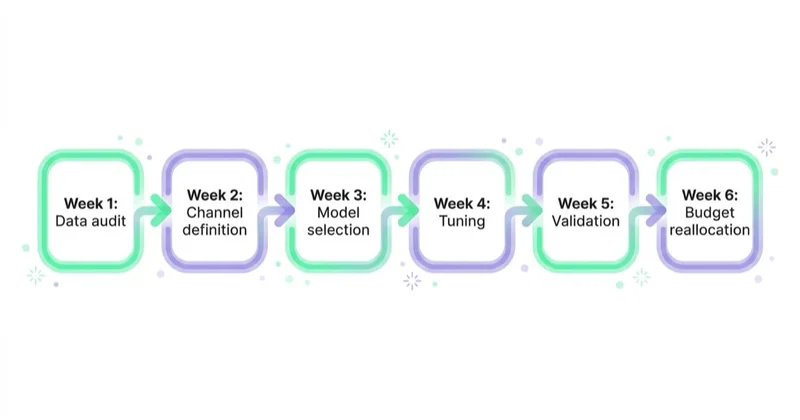
A 6-Week MMM Pilot Roadmap
Week 1: Define The Decision
Start with the business decision. Examples: Q4 budget split, YouTube investment, Meta scaling, brand search reduction, marketplace incrementality or retail media planning.
Week 2: Audit Data
Check completeness, date ranges, missing values, tracking changes, promotions, stockouts, pricing changes and channel naming.
Week 3: Build The Dataset
Create a single modelling table with date, KPI, media variables, costs and control variables. This is often the most time-consuming step.
Week 4: Run The First Model
The first model is for diagnosis. Review whether outputs make business sense, whether channels are too correlated and whether seasonality is absorbing too much effect.
Week 5: Calibrate And Interpret
Use incrementality results where available. If no experiments exist, compare model outputs with historical business knowledge and known campaign changes.
Week 6: Scenario Planning
Translate the model into budget scenarios. Examples: shift 15% from saturated remarketing into prospecting, reduce over-credited brand search, increase YouTube only if search demand lifts, or separate marketplace budgets by SKU margin.
When Not To Use MMM
MMM is not always the right next step.
Avoid it when:
- there is only one major channel;
- the business has very little historical data;
- tracking has changed repeatedly;
- promotions and pricing are undocumented;
- budget is too small for recommendations to matter;
- there is no analyst or partner to interpret the model;
- leadership expects one exact truth rather than a range of estimates.
In those cases, start with better GA4, CRM hygiene, UTM discipline, server-side tagging, blended MER and simpler holdout tests.
How we approach this at Space Ads
MMM matters to us because it settles the question every dashboard argues over: what actually drove the result. We don't take last click from one source as the whole truth; we connect platform data with business numbers daily, so budget calls hold up. A full MMM is usually overkill for mid-market, though — it wants years of data and real volume. More often we run the MMM way of thinking, asking whether a given spend genuinely adds to sales or just collects conversions that would have happened anyway, and confirm it with lighter methods like incrementality tests or holdouts. The model is only a tool; the goal is knowing which budget is working, not which one photographs well in a report.
FAQ
What is Marketing Mix Modeling?
Marketing Mix Modeling is a statistical method that estimates how marketing channels and business factors influence outcomes such as revenue, margin or leads over time.
Is MMM privacy-safe?
MMM uses aggregated data rather than individual user-level tracking. That makes it more resilient in privacy-constrained environments, although data governance still matters.
Is Google Meridian free?
Meridian is open-source, but an MMM project is not free in practice. Data preparation, modelling, interpretation and decision-making require time and expertise.
What is Meta Robyn?
Robyn is an open-source, semi-automated MMM package from Meta Marketing Science. It helps teams build and evaluate marketing mix models.
Does MMM replace GA4?
No. GA4 is useful for operational analytics and path reporting. MMM is useful for higher-level budget and media mix decisions.
How much data is needed?
More stable history is better. A practical pilot usually needs months of data, and many stronger models use one to three years depending on seasonality and business complexity.
Key Takeaways
Marketing Mix Modeling is becoming practical for more brands because open-source tools lowered the barrier and privacy changes weakened classic attribution. The goal is not to create a beautiful model. The goal is better budget decisions.
Meridian and Robyn both make MMM more accessible, but neither removes the need for clean data, critical review and business interpretation. The strongest measurement systems combine MMM, incrementality testing and operational tracking.
Sources and further reading
- Google Ads & Commerce Blog: Meridian is now available to everyone
- Google for Developers: Meridian
- GitHub: google/meridian
- Google Ads & Commerce Blog: Meridian GeoX and Meridian Studio
- GitHub: facebookexperimental/Robyn
- Robyn documentation
- arXiv: Packaging Up Media Mix Modeling
- Google Cloud Cortex Framework for Meridian
Continue Learning
Continue reading

Marketing Attribution for Executives: Why Your Dashboards Disagree
Marketing attribution assigns conversion credit to touchpoints; it does not prove which channel caused the outcome. This guide shows executives how to use last-click, data-driven attribution, incrementality, and MMM for different decisions.
ChatGPT Ad Formats and Character Limits: What Actually Fits
A ChatGPT ad appears below the response and carries six elements, with specific limits: title 3–50 characters, body up to 100. The "24 / 48 character" figures in trade coverage do not match the documentation, so this guide gives the full limits table, shows how to fit a useful message, and covers the image, product ads and end-to-end consistency with the landing page.

OpenAI Ads Manager: How to Set Up Your First ChatGPT Ads Campaign
OpenAI Ads Manager has three campaign levels, but launch also requires advertiser verification, billing, landing-page checks, measurement and deliberate choices for settings that cannot be changed later. This guide covers the setup sequence, budgets, context hints, oCPC, targeting, review and Ads API workflows.