A sales funnel is a model that describes how people move from first contact with a brand to purchase, repeat purchase, referral or long-term customer value. It helps organise content, advertising, sales activity and measurement around the stage of decision-making a person is in.
The funnel is useful, but it should not be treated as a literal map of human behaviour. Real journeys are not perfectly linear. People compare options, leave, return, ask questions, switch devices, watch reviews, open emails, click ads and sometimes convert weeks later. A good funnel model accepts that complexity and still gives the team a practical structure for planning and optimisation.
In 2026, the strongest sales funnels combine classic stage planning with evidence from analytics, CRM data, customer research and channel performance. The goal is not to force every user through one path. The goal is to remove friction and provide the right information at the right decision moment.
TL;DR
- A sales funnel organises the journey from awareness to purchase, retention and advocacy.
- Real customer journeys are non-linear, but funnel thinking is still useful for planning.
- Each stage needs a different message, offer, channel and KPI.
- Top-of-funnel activity builds demand and category awareness.
- Middle-of-funnel content helps people compare options and reduce risk.
- Bottom-of-funnel activity turns intent into an action, such as a purchase, enquiry or signup.
- Retention and loyalty should be part of the funnel, not an afterthought.
- Funnel performance should be measured by stage transitions, drop-off and business quality, not only final conversions.
- In GA4, funnel explorations and key events can help diagnose where users succeed or abandon a task.
- A good funnel connects marketing, sales, analytics and customer experience.
What is a sales funnel?
A sales funnel is a strategic model for understanding how potential customers become customers. It is called a funnel because the number of people usually narrows at each step: many people may become aware of a brand, fewer will consider it, fewer will request a quote or add to cart, and fewer still will buy.
The funnel can describe:
- ecommerce purchases;
- lead generation;
- SaaS trials;
- consultation bookings;
- demo requests;
- marketplace transactions;
- subscriptions;
- renewals;
- referrals.
The model is not only for advertising. It affects landing pages, SEO, email, sales calls, onboarding, customer support, product information and reporting.
Sales funnel vs marketing funnel
The terms are often used interchangeably, but there is a useful distinction.
A marketing funnel usually focuses on awareness, interest, education and demand creation. It answers questions such as:
- How do people discover the category?
- How does the brand become familiar?
- What content helps people understand the problem?
- Which channels create qualified attention?
A sales funnel usually focuses more on evaluation, intent, conversion and revenue. It answers questions such as:
- What makes people request a quote?
- What blocks checkout?
- Which leads become opportunities?
- Which opportunities become customers?
In practice, the two should be connected. A blog article, YouTube video or LinkedIn campaign may create demand long before a search ad or sales call captures it. Treating marketing and sales as separate worlds usually creates gaps in the customer journey.
The main stages of a sales funnel
Different companies name funnel stages differently. A practical model includes five stages: awareness, interest, consideration, decision and loyalty.
1. Awareness
At the awareness stage, the audience becomes aware of a problem, need, category or brand. The person may not be ready to buy. The goal is to be visible, useful and memorable.
Useful channels and formats:
- SEO content;
- educational blog posts;
- YouTube videos;
- short-form social content;
- PR;
- podcasts;
- demand generation campaigns;
- display and video campaigns;
- reports and trend articles.
Good awareness content is not a sales pitch. It explains the problem, gives context and earns attention.
For paid awareness planning, see Demand Gen campaigns and brand marketing.
2. Interest
At the interest stage, people start looking for more information. They may be trying to understand possible solutions, common mistakes, costs, timelines or implementation requirements.
Useful formats:
- guides;
- checklists;
- beginner explainers;
- webinars;
- newsletters;
- calculators;
- comparison frameworks;
- short educational videos.
The role of this stage is to convert attention into informed interest. The message should make the next step feel logical, not forced.
3. Consideration
At the consideration stage, people compare providers, products, approaches and risks. They need proof, detail and reassurance.
Useful formats:
- case studies;
- customer stories;
- demos;
- product comparisons;
- service pages;
- pricing context;
- implementation guides;
- FAQ pages;
- testimonials and reviews;
- objection-handling content.
The biggest mistake at this stage is being too vague. People need enough information to understand whether the offer fits their situation.
4. Decision
At the decision stage, the user is close to acting. The action can be a purchase, lead form submission, booking, trial signup, checkout, phone call or demo request.
Useful channels and assets:
- search campaigns;
- brand campaigns;
- remarketing;
- landing pages;
- pricing pages;
- product pages;
- checkout;
- sales emails;
- proposal documents;
- chat or sales support.
The job here is to reduce friction. The offer, price, terms, delivery, guarantee, proof and next step should be clear.
For direct campaign planning, see sales campaigns and Google Ads audits.
5. Loyalty and advocacy
The funnel does not end at purchase. Retention often determines profitability, especially in ecommerce, SaaS, B2B services and subscription businesses.
Useful actions:
- onboarding;
- post-purchase email;
- product education;
- customer support;
- renewal campaigns;
- replenishment reminders;
- loyalty programmes;
- cross-sell and upsell;
- referral requests;
- review requests.
Retention should be measured separately from acquisition. A business can acquire many new customers and still lose money if repeat purchase, retention or customer value is weak.
TOFU, MOFU and BOFU
Another common way to describe the funnel is TOFU, MOFU and BOFU.
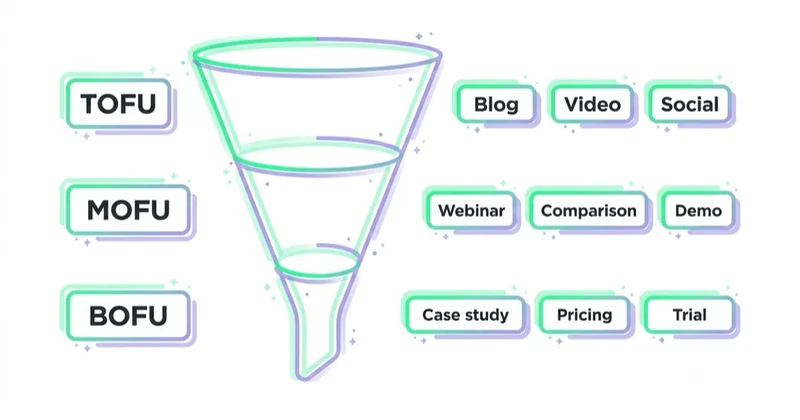
| Stage | Meaning | User mindset | Content examples |
|---|---|---|---|
| TOFU | Top of funnel | What is the problem? What options exist? | Educational articles, videos, guides, trend content |
| MOFU | Middle of funnel | Which approach or provider makes sense? | Comparisons, case studies, webinars, checklists |
| BOFU | Bottom of funnel | Why this offer, and why now? | Pricing, demos, reviews, consultations, product pages |
The mistake is using BOFU messaging everywhere. A person who is still learning the category may ignore a hard sales CTA. Equally, a person ready to buy may be frustrated by another broad educational article instead of clear next steps.
AIDA and the sales funnel
The AIDA model, attention, interest, desire and action, overlaps with funnel thinking. It is useful for copywriting and campaign structure:
- Attention: make the message noticeable and relevant.
- Interest: show why the topic matters.
- Desire: build preference with benefits, proof and fit.
- Action: make the next step clear and low-friction.
AIDA is not a full analytics model, but it is helpful when writing landing pages, ads, emails and product messages. For a deeper explanation, see the AIDA model in marketing.
Why the funnel is not linear
People rarely move neatly from one stage to the next. Research journeys are messy. A user may see a video, search for reviews, visit a competitor, return through a brand ad, ask a colleague, read an article and then buy directly.
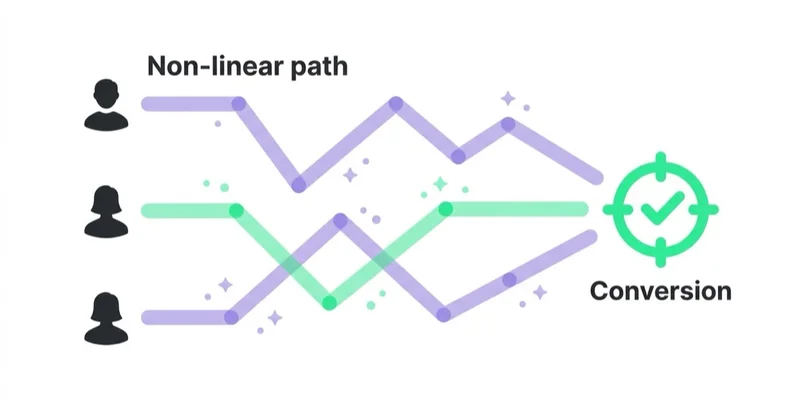
Google's "messy middle" research describes the space between trigger and purchase where people move between exploration and evaluation. This is why funnel strategy should not overvalue only the last click.
Practical implications:
- keep brand presence active while people research;
- answer comparison and objection questions clearly;
- make proof easy to find;
- use remarketing carefully to support, not pressure;
- measure assisted touchpoints where possible;
- avoid judging awareness activity only by immediate sales.
The funnel is a planning model. The customer journey is the reality. Strategy needs both.
How to map a sales funnel
Use this process to build a practical funnel.
1. Define the business goal
Start with the outcome that matters:
- purchase;
- qualified lead;
- demo request;
- trial signup;
- booking;
- subscription renewal;
- repeat purchase;
- referral.
Without a clear goal, the funnel becomes a diagram rather than a management tool.
2. List the decision stages
Map what a person needs to know before taking action:
- problem recognition;
- solution awareness;
- category education;
- provider comparison;
- risk reduction;
- final action;
- onboarding;
- repeat decision.
The stages should reflect how customers actually decide, not only how the company is organised internally.
3. Assign content and channels to each stage
For each stage, define:
- main user question;
- primary content asset;
- channel;
- CTA;
- KPI;
- owner.
Example:
| Stage | User question | Asset | KPI |
|---|---|---|---|
| Awareness | What is the problem? | Educational guide | Qualified visits, engagement |
| Interest | What are the options? | Checklist or webinar | Signup, return visits |
| Consideration | Which provider is credible? | Case study | Demo clicks, sales-qualified leads |
| Decision | What happens next? | Landing page or quote form | Conversion rate, cost per lead |
| Loyalty | How to get more value? | Onboarding email | Retention, repeat purchase |
4. Define events and conversions
Measurement should include macro conversions and micro conversions.
Macro conversions:
- purchase;
- lead form;
- booked call;
- trial signup;
- contract request.
Micro conversions:
- product view;
- add to cart;
- checkout start;
- guide download;
- video completion;
- pricing page view;
- webinar registration;
- email click;
- account creation.
In GA4, important actions can be marked as key events, and funnel explorations can show how users move through defined steps. The key is to track actions that reflect real progress, not every minor click.
5. Find drop-off and friction
The most valuable funnel work often happens at the transitions:
- traffic to engaged visitor;
- engaged visitor to lead;
- product view to cart;
- cart to checkout;
- checkout to purchase;
- lead to qualified opportunity;
- opportunity to customer;
- customer to repeat purchase.
Each drop-off needs diagnosis. The issue may be messaging, price, trust, page speed, form complexity, weak targeting, poor traffic quality, missing proof or operational constraints.
Sales funnel in ecommerce
A typical ecommerce funnel may include:
- Landing page or category entry.
- Category view.
- Product view.
- Add to cart.
- Cart view.
- Checkout start.
- Delivery and payment selection.
- Purchase.
- Post-purchase email.
- Repeat purchase or loyalty action.
Each step has different friction:
- category: weak filters or unclear navigation;
- product page: missing photos, delivery details or size information;
- cart: hidden costs or unclear free shipping threshold;
- checkout: long forms or limited payment options;
- post-purchase: no retention communication.
Ecommerce funnels should be measured by revenue, margin, new customer rate, repeat purchase and customer value, not only conversion rate. For practical ecommerce optimisation, see how to increase online sales.
Sales funnel in B2B and services
B2B funnels are often longer and less visible in web analytics because decisions involve multiple people and offline interactions.
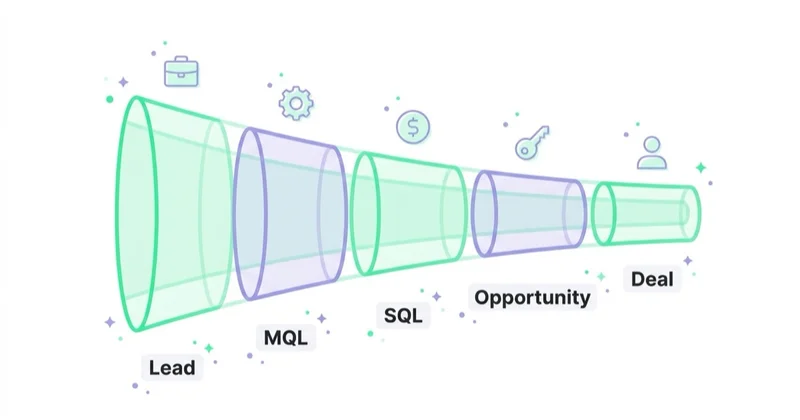
A practical B2B funnel may include:
- Category or problem awareness.
- Educational content consumption.
- Newsletter, webinar or guide signup.
- Service page view.
- Case study or proof review.
- Demo request or contact form.
- Discovery call.
- Proposal.
- Contract.
- Onboarding and expansion.
Important B2B metrics:
- marketing-qualified leads;
- sales-qualified leads;
- lead-to-opportunity rate;
- opportunity-to-customer rate;
- sales cycle length;
- average deal value;
- pipeline value;
- retention;
- expansion revenue.
In B2B, traffic volume alone can be misleading. A small number of high-intent, high-fit accounts can be more valuable than a large number of low-fit leads.
How we approach this at Space Ads
We treat the funnel as a map for measurement and budget allocation, not a path everyone walks neatly in order. In reality people jump between stages, come back, vanish for weeks and reappear ready to buy — so instead of forcing a linear story, we read the effects between stages and the assisted ones. The practical use of the funnel is simple: match the money and the message to the stage someone is actually at, and don't judge top-of-funnel work by a bottom-of-funnel metric. Awareness advertising measured by last-click cost will always look weak — and it usually ends with prematurely switching off something that was genuinely feeding sales further down. The funnel helps us make sure every stage is served and measured by its own, appropriate metric.
Common sales funnel mistakes
Measuring only the final conversion
Final conversions matter, but they do not explain where demand is created or where users drop out. Track stage transitions.
Using the same message everywhere
Awareness, comparison and decision stages need different information. One generic CTA rarely fits the whole journey.
Ignoring the middle of the funnel
Many brands invest in awareness and bottom-funnel campaigns but lack comparison content, proof, case studies and objection handling.
Treating the funnel as linear reality
The funnel is a planning model. Users can enter, leave, return and skip steps.
Optimising for lead volume instead of lead quality
More leads are not always better. Track qualification, revenue and retention.
Forgetting retention
Repeat purchase, renewal and expansion often drive profitability. Retention needs content, campaigns and measurement.
Building reports without action
A funnel dashboard is useful only when it leads to decisions: what to improve, where to test and what to remove.
FAQ
Is the sales funnel still relevant?
Yes, as a planning and measurement model. It is not a perfect description of customer behaviour, but it helps align content, campaigns and KPIs with different decision stages.
What are the stages of a sales funnel?
A practical model includes awareness, interest, consideration, decision and loyalty. Some businesses use shorter or more detailed versions depending on the buying process.
What is the difference between TOFU, MOFU and BOFU?
TOFU is top-of-funnel education and awareness. MOFU is middle-of-funnel comparison and evaluation. BOFU is bottom-of-funnel conversion activity such as demos, pricing, checkout or contact.
How should a sales funnel be measured?
Measure stage transitions, drop-off, conversion rate, lead quality, cost per qualified action, revenue, retention and time to conversion. The exact metrics depend on the business model.
Does ecommerce need a sales funnel?
Yes. Ecommerce has clear behavioural steps such as product view, add to cart, checkout and purchase. Analysing these steps helps identify where revenue is being lost.
Can GA4 measure a sales funnel?
GA4 can support funnel analysis through events, key events and funnel explorations. The quality depends on whether tracking is implemented correctly and whether the steps match the real user journey.
Conclusion
A sales funnel is most useful when it connects strategy with real behaviour. It helps decide what content to create, which channels to use, what to measure and where to reduce friction.
The best funnels are not rigid diagrams. They are working systems: awareness creates demand, middle-funnel content builds confidence, bottom-funnel assets reduce friction and retention activity increases customer value. When each stage has a clear role, message and KPI, funnel optimisation becomes a practical way to grow revenue rather than just another marketing framework.
Sources and further reading
- Think with Google: The messy middle of the purchase journey
- Google Analytics Help: About key events
- Google Analytics Help: Funnel exploration
- Google Analytics for Developers: Measure ecommerce
Continue learning
Continue reading
What Is Benefit-Led Copywriting and How to Use It?
Benefit-led copywriting translates features into customer value. Learn feature vs advantage vs benefit, with examples for ads, ecommerce, B2B, landing pages and CTAs.
What Is a CTA and How to Create an Effective Call to Action?
A CTA works when the next step is clear, relevant, low-friction and supported by enough context for the user's level of commitment.
Website Marketing: How to Actually Drive Revenue From Your Site
A website creates commercial value when it helps the right people complete the right task and gives the business reliable feedback. This guide connects audience journeys, acquisition, experience, measurement and experimentation.