A modern marketing team is not defined by a fashionable job title or a fixed ratio of employees to agencies. It is an operating system: clear business outcomes, the capabilities required to produce them, named decision owners, enough capacity to do the work and reliable handoffs to sales, product, finance and data teams. In-house employees, agencies, freelancers and fractional leaders are sourcing choices within that system — not the structure itself.

The practical answer is usually a deliberate mix, but the mix depends on the business. A regulated enterprise may need more control and specialist knowledge in-house. A growing company entering several markets may need external capacity quickly. A founder-led business may need senior prioritisation before it needs another channel operator. Design the work first; decide who should perform it second.
TL;DR
- Start with outcomes and work, not titles. Revenue model, customer journey, market complexity and growth priorities determine the capabilities you need.
- Name one accountable owner for each material decision. Budget, positioning, acquisition, lifecycle, measurement and creative quality cannot sit between boxes on an org chart.
- Keep business-critical knowledge and control close. The company should retain access to its accounts, data, customer insight, brand standards and decision history even when execution is external.
- Choose in-house, agency, freelance or fractional support capability by capability. Strategic importance, workload, speed, specialist depth, risk and total cost all matter.
- Plan capacity as well as capability. A team can have every role on paper and still fail because creative, analytics or approvals are overloaded.
- Treat stage-based models as starting points. A B2B SaaS company, an ecommerce brand and a regulated financial business at the same revenue level may need different teams.
There is no universal modern marketing org chart
An all-in-house department can be the right model when work is continuous, company context is difficult to transfer, response time matters and the business can attract and develop specialists. An external model can be better when demand is variable, the required skill is narrow, speed matters or an experienced team can be bought more efficiently than it can be built. Neither model is inherently more modern.
The 2026 CMO Survey illustrates why simple rules are misleading. When respondents allocated emphasis across ways to develop new marketing capabilities, building them through current or new employees received the largest average allocation. Agency, company and consultancy partnerships still played a role. In a separate open-ended question, the most common reported gap was not a missing discipline but insufficient people, time and money behind existing capabilities. The implication is useful: diagnose the constraint before adding a vendor or another job title.
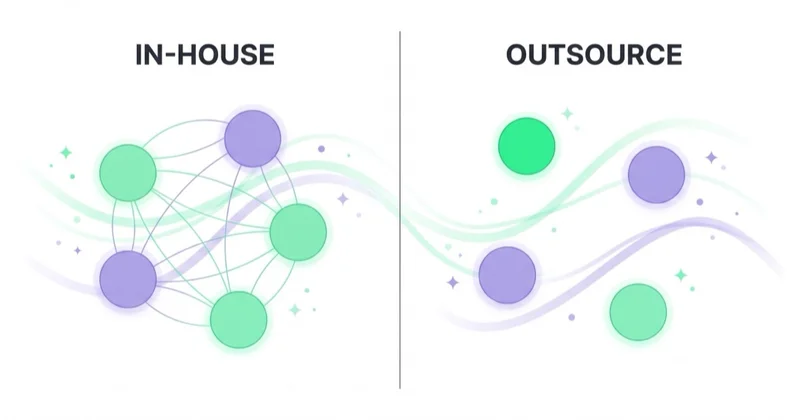
Step 1: define what marketing must own
Begin with a short list of outcomes and decisions for the next 12 to 18 months. Examples include entering a new market, improving qualified pipeline, increasing repeat purchase, repositioning the brand or building a trustworthy measurement system. Translate each outcome into recurring work and dependencies.
| Business requirement | Capabilities that may be needed | Critical interfaces |
|---|---|---|
| Create and capture B2B demand | Positioning, product marketing, content, paid acquisition, sales enablement, operations | Sales, product, subject-matter experts |
| Grow ecommerce contribution | Merchandising input, creative production, paid media, CRO, lifecycle, analytics | Trading, inventory, finance, customer service |
| Improve retention or expansion | Customer insight, lifecycle, experimentation, product adoption, community | Product, customer success, data |
| Enter a regulated market | Local insight, compliant messaging, review workflow, channel execution | Legal, compliance, operations |
| Build a category or premium brand | Research, strategy, distinctive creative, media, communications, measurement | Leadership, product, sales |
This prevents a common mismatch: hiring a social media manager when the real bottleneck is positioning, or adding a paid-media agency when weak lead qualification and slow sales follow-up are limiting revenue.
Step 2: map capabilities before roles
Job titles vary widely. A capability map is clearer because it describes work the company must be able to perform. Most teams need some version of the following, although one person may cover several areas early on:
- Leadership and commercial planning — priorities, budget, forecast, portfolio choices and alignment with company strategy.
- Customer, market and product insight — segmentation, research, positioning, proposition and go-to-market input.
- Demand and acquisition — channel strategy, campaigns, media buying, SEO, partnerships and conversion.
- Brand, content and creative — brand system, narrative, editorial work, design and production.
- Lifecycle and customer growth — onboarding, CRM, retention, cross-sell, loyalty and customer communication.
- Marketing operations and measurement — data definitions, consent, platforms, automation, experimentation and reporting.
For each capability, record the accountable owner, required proficiency, expected workload, current capacity, source of delivery and next likely constraint. This simple inventory is more actionable than an aspirational org chart full of empty boxes.

Step 3: decide what stays in-house
Internal ownership matters most when the work carries durable company context, frequent cross-functional decisions or material risk. That often includes:
- the final decisions on company strategy, positioning and brand standards;
- customer and product knowledge that should accumulate rather than disappear with a supplier;
- budget allocation and definitions of commercial success;
- governance of first-party data, consent, access and measurement definitions;
- coordination with product, sales, finance, legal and operations;
- the record of experiments, decisions and lessons.
Ownership does not mean every deliverable must be produced by an employee. An agency can help develop positioning or execute creative, while a named company leader approves the direction and ensures the learning remains accessible. Likewise, internal execution is not the same as control: a company can employ a media buyer yet still lack governance if ad accounts, definitions and decisions are poorly documented.
Step 4: choose the right delivery model for each capability
Use several factors together rather than relying on the slogan “core in-house, specialist work outsourced.”
| Question | More likely to favour an employee | More likely to favour external support |
|---|---|---|
| How continuous is the workload? | Stable, substantial work every week | Intermittent, seasonal or project-based demand |
| How much company context is required? | Deep product, customer and organisational context | A transferable method or bounded brief |
| How fast is the capability needed? | The company can recruit and onboard deliberately | A material gap must be covered quickly |
| What depth is required? | One or more roles can be kept challenged and current | Several specialists are needed for a limited share of their time |
| What are the risks? | Sensitive decisions or data require close control | Controls, access and review can be contractually and operationally bounded |
| What is the real cost? | Salary, management, tools and development are justified by utilisation | Fees are lower than the fully loaded cost of equivalent usable capacity |
Different external models solve different problems:
- Agency: a coordinated team, specialist depth and execution capacity. Best when the mandate, commercial event, access and feedback loop are clear. See PPC agency vs in-house.
- Freelancer or contractor: focused expertise or flexible production. Best when an internal owner can integrate the work and quality does not depend on a larger multidisciplinary team.
- Fractional marketing leader: senior decisions and operating cadence for part of the week. Best when leadership work is real and recurring but does not yet support a full-time executive. It is not a substitute for execution capacity. See your first senior marketing hire.
- Interim leader: temporary full ownership during a search, transition or turnaround. The remit and handover should be explicit from the start.
The decision should be revisited. A channel initially run by an agency may move in-house when volume becomes stable and knowledge should compound internally. A mature internal team may still use an agency for a new market, specialist audit or production surge.
Step 5: organise around outcomes and interfaces
Organising only by channel can create local optimisation: the SEO lead maximises traffic, paid media maximises platform conversions and lifecycle maximises email revenue, while nobody owns total customer economics. Organising only in cross-functional pods can duplicate tools and weaken specialist standards. A hybrid often works better: outcome owners coordinate the work, while capability leads maintain methods, development and governance.
For example, an acquisition pod may include product marketing, paid media, content, creative and analytics input. Those contributors still need shared definitions, an agreed budget owner and a route to specialist review. The team design should also state what marketing does not own. Pricing, product activation, sales conversion and retention may be shared outcomes, but shared does not mean ownerless.
Glossary
- Capability map — a view of the work the business must be able to perform, independent of current job titles.
- Decision right — authority to make a defined choice, such as budget reallocation or approval of positioning.
- Fractional leadership — recurring senior leadership delivered for a defined part of a working week or month.
- Outcome-based structure — organising work around a business result while preserving specialist standards.
- Pod — a cross-functional group organised around an outcome or segment.
- Capacity — the realistic amount of quality work a person or team can deliver within available time and constraints.
Team structure by stage
These examples are starting hypotheses, not headcount benchmarks. Business model, geography, regulation, product complexity, sales motion and leadership maturity can matter more than funding label.
| Stage | Illustrative structure | Watch out for |
|---|---|---|
| Early / validating | Founder or commercial leader owns the market choice; a versatile operator covers the highest-priority work; specialists are added for bounded gaps | Hiring channel roles before product, audience and proposition are sufficiently clear |
| Repeatable growth | A marketing leader owns the plan; product marketing, acquisition, creative or lifecycle capacity follows the actual bottleneck | Scaling spend without operations, creative and measurement capacity |
| Multi-product or multi-market | Outcome or segment teams supported by shared brand, creative, operations and analytics capabilities | Duplicated tools, definitions and campaigns across teams |
| Enterprise or regulated | Clear functional leadership, governance and specialist teams; agencies or contractors serve explicit mandates | Slow approvals, unclear local-versus-global rights and inaccessible account ownership |
Growth does not require every capability to move in-house. It usually increases the need for internal leadership, governance and institutional knowledge, while the most efficient source of execution can continue to vary. The related role decisions are covered in digital marketing salaries and job descriptions.
Decision rights beyond the org chart
An org chart shows reporting lines; it does not explain how work moves. A usable operating model names a single accountable owner for material decisions such as positioning, budget allocation, campaign launch, data definitions and creative approval. It also names contributors, required reviewers, escalation paths and the time allowed for a decision. UK Government Communication Service team-design guidance similarly emphasises clear ownership of outcomes and processes, multidisciplinary work and roles shaped by the activity required.
External partners need the same clarity. The company should retain administrative access to its core advertising, analytics, CRM and creative assets; document data definitions; and control supplier offboarding. An agency may own day-to-day decisions within agreed guardrails, but the internal accountable leader must connect those decisions to product, finance, sales and operations.
Capacity planning: test whether the team can do the work
Capacity planning should use work volume rather than titles. Estimate the number and complexity of launches, campaigns, creative variants, markets, lifecycle programmes, research projects and reporting cycles. Add recurring coordination, reviews and maintenance — work that is routinely omitted from plans.
Then locate the constraint. Hiring another channel specialist will not solve a creative-production queue, a slow compliance review or missing analytics foundation. Equally, buying an agency retainer will not solve delayed product input or the absence of a decision-maker. Review planned versus completed work, cycle time, rework and queue length alongside marketing results; these operating signals reveal why output is slowing.
A practical marketing-team design audit
Use this sequence before opening a role or issuing an agency brief:
- Write the business outcomes. Limit them to the material changes marketing must help produce over the planning period.
- Map the customer journey and commercial model. Identify where marketing owns a result, contributes to it or depends on another team.
- List capabilities and recurring work. Include strategy, insight, creative, operations and governance — not only visible channels.
- Assign decision rights. Give each consequential decision one accountable owner and a clear review path.
- Estimate capacity and find the constraint. Use actual work volume, cycle time and quality requirements.
- Choose a sourcing model for each gap. Compare a hire, agency, contractor, fractional leader, automation or stopping lower-value work.
- Define interfaces and measures. Document sales handoffs, product inputs, finance definitions, access, service levels and outcome metrics.
- Set a review trigger. Revisit the design after a new market, product, funding round, acquisition or sustained change in workload.
How Space Ads approaches team structure
We start by identifying the commercial outcome, accountable company owner, decision cadence, measurement definitions and capacity constraints. Only then do we define the role external performance marketing should play. Sometimes the answer is ongoing specialist execution; sometimes it is a bounded test, a measurement repair or support while the client builds an internal capability.
The client retains account access, business decisions and visibility into the evidence. Space Ads can provide performance marketing capability within those guardrails, while a fractional CMO engagement can establish priorities and operating rhythm when a part-time leadership model fits. These are not default recommendations: the correct structure is the one that gives the business sufficient control, context, specialist quality and usable capacity at an acceptable total cost.
Stop doing / Do instead
| Stop doing | Do instead |
|---|---|
| Copying another company's org chart | Map your outcomes, work, risks and interfaces first |
| Starting with job titles | Define missing capabilities and required capacity |
| Treating in-house or agency as an ideology | Select the delivery model capability by capability |
| Giving several people joint accountability | Name one owner and the contributors for each decision |
| Hiring a channel role to fix a different bottleneck | Locate the constraint before adding capacity |
| Letting a supplier control accounts or definitions | Retain access, governance, documentation and an exit path |
| Measuring activity by team | Connect work to shared commercial outcomes and operating quality |
FAQ
How should a modern marketing team be structured?
Start with the business outcomes, recurring work, required capabilities, capacity and decision rights. Then choose employees, agencies, contractors or fractional leaders for each gap. Most teams use a mix, but there is no universal ratio or org chart.
What marketing roles should stay in-house?
Keep accountable ownership of company strategy, customer knowledge, brand standards, budget, data governance, core account access and cross-functional decisions close to the business. Execution can still be shared. A role should stay in-house when work is continuous, context-intensive, sensitive or important to long-term advantage.
When should you build an in-house marketing team versus use agencies?
Compare strategic importance, workload continuity, required context, speed, specialist depth, risk and fully loaded cost. An agency fits a clear mandate requiring a coordinated specialist team; a hire fits sustained context-heavy work; a contractor fits a bounded skill or flexible production need.
How many people should be on a marketing team?
There is no reliable headcount-to-revenue ratio for every business. Estimate the recurring work, quality standard, cycle time and coordination load for the outcomes you have prioritised. One person may cover several capabilities at an early stage, but the scope must fit their time and proficiency; external contributors still consume internal management and review capacity.
What is the most common mistake in structuring a marketing team?
Designing around titles or channels without defining outcomes, decision rights and capacity. This produces duplicated work, gaps between teams and local metrics that do not add up to a commercial result, regardless of whether delivery is internal or external.
How does marketing team structure change as a company grows?
Internal leadership, governance and specialist depth often increase as complexity grows. Delivery does not have to move in one direction: mature teams still use agencies and contractors for selected capabilities, markets and demand peaks. Revisit the model when workload, risk or strategic importance changes materially.
Should strategy be in-house or outsourced?
The company should retain final accountability, access to evidence and the resulting institutional memory. External experts can research, challenge and help build strategy; a fractional leader may even run the planning process. The executive team still needs to approve consequential choices and understand their trade-offs.
Key takeaways
- Build the team from business outcomes, capabilities, recurring work and decision rights — not a copied org chart.
- Keep critical knowledge, governance, account access and consequential decisions close to the company.
- Select employees, agencies, contractors and fractional leaders capability by capability.
- Plan capacity and interfaces; the visible channel team may not be the real constraint.
- Treat every stage-based structure as a hypothesis to test against the business model and workload.
Sources and further reading
- The CMO Survey — 2026 report on marketing capabilities, resources, and leadership
- UK Government Communication Service — Modern Communications Operating Model 3.0
- U.S. Bureau of Labor Statistics — Advertising, promotions and marketing manager responsibilities
Continue learning
Continue reading

How to Hire a Digital Marketer — or Whether You Should at All
Before hiring a digital marketer, answer the prior question: should this be a hire, or an agency or fractional lead? Then hire for an outcome, not a task list — the most common mistake is one generalist expected to run every channel deeply, which sets the person up to fail.

Digital Marketing Salaries & Job Descriptions in 2026 (Benchmarks and Templates)
A useful digital marketing salary benchmark matches the role's decisions, scope, location and compensation model. Learn how to build a defensible range and a job description candidates can trust.

Your First Senior Marketing Hire: CMO, VP, or Fractional?
When founder-led marketing hits its ceiling, the instinct is to hire a CMO. Often that is too senior, too early, and too expensive — a VP who still executes, or a fractional lead for direction plus specialist hands, fits better until the company is large enough for a full CMO to have leverage.