Hiring a digital marketer starts with a question many companies skip: is there a durable full-time role to fill, or does the business currently need specialist delivery, temporary leadership or a better operating plan? Only then should recruitment begin. Define the business outcome, the decisions the person can make, the resources they will receive and the work they must perform well. A vague brief that combines paid media, SEO, email, content, design and analytics can make a capable hire look unsuccessful because the job was never realistically designed.

TL;DR
- Ask the prior question first: hire, agency, or fractional lead? Each fits a different need.
- In-house fits continuous, context-heavy, core work you want owned internally.
- Hire for an outcome, not a task list. "Own paid acquisition and its CAC" beats "manage our ads."
- Avoid the generalist trap. Breadth is useful, but one person cannot provide specialist depth, strategy and production across every channel at the same time.
- Match seniority to the need. An executor, a channel owner and a function leader are different hires.
- Evaluate job-related evidence. Use the same structured questions and scoring criteria for every candidate, then add a short, paid work sample where appropriate.
- Sometimes the honest answer is "don't hire yet" — a fractional lead plus specialist execution fits better at early stage.
The prior question: should you hire at all?
Before writing a job description, identify the actual gap. Is it daily coordination, deep execution in one channel, leadership across the function or a short-term transformation? Then compare the realistic options, including the management time each one requires.
| Model | Best when | Trade-off |
|---|---|---|
| In-house hire | Work is continuous, context-heavy and important to own internally | Total employment cost, management and development; expertise is limited to the team hired |
| Agency | The need is specialist, variable or multi-disciplinary and speed matters | Less embedded by default; quality depends on scope, access and governance |
| Fractional lead | Senior direction is needed before there is a full-time leadership role | Limited capacity; needs an execution team and explicit decision rights |
| Contractor | A defined project or temporary capacity gap | Continuity and availability can be limited; employment classification rules vary |
The answer may be a combination: an internal owner who holds company context, supported by a specialist agency; or a fractional lead who designs the function before permanent hiring. A broad generalist can be the right choice when the work genuinely requires coordination and fast experimentation. The role becomes unrealistic only when that person is expected to deliver senior specialist performance in several disciplines without budget, support or authority. The models are compared in PPC agency vs in-house and fractional CMO vs agency vs full-time CMO.
Before choosing, calculate more than salary or retainer. Include employer costs, recruitment time, software, creative and data support, onboarding, management time and the cost of leaving the problem unresolved. Also ask what happens if demand changes: can the workload sustain a permanent role for the next 12–18 months?
If you do hire: for an outcome, not a task list
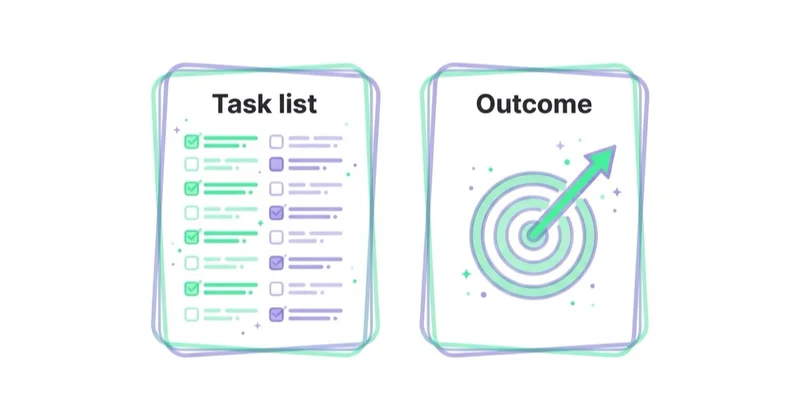
Once a hire is justified, frame the role around outcomes and controllable responsibilities. A task list such as "manage Google and Meta ads, run the newsletter and post on social" says little about priorities. A stronger brief might read: "Improve qualified customer acquisition within an agreed contribution-margin and payback range; own channel planning, measurement and weekly decisions for a defined budget."
An outcome must still be fair and controllable. A paid-media manager cannot own revenue alone if pricing, stock, creative approvals and sales follow-up sit elsewhere. Write down the dependencies, baseline, time horizon and decision rights. Distinguish the metric the role influences from the company result it contributes to. This is the difference between the job descriptions covered in digital marketing salaries and job descriptions: a strong one connects accountability with authority and resources.
The generalist trap
A recurring failure in marketing hiring is the "unicorn" job description: one person is expected to be a strategist, paid-media specialist, SEO, email marketer, designer, copywriter and analyst. Strong marketers often have breadth plus depth in selected areas, but capacity is finite. The company either struggles to recruit or hires someone who is effective in one or two areas and spread thin across the rest.
The result can look like a performance problem when it is partly a role-design problem. Decide which one or two capabilities must be present on day one, which can be learned and which will be supplied by colleagues or partners. A generalist coordinator with access to specialists may outperform a nominal "head of marketing" who has no team, data or production budget.
Match seniority to the actual need
"Digital marketer" spans very different roles, and hiring the wrong seniority wastes money in both directions.
- Executor / coordinator — delivers defined work with guidance and keeps inputs moving. Appropriate when strategy and specialist support already exist.
- Channel owner / specialist — plans and improves one discipline in depth. Appropriate when a specific channel is material to growth.
- Manager — coordinates priorities, budget and people across channels. Appropriate when the operating system needs a day-to-day owner.
- Head / director — sets direction, builds the team and represents marketing in company decisions. Appropriate when marketing is a leadership function.
Do not infer seniority from title alone. Specify the decisions the person will make, the complexity and scale they have handled, who they manage and who will manage them. Hiring an executor when the company needs direction leaves a leadership gap; hiring a leader for a production-heavy role creates a different mismatch.
Glossary
- Outcome-based role — a role defined by the result it owns and how it's measured, not a task list.
- Generalist trap — expecting one hire to be senior across every marketing discipline.
- Channel owner — a specialist accountable for one channel's performance.
- Fractional lead — a senior marketer engaged part-time for direction and ownership.
- Time-to-hire — how long recruiting takes; a real cost of the in-house route.
- Skill ceiling — the limit of what one hire can cover well; why depth needs specialisation.
A structured hiring process for a digital marketer
The process should collect comparable, job-related evidence without extracting free consulting. Start from a job analysis: the critical outcomes, recurring decisions, required competencies and realistic constraints. Turn those into the same core questions and scoring anchors for every candidate. Structured interviews improve consistency because candidates receive the same opportunity to respond and assessors use the same standards.
Review portfolios by asking what the candidate personally owned, what the starting position was, what changed and what they would do differently. Marketing results are usually produced by a team and market conditions, so do not credit or blame one person for a screenshot without context.
Where a work sample is appropriate, keep it short, paid and close to the actual job. For example, provide anonymised performance and commercial data, then ask the candidate to identify missing information, prioritise three actions and define one experiment. State how the work will be used, offer reasonable adjustments and do not reuse candidate ideas as unpaid consulting. Score the evidence, commercial reasoning and communication against criteria agreed before interviews begin.
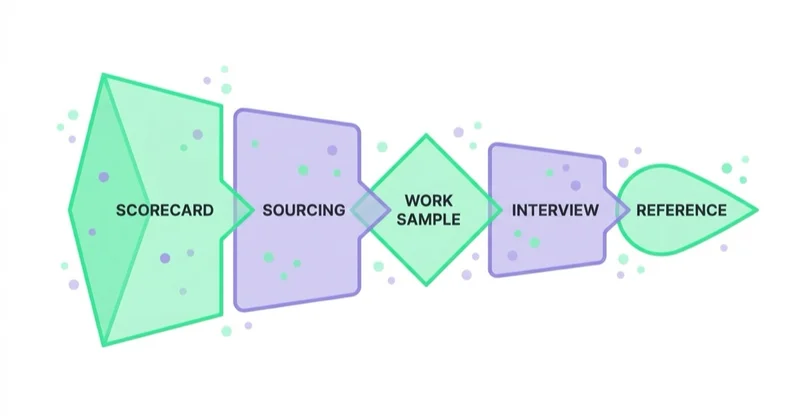
Before opening the role, draft a 30/60/90-day onboarding scorecard, decision rights and the capabilities required on day one versus those that can be learned. The first 30 days should usually emphasise access, diagnosis and relationships rather than an arbitrary revenue jump. By day 60, expect an agreed plan and operating rhythm. By day 90, look for well-founded decisions, early tests and reliable reporting; business outcomes may take longer depending on the buying cycle.
Once the model and seniority are set, a lightweight process beats a long one:
- Define the job — outcome, scope, dependencies, decision rights, budget and reporting line.
- Separate essential from learnable — require only the experience needed to perform the actual job.
- Use structured interviews — ask the same job-related questions and score them against pre-agreed anchors.
- Add a proportionate work sample — test a realistic task without requesting useful unpaid client work.
- Verify claims and context — clarify personal contribution, references and the conditions behind prior results.
- Audit fairness and candidate experience — provide adjustments, protect data and check local employment law, especially when automated screening tools are used.
Tool knowledge matters when the person must be productive quickly, but it should not become a proxy for capability. Test whether candidates can diagnose a problem, explain trade-offs, use evidence and communicate a decision. Some platform details can be learned; the required technical depth, commercial judgment and learning speed should be scored separately.
How Space Ads approaches the hire-or-outsource decision
Space Ads is often engaged alongside an internal team or during a capability gap, so the first question should be where external support genuinely adds value. An agency is not automatically the answer. If the work is continuous, highly company-specific and needs daily cross-functional influence, an internal owner may be the better investment.
Where the gap is specialist acquisition, measurement or a temporary need for senior marketing structure, external support may be faster and lower-risk. A practical diagnostic should leave the company with a clear capability map: what belongs in-house, what can be supplied by a partner, who owns the commercial result and how knowledge will transfer. Space Ads can support specialist performance marketing or fractional CMO work when those are the missing capabilities.
Stop doing / Do instead
| Stop doing | Do instead |
|---|---|
| Defaulting to a full-time hire | Weigh in-house vs agency vs fractional first |
| Writing a task-list job description | Frame the role around an outcome it owns |
| Expecting one hire to master every channel | Decide what it must own deeply; staff the rest |
| Hiring the wrong seniority | Match executor / owner / leader to the actual gap |
| Over-weighting tool familiarity | Evaluate judgment, ownership and communication |
| Comparing salary with agency fee alone | Compare total cost, capacity, management and time to value |
| Asking every candidate different questions | Use the same job-related questions and scoring anchors |
| Using an unpaid strategy project | Use a short, paid and anonymised work sample |
FAQ
Should I hire a digital marketer in-house or use an agency?
In-house fits continuous, context-heavy, core work you want owned internally. An agency fits when you need senior specialist depth across channels quickly and flexibly. A fractional lead fits when you need senior strategy and ownership without a full salary. Many early-stage companies are best served by a combination rather than a single generalist hire.
How do I write a job description for a digital marketer?
Frame it around the outcome, controllable responsibilities and how success is measured. State the scope, budget, reporting line, autonomy, dependencies, required specialism and what support exists. Replace vague phrases such as "own growth" with the decisions the person can make and the metrics they can realistically influence.
What is the biggest mistake in hiring a digital marketer?
An unclear role with more responsibilities than authority, capacity or support. The common version expects one generalist to provide specialist depth across paid media, SEO, lifecycle, content, design and analytics. Decide what must be owned deeply, what can be learned and what another person or partner will supply.
What seniority of marketer should I hire?
Match it to the gap: an executor or coordinator when you have strategy and need hands; a channel specialist when one channel must perform; a manager when you need the engine run day to day; a head or director when marketing is a leadership seat. Hiring too junior leaves it rudderless; too senior wastes salary on task work.
How should I evaluate marketing candidates?
Use structured, job-related evidence. Ask every candidate the same core questions, apply the same scoring anchors, clarify their personal contribution to past results and use a short paid work sample where appropriate. Evaluate technical depth, commercial reasoning, communication and learning ability separately. Ensure the process complies with local employment and data-protection law.
When should I not hire a digital marketer?
When the need is really senior direction (a fractional lead fits better) or specialist channel depth across many platforms (an agency fits better), or when one hire would be stretched across every discipline. At early stage, a fractional lead plus specialist execution often beats a single full-time generalist.
Key takeaways
- Answer the prior question — hire, agency, or fractional — before writing a job description.
- If you hire, frame the role around an outcome it owns, not a task list.
- Avoid the generalist trap; decide what the role must own deeply and staff the rest.
- Match seniority to the actual decisions and evaluate candidates through consistent, job-related evidence.
- Sometimes the honest answer is a fractional lead plus specialist execution, not a hire.
Sources and further reading
- CIPD — Selection methods
- U.S. Office of Personnel Management — Structured interviews
- U.S. Equal Employment Opportunity Commission — Employment tests and selection procedures
- U.S. Equal Employment Opportunity Commission — Disability discrimination and AI hiring tools
Continue learning
Continue reading

Digital Marketing Salaries & Job Descriptions in 2026 (Benchmarks and Templates)
A useful digital marketing salary benchmark matches the role's decisions, scope, location and compensation model. Learn how to build a defensible range and a job description candidates can trust.
How to Structure a Modern Marketing Team (In-House, Agency, Fractional)
There is no universal modern marketing org chart. Build the team from business outcomes, recurring work, decision rights and capacity, then choose the right mix of employees, agencies, freelancers and fractional leadership.

Product Marketing vs Growth Marketing: Who Owns the Number?
Product marketing usually leads market and message decisions; growth marketing leads the experiment portfolio. This guide maps decision rights, metrics and one accountable owner for the commercial target.