
Digital marketing salaries cannot be reduced to one reliable global average. The same title can describe a coordinator scheduling posts, a specialist managing a seven-figure media budget or a director responsible for revenue, people and forecasting. Geography, employment model and total compensation widen the gap further.

The useful question is therefore not “What does a digital marketer earn?” It is: what decisions must this person make, what outcomes will they own, and what is the fair market range for that scope in the hiring location? This guide provides a practical method for answering that question, a current US benchmark for context and job-description templates that can be adapted without turning one role into an entire marketing department.
TL;DR
- Benchmark the work, not the title. Decision authority, budget, team size, channel depth and commercial responsibility determine the level.
- Use current, local and comparable data. Record the data period, geography, sample definition and whether figures show base pay or total compensation.
- Do not treat a management benchmark as a specialist salary. The latest US government figure for marketing managers describes a leadership occupation, not every digital marketing role.
- Publish a defensible range. Explain what experience or responsibility moves a candidate through it; check the rules in every hiring jurisdiction.
- Write the job around outcomes and operating conditions. Candidates need to know the objective, scope, resources, authority and measures of success.
- Cost the complete model. Salary is only one part of an in-house hire, contractor, fractional leader or agency comparison.
What actually determines digital marketing pay?
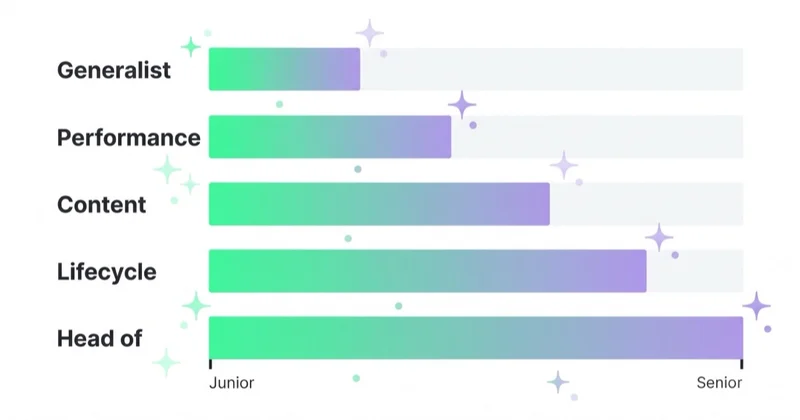
A credible pay range begins with job evaluation. In practice, eight variables matter:
- Decision level: does the person follow a plan, own a channel or set company-level marketing strategy?
- Commercial accountability: are they measured on delivery, qualified pipeline, contribution or a company revenue target?
- Budget and risk: a small local campaign and a multi-market portfolio require different judgement and controls.
- Specialist depth: measurement architecture, paid media, technical SEO and lifecycle automation can require scarce technical expertise.
- People responsibility: hiring, coaching and evaluating a team changes the role even when the title does not.
- Business complexity: the sales cycle, regulation, product range, markets and data environment affect the difficulty of the work.
- Hiring market: country, city, remote-pay policy and local availability shape the competitive range.
- Employment and reward model: permanent employment, contract work and fractional leadership carry different risk, benefits and tax treatment.
Seniority should describe the decisions expected, not years served. A junior marketer normally works within defined processes and receives review. A specialist owns a channel and can diagnose performance. A manager allocates resources and coordinates work across functions. A director or VP sets priorities, builds the team and is accountable for the operating system—not merely for campaign delivery.
2026 salary benchmark: what current public data can and cannot tell you
As of July 2026, the latest US Occupational Employment and Wage Statistics release covers May 2025. It reports a median hourly wage of $80.19 and a mean annual wage of $177,770 for marketing managers. The category covers 395,240 employed people nationally and excludes self-employed workers. It is useful as a leadership-level anchor, not as a pay recommendation for a PPC specialist, content marketer or coordinator.
That limitation matters. Government occupational categories are broader than the titles commonly used in digital teams. A benchmark for “marketing managers” should not be pasted into a vacancy for someone who will execute campaigns under supervision. Nor should a national figure replace local data: industry, metropolitan area and the exact role can materially change the result.
For UK hiring, the Office for National Statistics publishes 2025 Annual Survey of Hours and Earnings data by occupation, region, working pattern and other cuts. The same principle applies: select the closest occupational group, confirm sample quality and compare like with like. For any country, use the newest official labour statistics available, then add recent market observations from genuinely comparable vacancies or compensation data—not from a generic search snippet.
A benchmark record you can defend
For every source, capture:
| Field | Why it matters |
|---|---|
| Data period and publication date | A 2026 page may still report 2024 or 2025 pay |
| Country, region and remote-pay policy | National and local markets can differ sharply |
| Occupation and actual scope | Similar titles may represent different levels |
| Base, variable pay, equity and benefits | Base salary is not total compensation |
| Mean, median and percentiles | The median is less distorted by extreme packages than the mean |
| Full-time, part-time, employee or contractor | These populations are not directly interchangeable |
| Sample and exclusions | Some datasets exclude founders, self-employed workers or small samples |
| Currency and reference date | Currency conversion does not adjust for local employment costs |
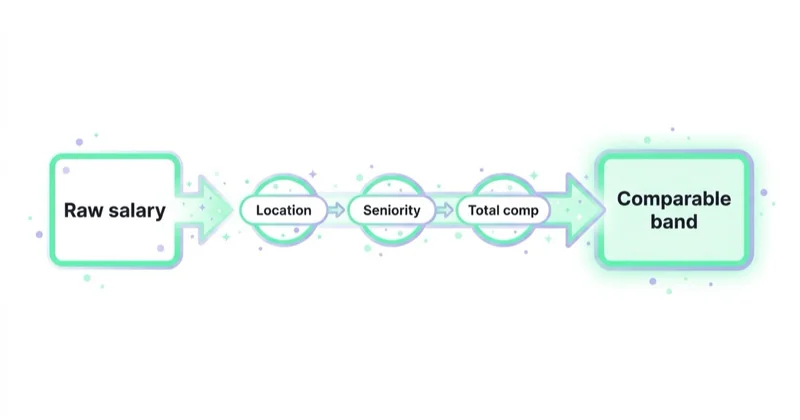
Use at least two relevant inputs when the decision is material. Official statistics provide a stable reference; current comparable hiring data helps test whether the range is competitive now. If they disagree, investigate the role definition, location and compensation package instead of averaging incompatible numbers.
Map the role before choosing the salary range
Job titles are weak data. A better benchmark uses a role scorecard.
| Level | Typical decisions | Appropriate scope | Evidence expected |
|---|---|---|---|
| Coordinator / executive | Execute defined work and escalate exceptions | Scheduling, QA, reporting support, campaign operations | Accuracy, reliability and learning speed |
| Channel specialist | Plan and improve one discipline | Paid search, paid social, SEO, CRM or analytics | Diagnosis, experiments, platform depth and commercial judgement |
| Marketing manager | Prioritise across a connected programme | Budget, agencies, calendar, reporting and stakeholder coordination | Resource allocation, forecasting and cross-functional delivery |
| Head / director | Design and run the marketing function | Strategy, team, budget, measurement and operating rhythm | Business planning, leadership and accountable growth decisions |
| VP / CMO | Set enterprise marketing direction | Portfolio, brand, growth model, organization and executive alignment | Company-level judgment, governance and capital allocation |
A specialist is not automatically senior because the discipline is technical, and a generalist is not automatically junior. Pay should reflect the value and difficulty of the decisions, the available support and the consequences of getting them wrong.
Convert market data into a hiring range
Do not start by choosing a midpoint and stretching it in both directions. Use a repeatable process:
- Write the role scorecard. Define the business outcome, decisions, budget, team, channels, markets and constraints.
- Choose the hiring geography. State whether remote pay follows the employee location, company location or a geographic zone.
- Find comparable roles. Match scope before title and discard observations that combine a different level or compensation model.
- Normalise the data. Separate base salary, target bonus, commission, equity and benefits. Note data age and currency.
- Check internal equity. Compare work of similar value inside the company, not only the external market.
- Set a range and progression logic. Define which demonstrated capabilities justify the lower, middle or upper part.
- Calculate employer cost. Add payroll taxes, benefits, equipment, recruitment, onboarding, management time and likely specialist support.
- Review with HR or employment counsel. Pay-transparency and recruitment rules depend on jurisdiction and continue to change.
A range that is so wide that almost any offer fits is not transparent. Neither is a range whose upper end the company would never pay. Publish a good-faith range and explain the factors that determine placement. In Great Britain, 2026 government guidance recommends including pay information in job adverts and making pay-band decisions clear; proposed statutory requirements should not be described as law until enacted.
What a strong marketing job description contains
A job description should help a qualified person decide whether the role fits. It should also give interviewers a consistent basis for assessment. Include:
- Purpose: why the role exists and which business problem it addresses.
- Outcomes: three to five results expected in the first 6–12 months.
- Scope: channels, markets, products, budget range, funnel stages and team responsibilities.
- Decision rights: what the person can decide, what requires approval and where they advise.
- Measures: business and operating metrics, with dependencies made explicit.
- Resources and constraints: team, agency support, data maturity, creative capacity and regulatory context.
- Essential capabilities: the few skills that are genuinely required on day one.
- Development areas: skills that can be learned rather than used as unnecessary barriers.
- Reporting and collaboration: manager, direct reports and core partners in sales, finance, product or operations.
- Compensation and working model: range, variable pay, location, working pattern and benefits.
- Selection process: stages, practical exercise if any and expected timeline.
Avoid making one person “accountable for revenue” when pricing, inventory, sales follow-up or product retention sit elsewhere. State the shared outcome and the part the role controls. Likewise, tools should appear only when prior proficiency is necessary. A capable specialist can often learn a reporting interface; they cannot instantly acquire years of judgement in experimentation or commercial analysis.
Recruitment language should be inclusive and job-related. Requirements such as a “recent graduate,” a specific age profile or unnecessary years of experience can exclude capable applicants and may create legal risk. Check local discrimination and accessibility requirements before publishing.
Four adaptable job-description templates
These are starting points, not copy-and-paste vacancies. Replace every bracketed field and remove responsibilities the role will not own.
Paid media specialist
Purpose: Build and improve paid acquisition for [market/product] within agreed contribution, data-quality and brand guardrails.
Outcomes in the first 6–12 months:
- establish a reliable campaign, conversion and QA structure;
- run a prioritised testing programme across [channels];
- improve qualified acquisition or contribution at an agreed level of spend;
- connect campaign decisions with creative, landing-page and sales feedback.
Scope and authority: [budget range], [markets], [Google/Meta/other channels], with authority to make campaign-level changes within agreed thresholds. [Manager/finance/client] approves material budget and market changes.
Success measures: qualified or fulfilled acquisition cost, marginal contribution/payback where measurable, lead quality, experiment learning, tracking health and budget control. Platform ROAS is a diagnostic, not the sole business outcome.
Essential capabilities: hands-on campaign judgement, measurement literacy, structured experimentation and clear commercial communication. Specify certifications only if they genuinely predict success.
SEO specialist
Purpose: Increase qualified organic discovery by improving technical accessibility, useful content and the site's evidence architecture.
Outcomes:
- diagnose and prioritise technical and content opportunities;
- create a roadmap connected to user demand and commercial value;
- improve indexability, internal linking and content quality with engineering and editorial teams;
- report leading indicators and business outcomes without claiming false causality.
Success measures: relevant non-brand visibility, qualified organic sessions, assisted pipeline or revenue, index coverage, content adoption and delivery against prioritised fixes. Rankings alone are insufficient.
Lifecycle / CRM manager
Purpose: Improve activation, retention and expansion through useful, permission-aware customer communication and reliable automation.
Scope: [email/SMS/push], [markets], lifecycle journeys, segmentation, experimentation and data requirements. Clarify who owns consent, deliverability, customer data and technical implementation.
Success measures: activation and retained cohorts, incremental conversion where testable, unsubscribe/complaint rates, deliverability, journey reliability and customer experience—not message volume.
Head of marketing
Purpose: Turn the company strategy into a coherent marketing plan, operating model and accountable investment portfolio.
Outcomes:
- agree target segments, positioning, priorities and measures with leadership;
- build the team and partner model needed for the plan;
- establish planning, forecasting, measurement and review rhythms;
- allocate budget based on evidence, constraints and company economics;
- create a credible view of contribution while documenting uncertainty.
Scope and authority: specify total budget, team, markets, executive reporting and which decisions sit with product, sales, finance and the CEO. Do not advertise a “Head of” role if the company wants a solo campaign executor with no strategic authority.
Before recruiting: hire, agency, contractor or fractional lead?
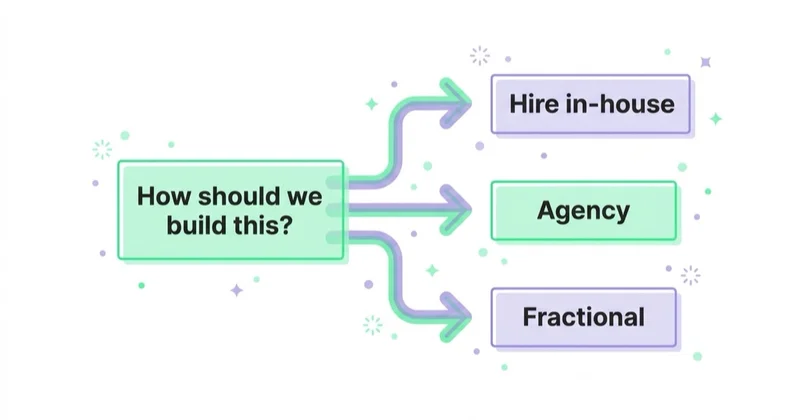
Before writing a job description, answer whether this should be a hire at all. Three models, each with a genuine best-fit.
| Model | Best fit | Cost and operating reality |
|---|---|---|
| In-house employee | Work is continuous, context-heavy and important to retain internally | Base and variable pay plus employment costs, tools, management, development and cover |
| Specialist contractor | A bounded skill or project is needed for a defined period | Higher unit rate can be rational; availability and knowledge continuity require planning |
| Agency | Several specialist capabilities or scalable execution are needed | Retainer or project cost plus internal briefing, approval and governance time |
| Fractional leader | Senior direction is needed before a full-time executive role is justified | Limited weekly capacity; execution resources still need to be assigned |
Compare equivalent outputs and risks, not salary versus invoice. A single employee may still require creative, analytics, legal, engineering or media support. An agency still requires an accountable internal owner. A contractor's rate includes costs and utilisation risk that an employer carries for an employee.
The right structure may be hybrid: internal ownership for positioning and customer knowledge, a specialist partner for paid media, and fractional leadership while the function is being built. The wrong structure is a vacancy that quietly combines strategist, copywriter, designer, media buyer, analyst, CRM engineer and sales-development representative into one “digital marketer.”
A fair and useful hiring scorecard
Interview every candidate against the same job-related criteria. A simple scorecard can cover:
- quality of diagnosis before recommending tactics;
- evidence of decisions made under constraints;
- depth in the disciplines the role will actually use;
- ability to distinguish attributed results from incremental impact;
- communication with non-marketing stakeholders;
- approach to customer privacy, accessibility and responsible claims;
- learning from a test or programme that did not work.
Use a work sample only when it resembles the role, can be completed in reasonable time and does not ask candidates for free production work. Tell candidates what is being assessed. Record evidence, not “culture fit” impressions, and provide reasonable adjustments where required.
Glossary
- Fractional lead — a senior marketer (often CMO-level) engaged part-time to own strategy and direction.
- Day-rate contractor — a specialist engaged per day, flexible but without long-term ownership.
- Total compensation — base salary plus applicable bonus, commission, equity and other reward; benefits and employer cost may be reported separately.
- Title inflation — a senior-sounding title attached to a role smaller than the title implies.
- Job evaluation — a structured assessment of a role's relative value based on its demands and responsibilities.
- Market pricing — comparison with external pay data for genuinely comparable work.
- Accountability — the outcome and decisions a role owns, with dependencies and authority made clear.
How Space Ads approaches the hire-or-partner decision
Our standard approach is to define the missing capability before recommending a delivery model. We look at the business objective, weekly workload, required seniority, channel breadth, internal owner, measurement maturity and time horizon. That usually makes the structural gap visible.
Continuous work that depends on daily company context is often best owned internally. A bounded specialist problem may suit a contractor. Multi-disciplinary execution may suit an agency. A company that lacks senior prioritisation may need a fractional leader before it adds more channel capacity. Space Ads can provide specialist performance marketing execution or fractional CMO support, but the recommendation should follow the operating need—not precede it.
Stop doing / Do instead
| Stop doing | Do instead |
|---|---|
| Copying a global “average salary” | Match scope, level, geography, data period and reward model |
| Treating a 2026 article as 2026 salary data | Check the underlying survey reference period |
| Comparing salary with an agency invoice | Compare total employer cost, capability, capacity and risk |
| Writing a long task inventory | Define purpose, outcomes, authority and constraints |
| Making one person responsible for every channel | Design a realistic role and provide specialist support |
| Using revenue as a solo marketing KPI | State shared dependencies and the levers the role controls |
| Publishing an artificial salary range | Use a good-faith range with clear placement criteria |
FAQ
What is the average digital marketing salary in 2026?
There is no responsible global average for all digital marketing work. In the US, the latest public OEWS release available in July 2026 reports May 2025 data: marketing managers had a median hourly wage of $80.19 and mean annual pay of $177,770. This is a management occupation, not a benchmark for every digital specialist. Use current local data for the actual scope and employment model.
How do I read a marketing salary benchmark correctly?
Match responsibilities rather than title; record geography, data period and sample; separate base salary from variable pay, equity and benefits; and distinguish employees from contractors. Prefer a median to a mean when high executive packages skew the distribution, but review percentiles and sample quality as well.
What should a digital marketing job description include?
Include the role's purpose, 6–12-month outcomes, scope, decision authority, measures, resources, constraints, required capabilities, reporting lines, compensation range, working model and selection process. Make dependencies explicit so the role is not held accountable for outcomes it cannot control.
Should I hire a digital marketer in-house or use an agency?
Choose in-house when the work is continuous and depends heavily on company context. Choose a contractor for bounded specialist work, an agency for coordinated specialist capacity, and a fractional leader when senior direction is needed without a full-time executive workload. Compare full cost, capability, capacity, continuity and governance—not salary alone.
Why shouldn't I hire one marketer to do everything?
Generalists can be highly valuable, but paid media, SEO, lifecycle, analytics and creative each contain specialist work. If the role requires deep execution across all of them, the design is probably unrealistic. Prioritise the capabilities needed now and identify the internal, freelance or agency support available for the rest.
What is a fractional marketing hire?
A fractional marketing leader is a senior practitioner engaged for part of the week or month to provide direction and operating ownership. The model can fit a company whose leadership need is real but not yet full time. Scope decision authority, availability and execution support clearly; “fractional” should not imply unlimited access.
Key takeaways
- Benchmark the role's decisions and scope before searching for a salary figure.
- The latest published dataset and the year in a headline are not necessarily the same; document the reference period.
- Separate base salary, variable compensation, benefits and total employer cost.
- A useful job description explains outcomes, authority, resources, dependencies and fair selection criteria.
- Decide whether the capability belongs in-house, with a contractor, at an agency or in a fractional role before opening a vacancy.
Sources and further reading
- US Bureau of Labor Statistics — May 2025 national occupational employment and wage data
- US Department of Labor / O*NET — Marketing Managers: tasks and occupational requirements
- Office for National Statistics — Employee earnings in the UK: 2025
- CIPD — Job evaluation and market pricing
- UK Government — Increase transparency for pay, promotion and rewards
- UK Government — Preventing discrimination in recruitment
Continue learning
Continue reading

How to Hire a Digital Marketer — or Whether You Should at All
Before hiring a digital marketer, answer the prior question: should this be a hire, or an agency or fractional lead? Then hire for an outcome, not a task list — the most common mistake is one generalist expected to run every channel deeply, which sets the person up to fail.

How to Structure a Modern Marketing Team (In-House, Agency, Fractional)
There is no universal modern marketing org chart. Build the team from business outcomes, recurring work, decision rights and capacity, then choose the right mix of employees, agencies, freelancers and fractional leadership.

Product Marketing vs Growth Marketing: Who Owns the Number?
Product marketing usually leads market and message decisions; growth marketing leads the experiment portfolio. This guide maps decision rights, metrics and one accountable owner for the commercial target.


































