Instagram hashtags help classify content, connect posts with topics and campaigns, and support discovery, but they are not a standalone reach tactic. A good hashtag strategy uses a small set of relevant tags, clear captions, searchable profile language, readable on-screen text and content that people actually watch, save, share or comment on.
In 2026, hashtags should be treated as one part of Instagram SEO. They help Instagram and users understand the subject of a post, but they do not compensate for weak creative, unclear positioning or generic content. The stronger approach is to make the topic obvious everywhere: in the caption, visual, Reel text, carousel headings, profile name, bio, location, product tags and hashtags.
TL;DR
- Instagram hashtags are classification and discovery signals, not a guaranteed reach booster.
- Relevance matters more than quantity. A short list of precise hashtags is usually better than a long block of broad tags.
- Social SEO matters more than hashtags alone. Captions, profile name, bio, on-screen text and topic consistency all help Instagram understand content.
- Use hashtags for topics, niches, locations, campaigns, events, communities and UGC.
- Avoid copy-pasting the same hashtag set under every post. Each post should have tags that match its actual content.
- A branded hashtag is useful only when people have a reason to use it. It needs a campaign, community, challenge, event or UGC workflow.
- Measure hashtag performance indirectly through reach, profile visits, follows, saves, shares, comments, UGC volume and downstream conversions.
- For ecommerce, hashtags support product discovery and UGC, but product pages, Reels, Shopping tags, creators, offers and paid media usually carry more commercial weight.
What are Instagram hashtags?
An Instagram hashtag is a word or phrase preceded by the hash sign. It becomes a clickable topic label that can connect a post with a hashtag page, campaign, community or search behaviour.
Examples:
- #runningtips
- #londonfood
- #b2bmarketing
- #skincare routine without the space would become one tag
- #spaceads as a branded tag
Hashtags can be added to captions or comments. Instagram's Help Center also explains that posts from private accounts do not appear publicly on hashtag pages, and that hashtags cannot contain spaces or special characters in the middle of the tag.
The tactical point is simple: hashtags should describe the content. If a hashtag does not match the post, audience or context, it creates noise instead of relevance.
Do hashtags still increase Instagram reach?
Short answer: hashtags can support discoverability, but they should not be treated as the main reason a post reaches more people.
Instagram distribution is influenced by many signals, including content quality, user behaviour, account history, engagement, recommendation eligibility, topic relevance and surface-specific ranking systems. Hashtags can help classify a post and make it easier to connect with a topic. They cannot force people to watch a weak Reel, save an unhelpful carousel or share a generic post.
This is why hashtag-heavy tactics became less effective. Posting 20 or 30 broad tags such as #love, #instagood or #marketing under unrelated content does not create a clear signal. It usually creates a messy one.
A better question is not "Which hashtag will make this go viral?" but "Which words make this post easier to understand and find by the right audience?"
Hashtags and Instagram SEO
Instagram is increasingly used like a search and discovery engine. People search for topics, places, creators, products, tutorials, reviews, ideas and inspiration. Hashtags are only one part of that search environment.
Instagram SEO includes:
- profile name and username;
- bio keywords;
- captions;
- carousel headlines;
- Reel on-screen text;
- spoken words and captions where available;
- alt text for images;
- location tags;
- product tags;
- creator and brand tags;
- topic consistency across the account;
- hashtags.
For example, a post about Pilates for runners should not rely only on #pilates and #running. The caption can explain "Pilates exercises for runners with tight hips", the Reel can show the same phrase on screen, the profile can clearly position the account around mobility or coaching, and the hashtags can support the topic with a few precise labels.
The same logic works for agencies, SaaS companies, local businesses, creators and ecommerce brands. Hashtags help, but the whole content unit needs to be searchable.
How Instagram uses hashtags
Hashtags can help in several ways.
Topic classification
Hashtags tell Instagram and users what a post is about. A tag such as #emailmarketing, #yogaforbeginners or #veganrecipes gives a content clue.
Discovery through hashtag pages
Public posts can appear on hashtag pages when the account and content are eligible. This is useful for niche topics, local communities, events and campaigns.
Community participation
Some hashtags are used by communities. Examples include local photography groups, founder communities, running clubs, university groups, event attendees or creator challenges.
Campaign organisation
Brands can use one campaign hashtag to gather user-generated content, contest entries, event photos or customer stories.
Search support
Hashtags can support search by adding topic context. They should work together with captions and profile language, not replace them.
How many hashtags should be used?
There is no universal number that works for every account, topic and post type. The practical default is to start with 3 to 5 highly relevant hashtags, then test whether fewer or slightly more improve discovery quality.
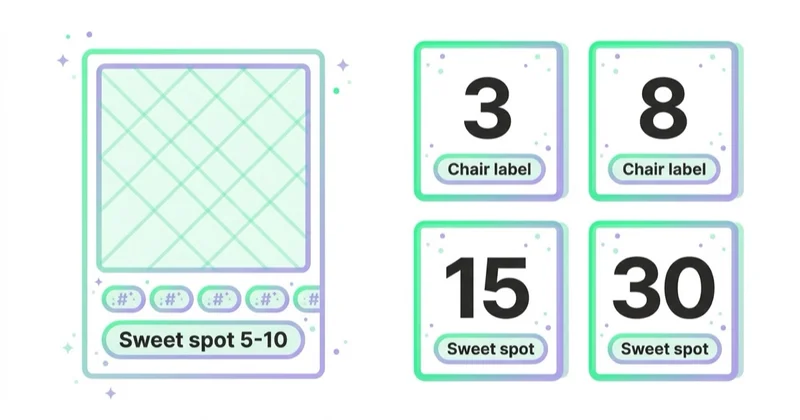
Use fewer hashtags when:
- the post has a very clear topic;
- the caption already includes strong keywords;
- the content is part of a branded campaign;
- the audience is narrow;
- the account wants a cleaner editorial style.
Use more only when every tag has a real job, for example topic plus location plus event plus community plus campaign. Do not add tags simply because there is unused space.
The platform interface and Help Center guidance can change by region, account type and rollout. Before building a process around a numeric limit, verify the current publishing interface and the official Help Center. The strategic principle remains stable: relevance beats volume.
A practical hashtag framework
A useful Instagram hashtag set usually combines several roles.
| Hashtag role | Purpose | Example |
|---|---|---|
| Core topic | Names the subject | #googleads, #pilates, #interiordesign |
| Niche topic | Narrows the context | #b2bleadgeneration, #prenatalpilates |
| Location | Connects local intent | #londonagency, #manchesterfood |
| Audience | Signals who it is for | #foundermarketing, #newrunners |
| Format | Describes the type of content | #tutorial, #checklist, #beforeandafter |
| Branded | Groups brand or campaign content | #spaceads, #brandchallenge |
| Event | Connects live or seasonal activity | #brightonseo, #blackfridaymarketing |
Most posts do not need every role. The goal is not to fill a checklist. The goal is to describe the content accurately.
How to research Instagram hashtags
Good hashtag research starts with the audience and topic, not a generator.
1. Define the post intent
Before choosing tags, define what the post is supposed to do:
- educate;
- entertain;
- show proof;
- sell a product;
- introduce an offer;
- collect UGC;
- invite event participation;
- build expert positioning;
- drive profile visits.
The tags should support that intent.
2. Search Instagram manually
Use Instagram search to look at topics, accounts, places and hashtags. Check what kind of content appears, not only how many posts use the tag.
Look for:
- whether the tag is active;
- whether posts are relevant;
- whether the audience matches the brand;
- whether competitors use it well;
- whether the hashtag is too broad;
- whether it is dominated by unrelated content.
3. Build a small library
Create a working list of hashtag groups:
- core industry tags;
- local tags;
- campaign tags;
- product category tags;
- customer language tags;
- event tags;
- community tags;
- branded tags.
Then select from the library for each post instead of pasting the same block every time.
4. Review before publishing
Before publishing, ask:
- Does this hashtag describe the post?
- Would a person searching this tag be satisfied to find this content?
- Is the tag too broad to be useful?
- Is the tag misleading?
- Is there a better keyword in plain language for the caption?
- Does the post need a branded or campaign tag?
If the answer is unclear, remove the tag.
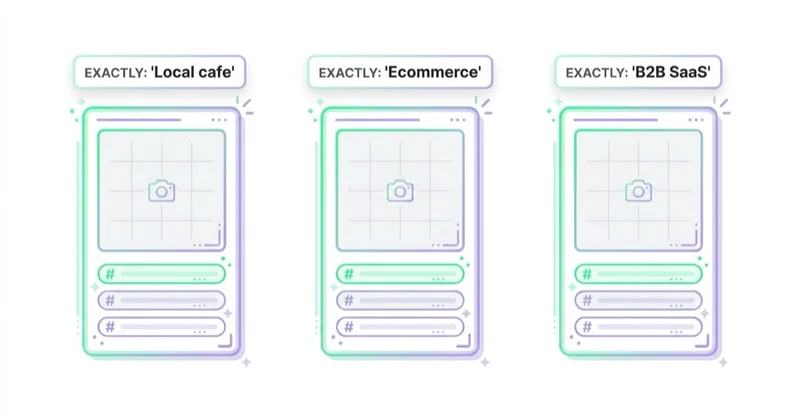
Examples by business type
| Business or creator type | Better hashtag logic | Weak hashtag logic |
|---|---|---|
| Local restaurant | dish, neighbourhood, city, event, cuisine | generic food tags only |
| B2B SaaS | problem, use case, audience, category | broad startup tags on every post |
| Fitness coach | training goal, audience, location, format | unrelated viral tags |
| Ecommerce fashion brand | product category, collection, occasion, branded UGC | only #fashion and #style |
| Marketing agency | platform, problem, industry, funnel stage | the same #marketing block every time |
| Event organiser | event name, city, topic, speaker community | generic motivation tags |
The best tags match both the content and the person who should find it.
Where to place hashtags: caption or comment?
Instagram allows hashtags in captions and comments. From a practical content perspective, the caption is usually cleaner because the context, keywords and hashtags stay together.
First-comment hashtags can still work, especially when an account wants a cleaner caption. The risk is operational: the comment may be delayed, forgotten, hidden by automation issues or separated from the main message.
For most brands, use the caption unless there is a clear reason not to. Keep the hashtag block short enough that it does not distract from the actual message.
Branded hashtags and UGC
A branded hashtag is not a growth strategy by itself. It is a container.
It becomes useful when people have a reason to use it:
- product review campaign;
- contest;
- event;
- creator collaboration;
- community challenge;
- customer story series;
- before-and-after campaign;
- local activation;
- packaging insert;
- post-purchase email prompt.
For user-generated content, make the instructions clear. Tell people what to post, which hashtag to use, whether the brand may reshare the content, and whether there are terms for a contest or incentive.
This is especially important for legal and trust reasons. A contest or giveaway needs clear rules, eligibility, dates, selection criteria and disclosure that the promotion is not run by Instagram where required.
Hashtags for ecommerce
In ecommerce, hashtags are useful but rarely the main sales lever. They can support:
- product discovery;
- collection launches;
- seasonal campaigns;
- styling ideas;
- creator content;
- customer photos;
- local pop-ups;
- Black Friday or sale campaigns;
- product education;
- community building.
They should be combined with stronger commercial signals:
- clear product naming;
- searchable captions;
- product tags where available;
- Reels that show real use;
- carousels that explain details;
- landing pages that match the post;
- creator proof;
- reviews and UGC;
- email and paid retargeting;
- clean analytics.
Example: a skincare brand launching a cleanser may use a few tags around the product category, skin concern, brand and campaign. But the post still needs a clear product benefit, credible claims, usage context and a path to buy.
For ecommerce content structure, read How to Set Up and Manage an Instagram Shop and What Is Facebook Shop and How to Set It Up?.
Hashtags for B2B and service businesses
B2B hashtags should avoid vague inspiration tags. A B2B buyer is usually looking for a problem, category or expertise signal.
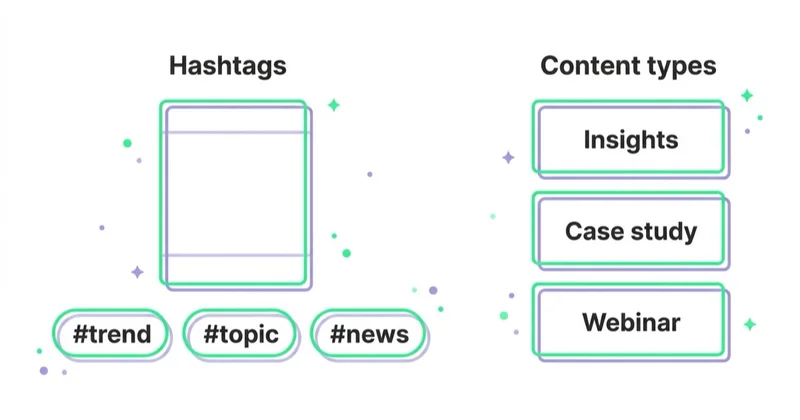
Useful B2B hashtag themes include:
- platform names, such as #googleads or #hubspot;
- role-based topics, such as #demandgeneration or #salesops;
- business problems, such as #leadquality or #conversiontracking;
- event tags;
- industry tags;
- local business tags;
- branded report or webinar tags.
The caption should still carry the main keyword in plain English. A post about Consent Mode v2 should say "Consent Mode v2" in the caption, not hide the topic only in #consentmode.
How to measure hashtag performance
Hashtag performance is not always cleanly isolated in public reporting. Instead of trying to attribute every impression to a single tag, measure whether the tagging system improves discovery quality.
Track:
- reach from non-followers;
- profile visits;
- follows;
- saves;
- shares;
- comments from relevant people;
- UGC volume;
- campaign hashtag usage;
- website visits from Instagram;
- link-in-bio clicks;
- conversions where tracking allows it;
- content topics that repeatedly attract relevant engagement.
For campaigns, use UTM-tagged links where possible and keep naming conventions consistent. Hashtags can support discovery, but analytics should connect Instagram activity with business outcomes.
For tracking discipline, read What Are UTM Parameters and How to Create UTM URLs for Google Analytics?.
How we approach this at Space Ads
Hashtags are a weak reach lever now: Instagram has sidelined them, and stacking thirty tags under a post barely moves anything. We don't hang a reach strategy on them. For brands, reach is driven by strong Reels and paid distribution, and increasingly by what's searchable in the app — the words in the caption far more than the tag set. A few relevant tags add context; they aren't a growth hack. We judge a post by what really signals strength — saves, shares, completion — rather than hashtag impressions that flatter the stats and convert to nothing. The effort that would go into hunting "good hashtags" is better spent on the opening frame.
Common mistakes
| Mistake | Why it hurts | Better approach |
|---|---|---|
| Using the same block every time | Tags stop matching the post | Choose tags per post |
| Chasing only huge hashtags | Content gets lost quickly | Mix niche, audience and topic tags |
| Adding unrelated viral tags | Creates weak relevance signals | Use only accurate tags |
| Treating hashtags as SEO alone | Instagram reads more than tags | Optimise caption, profile and visual text |
| Hiding a weak message behind tags | Discovery does not fix poor content | Improve hook, value and format |
| No branded tag plan | Users have no reason to use it | Connect tags to campaigns or UGC |
| Ignoring local context | Local intent is missed | Add city, venue or area tags when relevant |
| Measuring only likes | Likes do not prove business value | Track saves, shares, profile visits and conversions |
A simple publishing checklist
Before publishing an Instagram post, check:
- The topic is clear in the first line or visual.
- The caption uses natural search language.
- The post has one main idea.
- The hashtags describe the content accurately.
- The branded or campaign hashtag has a purpose.
- The location tag is added when location matters.
- The CTA matches the user's stage.
- The post can be understood without guessing.
- The performance metric is defined before publishing.
This checklist prevents the most common error: optimising tags while leaving the content itself unclear.
FAQ
Are Instagram hashtags still worth using?
Yes, but they should be used as supporting context. Hashtags can help classify content and connect it with topics, communities and campaigns. They do not replace strong creative or useful content.
How many hashtags should be used on Instagram?
Start with 3 to 5 highly relevant hashtags and test from there. The exact number matters less than relevance. Always check the current Instagram interface and official Help Center before relying on a fixed platform limit.
Should hashtags go in the caption or the first comment?
Both can work. The caption is usually simpler because hashtags stay connected to the message. The first comment can keep captions cleaner, but it adds operational risk.
Do hashtags help Reels?
They can help clarify the topic of a Reel, but Reels performance depends more on the hook, retention, relevance, originality, shares, saves and overall viewer behaviour.
Are broad hashtags bad?
Broad hashtags are not automatically bad, but they are usually less useful because competition and ambiguity are high. A specific tag that matches the content often creates a clearer signal.
What is a branded hashtag?
A branded hashtag is a tag connected to a brand, campaign, event or community. It is useful when people are encouraged to use it and when the brand has a reason to collect or monitor those posts.
Can hashtags help ecommerce stores?
Yes, especially for product discovery, UGC, collections and seasonal campaigns. They should be combined with product tags, clear captions, creator content, strong landing pages and paid retargeting where appropriate.
Conclusion
Instagram hashtags still have a role, but that role is narrower and more strategic than it used to be. They help describe, organise and connect content. They do not rescue unclear posts or guarantee reach.
The best Instagram hashtag strategy starts with the content itself. Make the topic clear, use searchable language, create posts people want to engage with, then add a small set of precise tags that support the message.
For brands, the strongest use cases are niche discovery, local relevance, campaign organisation and UGC. For creators, hashtags are a useful context layer. For ecommerce, they support product and community discovery, but the commercial system around the content matters more.
Sources and further reading
- Instagram Help Center: Use hashtags on Instagram
- Instagram Blog: Break down how Instagram Search works
- Instagram Blog: Instagram ranking explained
- Instagram Help Center: Recommendations on Instagram
- Instagram Help Center: Recommendation eligibility on Instagram
Continue learning
- What You Need to Know About Instagram Reels
- How to Use Instagram Stories for Effective Communication
- How to Set Up and Manage an Instagram Shop
- How to Engage Fans and Increase Reach with Facebook Posts
- What Is Facebook Ads Manager and How to Use It?
- What Are UTM Parameters and How to Create UTM URLs for Google Analytics?
Continue reading
How to Run Facebook Contests and What to Know
Facebook contests can build engagement, UGC and leads, but they need clear rules, Meta policy compliance, privacy discipline and relevant prizes.
What You Need to Know About Instagram Reels
Instagram Reels can support discovery, trust, product education and lead generation when each video has one idea, a strong hook, retention logic and a clear next step.
How to Use Instagram Stories for Effective Communication
Instagram Stories are a relationship and activation channel. Use sequences, stickers, link stickers, Highlights, DMs and measurement to turn warm attention into action.