A paid-ad creative brief is a decision document between strategy, production, legal and media. It explains the business problem, audience insight, offer, hypothesis and evidence; defines deliverables and distribution; and makes approvals, rights and measurement explicit.

It may include art direction or exact language when brand recognition, localisation, accessibility, regulation or platform policy requires it. The useful principle is not “never script.” It is to specify what must remain fixed, what may vary and why.
TL;DR
- State the decision. Define the objective, primary metric, guardrails and what the result will change.
- Ground the idea in an audience insight. Include source, context, customer tension and stage of awareness—not a demographic label alone.
- Define the offer and claim. Separate approved facts from hypotheses and attach substantiation before production.
- Map deliverables to placements. List aspect ratios, duration, safe zones, captions, audio, thumbnails, copy fields and landing pages.
- Make accessibility and comprehension explicit. Do not rely on sound alone; caption speech and keep key visual information readable.
- Document rights and approvals. Cover talent, creator, music, locations, AI use, territories, duration, edits and source files.
- Protect test validity. Specify the variable, control, audience, success rule and conversion-delay window; do not change everything at once.
A brief is an alignment and testing document
Paid creative must satisfy several jobs: communicate accurately, fit the placement, remain recognisable, comply with policy and law, and generate evidence for a decision. Art direction can support those jobs. The failure occurs when visual references replace the customer insight and commercial hypothesis—or when performance language ignores brand and compliance.
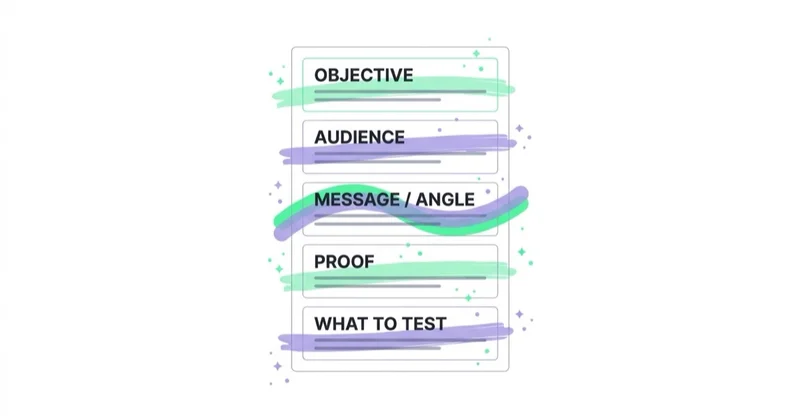
Use references to explain intent, not to invite copying. Mark mandatory claims, disclaimers, product shots and brand elements. Then identify the variable the creative testing framework should evaluate. A brief for a production asset may be detailed; a brief for creator exploration may deliberately offer more latitude.
What a paid-ads creative brief must contain
A complete brief normally contains:
- Business context and objective — the problem, product economics, campaign role and desired action.
- Audience and insight — who, in which situation, what they believe now, and evidence for that understanding.
- Offer and proposition — what is available, material terms, landing destination and why the audience should care.
- Hypothesis and variable — the angle, hook, demonstration, proof or format being evaluated against what control.
- Claims and substantiation — approved objective and implied claims, sources, typicality, required qualifications and prohibited language.
- Deliverables and distribution — platforms, placements, aspect ratios, durations, copy fields, captions, thumbnails and localisation.
- Brand and accessibility requirements — recognition, tone, contrast, readable text, captions and information that cannot rely on one sensory mode.
- Rights, approvals and operations — talent, music, usage, territories, duration, source files, deadlines, owners and approval stages.
- Measurement plan — audience, budget, primary metric, guardrails, conversion delay, test duration and decision rule.
Exact wording and frames may be necessary for a regulated claim, demonstration, translation, disclosure or tightly controlled brand asset. For exploratory concepts, define intent and boundaries and let the maker propose execution. The brief should label which elements are fixed and which are test variables.
Glossary
- Creative brief — the document specifying what ad creative should communicate and test.
- Angle — the perspective used to frame the audience's problem, desired outcome or reason to believe.
- Hook — the opening device intended to establish relevance and earn continued attention.
- Substantiation — evidence held before publication to support objective express and implied advertising claims.
- Constraint / do-not — claims, tone or elements the creative must avoid or include.
- Over-scripting — specifying execution so tightly it kills the maker's craft and authenticity.
Leave execution to the maker
Creative freedom should be assigned, not assumed. A creator may need freedom in voice and delivery while the claim, disclosure, product use and call to action remain controlled. In other cases, a storyboard protects a complex demonstration or expensive shoot. The level of specification follows risk, cost, repeatability and the purpose of the asset.
For UGC and creator content, ask creators to disclose material connections and speak from genuine experience. A testimonial is not, by itself, substantiation for a product claim. Provide escalation routes when a creator cannot honestly say or demonstrate what the script requests.
How Space Ads approaches creative briefs
Our paid-creative briefs connect the commercial objective, audience evidence, proposition, substantiated claims, platform delivery and test plan. Each requirement is marked as fixed, optional or experimental so strategy, legal, production and media know where judgment belongs.
The deliverable matrix covers placements, versions, captions, rights, source files and approvals. The measurement section defines a control, decision rule and guardrails before results arrive. This creates reusable learning without promising that any brief will produce a “winner.” The process supports our ad creative and video production work.
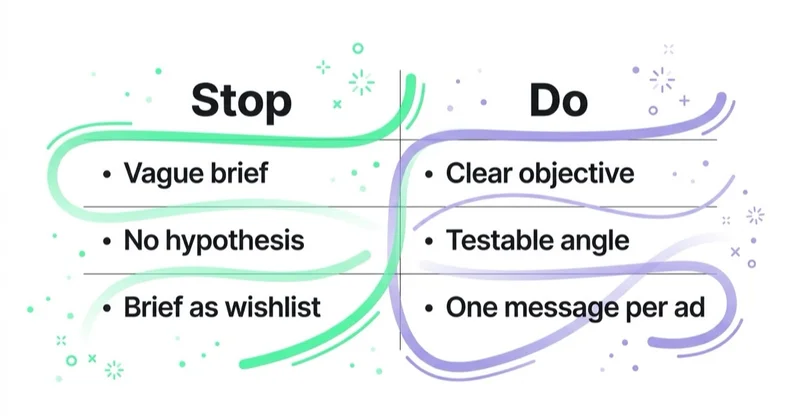
Stop doing / Do instead
| Stop doing | Do instead |
|---|---|
| Starting with a mood board alone | Start with objective, audience evidence and proposition |
| Treating every element as fixed | Mark mandatories, freedoms and the single test variable |
| Producing variants with no hypothesis | Define the decision each variation can inform |
| Using testimonials as proof of the claim | Hold substantiation and document disclosure requirements |
| Saying only “vertical video” | Provide placement specs, safe zones, captions and deliverable matrix |
| Leaving rights until after production | Define talent, music, edit, territory, duration and source-file rights |
FAQ
What should a creative brief for paid ads include?
Include business objective, audience evidence, offer and landing page, hypothesis, approved claims and substantiation, deliverables by placement, brand and accessibility requirements, rights, owners, deadlines, approvals and measurement. State which elements are mandatory and which are creative or test variables. Exact wording or art direction may be appropriate where risk or production requires it.
How is a paid-ads brief different from a normal creative brief?
It adds media-delivery and experimental detail: objective, placement variants, platform policies, landing destination, budget or traffic context, conversion delay and decision rule. It still performs the traditional brief's alignment role across audience, proposition, brand and production. Art direction and performance requirements should support the same strategy.
Should a creative brief specify the exact copy?
Sometimes. Exact language may be needed for regulated claims, disclosures, legal approval, localisation or repeatable demonstrations. Creator-led work may benefit from looser phrasing so the delivery remains genuine. Label non-negotiable facts and prohibited claims, then let the maker propose language within those boundaries.
How many angles should a creative brief cover?
Only as many distinct hypotheses as the production and media plan can evaluate. If several angles launch simultaneously under adaptive delivery, the platform may not allocate a fair comparison. Prioritise by expected value and evidence, and use sequential or controlled tests when causal learning matters.
Why does creative quality depend on the brief?
The brief improves alignment and reduces avoidable rework, but it does not determine performance alone. Customer insight, offer, maker skill, media delivery, landing experience and market conditions also matter. A strong brief makes assumptions testable and preserves learning even when the creative does not win.
Key takeaways
- A paid-ad brief aligns strategy, production, compliance, media and measurement.
- Include audience evidence, offer, substantiated claims, deliverables, rights, approvals and a test plan.
- Mark which elements are mandatory, flexible and experimental; specification level depends on risk and purpose.
- Make creative accessible and placement-ready, including captions and safe-zone checks.
- A good brief cannot guarantee a winner; it makes the outcome interpretable and the learning reusable.
Sources and further reading
- TikTok for Business — Creative best practices for performance ads
- US Federal Trade Commission — Advertising and marketing basics
- US Federal Trade Commission — Consumer reviews and testimonials rule
- W3C Web Accessibility Initiative — Making audio and video accessible
Continue learning
Continue reading
An Ad Creative Testing Framework That Actually Finds Winners
Creative testing should separate finding an ad that can scale from proving why it works. This framework covers hypotheses, controls, randomised experiments, primary metrics, sample size, conversion delay, decision rules, and iteration.
Static vs Video Ads: Which Converts, and When to Use Each
Static and video ads can both sell. The useful question is which format communicates a specific idea in a specific placement at an acceptable total cost. This guide shows how to choose and test them fairly.
How Many Ad Creatives Do You Need Per Campaign?
The right creative count depends on the platform format, objective, audience, budget and question being tested. Use this framework to plan coverage, testing and refreshes without manufacturing a magic number.