There is no platform-wide answer to “how many creatives per campaign?” A Meta ad, a responsive Search ad and a Performance Max asset group are different objects. They have different limits, placements and reporting. The useful question is: how much distinct creative coverage does this campaign need, and how many hypotheses can the budget evaluate responsibly?
Start with the platform's current format requirements. Then add only assets or ads that introduce a meaningful message, format, audience insight or placement adaptation. More files do not automatically create more learning, and automated delivery is not a fair A/B test of every creative.
TL;DR
- Separate ads from assets. Meta ads, Google responsive-ad text assets and Performance Max images or videos should not share one count.
- Cover the required formats first. Build for eligible placements and aspect ratios before producing cosmetic variants.
- Count distinct hypotheses. A new hook, proof point, offer or visual mechanism adds learning; a colour change often does not.
- Budget determines test capacity. Estimate whether the campaign can reach a useful sample and enough mature conversions for the chosen decision rule.
- Delivery is adaptive. An ad receiving little spend is not necessarily disproved, and the highest-spend ad is not automatically the causal winner.
- Refresh from evidence. Add or replace creative when performance, audience exposure, product priorities or the test roadmap justify it—not on an arbitrary weekly schedule.
Why there's no magic number
A fixed answer ignores the unit being counted. In Meta, several ads may sit within an ad set. In Google Search, one responsive ad can contain multiple headlines and descriptions that are assembled in combinations. Performance Max uses asset groups with specified text, image, logo and video requirements. Platform maximums are capabilities, not instructions to fill every slot with near-duplicates.
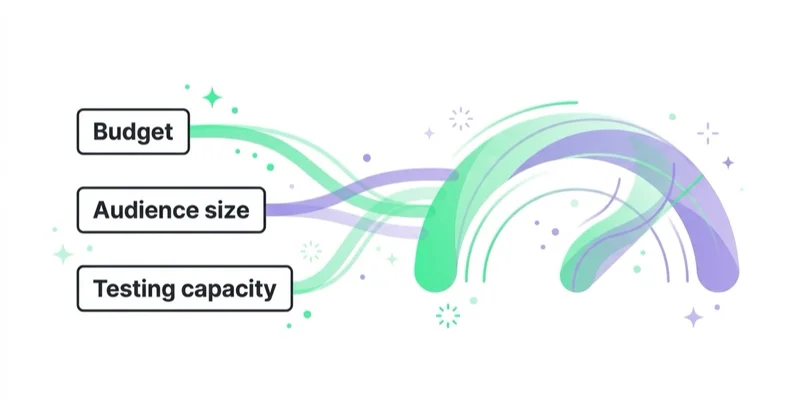
The number also depends on the decision. A campaign may need broad format coverage for delivery but only one controlled creative hypothesis at a time. Conversely, a qualitative screening round can compare several concepts before media spend. Define whether the work is for coverage, optimisation or causal learning; each purpose leads to a different plan.
It scales with budget and conversion volume
Budget and conversion volume limit how many questions can be answered, but delivery is rarely split evenly across creatives. Before launch, estimate baseline conversion rate, conversion delay, minimum effect worth detecting and the traffic or spend needed. If the account cannot support that test, narrow the hypothesis, use a higher-frequency upstream metric with clear limitations, pool compatible traffic or use qualitative research.
Do not describe individual creatives as “stuck in learning.” Meta's learning status applies at ad-set level, and Google reports its automated systems differently. Low delivery can result from predicted performance, overlap, eligibility, format, bid strategy or limited demand—not just creative count. Use the creative testing framework to separate platform optimisation from a controlled comparison.
Glossary
- Creative — a single ad (image, video) tested within a campaign or ad set.
- Asset — a component such as a headline, description, image, logo or video that a platform may combine into ads.
- Ad set / asset group — platform-specific containers; they are not interchangeable units.
- Creative hypothesis — a testable proposition about a message, visual, proof point, offer or format.
- Creative fatigue — a diagnosis for deteriorating response associated with repeated exposure, after other causes are checked.
- Minimum detectable effect — the smallest performance difference a planned test is designed to detect.
Plan coverage, experiments and refresh separately
First build coverage: the messages and formats needed for the campaign's audiences, placements and compliance requirements. Google publishes explicit minimums, recommendations and maximums for Performance Max assets. Responsive Search ads support up to 15 headlines and four descriptions, but those assets must remain coherent in the combinations that can serve.
Then plan experiments from the test capacity. Prioritise differences that could change a decision: customer problem, offer, demonstration, proof or creator style. Platform asset and combination reports describe delivery and relative signals, but they do not recreate a randomised test.
Finally set a refresh trigger. Review sustained changes in cost, conversion rate, reach, frequency, audience saturation, offer relevance and business outcomes. Replace a creative when the diagnosis supports it or a better hypothesis is ready. A calendar can organise production, but it should not manufacture creative fatigue where the evidence does not show it.
How Space Ads approaches creative count
We separate platform compliance, creative coverage and experimental learning. The launch inventory covers the required placements and distinct strategic angles. The test roadmap is limited by traffic, mature conversions and the commercial importance of the decision—not by a weekly output quota.
We analyse uneven delivery without assuming that every low-spend ad failed, and we use experiments when causal comparison matters. Refresh priorities combine platform data with product launches, customer research, margin and production capacity. This is how our ad creative and Meta Ads work connects output to decisions.
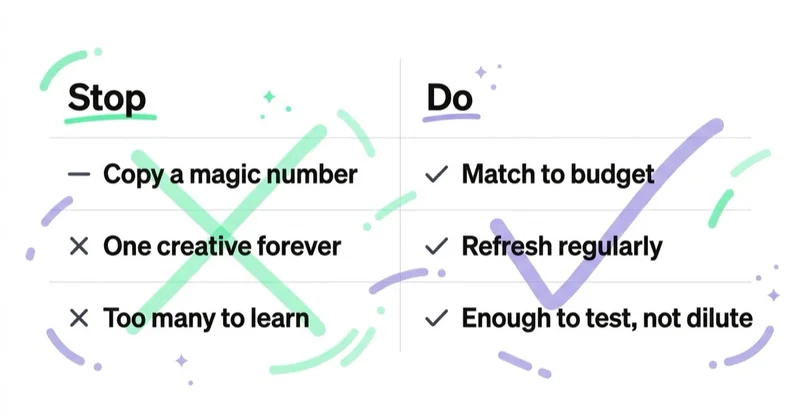
Stop doing / Do instead
| Stop doing | Do instead |
|---|---|
| Chasing one number across platforms | Identify whether you are counting ads, assets or asset groups |
| Filling every slot with small variations | Add distinct, placement-ready creative ideas |
| Calling automated delivery a fair test | Use an appropriate experiment for causal comparison |
| Refreshing every week by rule | Refresh when evidence or the commercial roadmap justifies it |
| Judging on platform conversions alone | Check margin, lead quality and downstream outcomes |
FAQ
How many ad creatives should I run per campaign?
There is no universal number. Identify the platform object first, meet current format requirements, cover distinct messages and placements, then limit active hypotheses to what the budget and conversion volume can evaluate. A small account may need a narrow test; a large one may support several segments, but neither should use arbitrary “two or three” guidance without a power and delivery assessment.
Is it better to run more or fewer creatives?
Neither. Too little format or message coverage can limit relevance; many near-duplicates add complexity without useful learning. Automated platforms allocate delivery adaptively, so the relationship is not a simple even split. Choose the smallest set that covers the strategy and the largest test plan the account can evaluate responsibly.
How often should I add new creatives?
Maintain a production pipeline, but publish from evidence rather than a universal cadence. Refresh when performance deterioration survives a broader diagnosis, when audience or placement coverage is missing, when the offer changes, or when the next high-value hypothesis is ready. Some evergreen creative can remain effective; novelty alone is not a business outcome.
Why are my creatives not getting enough data?
Low delivery can reflect predicted performance, format eligibility, audience overlap, bid strategy, policy, limited demand or the surrounding campaign structure. Individual ads are not necessarily in their own learning phase. Check delivery and eligibility first; if causal comparison matters, use a test design that allocates traffic appropriately rather than waiting for the default system to distribute it evenly.
Does the ideal number differ between Meta and Google?
Yes. Meta commonly delivers discrete ads inside ad sets, while Google Search assembles headline and description assets and Performance Max uses asset groups across inventory. Follow each product's current specifications and reporting. Do not apply Meta ad-level rules to Google assets or interpret a Google combination report as a Meta-style ad test.
Key takeaways
- Count the correct unit: ad, responsive-ad asset or Performance Max asset group.
- Cover placements and distinct strategic ideas before adding cosmetic variations.
- Budget and mature conversions limit the number of hypotheses, not necessarily the number of eligible assets.
- Automated delivery optimises; it does not guarantee a fair creative experiment.
- Maintain a pipeline, but refresh from diagnosis and commercial priorities rather than a fixed calendar.
Sources and further reading
- Meta Business Help Center — About the learning phase
- Meta for Business — Ad creative strategy and placement coverage
- Google Ads Help — About responsive search ads
- Google Ads Help — Responsive Search ad combination reporting
- Google Ads Help — Performance Max specifications and format requirements
Continue learning
Continue reading
An Ad Creative Testing Framework That Actually Finds Winners
Creative testing should separate finding an ad that can scale from proving why it works. This framework covers hypotheses, controls, randomised experiments, primary metrics, sample size, conversion delay, decision rules, and iteration.
Static vs Video Ads: Which Converts, and When to Use Each
Static and video ads can both sell. The useful question is which format communicates a specific idea in a specific placement at an acceptable total cost. This guide shows how to choose and test them fairly.

UGC Ads: How to Brief, Source and Run Creator Content That Performs
Creator-led ads can make a product easier to understand, but paid content must not masquerade as an independent customer opinion. Learn how to source, brief, contract, disclose and test creator content responsibly.