"UGC ads" commonly describes paid creator content designed for social feeds: demonstrations, explanations, testimonials and direct-to-camera videos. The label can be misleading. Genuine user-generated content is volunteered by a customer; commissioned creator content is advertising and should be managed as such.
Natural delivery is valuable, but a paid ad must not pretend to be an independent review. The creator's experience and claims must be truthful, material connections need clear disclosure where required, and the brand needs the rights to edit and distribute the work. This guide covers the full process from brief to measurement. It is operational guidance, not legal advice; endorsement and advertising rules vary by market and category.
TL;DR
- Name the content accurately. A paid creator testimonial is not an unsolicited customer review.
- Vet for fit and risk. Assess communication skill, real product relevance, audience quality where applicable, brand safety and conflicts.
- Give creators evidence, not invented talking points. Every objective claim needs support; personal experience must be genuine.
- Make the ad recognisable. Use clear, prominent disclosures and the platform's branded-content tools where required.
- Contract the complete use. Define platforms, paid and organic media, territory, duration, edits, raw files, likeness, audio, exclusivity and AI use.
- Brief to the risk level. Some creators benefit from flexible phrasing; regulated or technical claims may require approved wording.
- Measure business quality. Watch time is diagnostic. Qualified sales, leads, returns, contribution and brand effects determine value.
Why UGC ads work
Creator content can work because a person can demonstrate use, answer an objection and translate a brand claim into everyday language. It can also provide footage suited to a vertical feed and a credible point of view. None of those benefits requires hiding the commercial relationship.
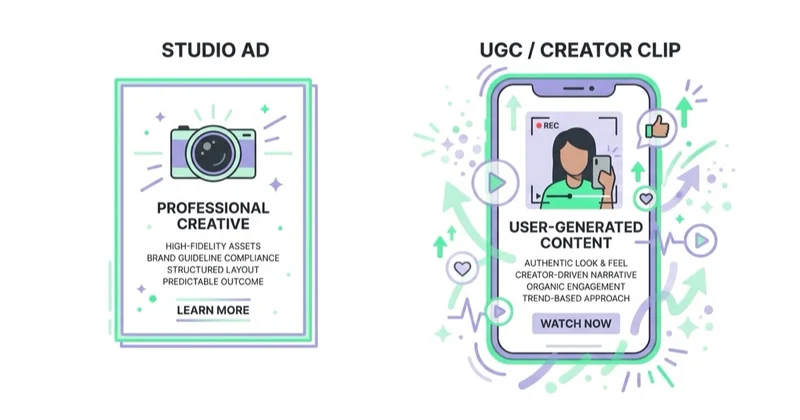
Regulators distinguish honest endorsements from deceptive ones. In the US, FTC guidance says an endorser should not describe an experience they have not had, material connections should be obvious, and claims requiring evidence cannot be invented by the creator. The FTC's Consumer Reviews and Testimonials Rule also prohibits specified fake or false reviews and testimonials. In the UK, CAP requires advertising to be obviously identifiable. The relevant rules depend on the audience's market, not only where the creator lives.
Use creator-led ad for commissioned work and reserve customer UGC for content a real customer supplied. If customer content is repurposed, obtain permission, preserve the meaning and do not turn a limited result into a typical-outcome claim.
Sourcing creators
Creators can come from a platform marketplace, specialist roster, direct outreach or an existing customer community. Before asking a customer to participate, confirm that consent is voluntary and that any incentive is not conditioned on positive sentiment.
Use a consistent scorecard:
- product and audience relevance;
- ability to explain and demonstrate clearly;
- examples of natural delivery and technical quality;
- past brand relationships, category conflicts and reputation risk;
- reliable process, revisions and deadlines;
- audience quality and reach if the creator's handle or distribution is part of the deal;
- accessibility, language and market fit;
- willingness to make required disclosures and follow approved claims.
Follower count is irrelevant when buying production alone, but it becomes relevant—alongside audience authenticity and brand fit—when the package includes organic distribution or partnership ads. Define whether the contract buys deliverables, reach, account permission or a combination.
The brief: direct the structure, not the script
The brief should make good work easier and unsafe work harder. Include:
- the audience situation and one communication objective;
- the approved proposition and evidence for objective claims;
- the creator's genuine experience that may be described;
- mandatory product moments, price or offer qualifications and call to action;
- prohibited claims, sensitive topics and category-specific review steps;
- the required disclosure and where it must appear;
- deliverables, aspect ratios, duration range, captions, safe zones and raw footage;
- audio, location, third-party marks and privacy restrictions;
- review rounds and who approves factual, legal and brand elements.
Flexible phrasing often preserves the creator's voice, but "never script" is not a rule. Financial, health, environmental and other regulated claims may need controlled wording. Even then, the creator must not present an approved line as their personal result unless it is true. Ask for a treatment or draft before production so corrections are cheaper and less intrusive.
The opening matters, but it cannot rescue a weak claim
The opening should quickly establish relevance: the product, problem, use case or credible result. Watch-time curves can show where attention falls, but they do not prove that the opening caused a sale. A sensational or negative hook may increase retention while attracting the wrong audience or damaging trust.
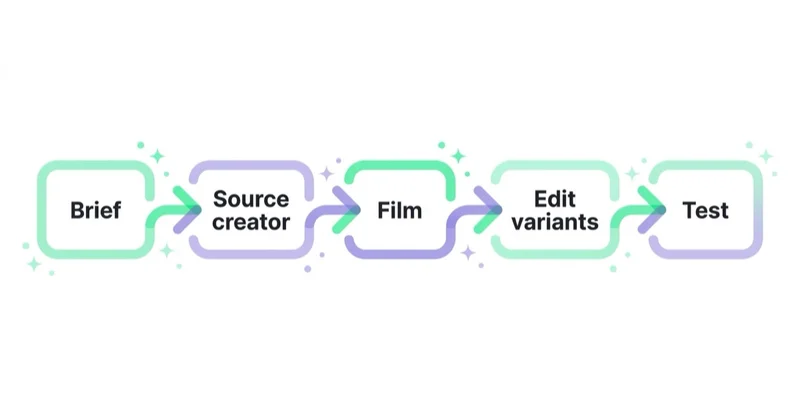
Film alternate openings when the budget can support a useful test. Keep the body, offer and destination stable where possible, and label each variation. Avoid fake controversy, fabricated reactions and results the creator did not achieve. Test other high-impact variables too: proof, demonstration, objection, offer and call to action.
Glossary
- Creator-led ad — commissioned advertising featuring a creator; often called a UGC ad.
- Customer UGC — content voluntarily created by a genuine customer, requiring permission before brand reuse.
- Hook — the first 1-2 seconds that decide whether the viewer keeps watching.
- Usage rights — the legal permission to use a creator's content in paid ads, for a defined time and scope.
- Partnership ad / Spark Ad — platform-specific paid use involving a creator identity or authorised post; permissions and eligibility apply.
- Material connection — a relationship such as payment, free product, employment or family connection that may require disclosure.
- Creative testing — running variations (especially hooks) to find winners and retire losers.
Usage rights and whitelisting
Written terms should cover the creator's services and the licence. At minimum, specify deliverables, platforms, paid and organic use, account/handle permissions, territory, duration, spend or impression limits if any, edit and adaptation rights, raw footage, creator name/likeness/voice, exclusivity, approval, takedown, renewal and fee. Confirm rights to music, locations, other people, trademarks and embedded material.
Address synthetic use explicitly. Do not assume permission to clone a creator's face or voice, train a model, generate new lines or keep a digital replica after the licence ends. State whether AI-assisted edits are permitted and require approval for uses that could change the creator's meaning.
Meta partnership ads and TikTok Spark Ads have separate technical permissions and eligibility. Spark Ads can use owned or authorised organic posts; Meta provides content- and account-level partnership permissions. These tools do not replace the commercial agreement, disclosure duties or underlying intellectual-property rights. Avoid the ambiguous term "whitelisting" in contracts unless it is precisely defined.
Disclosure and claims checklist
- Identify the target markets and applicable advertising, endorsement and sector rules.
- Use a clear disclosure that people can notice and understand; do not hide it after "more" or among hashtags.
- For video endorsements, place the disclosure in the content where required, not only in the caption. Consider both visual and audio communication.
- Use the platform's paid-partnership label where applicable, but do not assume that tool alone satisfies every market's standard.
- Confirm that the creator actually used the product before describing personal experience.
- Substantiate objective claims and qualify atypical results clearly.
- Monitor live content and ads; approval on paper is not enough if the published version changes.
Where UGC fits with AI and studio content
Creator, customer, studio and AI-assisted content are production approaches, not fixed funnel roles. Use the approach that can communicate the idea accurately, safely and at the required quality. A creator may deliver a premium product film; a studio may produce a direct demonstration.
AI can support transcripts, captions, translation, storyboards or approved adaptations, but low cost does not remove review, consent or disclosure needs. Synthetic people must not be presented as genuine customers, and a generated testimonial must not imply an experience that never happened. Read more in AI UGC ads.
How Space Ads approaches UGC ads
We use one operating record from sourcing through reporting: creator scorecard, approved brief, claim evidence, contract scope, disclosure requirement, platform permission, asset versions and test result. This reduces the risk of a strong asset being unusable because rights or substantiation were missed.
The test plan separates the opening, proposition, proof and offer where volume allows. Reporting connects creative diagnostics with confirmed sales, qualified leads, new-customer share, returns and contribution. Renewal decisions consider total production and licence cost as well as media performance. The work lives in ad creative, video production and Meta Ads.
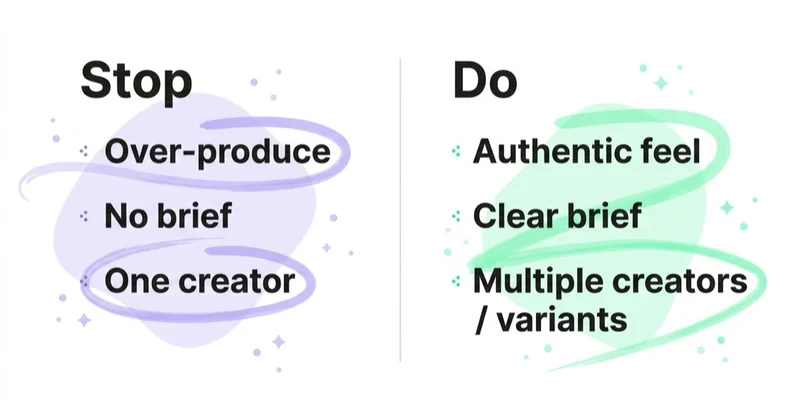
Stop doing / Do instead
| Stop doing | Do instead |
|---|---|
| Making a paid ad look like an independent review | Disclose the relationship clearly and preserve truthful experience |
| Selecting only by follower count | Score production fit, risk and audience quality for the actual scope |
| Giving unsupported claims to a creator | Provide an approved claim-and-evidence matrix |
| Treating a post permission as a full licence | Contract platforms, duration, edits, likeness, audio and paid use |
| Assuming AI may clone or rewrite a creator | Obtain explicit permission and define prohibited synthetic uses |
| Judging on watch time or platform CPA | Review qualified outcomes, contribution and total content cost |
Common mistakes
Common failures are undisclosed material connections, testimonials from people who did not use the product, unsupported before-and-after or health claims, and contracts that omit paid use or editing. Teams also overlook music, likeness and location rights, or rely on a platform permission after the commercial licence has expired. These are governance failures, not creative optimisation issues.
FAQ
What are UGC ads?
The term usually means paid creator-led advertising designed in a social-feed style. It may be a demonstration, explanation or truthful testimonial. Commissioned creator content should not be confused with unsolicited customer content, and a paid relationship must be disclosed where required.
How do I find creators for UGC ads?
Use platform marketplaces, specialist rosters, direct outreach or an opt-in customer programme. Score communication ability, product relevance, reliability, disclosure compliance, conflicts and brand safety. If distribution through the creator's handle is included, validate audience quality and reach as well.
How should I brief a UGC creator?
Provide the audience problem, approved claims and evidence, genuine experience, mandatory product moments, prohibited claims, disclosure, deliverables and review process. Allow natural phrasing when appropriate, but use approved wording where regulation or technical accuracy requires it. Never script a personal result the creator did not have.
Do I need usage rights to run UGC as ads?
Yes. Obtain written permission covering the intended platforms, paid and organic use, territory, duration, edits, raw footage, likeness, audio, exclusivity and account permissions. Platform partnership or Spark Ads authorisation is additional; it does not replace the underlying agreement. Obtain legal advice for high-risk markets or categories.
Is UGC better than studio or AI-generated content?
No production method is universally better. Choose the one that can communicate the claim accurately in the intended placement at an acceptable total cost. Treat synthetic people and AI-generated testimonials with particular care: they must not imply a real customer experience that did not occur.
How many UGC ads should I test?
There is no fixed number. It depends on budget, expected conversion rate and the minimum evidence needed for a decision. Start with a few genuinely different concepts and one useful control; add variations only when each can receive enough delivery. More assets without decision volume create noise, not learning.
Key takeaways
- Paid creator content should be natural but clearly recognisable as advertising.
- Genuine experience, claim substantiation and prominent disclosures come before optimisation.
- Define whether the deal buys content, distribution, account permission or all three.
- Contract paid use, duration, edits, likeness, music, exclusivity and AI rights explicitly.
- Measure confirmed business outcomes and total content cost, using watch metrics as diagnostics.
Sources and further reading
- US Federal Trade Commission — Endorsements, influencers and reviews guidance
- US Federal Trade Commission — Consumer Reviews and Testimonials Rule: questions and answers
- UK ASA/CAP — Recognising ads in brand-owned and paid social media
- Meta Help Center — Partnership ads and permission management
- TikTok Business Help Center — Spark Ads and creator authorisation
Continue learning
Continue reading
An Ad Creative Testing Framework That Actually Finds Winners
Creative testing should separate finding an ad that can scale from proving why it works. This framework covers hypotheses, controls, randomised experiments, primary metrics, sample size, conversion delay, decision rules, and iteration.
How Many Ad Creatives Do You Need Per Campaign?
The right creative count depends on the platform format, objective, audience, budget and question being tested. Use this framework to plan coverage, testing and refreshes without manufacturing a magic number.
One Creative Won't Fit All: Ad Creative for Meta vs TikTok vs Google
A strong concept can travel across Meta, TikTok, and Google, but the same file may not suit every placement. Learn what to preserve, what to adapt, which specifications matter, and how to test cross-platform creative without relying on stereotypes.