A language school often contains two commercial motions: consumer enrolment and corporate training. They may share teachers and a brand, but the buyer, timetable, evidence, sales process and measurement are different. A parent comparing children's classes is not asking the same questions as an L&D manager procuring training across several teams.
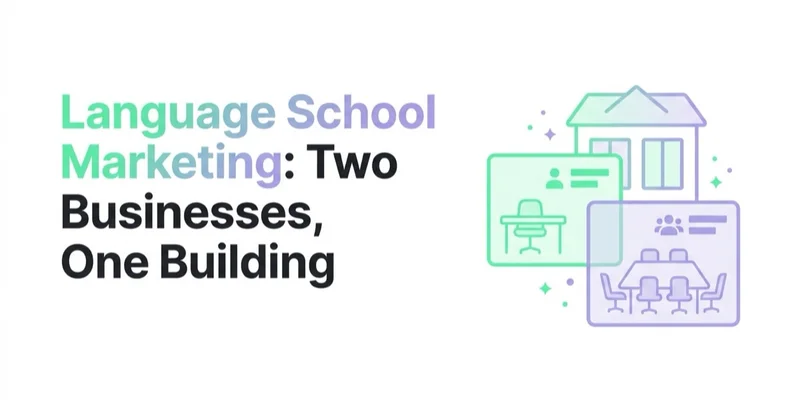
The practical strategy is to separate the journeys without fragmenting operations. Build distinct offers, pages, campaigns, CRM stages and targets for each audience; then manage them against shared teacher capacity, timetable, classroom/online delivery and contribution.
TL;DR
- Separate consumer and corporate funnels, then segment further by learner need: children/parents, adults, exams, relocation, professional language or conversation.
- A trial lesson is one possible conversion mechanism, not a universal final KPI. Track attendance, assessment, enrolment and payment.
- Map seasonal demand by actual course and market; do not assume every programme peaks only in September and January.
- Sell specific outcomes, format, timetable and evidence—not “effective learning with experienced teachers”.
- Use recognised frameworks such as CEFR accurately. A CEFR-aligned level claim is not the same as external accreditation or an exam guarantee.
- Return enrolled/qualified outcomes to advertising platforms where lawful and technically appropriate.
- Optimise group fill and contribution, not aggregate lead volume. A full waiting list for Tuesday does not fill Thursday's course.
- Calculate acquisition against contribution and observed continuation, with a risk-adjusted payback window.
One school, several distinct buying journeys
The B2C/B2B distinction is the first split, not the last.
| Segment | Buyer | Trigger | Evidence needed | Likely conversion path |
|---|---|---|---|---|
| Children's courses | Parent/guardian | School support, confidence, exam or enrichment | Safeguarding, teacher fit, schedule, progress communication | Enquiry/assessment → trial or consultation → enrolment |
| Adult general language | Learner | Travel, confidence, integration or personal goal | Level fit, practical method, timetable, atmosphere | Placement → trial/direct enrolment → payment |
| Exam preparation | Learner/parent | Test date and score/qualification need | Exam expertise, plan, realistic preparation time | Consultation/test → course → exam |
| Professional/sector language | Learner/employer | New role, client work or relocation | Relevant scenarios, teacher expertise, measurable outcomes | Needs analysis → programme recommendation |
| Corporate training | HR/L&D/manager/procurement | Capability gap across a team | Delivery model, reporting, security, administration and outcomes | Discovery → proposal → pilot or contract |
Create separate landing pages when intent, offer and proof genuinely differ. A single “English courses for everyone” page forces users to search through internal categories and gives advertising systems a weak relevance signal.
Position the course around a job to be done
Most schools describe inputs: qualified teachers, modern methods, small groups and friendly atmosphere. Buyers need to understand the resulting experience and fit.
A strong offer answers:
- who the course is for and current/target level;
- practical outcome and context of language use;
- in-person, online or hybrid format;
- group size or individual delivery;
- schedule, duration, start date and missed-class policy;
- teaching and assessment method;
- what progress evidence the learner receives;
- total price, instalments and materials;
- what happens after the course;
- who should choose another option.
Use CEFR precisely
The Council of Europe's Common European Framework of Reference for Languages organises proficiency from A1 to C2 using “can-do” descriptors. Its Companion Volume extends descriptors across areas including mediation and online interaction.
CEFR is a framework for learning, teaching and assessment. Saying “our course follows a CEFR-aligned syllabus” is not the same as claiming the school is accredited by the Council of Europe, that a learner will automatically advance a full level, or that an internal certificate equals an external examination.
State:
- how placement is assessed;
- which skills are measured;
- what evidence supports progress claims;
- whether the certificate is attendance, internal achievement or an externally recognised qualification;
- which exam body, if any, is involved.
Avoid guaranteed fluency or score claims unless the exact wording can be substantiated and lawfully advertised in the target market.
Consumer funnel: the real conversion is enrolment
A trial lesson can reduce uncertainty and let the learner experience the teacher, but it is not automatically the best mechanism for every school. Alternatives include a placement consultation, paid starter workshop, open day, diagnostic test or direct enrolment with a clear change/cancellation policy.
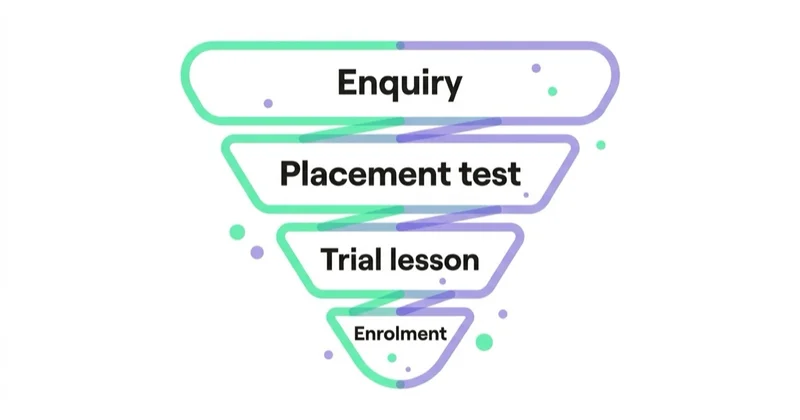
Map the full funnel:
- relevant page visit or call;
- enquiry, booking or placement-test start;
- qualified level/schedule fit;
- assessment/trial booked;
- assessment/trial attended;
- offer or recommended group;
- paid enrolment;
- first class attended;
- continuation or next-level enrolment.
Optimising only for submitted forms rewards low-friction leads, including people who cannot attend the available schedule or afford the course. Send later-stage outcomes back to campaign and analytics systems where consent, privacy, volume and platform requirements allow.
Reduce speed-to-contact and scheduling loss
A lead becomes less valuable when:
- no available group matches level and time;
- the school replies after the buyer has booked elsewhere;
- the placement process is unclear or too long;
- the trial date is far away;
- price and commitments appear only on the sales call;
- the prospect must repeat information across channels.
Automation can acknowledge and route an enquiry, but a fast generic reply is not the same as a useful answer. Show relevant schedules and availability on the page, then let the team confirm fit.
Placement is both service and qualification
A good placement process improves the buying decision and reduces the risk of a poor group match. Explain whether it measures listening, speaking, reading and writing or only a subset. A short online quiz may be useful for routing but insufficient for a high-stakes level claim.
Record placement result, preferred schedule, learning goal and recommended group in the CRM. This makes follow-up relevant and provides aggregate demand data for future timetables.
Seasonality is a capacity-planning problem
Many consumer courses experience demand around academic terms, new-year goals, exam dates, relocation cycles or summer programmes. The pattern varies by market, audience and product.
Build a rolling calendar from the school's own history:
| Period | Commercial task | Marketing task |
|---|---|---|
| 8–12 weeks before start | Confirm teacher and room capacity | Validate offer, pages, creative and early-interest lists |
| 4–8 weeks before start | Open priority groups | Increase demand capture and outreach |
| 1–4 weeks before start | Fill specific gaps | Shift budget by level, time and location |
| First course weeks | Reduce no-shows and early drop-off | Onboarding, expectation and support messages |
| Mid-course | Diagnose progress and satisfaction | Referral and continuation preparation |
| Before course end | Confirm next-level capacity | Offer continuation while fit and progress are visible |
Do not spread media evenly when commercial opportunity is uneven. Also do not stop all acquisition outside peak enrolment: individual lessons, corporate leads, exam preparation and evergreen online courses may follow different cycles.
Group economics and timetable-aware acquisition
Aggregate cost per enrolment can hide the operational result. A course group has fixed and variable costs and a maximum capacity.
expected group contribution = enrolled students × net fee per student − teacher cost − room/platform cost − materials − payment/variable service cost − allocated acquisition cost
Marketing should know:
- minimum viable and target group size;
- maximum pedagogically acceptable capacity;
- level, schedule, location and delivery mode;
- probability of cancellation or consolidation;
- deadline for a go/no-go decision;
- waitlist and alternative-group process.
Use course inventory in campaign and CRM decisions. Pause or redirect promotion for full groups, increase attention on viable underfilled groups and avoid collecting leads for a schedule the school cannot offer.
Illustrative group model
Suppose a 12-week group has:
- net fee per learner: £420;
- target of 8 learners;
- direct teacher, room, materials and variable administration cost: £2,200;
- acquisition cost: £800.
At eight learners, revenue is £3,360 and illustrative contribution is £360. At ten learners, with no additional teacher/room cost, it becomes £1,200 before fixed overhead. At five learners, the same group loses money.
These are hypothetical numbers, not benchmarks. The example shows why the marginal value of an enrolment depends on the exact group and capacity—not only an account-level CPA.
Corporate language training is a B2B service
Corporate buyers may include L&D, HR, procurement, a business-unit leader or an executive assistant. The learner and economic buyer may be different people.
Discovery should establish
- language tasks employees must perform;
- baseline skill and target outcomes;
- number, location and work pattern of learners;
- group, one-to-one or blended format;
- scheduling and cancellation requirements;
- reporting and stakeholder cadence;
- data protection, security and procurement needs;
- budget, approval process and decision date;
- how success will be evaluated.
Corporate proof
Useful evidence can include:
- anonymised sample reports;
- programme design and placement method;
- trainer selection and quality assurance;
- relevant sector scenarios;
- learner and manager feedback process;
- operational capacity across time zones or locations;
- case studies with clear context and permission;
- service levels and contingency planning.
A pilot can reduce risk when the programme is large or the delivery model is new. It is not a mandatory conversion stage for every contract. Define pilot participants, success criteria, reporting, price and expansion decision before it begins; otherwise it becomes unpaid delivery without a buying commitment.
The wider model is covered in B2B lead generation.
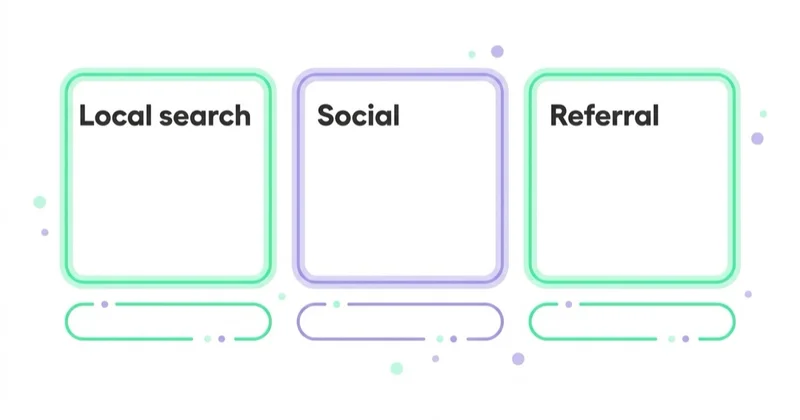
Channel strategy for language schools
Local and organic search
Build pages around actual services and locations, not hundreds of near-duplicate keyword pages. Keep name, address, phone, course information and location consistent. A Google Business Profile should reflect the real business, use accurate categories and remain controlled by the school.
Google currently disables/removes reviews for certain Business Profiles primarily categorised as general education schools for ages 6–18. This does not affect every education business, but it means a school should verify the current category and review availability rather than building its whole trust strategy on Google reviews.
Use authentic reviews where permitted, student stories with consent, teacher profiles, course information and clear policies. Google prohibits incentives in exchange for Business Profile reviews.
Paid search
Separate intent by language, location, audience, format and goal. Someone searching “business English for finance team” needs a different page and sales route from “evening Spanish course near me”.
Use negative keywords for jobs, free resources, translation requests or irrelevant exam terms as appropriate. Track calls, bookings, placement, attendance and enrolment—not only form submissions.
Paid social and video
Social works best when creative makes the experience tangible:
- short teacher explanations;
- a realistic class exercise;
- learner goal and progress story;
- common pronunciation or workplace scenario;
- course format and schedule;
- parent-facing explanation of progress reporting.
Avoid targeting or creative that exploits insecurity. For children, comply with platform rules, advertising standards and applicable data/privacy law; target the responsible adult unless a lawful, age-appropriate approach has been reviewed.
Content and email
Create content that resolves high-value decisions: choosing a level, preparing for an exam, comparing group and individual learning, using language in a role, and maintaining progress. Generic vocabulary articles may attract traffic without enrolment intent.
Email/SMS can support booked assessment attendance, onboarding, progress, renewal and referrals. Obtain appropriate permission and distinguish operational messages from marketing.
Partnerships and referrals
Potential partners include employers, relocation firms, universities, community organisations, exam centres and complementary education providers. Define lead ownership, consent, referral compensation and brand use.
A referral programme should reward genuine recommendations without buying positive public reviews. Measure referred enrolment and continuation separately.
Corporate search, LinkedIn and outreach
Use a named-account or segment hypothesis rather than a generic “corporate English” campaign. Offer useful diagnostics: a needs-analysis workshop, sample reporting plan or programme design—not a vague free consultation.
Coordinate paid media, outbound and CRM so the same company is not contacted by several unconnected people. Measure qualified opportunities and programme contribution over the full cycle.
Landing pages that help people enrol
Each priority offer page should include:
- audience and outcome;
- current/target level and placement method;
- schedule, format, location and start date;
- teacher and method information;
- group size/capacity where material;
- price and additional costs;
- what happens in a trial/assessment;
- evidence and realistic progress expectations;
- cancellation, missed-class and refund terms;
- accessible booking/contact route;
- answers to actual admissions questions.
For corporate pages, replace consumer timetable detail with programme design, reporting, administration, delivery capacity, security/procurement readiness and discovery route.
Retention and continuation economics
Language learning often spans multiple terms, but do not assume every enrolment produces a long lifetime. Measure cohort continuation by course, teacher, level, schedule, acquisition source and learner goal.
expected customer contribution = first-course contribution + probability-weighted contribution from later courses − expected service/refund cost
Set allowable acquisition cost against a conservative payback window. If continuation data is immature, use the first course and treat future value as upside rather than financing current overspend.
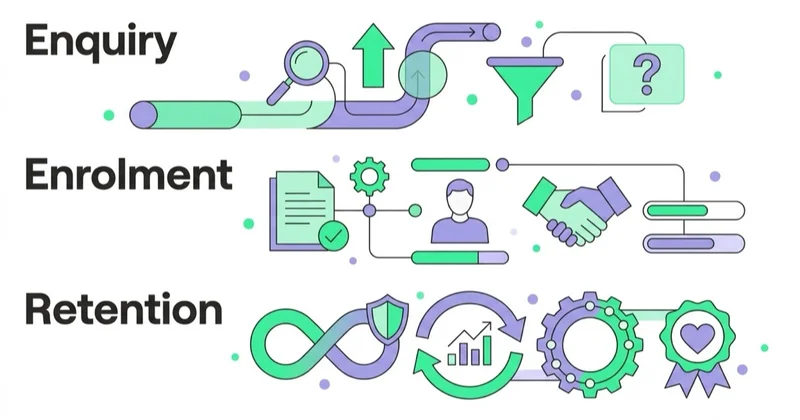
Improve continuation through the service
- accurate placement and expectations;
- reliable teaching and substitute process;
- visible progress using appropriate descriptors/evidence;
- intervention after absence or difficulty;
- schedule continuity and early next-level planning;
- simple re-enrolment and payment;
- a clear alternative when the original group cannot continue.
Marketing can communicate progress and timing, but it cannot manufacture retention if teaching, fit or scheduling fails.
Measurement architecture
Consumer dashboard
- leads/bookings by course, level and schedule;
- contact/booking speed;
- assessment/trial booking and attendance;
- qualified schedule/level fit;
- enrolment and payment;
- cost per enrolled student;
- first-class attendance and early withdrawal;
- group fill and contribution;
- continuation and cohort contribution;
- referral and review source.
Corporate dashboard
- target accounts reached/engaged;
- qualified discovery meetings;
- needs assessments;
- proposals and weighted pipeline;
- pilots where applicable;
- won programme value and contribution;
- sales-cycle length;
- learner participation and agreed outcome measures;
- renewal/expansion.
Keep the funnels separate, then reconcile them with shared capacity and finance. A corporate contract and eight consumer forms should never be averaged into one “lead conversion rate”.
Data and privacy
Language schools may process level assessments, attendance, children's data and employer-sponsored learning records. Apply role-based access, retention rules and clear notices. Do not expose individual learner progress to an employer beyond the agreed, lawful reporting scope.
The UK's Children's Code, for example, sets expectations for online services likely to be accessed by children, including profiling and best-interests considerations. Requirements vary by jurisdiction and service; obtain appropriate privacy and safeguarding advice.
A 90-day implementation plan
Days 1–30: economics and measurement
- separate B2C and B2B offers/funnels;
- map course capacity and group contribution;
- audit pages, search demand and local presence;
- define CRM stages and offline outcome imports;
- verify claims, CEFR language, consent and review process.
Days 31–60: launch priority journeys
- rebuild the highest-value pages;
- connect schedule/placement/booking flows;
- launch focused search and social tests;
- build corporate target segments and proof;
- start attendance, enrolment and cohort reporting.
Days 61–90: optimise the constraint
- move budget by qualified enrolment and group need;
- reduce booking/attendance loss;
- refine creative from objections and placement data;
- progress corporate opportunities with defined next steps;
- launch continuation and referral workflows;
- update acquisition targets with observed contribution.
Space Ads approach
Space Ads treats language-school growth as a combination of demand, capacity and learner economics. We separate consumer and corporate journeys, then connect campaigns to the CRM stages and course groups that create revenue.
Search, social, local presence and landing pages are built around specific learner intent. Reporting moves past enquiry volume to attendance, paid enrolment, fill, continuation and corporate pipeline. If the constraint is timetable, response speed or group economics, we identify it rather than hiding it with cheaper leads.
FAQ
How do I market a language school?
Segment by buyer and learning goal, create specific offers/pages, capture existing demand through local/search channels, demonstrate the teaching experience through social/video, and connect marketing to assessment, attendance, enrolment and continuation. Manage spend against available course capacity.
Should a language school offer free trial lessons?
A trial can reduce risk, but it is not mandatory. Use it when the experience helps the buyer decide and the school can follow up quickly. A placement consultation, paid workshop or direct enrolment may work better for other offers. Measure attendance and enrolment, not bookings alone.
What is the best advertising channel for language courses?
Paid/local search is strong for existing intent; social/video can demonstrate the experience; email, referrals and partnerships support trust and continuation; LinkedIn/outreach can support corporate sales. The best mix depends on audience, location, course economics and available creative.
When should language schools advertise?
Build a demand calendar from the school's courses and historical enrolments. Increase activity before term starts, exams and relevant seasonal triggers, while keeping evergreen programmes and corporate acquisition on their own cycles.
How should corporate language training be marketed?
Target the business need and buying group. Show needs analysis, programme design, delivery capacity, progress reporting and administrative fit. Track qualified opportunities, proposals, pilots where useful, won contribution and renewal separately from consumer enrolment.
What should the school optimise Google Ads for?
Initially use the deepest reliable event with enough timely volume, then import paid enrolment or qualified stages where feasible. Do not let every enquiry, brochure view and paid course drive bidding as if they were equal.
How should course lifetime value be calculated?
Use contribution from the first course plus probability-weighted contribution from observed continuation cohorts, within a chosen payback period. Deduct teaching, rooms/platforms, materials, refunds and variable service costs. Avoid assuming years of retention without evidence.
Can a school say its courses are CEFR accredited?
CEFR is a Council of Europe reference framework, not in itself a school accreditation. Describe how the curriculum, placement or assessment uses CEFR descriptors and separately name any genuine accreditation or external exam relationship.
Key takeaways
- Separate consumer enrolment and corporate sales in offer, campaign, CRM and reporting.
- Segment consumer demand by goal, buyer, level, schedule and format.
- Treat trial/assessment as a stage; paid enrolment and group contribution are the commercial result.
- Use CEFR, accreditation, exam and progress claims precisely.
- Align acquisition with teacher/timetable capacity and course economics.
- Measure continuation from real cohorts and use conservative contribution in CAC targets.
- Protect children's and learner data and keep public review practices compliant.
See how Space Ads approaches performance marketing and lead generation.
Sources and further reading
- CEFR levels and descriptors — Council of Europe
- CEFR Companion Volume — Council of Europe
- Google Business Profile representation guidelines
- Google reviews guidance for educational institutions
- Google Business Profile review policy and best practices
- ICO guidance on children's data and profiling
- B2B lead generation
Continue reading
Driving School Marketing: Selling Instructor Hours, Not Courses
A practical system for growing a driving school around real instructor capacity: local demand, transparent lesson offers, compliant proof, responsive booking and completed-pupil value.
Bike Shop Marketing: The Workshop Pays the Rent
A practical marketing system for bike retailers and workshops: model capacity and contribution, capture local service demand, promote in-stock bikes, and turn first visits into lasting customer relationships.

Car Rental Marketing: Selling a Perishable Asset on a Fixed Calendar
Car rental marketing must connect live availability, total price, location, vehicle class and completed-rental value. This guide shows how to acquire demand without separating media from fleet economics.