B2B lead generation is the process of creating and capturing demand from relevant businesses, then turning that demand into sales opportunities. A form submission is only the first observable event. The commercial result depends on fit, contactability, sales follow-up, qualification, deal progression, margin and the time it takes to close.
“Predictable pipeline” does not mean guaranteed revenue on schedule. It means the company has stable stage definitions, enough historical cohorts to estimate conversion ranges, known sales-cycle delays and a feedback loop between marketing and sales. Paid media and SEO can then be planned against qualified pipeline rather than against the cheapest possible form.
The system works only if marketing, sales and finance use the same definitions. If sales rejects a lead without a reason, CRM stages are skipped or campaign reports count duplicate enquiries, the forecast will look precise while resting on weak data.
TL;DR
- B2B lead generation should be measured through the funnel. Track raw enquiries, valid leads, accepted leads, opportunities and won revenue using definitions agreed with sales.
- Paid media and SEO play different roles. Paid media captures and tests demand quickly; SEO builds durable visibility around problems, comparisons and category education.
- CRM feedback is essential for learning. Importing a later-stage outcome can help an ad platform optimize beyond shallow form fills, but only when the stage is frequent, timely and consistently applied.
- The offer changes who responds. A demo, audit, calculator, guide and newsletter signal different intent; compare their progression to opportunity rather than their form conversion rate alone.
- Nurture is not a holding pen for every weak lead. Define who should enter it, which permission or lawful basis applies and what behavior returns the account to sales.
- A landing page is a qualification tool. It should filter weak-fit leads as much as it converts good-fit ones.
- “Predictable” requires cohorts and lag. A June lead that closes in September belongs to the June acquisition cohort; same-month dashboards can misread long sales cycles.
What B2B lead generation really includes
B2B lead generation includes the work between a market problem and a qualified sales opportunity. A complete operating model covers:
- serviceable market and ideal customer profile (ICP) definition;
- offer and positioning;
- paid search, paid social and retargeting;
- SEO and content for problem-aware buyers;
- landing pages and conversion tracking;
- CRM routing and lifecycle stages;
- sales qualification rules;
- offline conversion imports;
- deduplication, spam handling and reporting by acquisition cohort;
- nurture content for buyers who are not ready yet.
That is why demand generation and lead generation should not be treated as the same job. Demand generation builds awareness, understanding and preference among a market; lead generation captures identifiable interest. The same person can move between both, but their short-term scorecards should not be collapsed into cost per lead.
B2B lead generation vs B2C lead generation
| Area | B2B lead generation | B2C lead generation |
|---|---|---|
| Decision process | Often multiple roles, internal approval and a longer cycle | Often one person or household and a shorter cycle |
| Main conversion | Demo, audit, consultation, quote, discovery call | Call, appointment, sale, store visit, short form |
| Lead quality signal | Role, company size, problem fit, budget, urgency | Location, need, timing, service fit |
| Follow-up | Sales development, account executive, nurture sequence | Call center, booking flow, automated reminder |
| Measurement | accepted lead, meeting, opportunity, pipeline and won revenue | lead, booked job, purchase and lifetime value |
| Main risk | Cheap leads that never become pipeline | High lead cost or low booking rate |
B2B lead generation fails when every submission has the same value. A job seeker, supplier, existing customer, researcher and active buyer can all use the same form. The ad platform sees five conversions unless the CRM sends back five different outcomes.
Define stages before choosing metrics
Terms such as MQL and SQL are not universal. One company may call a downloaded guide a marketing-qualified lead; another reserves that stage for an account that matches firmographic and behavioral criteria. Use plain operational definitions first.
| Stage | Example entry rule | Required exit or loss reason |
|---|---|---|
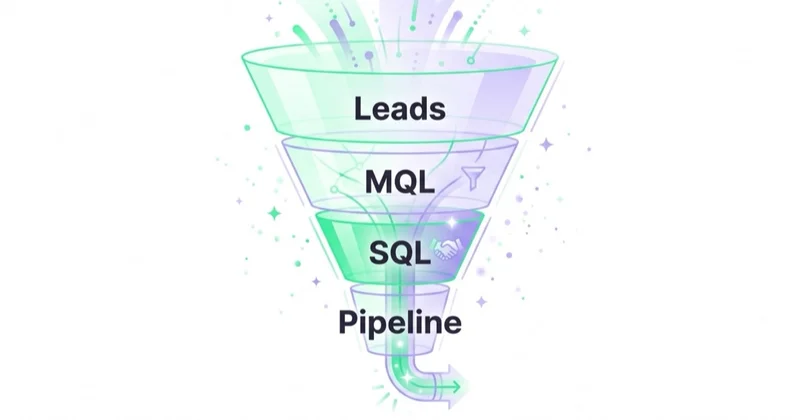
| Enquiry | A unique person or company submits a form or makes a trackable call | Valid, duplicate, spam, support, job or other |
| Valid lead | Contact details work and the request relates to the offer | Accepted by sales, nurture or disqualified |
| Sales-accepted lead | Sales agrees the account merits direct follow-up | Meeting, no contact, no interest or disqualified |
| Qualified opportunity | Need, fit, buying process and a real next step are confirmed | Progressed, lost, delayed or won |
| Won deal | Contract or order meets the company's finance rule for booked revenue | Revenue, margin and acquisition cohort recorded |
The exact rules will differ. What matters is that each stage has an owner, timestamp, entry condition and controlled reason for leaving. “Sales did not like it” is not a usable rejection category.
Start with ICP and buying triggers
The first step is not choosing Google Ads, LinkedIn or Meta. It is defining which accounts the company can serve profitably, which people influence the decision and what change makes the problem urgent.
Useful ICP fields:
- company size or another variable that genuinely predicts fit;
- industry or operating model;
- geography only where service delivery depends on it;
- users, evaluators, decision-makers, procurement and other relevant roles;
- technology stack;
- current pain;
- how the purchase is funded and approved;
- urgency;
- disqualifiers.
Useful buying triggers:
- cost per lead is rising;
- sales is rejecting many leads;
- a new market is opening;
- a competitor is gaining visibility;
- CRM reporting is unreliable;
- paid media is scaling but pipeline is flat;
- a board, founder or finance team needs clearer marketing evidence;
- a category is becoming more competitive in search or AI answers.
Do not fill the ICP with data simply because an advertising platform can target it. Each field should change the offer, qualification or channel decision. “We help companies grow” is not a trigger. “Paid media is producing enquiries that sales rejects” is specific enough to shape a diagnostic offer and landing page.
An ICP is a hypothesis until the company compares it with won, lost and unprofitable accounts. Review not only close rate but also sales effort, implementation burden, gross margin, retention and payment behavior. The easiest account to acquire is not necessarily the best account to keep.
Paid media channels for B2B lead generation
Paid media can create feedback faster than organic search, but speed does not make the feedback representative. A campaign tests a specific audience, message, offer, auction and landing page. The best channel depends on how demand appears and whether the platform can receive a meaningful quality signal.
| Channel | Best role | Watch-out |
|---|---|---|
| Google Search | Capturing high-intent problem and vendor searches | Expensive clicks if intent is too broad |
| Performance Max / Demand Gen | Testing broader Google inventory after measurement is reliable | Can scale shallow leads if the optimization signal is weak |
| LinkedIn Ads | Reaching selected roles, industries and account lists | Higher media costs can expose a weak offer quickly |
| Meta Ads | Retargeting and problem education where the audience can be reached credibly | Low-friction forms can outpace sales capacity and quality |
| YouTube | Category education and remarketing | Attribution may undercount assisted influence |
| Microsoft Ads | Incremental search demand in some B2B categories | Smaller volume, but sometimes efficient |
When buyers actively search for the problem or provider, Google Ads can capture that demand. Meta Ads, LinkedIn and YouTube can build understanding or re-engage consented audiences before a later search. None is universally “closer to revenue”: a narrow category with little search demand may need education first. Plan performance marketing around the buying process rather than a fixed channel hierarchy.
Start with one falsifiable role for each channel. For example: Search captures existing vendor demand; LinkedIn tests a finance-focused message with a named account set; YouTube explains an unfamiliar category; Meta retargets visitors who viewed the implementation page. If a channel has no specific job, its dashboard will produce activity without answering a business question.
SEO for B2B lead generation
SEO supports B2B pipeline when the company has useful answers for questions that appear before and during a sales process:
- "how to reduce cost per lead";
- "why are leads not converting to sales";
- "how to choose a paid media agency";
- "Google Ads vs SEO for B2B";
- "demand generation vs lead generation";
- "what should a marketing audit include";
- "how to measure lead quality in CRM".
Some of these searches will not convert in the same session. Their value can include creating the first visit, supporting due diligence or giving sales a useful explanation to send after a call. Measure assisted behavior and influenced accounts cautiously; do not assign every reader to pipeline.
Useful B2B SEO assets can include:
- problem guides;
- comparison pages;
- category definitions;
- implementation checklists;
- integration guides;
- case studies;
- pricing and scope explainers;
- "how to choose" articles;
- service documentation that answers recurring commercial and implementation questions.
Educational content should link to a commercial page when that is a helpful next step. Pages such as marketing audit, Fractional CMO, Google Ads and Meta Ads should then explain fit, scope, process, evidence and how to start—not simply repeat the article with a contact form.
The offer: what should the lead receive?
A B2B offer exchanges something useful for an appropriate level of commitment. It should match the buyer's stage and give the company a legitimate reason to follow up. A gated asset is not automatically a sales lead.
| Offer | Best for | Lead quality |
|---|---|---|
| Diagnostic or consultation | Buyer wants expert review of a defined problem | Sales follow-up if fit and need are confirmed |
| Demo request | Buyer wants to evaluate a product or workflow | Product and sales qualification |
| Calculator or benchmark | Buyer wants evidence before contact | Education first; follow-up depends on declared intent and permission |
| Webinar | Several people want to learn about a topic | Attendance and engagement, not registration alone |
| Checklist or guide | Early research | Nurture only unless another buying signal exists |
| Newsletter | Ongoing education | Subscription engagement, not immediate pipeline |
| General contact | Mixed requests | Route by intent before assigning to sales |
The offer should clarify who it is for, what the recipient receives, what data is required, how long the process takes and what happens next. If the company intends to call every person who downloads a guide, it should say so before submission rather than disguising a sales request as content access.
Landing page structure for qualified leads
A B2B landing page should answer the questions a serious buyer asks before submitting a form.
Useful elements often include:
- A clear problem statement.
- A specific outcome or diagnostic scope without an unprovable guarantee.
- A short explanation of who it is for.
- Proof: case study, process, expert credibility or methodology.
- A simple form that asks only for useful qualification data.
- A clear next step.
- Answers to material objections, risks and exclusions in the most natural section.
Every form field should change routing, qualification or the next conversation. Company name, website, role, budget range and challenge can be useful, but each adds effort and personal data. Do not collect information merely because the CRM has an empty field. Explain how data will be used, apply appropriate consent choices and protect the form from spam without making it unusable.
A short form is not always better and a long form is not always more qualified. Test completion, valid-lead rate, sales acceptance, meeting creation and opportunity rate together. A field that lowers submissions by 20% but removes no unqualified demand is friction; a field that routes technical support away from sales may save substantial time.
For deeper landing page work, see what a landing page is and how to build one and why Google Ads are not converting.
Measurement: from form fill to pipeline
No single metric is sufficient. Cost per qualified opportunity is useful only if “qualified opportunity” is applied consistently, duplicates are removed and sales does not create opportunities merely to make the dashboard look healthy.
Recommended measurement layers:
| Layer | Example metric | Why it matters |
|---|---|---|
| Ad platform | spend, conversion action, search term, audience and ad | Shows what the platform observed and can optimize |
| Website | form conversion rate, call clicks, engaged sessions | Shows page and offer performance |
| CRM | valid lead, accepted lead, meeting, opportunity and won deal | Shows progression and business quality |
| Sales | contact rate, show rate, reason lost, deal size | Shows follow-up quality |
| Finance | CAC, payback, gross margin, LTV | Shows whether scale makes sense |
For Google Ads, create separate conversion actions for meaningful offline stages such as qualified lead and converted lead. Google recommends enhanced conversions for leads for new implementations. As of June 15, 2026, current and future offline uploads are moving to the Data Manager API, while legacy Google Ads API access is restricted. Existing integrations should be checked rather than assumed to keep working.
Do not automatically bid to the deepest stage. A won deal may be the best business outcome but a poor bidding signal if it occurs only twice a month and 120 days after the click. Google advises choosing one relevant optimization stage, using fresh uploads and ensuring sufficient volume; its current lead-quality guidance cites at least 15 conversions in the previous 30 days and ideally an event within seven days of the ad interaction. Treat those as platform guidance, then choose the deepest stage that is frequent, timely and consistently recorded for the account.
Meta's Conversions API and LinkedIn's Conversions API can also receive later-stage online or offline events. Server-side does not mean consent-free, perfectly attributed or automatically deduplicated. Configure event IDs, stage definitions, permissions and regional privacy requirements before using CRM data for measurement or optimization.
A practical pipeline scorecard
Read the funnel as a set of rates and time delays:
- valid lead rate = valid unique leads ÷ raw enquiries;
- sales acceptance rate = sales-accepted leads ÷ valid leads;
- meeting rate = completed first meetings ÷ sales-accepted leads;
- opportunity rate = qualified opportunities ÷ valid leads;
- win rate = won deals ÷ mature opportunities;
- cost per opportunity = acquisition spend ÷ qualified opportunities;
- pipeline created per acquisition dollar = qualified opportunity value ÷ acquisition spend;
- customer acquisition cost = relevant sales and marketing acquisition cost ÷ new customers, using a documented scope;
- median days between each stage, plus the 75th percentile to expose long-tail delay.
Pipeline value is not revenue. Use the opportunity amount only after scope and commercial potential are credible, and show weighted pipeline separately if probabilities are used. Build forecasts as ranges from mature cohorts rather than multiplying this month's immature leads by an optimistic lifetime close rate.
How a Space Ads engagement can approach this
A suitable B2B lead generation engagement starts by treating measurement and qualification as part of the media problem. The work can include agreeing stage definitions, mapping ownership and identifying the deepest reliable event each platform can use. The exact reporting, CRM and integration responsibilities should be confirmed in the scope for the individual engagement.
The diagnostic question is not simply “why is cost per lead rising?”. It may be a traffic problem, an offer problem, a landing-page problem, slow sales follow-up, inconsistent qualification or a CRM integration failure. We isolate those layers before changing bids. When a later-stage event has enough volume and arrives quickly enough, it can become the optimization signal; otherwise it remains a reporting signal until the data is ready.
Nurture after the lead
Some relevant accounts are not ready for a sales call at first contact. That does not make every early-stage contact valuable. Nurture should have explicit entry criteria, a useful message, a lawful communication basis and a defined exit.
Useful nurture layers:
- immediate confirmation email with clear next step;
- sales follow-up within the agreed response standard;
- retargeting where the required consent and platform rules allow it;
- email communication appropriate to the permission and stated purpose;
- comparison content for late-stage buyers;
- case studies by use case;
- sales enablement pages that answer objections;
- reactivation of old opportunities only after checking status, suppression rules and applicable communication law.
This is where lead generation connects with CRM marketing automation and lead nurturing. Measure response time, contact rate and progression by representative and cohort. Paid media cannot repair a follow-up process that loses valid demand.
Privacy and data governance are part of the design
Hashing an email address does not make the upload anonymous and does not create permission to use it. Before sending CRM events to an advertising platform:
- define the purpose and legal basis with the appropriate privacy owner or counsel;
- disclose relevant sharing and use in the privacy information;
- collect and pass required consent signals, including EEA requirements where applicable;
- send only fields needed for the documented measurement or optimization purpose;
- exclude sensitive notes, free-text sales comments and unnecessary CRM attributes;
- set access, retention and deletion procedures;
- test deduplication and prevent the same event being counted through browser and server paths;
- document which party controls the integration and can change the stage mapping.
Google, Meta and LinkedIn each publish their own data terms and implementation rules. A technically successful match rate is not evidence of legal compliance.
B2B lead generation by business model
| Business model | Main goal | Important lead-quality signal |
|---|---|---|
| SaaS | demo, trial, sales conversation | company size, use case, current stack, urgency |
| Professional services | consultation, audit, proposal | problem clarity, budget, authority |
| Manufacturing / distribution | quote, distributor enquiry, account opening | product fit, location, order volume |
| High-ticket local services | inspection, appointment, estimate | location, service need, timeframe |
| Agencies / consulting | strategy call, audit, workshop | problem, authority, timing and commercial fit |
The same channel can behave differently across these models. Search may capture existing demand for a professional service, while a new software category needs education before buyers know what to search. The decision should come from evidence about the buying process, reachable audience, economics and measurement quality—not the current channel trend.
Common mistakes
| Mistake | Why it hurts | Better approach |
|---|---|---|
| Optimizing only for cost per lead | Attracts easy forms, not necessarily good prospects | Optimize toward sales-accepted or qualified leads |
| Using one offer for every stage | Early researchers and active buyers need different next steps | Match offer to intent |
| Treating SEO as awareness only | Buyers search comparison and vendor questions before contact | Build content for research, evaluation and due diligence |
| Ignoring offline conversions | Platforms learn from shallow events | Import CRM outcomes where possible |
| Letting sales reject leads without feedback | Marketing cannot learn why quality is weak | Create rejection reasons and closed-loop reporting |
| Hiding disqualifiers | Sales wastes time on bad-fit enquiries | Use landing page copy and form fields to qualify |
| Separating reporting by channel only | The buyer journey crosses channels | Report pipeline and blended acquisition cost |
| Bidding to a rare, delayed deal stage | The platform receives too little feedback | Use the deepest reliable stage with sufficient volume and freshness |
| Treating hashed CRM data as anonymous | Creates privacy and governance risk | Apply consent, minimization, access and retention controls |
| Calling all open value “pipeline” | Inflates the forecast | Define opportunity entry and report mature cohorts separately |
30-day implementation plan
Days 1-7: define the pipeline
Document the serviceable market, ICP hypothesis, buying triggers, stage rules, owners, disqualifiers and current conversion actions. Audit duplicates, spam, missing timestamps and free-text rejection reasons. Align sales, marketing and finance on when an opportunity and won deal count.
Days 8-14: fix measurement
Audit analytics, Google Ads conversion actions, Meta and LinkedIn event sources, CRM stages, URL campaign parameters and call tracking. Review the June 2026 Google Data Manager API migration. Choose which events are reporting-only and which one, if any, has enough volume and speed for bidding. Complete privacy and data-governance review before uploading customer data.
Days 15-21: rebuild offer and landing page
Create one offer for active buyers and a genuinely useful path for earlier research. Update the landing page with fit, scope, proof, exclusions, next step and a form whose fields each serve a purpose. Define routing, confirmation and follow-up before launch.
Days 22-30: launch and review quality
Launch the smallest channel test that can answer the priority question; do not assume Search or retargeting must always come first. Review lead outcomes with sales on a fixed cadence. Report valid rate, acceptance, meetings, opportunities, time between stages and reasons lost. Wait for a mature cohort before declaring the pipeline economics proven.
FAQ
What is B2B lead generation?
B2B lead generation is the process of creating or capturing interest from relevant business accounts and progressing valid demand into qualified sales opportunities. It includes market definition, offers, paid and organic acquisition, conversion paths, CRM stages, sales follow-up and revenue measurement.
What is the best channel for B2B lead generation?
There is no universal best channel. Search can capture demand that already exists; SEO can support research and due diligence; LinkedIn can reach selected professional audiences; Meta and video can educate or re-engage relevant users. Choose based on the buying process, reachable volume, acquisition economics and the quality signal available to the platform.
How should B2B lead generation be measured?
Measure raw enquiries, valid-lead rate, sales acceptance, completed meetings, qualified opportunities, win rate, cost per opportunity, won revenue, gross margin and time between stages. Use acquisition cohorts so a long sales cycle does not make the current month look artificially weak or strong.
How does SEO support B2B lead generation?
SEO supports B2B lead generation by answering problem, comparison, implementation and vendor-selection questions before and during the sales process. The strongest assets add original evidence, help buyers perform due diligence and give sales a credible resource to share.
Are lead magnets useful in B2B?
They can be useful when the asset solves a real problem and the follow-up matches the permission and intent. A download alone should not automatically become a sales-qualified lead. Evaluate the asset by engagement, later progression and influenced pipeline—not registrations alone.
Why do B2B campaigns generate low-quality leads?
Possible causes include poor targeting, ambiguous search intent, an offer that attracts the wrong motivation, misleading copy, spam, weak routing, slow sales response or inconsistent qualification. Diagnose valid rate and loss reasons by source before changing bids. Import later-stage CRM events only after definitions, volume, privacy and data quality are ready.
Which CRM stage should an ad platform optimize for?
Use the deepest stage that is consistently defined, frequent enough and returned quickly enough to support learning. A rare closed deal may be commercially ideal but operationally too delayed for bidding. Keep deeper stages in reporting and move the optimization event only after validating volume, freshness and value.
Is server-side conversion tracking automatically privacy-compliant?
No. Hashing and server-to-server transport are technical safeguards, not a legal basis or consent. Review platform terms, applicable privacy law, disclosures, consent signals, data minimization, access, retention and deletion before sharing CRM data.
Key takeaways
B2B lead generation becomes more forecastable when the business stops treating every form as success. The system needs an evidence-based ICP, offers matched to intent, clear stage rules, acquisition channels with defined roles, landing pages that set expectations and a CRM that records outcomes consistently.
The practical goal is not a perfectly smooth chart. It is a range the company can explain: how many valid leads become opportunities, how long that takes, what the cohort costs and which loss reasons deserve action. Marketing, sales and finance must work from the same definition of value.
If you want support designing and running the acquisition layer, explore our lead generation service. The proposal should state explicitly which offer, channel, landing-page, measurement, CRM and follow-up responsibilities sit with Space Ads and which remain with your team or other suppliers.
Sources and further reading
- Google Ads Help - Best practices for generating high-quality leads
- Google Ads Help - Qualified leads and converted leads
- Google Ads Help - Offline conversion imports and the 2026 Data Manager API migration
- Google Ads Help - Enhanced conversions for leads implementation checklist
- Google Ads Help - Customer data policies
- Google Analytics Help - About events
- Meta Business Help - About Conversions API
- LinkedIn Marketing Solutions - Conversions API
Continue learning
Continue reading
Lead Nurturing: How to Convert More Leads Without Increasing Your Ad Budget
Lead nurturing turns existing leads into better sales conversations through segmentation, useful follow-up, CRM triggers, email, retargeting and sales timing. It improves pipeline without relying only on more ad spend.
How to Choose a Lead Generation Agency (Questions to Ask, Red Flags)
A practical framework for comparing lead generation agencies: scope, measurement, pricing, account ownership, security, contracts and the questions worth asking before you sign.
Speed to Lead: Why Response Time Decides Who Wins the Deal
Learn how to measure and improve lead response time without sacrificing quality: define the right timestamps, set channel-specific targets, fix routing and coverage, and validate the impact on sales outcomes.