Bike shop marketing has to balance two related but economically different businesses: retail and workshop services. The showroom sells bikes, components and accessories; the workshop sells skilled local capacity. One creates larger but less frequent transactions, while the other can create recurring contact and demand that an online-only retailer cannot fulfil remotely.
That does not prove that service is always the most profitable part of every shop. Labour rates, technician productivity, rent, warranty work, parts mix and local seasonality decide the answer. It does mean the workshop should be measured and marketed as a revenue operation rather than treated as a small line beneath the list of bicycle brands.
TL;DR
- Start with contribution and capacity. Calculate contribution per productive workshop hour, available hours and lead time before increasing demand.
- Give each service a real landing page. State what is included, starting price or quote process, expected turnaround, accepted bike types and how to book.
- Own the local basics. Keep Google Business Profile details, workshop hours, service and booking links, location pages and review requests accurate.
- Separate service and retail campaigns. A repair booking, an in-stock bike sale and an ecommerce accessory order are different conversions with different values.
- Use actual local inventory where possible. Local inventory ads can show nearby shoppers products that are genuinely available in-store in supported markets.
- Plan around each shop's seasonality. Use historic bookings, weather-independent maintenance needs, events and current lead time — not a universal cycling calendar.
- Connect the customer journey. With appropriate consent, service reminders, safety notices and relevant accessory or bike follow-up can turn one visit into a longer relationship.
- Measure retained contribution, including rework, discounts and technician time, rather than treating every booking or store visit as equally valuable.
First establish the economics
| Question | Bike and product retail | Service and repair |
|---|---|---|
| Unit of capacity | Stock, cash and selling space | Productive technician hours |
| Primary contribution drivers | Gross margin, discount, attachment, fulfilment and returns | Labour rate, billed time, technician cost, parts margin and rework |
| Purchase pattern | Often high value and infrequent | Can recur by condition, use and service schedule |
| Geographic reach | Local, click-and-collect or national ecommerce | Usually limited by practical travel distance |
| Main conversion | Paid order, qualified visit, test ride or reservation | Completed booking and collected invoice |
The table does not declare a winner. It shows why the two revenue streams need separate plans and reporting.
For the workshop, calculate at least:
- Workshop utilisation = sold productive hours ÷ available productive hours. Exclude leave, training and non-billable duties from genuinely available capacity.
- Contribution per sold hour = labour revenue + parts gross profit − variable fulfilment and rework cost, divided by sold hours. Use finance definitions consistently.
- Effective labour rate = labour revenue ÷ sold hours. Compare it with the published rate to expose discounting, poor estimating or unbilled work.
- Lead time to next suitable slot. This is both an operating metric and a signal for media pacing.
- First-time fix or rework rate. Additional bench time can turn apparently profitable jobs into loss-making ones.
For retail, monitor product gross margin after discount, stock age, accessory attachment, assembly or delivery cost, returns and finance cost. A high-revenue bike sale can contribute less than expected; a basic service can also be unprofitable if inspection, communication and rework are not priced.
As one useful market signal, the UK's Bicycle Association reported that service volume and value rose in 2024 while the wider cycle market remained difficult. This supports treating service as strategically important, but it is not a benchmark for an individual store or another country.
Build a service offer people can understand
A list containing “repairs available” does not answer the questions that stop a customer from booking. Build a service menu around real jobs, capabilities and capacity. Depending on the workshop, that may include:
- safety checks and routine service tiers;
- puncture, tyre, brake, gear and drivetrain work;
- wheel truing or wheel building;
- suspension servicing;
- bike fitting and setup;
- cargo-bike or adaptive-cycle support;
- e-bike diagnostics and manufacturer-specific work;
- assembly, collection/delivery or fleet maintenance.
Only advertise capabilities the workshop can safely deliver. E-bike motor systems, hydraulic components, carbon repair and suspension work may require specific tools, training or manufacturer authorisation. State supported systems and exclusions rather than accepting every booking and discovering the limitation at drop-off.
Each important service page should answer:
- What problem or maintenance need does this service address?
- What inspection and labour are included — and what is not?
- Is the price fixed, “from” a stated amount, or quoted after inspection?
- Are parts additional, and is customer approval required above a threshold?
- Which bike types, components or systems are supported?
- What is the current or typical turnaround, without promising a deadline the workshop cannot meet?
- What must the customer bring, and how do they book?
Clear scope protects trust and reduces low-quality calls. It also gives search engines and answer systems a precise response to queries such as “bike brake repair in Bristol” or “Bosch e-bike diagnostic near me” when those services are genuinely offered.
Match search intent to the right destination
Urgent repair searches combine a problem and a location. Send them to the relevant workshop or service page with hours, location, availability and booking action — not to a generic homepage.
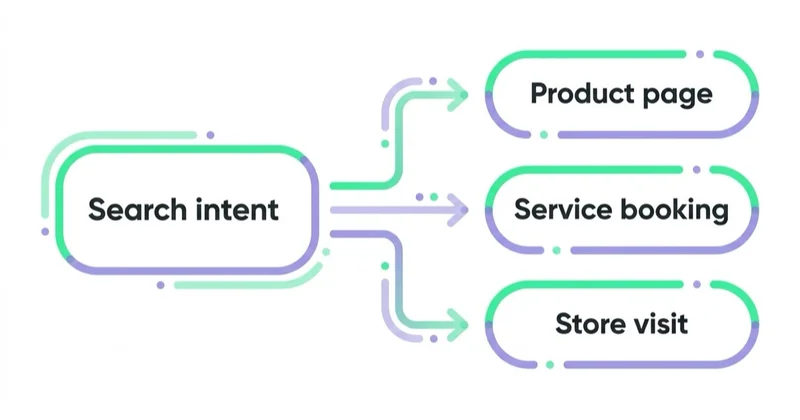
Specialist service searches such as fitting, suspension or wheel building need evidence of capability: process, technician credentials where applicable, equipment, supported products and what the customer receives.
Specific brand, category and model searches should land on accurate inventory or a useful category. Show sizes, variants, price, store availability and the next action: buy online, reserve, request a test ride or contact the shop.
Broad discovery searches such as “buy a bike” may still be useful for a retailer with the range, budget and landing experience to serve them. Test them separately from high-intent model and local stock searches; do not reject them purely because they are broad.
Advice searches around sizing, bike types, maintenance and ownership need genuinely useful guidance. Connect the article to an appropriate fitting, test-ride, product or service action without turning every answer into a sales pitch.
Capacity should control workshop acquisition
This is the operational point that separates a good plan from a wasteful one.
A workshop has finite productive hours. More demand can be useful when it fills cancellations or future slots, but it can also create unmanageable lead times, rushed work and poor communication. Media should respond to capacity rather than run at one budget all year.
So spend should follow capacity:
- Set budget rules against lead time and forecast capacity. When immediate slots are scarce, reduce acquisition or promote later appointments rather than paying for urgency the shop cannot serve.
- Keep high-value specialist work separate from quick repairs if they use different technicians or bench time.
- Reserve capacity for warranty obligations, repeat customers or urgent safety work where that is a deliberate business policy.
- Use accurate availability in messaging. Do not create false scarcity or publish an outdated “three-week wait”.
- If demand persistently exceeds safe capacity, evaluate pricing, opening patterns, processes and recruitment before adding more media.
A simple weekly view can join booked hours, available hours, forecast demand, average contribution and next slot. Marketing then has an operating signal more useful than the calendar alone.
Win the local decision
For workshop demand, the Google Business Profile and location page are part of the conversion path.
Keep the profile's name, category, address, phone number, regular and special hours, photos and website destination accurate. Google allows eligible profiles to add service and appointment links; send the booking link to a relevant, trackable page rather than the homepage. Do not add marketing keywords to the business name unless they are part of the real-world name.
The location page should show the shop and workshop clearly, including entrance or parking instructions where helpful, public transport access, service area only when relevant, supported services, contact options and current booking process. Add valid LocalBusiness structured data that matches visible information. Markup can help search engines understand details, but it does not replace a verified Business Profile or strong page.
Ask real customers for honest reviews at a consistent point after collection. Do not offer rewards, manufacture reviews or ask only customers expected to leave five stars. Google can restrict profiles involved in fake or incentivised review activity. Respond professionally, protect customer privacy and use recurring feedback as an operational signal.
Paid media: separate the jobs
One campaign should not optimise calls, workshop bookings, ecommerce orders and directions as if they have the same value.
Search for services. Group by meaningful intent and location, use relevant landing pages, and review actual search terms. Measure completed bookings or qualified calls where possible; a click on the telephone number is only an intermediate action.
Retail Search and Shopping. Promote products actually available at a competitive total proposition. Maintain Merchant Center identifiers, prices, availability and landing pages. Protect margin with product-level reporting rather than scaling on revenue alone.
Local inventory. Eligible bricks-and-mortar retailers in supported countries can use free local listings and local inventory ads to show nearby shoppers in-store products. This requires accurate local product and inventory data and, depending on the implementation, inventory verification. It is valuable for “available near me” demand, but only if the point-of-sale stock and feed stay synchronised.
Store-focused campaigns. Google Ads supports Performance Max for store goals using actions such as calls, directions and — for eligible accounts — store visits or store sales. These signals are not equivalent. A directions click is not a sale, and modelled store visits should not be assigned an arbitrary full transaction value.
Use location assets connected to the correct Business Profile, and separate stores when capacity, stock or economics differ materially. For a small single-location shop, tightly themed Search campaigns may provide a clearer first test than a broad automated mix with little conversion volume.
Glossary
- Workshop utilisation: sold productive hours divided by genuinely available productive hours for the period.
- Bike fitting: paid service adjusting a bicycle to the rider's body and riding style.
- Direct-to-consumer brand: a manufacturer selling to riders without a dealer network.
- Attachment rate: the share of bike sales that include a relevant accessory, service plan or other add-on.
- Service interval: the recommended period between routine services.
- Lifetime value: the expected contribution from a customer across a defined future relationship, not simply total revenue from one transaction.
Make the in-store proposition explicit
Local retailers do not have to abandon price competitiveness, but price should not be the only reason to choose them. The proposition may include:
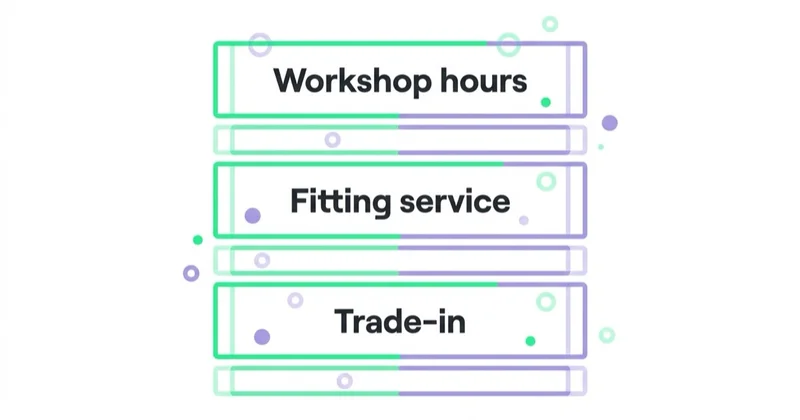
Assembly and handover. Explain what setup, safety check and orientation are included. Do not imply every competitor delivers an unusable bicycle.
Sizing, fit and test rides. State whether the service is a basic size recommendation, a test ride or a paid bike fit; these are not the same promise.
Aftercare. Define initial adjustments, warranty handling, service-plan terms and exclusions in writing.
Advice and local relevance. Staff can connect terrain, routes, storage, transport and maintenance needs with the right product, provided the recommendation is consultative rather than brand-led.
Immediate local availability. Accurate stock, the ability to inspect the product and a clear collection time can be decisive. This is where local inventory data and store-specific landing information support the commercial promise.
Communicate only the benefits the store consistently delivers. “Free lifetime service” may sound persuasive but becomes a liability when scope and capacity are unclear.
Seasonality and retention
Seasonality varies with climate, cycling segment, tourism, school calendars, commuting patterns and local events. Build a demand calendar from several years of workshop bookings and sales, then overlay weather and campaign activity carefully. Weather can explain part of a change, but it should not become the default explanation for every weak week.
Use quieter periods for services customers can reasonably schedule in advance: major overhauls, suspension work, fleet maintenance or pre-season preparation. During peak lead times, shift messaging toward future availability or retail categories with stock and capacity.
Retention should be useful, not indiscriminate. With the required consent and an easy opt-out, follow-up can include:
- collection and aftercare information;
- a reminder based on the actual service performed or manufacturer guidance;
- safety or product notices;
- relevant consumables or seasonal preparation;
- an invitation to book a fit, test ride or next service when there is a credible reason.
Avoid claiming a universal service interval. Riding conditions, mileage, component manufacturer and use determine when work is needed. Store the bike type and work history only to the extent justified by the customer relationship and applicable privacy law.
What to measure
Use metrics that connect marketing to the completed commercial outcome.
- Lead-to-booking and booking-to-completion rate, split by source and service.
- Cancellation, no-show and quote-decline rate. A lead or provisional slot is not earned revenue.
- Workshop utilisation, lead time, sold hours and contribution per sold hour.
- New vs returning customers and the interval between completed services.
- Retail conversion, product contribution, attachment and return rate.
- Cross-channel behaviour, such as service customers who later buy a bike, without assuming the service campaign caused every later purchase.
- Customer acquisition cost against retained contribution over a defined and disclosed window.
- Review themes, rework and complaints, which protect quality as demand grows.
Connect the booking system, point of sale, ecommerce platform and advertising identifiers where lawful and practical. Use order or booking IDs, not personal details, as the reconciliation key. Agree which system is authoritative when an appointment is rescheduled, partially refunded or completed with a different invoice value.
How Space Ads approaches bike shop marketing
We start with a location-level measurement map: services and technician capacity, retail stock, gross contribution, booking flow, point-of-sale data and the actions currently reported to advertising platforms. This shows whether the immediate need is demand generation, better conversion, cleaner offline attribution or capacity management.
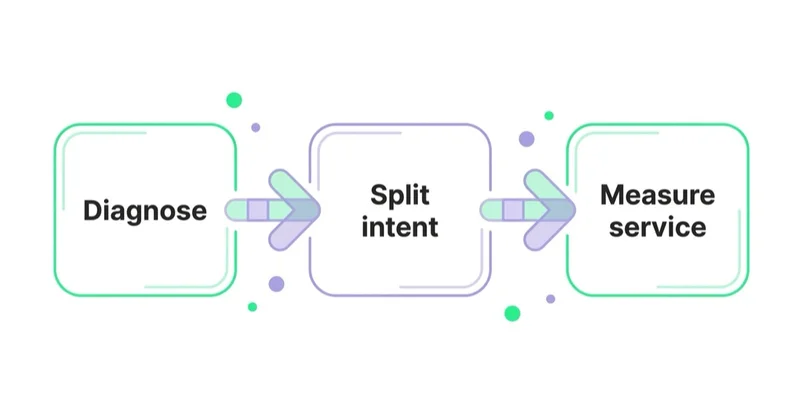
We then separate campaign roles while retaining a shared customer view. Workshop Search is judged on completed, commercially useful bookings; product campaigns on contribution from online or matched store sales; upper-funnel activity on an agreed incremental test. Where Space Ads does not have client-specific evidence, we apply these as industry-standard hypotheses and measurement requirements, not as invented portfolio results.
A practical 90-day sequence
Weeks 1–2: establish the baseline. Map services, productive capacity, contribution definitions, lead time, inventory sources and current conversion tracking. Correct Business Profile and location details.
Weeks 3–4: fix the destinations. Build or improve pages for the highest-value and highest-demand services. Make pricing logic, scope, supported bikes, location and booking action clear. Repair broken booking analytics.
Weeks 5–8: launch controlled acquisition. Start with local service searches and specific in-stock product demand. Connect location assets. Add negative keywords and reconcile bookings with completed invoices each week.
Weeks 9–12: expand from evidence. Add services with available capacity, test local inventory if data quality supports it, and introduce consented follow-up. Reallocate using retained contribution and lead time, not lead count alone.
FAQ
What should a bike shop advertise? Advertise the combination that has capacity, attractive retained contribution and a credible local proposition. This often includes workshop services plus specific bikes and products genuinely in stock. Keep the campaigns and conversion values separate so service bookings do not hide weak retail economics or vice versa.
How should seasonality be handled? Use the shop's historic booking, sales and lead-time data rather than a generic spring schedule. Promote schedulable work before capacity tightens, change messages when the next slot moves out, and use quiet periods for services with a genuine reason to be performed then.
How does a local shop compete with online bike retailers? By making the complete proposition visible: accurate local stock, sizing or fitting, test rides, assembly, handover, aftercare, warranty process and accountable advice. Price still matters, but the comparison should include what the customer receives rather than only the product box.
Why does workshop capacity matter for marketing? Because technician hours are finite. When lead time becomes too long, more immediate-demand advertising may create cancellations or poor experience instead of incremental completed work. Budget, service mix and messaging should respond to forecast productive hours and next available slots.
What should a bike shop measure? Track completed bookings, sold hours, utilisation, lead time, contribution per sold hour, cancellations, quote acceptance and rework. For retail, track contribution after discounts, fulfilment and returns. Connect new and returning customers over a clearly defined period where privacy and system quality allow it.
Are generic bike search terms worth bidding on? They are broader and often harder to interpret than specific model, category or local-stock terms, but they are not automatically unprofitable. Isolate them, use a landing page with suitable range and filters, and judge incremental contribution. A small store with limited stock may reasonably prioritise narrower demand first.
Key takeaways
- Model workshop contribution and productive capacity before scaling demand.
- Build specific service pages with clear scope, pricing logic, supported bikes, turnaround and booking actions.
- Keep Google Business Profile, location information and honest review acquisition accurate.
- Separate workshop bookings, ecommerce orders and in-store outcomes in campaign goals and reporting.
- Use local inventory advertising only when store-level stock and pricing can remain reliable.
- Plan seasonality from the shop's data and pace media against actual lead time.
- Connect service, retail and retention using completed invoices and retained contribution — not clicks or provisional bookings alone.
How we run acquisition for local, capacity-constrained businesses is on our performance marketing page.
Sources and further reading
- Powersports dealership marketing: motorcycle, ATV and UTV
- Auto repair shop marketing with Google Ads
- Customer retention marketing: repeat revenue
- Car rental marketing: fleet utilisation
- Manage local business and booking links — Google Business Profile Help
- LocalBusiness structured data — Google Search Central
- Local inventory ads and free local listings policies — Google Merchant Center Help
- Performance Max for store goals — Google Ads Help
- UK cycling market update — Bicycle Association
Continue reading

Language School Marketing: Two Businesses, One Building
Language schools often combine consumer enrolment and corporate training. Market them as separate buying journeys, then connect campaigns to attendance, enrolment, group contribution and continuation.
Driving School Marketing: Selling Instructor Hours, Not Courses
A practical system for growing a driving school around real instructor capacity: local demand, transparent lesson offers, compliant proof, responsive booking and completed-pupil value.

Car Rental Marketing: Selling a Perishable Asset on a Fixed Calendar
Car rental marketing must connect live availability, total price, location, vehicle class and completed-rental value. This guide shows how to acquire demand without separating media from fleet economics.