Moving company marketing is one of the clearest examples of high-intent local lead generation. A person searching for movers usually has a real date, a pickup location, a destination, an inventory problem and a short list of companies to compare. The company that responds quickly with a credible estimate often has a major advantage over the company that only "generated a lead."

That is why moving campaigns should not be optimized to form submissions alone. The useful business outcome is a booked move at an acceptable acquisition cost and margin. Local moves, long-distance moves, interstate moves, office moves, apartment moves and specialty moves have different economics, quote processes and trust requirements. Campaign structure, landing pages and measurement have to reflect those differences.
TL;DR
- Moving company marketing should optimize for booked moves. Raw leads are only useful if they become qualified quotes, booked jobs and completed moves.
- Speed-to-quote is a conversion lever. Moving shoppers often request several estimates; response time, availability and quoting clarity shape win rate.
- Local, long-distance and interstate moves are different funnels. They need separate campaigns, pages, qualification questions and reporting.
- Trust signals affect paid media performance. Reviews, service areas, proof of registration where applicable, insurance language, estimates and damage/liability explanations reduce hesitation.
- Demand is seasonal and capacity-constrained. Summer, month-end and lease-cycle spikes should be planned against truck, crew and dispatch capacity.
- Google Search and Local Services Ads do different jobs. Search gives more control; LSA can add phone/message leads where eligible and available.
- CRM feedback matters. Importing qualified quotes, booked moves and move value helps bidding learn from jobs, not only calls.
Why Moving Company Marketing Is Different
Moving is not a normal local-service lead. It is date-specific, competitive and operationally fragile.
First, the buyer has a deadline. A move is tied to a lease, closing date, office opening, school calendar or relocation timeline. This creates strong intent but also impatience. Slow follow-up converts poorly even when the click was good.
Second, the quote depends on details. Room count, inventory, stairs, elevators, access, packing, fragile items, distance, storage, truck access, destination and move date all affect pricing. A generic "contact us" form gives the sales team too little information to quote quickly.
Third, the job mix changes profitability. A small apartment move across town, a high-rise move with elevator restrictions, a piano move, an office relocation and an interstate move are not the same product. They should not be forced into one cost-per-lead target.
Fourth, the category has trust risk. Consumers worry about damage, late arrivals, surprise charges, brokers, deposits and unclear estimates. Marketing that addresses those concerns can convert better than marketing that only says "get a free quote."
Fifth, operations control scale. A campaign can generate demand faster than the company can answer phones, send estimates, dispatch crews or handle peak weekends. Spend should follow capacity, not only search volume.
Segment The Moving Funnel
The first strategic step is move-type segmentation.
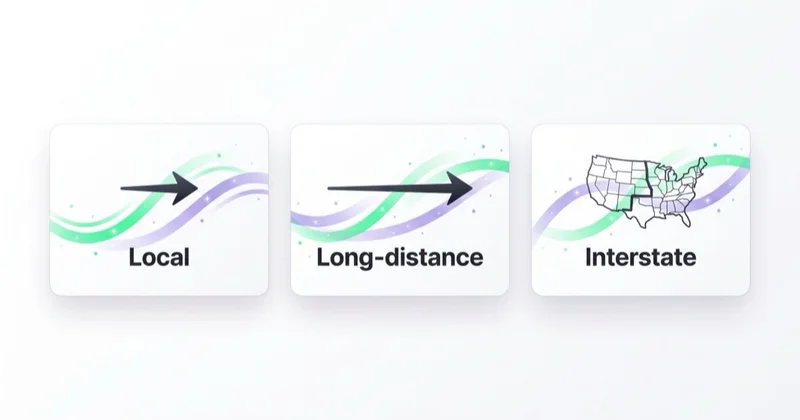
| Move Type | Buyer Need | Marketing Implication |
|---|---|---|
| Local residential | fast quote, local availability, reviews | city/service-area Search and fast quote form |
| Apartment move | stairs, elevator, parking, building rules | landing page with access questions and quick scheduling |
| Long-distance | route, timeline, inventory and trust | route-based pages and stronger estimate process |
| Interstate | registration, documents, liability and broker/carrier clarity | trust-heavy pages and clear compliance language |
| Office/commercial | downtime, equipment, scheduling, insurance | separate B2B funnel and consultation path |
| Specialty | piano, antiques, storage, packing, fragile items | service-specific pages and proof |
| Labor-only | loading/unloading without truck | separate pricing and negative keyword protection |
This segmentation improves ads, landing pages and call handling. It also prevents a common reporting error: celebrating low-cost local leads while underinvesting in higher-value moves, or overpaying for long-distance inquiries that never fit the company's operating model.
The broader contractor framework is covered in Google Ads for local businesses, home services and contractors.
Google Search Structure
Google Search captures people already looking for movers. The account should be built around intent, geography and profitability.
| Campaign Group | Example Search Pattern | Landing Page Need |
|---|---|---|
| Local movers | movers near me, local movers city, moving company city | fast quote, service area, reviews, availability |
| Apartment movers | apartment movers, high-rise movers, small move movers | building access, minimums, hourly framing |
| Long-distance movers | long-distance movers, moving from city to city | route details, estimate process, trust proof |
| Interstate movers | interstate moving company, cross-state movers | registration, documents, liability, carrier/broker clarity |
| Specialty movers | piano movers, packing services, office movers | equipment, experience, quote path |
| Brand | company name, reviews, complaints, phone number | direct quote and reputation control |
Search term control is essential. Moving queries attract truck rentals, boxes, storage, jobs, salary research, DIY guides, freight, courier services, real estate searches and people looking for free labor. The negative keyword list should be based on real search terms, but common exclusions include:
- truck rental and van rental terms;
- moving boxes and packing supplies when not sold;
- jobs, careers, salary and training;
- DIY guides and checklists;
- freight, logistics and pallet shipping;
- out-of-area cities;
- services the company does not provide;
- broker terms if the company does not want broker traffic;
- labor-only terms if the company only sells full-service moves.
For deeper structure, see negative keywords in Google Ads.
Local Services Ads For Movers
Local Services Ads can be useful for moving companies where the category is eligible and the market supports it. Google's Local Services documentation says these ads can generate leads through phone calls and messages and that advertisers pay for leads related to the services offered. It also references Google Verified badges in selected verticals.
LSA can work well when:
- calls are answered quickly;
- service areas are accurate;
- reviews are strong;
- profile information is complete;
- lead review is disciplined;
- booked moves are tracked outside the platform;
- budget is adjusted to capacity.
LSA should not be judged only by lead count. A message from someone outside the service area, a call for truck rental, a tiny labor-only job or an unserved route may be a valid contact but still a poor commercial lead. LSA and Search should be compared by booked moves and move value.
The broader LSA mechanics are covered in Google Local Services Ads and Google Verified / Google Guaranteed guide. The visible badge and eligibility language can vary by category and market, so ad copy and sales scripts should match what is actually approved in the account.
Trust, Registration And Broker Clarity
Trust is part of conversion rate optimization for movers. The customer is handing over household goods, office equipment or personal items to a company they may have found 10 minutes ago.
For interstate moves in the United States, FMCSA's Protect Your Move resources state that interstate movers must be registered with the federal government and have a U.S. DOT number. FMCSA also provides a registered mover search tool and consumer resources about red flags, rights and responsibilities. Marketing should make legitimate trust signals easy to verify when they apply.
Useful trust elements include:
| Trust Element | Why It Matters |
|---|---|
| USDOT or state license information where applicable | supports legitimacy for regulated moves |
| carrier vs broker clarity | reduces confusion about who handles the move |
| insurance and liability explanation | addresses damage concerns |
| written estimate process | reduces fear of surprise charges |
| reviews with move type and route context | proves relevant experience |
| crew, truck and equipment photos | shows operational reality |
| service-area transparency | prevents poor-fit leads |
| deposit and cancellation policy | reduces sales friction |
| claims and damage process | reassures serious buyers |
The language needs to be accurate. A local-only mover should not imply interstate authority. A broker should not write copy like a carrier. A carrier should make that distinction useful. A company should not claim licensing or insurance unless those details are true and current.
Landing Pages And Quote Forms
A moving landing page has one job: help the company produce a fast, credible estimate and help the customer trust the process.
The quote form should collect enough data to route and price the move:
- move type;
- pickup ZIP code and destination ZIP code;
- move date or date range;
- home size or office size;
- stairs, elevator and parking details;
- packing needs;
- specialty items;
- storage needs;
- contact phone and email;
- preferred contact time;
- photos or inventory upload where useful.
The page should also include:
- service-area coverage;
- local reviews;
- estimate process;
- response-time expectation;
- insurance or valuation explanation;
- license/registration details where applicable;
- crew and equipment proof;
- FAQ about pricing, deposits, packing, damage and timing;
- click-to-call CTA for urgent moves.
A bare lead form can produce volume, but it often slows quoting because the intake team has to call back for basic details. A better form improves both ad conversion quality and sales productivity.
For broader conversion structure, see what a landing page is and how to build one.
Speed-To-Quote And Intake
Moving companies often lose after the lead, not before it. The ad did its job; the business failed to answer, qualify or quote quickly enough.

The intake system should track:
| Intake Metric | Why It Matters |
|---|---|
| missed call rate | high-intent callers rarely wait |
| first response time | speed strongly affects quote opportunity |
| quote completion rate | shows whether forms provide enough information |
| quote-to-book rate | identifies sales quality and pricing fit |
| no-show or cancellation rate | reveals weak lead quality or poor confirmation |
| booked move value | connects marketing to revenue |
| crew capacity by date | prevents overspending on full days |
Fast does not mean careless. A credible estimate still needs the right details and disclosures. The best systems combine immediate response with structured questions, route and date checks, and follow-up by text/email so the customer can compare without confusion.
Phone tracking is especially important in moving because many high-intent buyers call. Google Ads call reporting can measure calls from ad assets and call ads, but the CRM still needs to know whether the call became a quote and whether the quote became a booked move. For deeper implementation, see call tracking for PPC and lead generation.
Seasonality And Capacity
Moving demand is seasonal, but not in one simple wave.
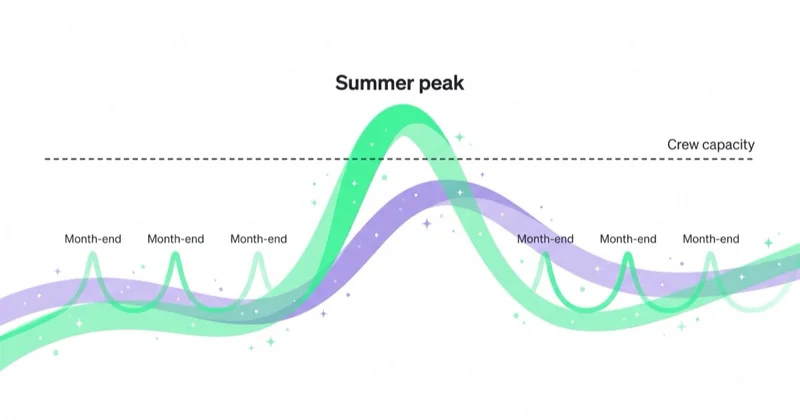
| Timing | Typical Planning Issue |
|---|---|
| late spring | demand ramps before peak summer |
| summer | high demand, high competition, capacity pressure |
| month-end | lease-cycle spikes and scheduling compression |
| weekends | crew and truck constraints |
| school-year transitions | family moves and relocation timing |
| fall | cooling residential demand, possible commercial/long-distance focus |
| winter | lower volume, efficiency and storage/packing opportunities |
The media plan should connect to the dispatch calendar. If crews are full on the last weekend of the month, more spend can create angry prospects, missed calls and weak reviews. If weekdays have unused capacity, budget and offers can shift toward flexible move dates. If long-distance capacity is strong in shoulder seasons, route-based campaigns can fill the gap.
Seasonal planning should include:
- peak-week budget rules;
- service-area bid adjustments;
- call staffing plans;
- quote follow-up templates;
- moving date availability in forms;
- weather or storm contingency;
- route and truck capacity;
- review generation after completed moves.
Measurement: Booked Moves And Move Value
The conversion hierarchy should move beyond lead volume.
| Stage | Meaning | Platform Use |
|---|---|---|
lead |
form, call, chat or LSA contact | early signal only |
qualified_lead |
in service area, real move date, right move type | stronger optimization signal |
quote_sent |
estimate delivered | shows sales progression |
quote_accepted |
customer agrees to move | strong commercial signal |
booked_move |
move scheduled in dispatch | main optimization signal |
completed_move |
job completed | confirms operational value |
move_value |
revenue or margin | supports value-based decisions |
Google Ads offline conversion imports are designed for cases where the valuable conversion happens after the online click. For movers, that means booked move, completed move and move value can be sent back when CRM data is reliable. Without this feedback, bidding may favor the cheapest calls instead of the jobs that actually fill profitable capacity.
Reporting should separate:
- local vs long-distance;
- residential vs commercial;
- apartment vs house;
- full-service vs labor-only;
- packing/storage add-ons;
- peak vs off-peak;
- first-time vs repeat/referral;
- Search vs LSA vs organic vs aggregator.
This prevents a blended cost per lead from hiding where profit is created.
Meta, Retargeting And Off-Peak Demand
Meta is rarely the primary source of urgent moving intent, but it has useful support roles:
- retargeting quote-page visitors who did not submit;
- reminding abandoned form starters;
- promoting packing, storage or specialty services;
- supporting off-season awareness in local markets;
- reaching office managers for commercial moves;
- using reviews and crew proof to build trust;
- creating moving checklists that feed email/SMS nurture.
Meta should be measured conservatively. A person who needs movers today is more likely to search. A person moving next month may respond to a checklist, reminder or retargeting ad. The channel has a job, but it should not replace high-intent Search unless data proves it is booking profitable moves.
How Space Ads Approaches Moving Accounts
At Space Ads, moving accounts are treated as operational lead-generation systems. The audit starts with the business model: service areas, move types, average job value, quote process, crew capacity, truck capacity, dispatch calendar, call handling, CRM stages and review profile.
Then the media account is rebuilt around job value. Search is split by local, long-distance, interstate, apartment, specialty and brand intent. Local Services Ads are evaluated where eligible. Landing pages collect quote-ready details. Call tracking and CRM imports connect spend to quotes, booked moves and completed jobs. Budget follows capacity rather than a flat monthly target.
For an existing moving company, a marketing audit can show whether spend is creating booked moves or only contacts. Ongoing execution connects Google Ads, Local Services Ads, performance marketing, landing pages and intake improvement.
30-Day Optimization Plan
- Map move economics. Break down local, long-distance, interstate, commercial, packing and specialty jobs by value and margin.
- Audit intake speed. Measure missed calls, first response time, quote completion and quote-to-book rate.
- Separate move types. Rebuild campaigns and pages around local, apartment, long-distance, interstate and specialty intent.
- Clean search terms. Add negatives for truck rental, boxes, jobs, DIY, freight and unserved service types.
- Upgrade quote forms. Capture locations, date, inventory, access, packing and contact preferences.
- Add trust proof. Show reviews, service areas, registration details where applicable, process and damage/liability information.
- Test or refine LSA. Review service categories, profile quality, lead quality, reviews and booked-move rate.
- Connect CRM stages. Track qualified lead, quote sent, quote accepted, booked move and move value.
- Plan capacity-based budgets. Shift spend by peak weeks, month-end, crew availability and route capacity.
- Review by booked value. Compare channels by booked moves and revenue, not cost per lead.
Common Mistakes
| Mistake | Why It Hurts | Better Approach |
|---|---|---|
| Optimizing to lead volume | cheap contacts may not book | optimize to quotes and booked moves |
| Slow response | shoppers compare multiple movers | track and improve speed-to-quote |
| Blending local and interstate | economics and trust needs differ | separate campaigns, pages and reporting |
| Weak quote forms | sales team lacks details | collect route, date, inventory and access data |
| Overbuying peak leads | crews and trucks may already be full | connect budget to dispatch capacity |
| Using broad terms without negatives | budget leaks into rentals, jobs and DIY | mine search terms weekly |
| Vague licensing claims | creates trust and compliance risk | state only accurate, verifiable details |
| Ignoring completed job value | platforms learn from shallow signals | import booked and completed move outcomes |
FAQ
What is moving company marketing?
Moving company marketing is the system used to generate qualified moving inquiries, quotes and booked moves through channels such as Google Search, Local Services Ads, Google Business Profile, SEO, retargeting, reviews and call tracking. The goal is booked move value, not only lead volume.
Which channel works best for movers?
Google Search is usually the strongest channel for active moving intent because people search when they have a move date and need quotes. Local Services Ads can add call and message leads where eligible. Google Business Profile, reviews and local SEO support trust, while Meta is usually better for retargeting and off-peak awareness.
How should local and interstate moving campaigns be separated?
They should use separate campaigns, landing pages, qualification questions, trust proof and reporting. Local moves often depend on hourly pricing and immediate availability. Interstate moves require more trust, route detail, inventory information and registration clarity where federal rules apply.
What should a moving quote form ask?
A useful form asks for pickup and destination ZIP codes, move date, home or office size, stairs, elevator, parking, packing needs, specialty items, storage needs and contact details. Better forms help the team quote quickly and reduce wasted follow-up.
Why is speed-to-quote so important?
Moving shoppers often request estimates from several companies. Fast response improves the chance of being included in the comparison and booked before the customer commits elsewhere. Speed should be measured alongside quote quality and booked-move rate.
Should moving companies use Local Services Ads?
Local Services Ads are worth testing where the moving category is eligible and the company can respond quickly. They should be measured by qualified leads, booked moves and move value rather than raw lead count, because not every contact is commercially useful.
How should moving marketing be measured?
The core funnel should track lead, qualified lead, quote sent, quote accepted, booked move, completed move and move value. Offline conversion imports and CRM feedback help Google Ads optimize toward jobs that fill profitable capacity instead of shallow contacts.
In Short
- Moving company marketing should be managed around booked moves, completed jobs and move value.
- Search and LSA can generate high-intent demand, but intake speed determines how much of that demand becomes revenue.
- Local, apartment, long-distance, interstate and specialty moves need separate structure.
- Trust signals such as reviews, registration details where applicable, estimate process and liability language improve conversion.
- Capacity-based budgeting prevents peak-season overspend when crews and trucks are already full.
Sources
- FMCSA - Protect Your Move
- FMCSA - Search for a Registered Mover
- Local Services Help - Getting started with Local Services Ads
- Google Ads Help - About call reporting
- Google Ads Help - About offline conversion imports
Continue Learning
- Google Ads for local businesses, home services and contractors
- Google Local Services Ads and Google Verified / Google Guaranteed guide
- Call tracking for PPC and lead generation
- Negative keywords in Google Ads
- What is a landing page and how to build one
- Google Ads · Performance marketing · Marketing audit
Continue reading

Tree Service Marketing: Storm Leads and Booked Jobs
Tree service marketing has to capture emergency storm demand and steady planned work without wasting crew capacity. This guide covers Google Search, Local Services Ads, Google Verified, storm budgets, safety proof, call triage and cost per booked job.

Electrician Marketing: Google Ads and Local Services for Steady Jobs
Electrician marketing should produce profitable completed work, not just cheap calls. Learn how to connect Google Ads, Local Services Ads, dispatch capacity and job economics.

Pest Control Marketing: Google Ads, LSA and Recurring Plans
Pest control marketing should turn urgent pest searches into booked jobs and recurring service plans. This guide covers Local Services Ads, Google Search, seasonal pest demand, emergency vs preventive intent, safety trust signals, negative keywords, call tracking and plan lifetime value.