Google Local Services Ads are pay-per-lead ads for eligible local service businesses. They are separate from standard Search campaigns. Instead of buying clicks against keywords, an advertiser appears in the Local Services unit, receives calls, messages or booking requests, and pays for valid leads.
The format can work well for trades, professional services and appointment-led local businesses, but it has its own rules. Eligibility depends on category and location. Verification is required. Ranking depends on bid, profile quality and the likelihood that the ad will produce a lead. Lead credits are mostly automated. The current trust badge is Google Verified, not the old Google Guaranteed or Google Screened badge structure.
That last point matters because many older LSA guides still describe the legacy badge system. In 2026, the useful question is not "How do I get Google Guaranteed?" It is "Can the business pass Local Services screening, earn the Google Verified badge, answer enquiries quickly and turn paid leads into booked jobs?"
Key Takeaways
- LSA is pay-per-lead, not pay-per-click. Google says advertisers pay for valid leads such as calls, messages, voicemail, meaningful automated engagement and booking requests where supported.
- Google Verified is the current badge. Google says it is simplifying advertiser badging into a single Google Verified badge for eligible advertisers who complete verification.
- The Money Back Guarantee changed. Google says it is discontinuing the Money Back Guarantee associated with the Google Guarantee badge; reimbursement requests apply only to eligible services booked before December 7, 2025.
- Ranking is not only a bid. Google's Local Services ad ranking considers bid and profile quality, including responsiveness, reviews, response time, images and completed verification checks.
- Lead credits are automated. Google uses machine-learning models to assess lead quality and may apply credits automatically, but credits are not available for health care verticals, tax specialists or advertisers in EMEA.
- LSA and Search should be judged together. LSA can capture high-intent local contacts. Search gives more control over keywords, landing pages, negatives and measurement. Both should be judged on booked work, not only lead volume.
What Local Services Ads Are
Local Services Ads appear in a dedicated unit for local service searches. Google describes them as a way to advertise locally, receive phone calls and messages from potential customers, reply to messages, track bookings and manage leads online.
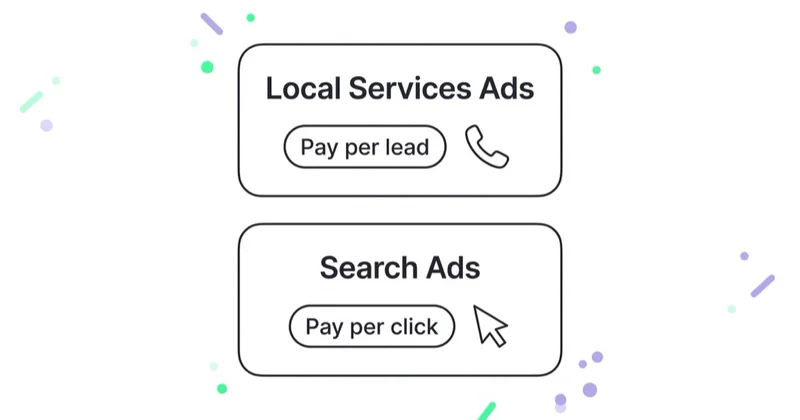
The core difference from standard Google Ads is the billing event:
| Area | Local Services Ads | Standard Search Ads |
|---|---|---|
| Pricing | Pay for valid leads | Pay for clicks |
| Targeting | Service category and service area | Keywords, match types, audiences, locations |
| Destination | Google-hosted Local Services profile | Website or landing page |
| Trust layer | Google Verified badge where eligible | No LSA badge |
| Primary controls | Screening, services, service area, reviews, responsiveness, budget and bid mode | Keywords, ads, landing pages, bid strategy, negatives |
| Best use | Hire-now local demand in eligible categories | Service-specific control, long-tail demand and full website experience |
This means LSA should not be managed like a keyword campaign. There are no keyword match types to tune. The account owner has to manage service categories, location coverage, reviews, call handling, lead feedback and profile accuracy.
Google Verified vs the Legacy Google Guaranteed Badge
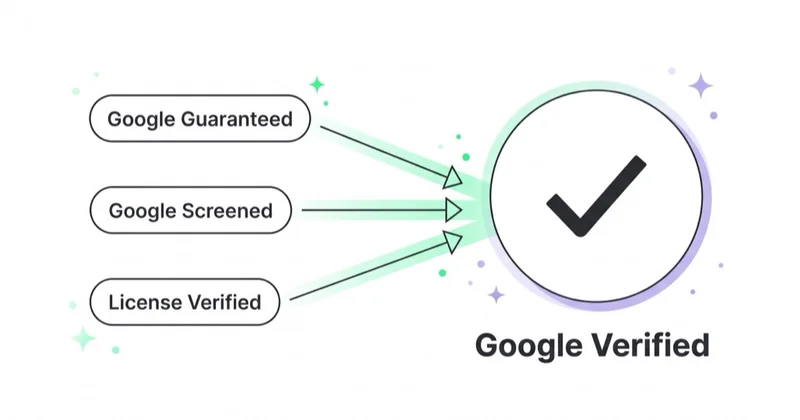
Google's current Local Services documentation says it is launching a single Google Verified badge for advertisers. Existing eligible advertisers who completed verification requirements automatically earn the new badge. New advertisers need to complete the Local Services screening and verification process.
The practical meaning:
- Google Verified signals that the business has passed Google's screening process for the relevant category and location.
- The badge appears on the Local Services profile and may appear on other surfaces where Google sees consumer value.
- Relevant verifications can also be called out on verified profiles.
- The badge is not available for dining verticals such as Food and Beverage, Restaurants, and Dessert and Coffee.
The Money Back Guarantee should be described carefully. Google's Google Verified badge page says the Money Back Guarantee associated with the Google Guarantee badge is being discontinued. Eligible consumers can submit reimbursement requests for services booked through Local Services Ads before December 7, 2025, within 30 days of service completion.
For 2026 content and sales language, that means:
| Legacy language | Current language |
|---|---|
| Google Guaranteed | Google Verified, unless discussing the legacy programme |
| Google Screened | Google Verified, unless explaining the old distinction |
| Money-back guarantee as current benefit | Not current for new eligible bookings after the stated cutoff |
| "Google backs the job" | "The business completed Google's Local Services verification process" |
The badge remains commercially important, but it should not be oversold. It is a verification signal, not a replacement for fast intake, strong reviews and good service.
How Leads and Charges Work
Google's Local Services help page says advertisers pay for valid leads. A valid lead can include:
- a text message or email from the customer in supported markets;
- a voicemail;
- meaningful automated engagement, such as requesting a callback or providing service details;
- an answered phone call where the business speaks with the customer;
- a missed call that the business returns and where it speaks with the customer or leaves a voicemail;
- a booking request in supported markets.
Lead prices vary. Google says pricing may depend on location, job type, lead type and bidding mode. This is why universal cost-per-lead benchmarks are weak. A plumber in a small market, a roofer in a competitive metro and an estate lawyer in a high-value market do not buy the same lead.
The better commercial metric is cost per booked job:
Cost per booked job = LSA spend / booked jobs from LSA
Then compare that with average job value and gross margin. A high-priced lead can be profitable if it books into a valuable job. A low-priced lead can be expensive if it rarely books or falls outside the service area.
Automated Lead Credits
Google's current lead-credit documentation says Local Services uses machine-learning models to assess lead quality. Leads are assessed when a potential customer first makes contact. Invalid or low-quality leads may not be charged. Charged leads can also be reassessed over time and may receive automatic credits.
Important limits:
- credits are generally applied to the account balance within 30 days;
- the original lead charge can still appear on the invoice;
- lead reports can show not charged, charged, in review and credited states;
- Google no longer supports credits for "job type not serviced" and "geo not serviced" leads;
- lead credits are not available for health care verticals, tax specialists or advertisers in EMEA.
The operational takeaway is direct: profile precision matters. If the service area is too broad or the selected job types are inaccurate, the business may pay for poor-fit contacts and have little credit protection. Lead feedback still matters because Google says feedback helps it understand preferences and send more suitable leads.
Eligibility and Screening
Local Services Ads are not open to every business. Google says availability depends on service category and area. The United States list includes many categories, from plumbers, electricians, HVAC, roofers and general contractors to lawyers, dentists, real estate services and other professional categories. Some categories are restricted by state or market.
To participate, businesses must pass Google's screening and verification process. Google says the process varies by category and location and may include:
- background checks;
- business registration checks;
- insurance checks;
- licence checks;
- minimum review requirements;
- Google Business Profile ownership or management verification.
For some US advertisers, Google also describes a risk-based verification process. Businesses may be re-evaluated over time, and failing to complete requested checks can lead to badge loss, ad pause or account suspension.
For operators, this changes the timeline. LSA is not always a same-day launch. Documentation, insurance, licences, profile ownership and reviews should be prepared before the launch date is promised.
How LSA Ranking Works
Google says Local Services listings are displayed and ranked through an auction. The highest ranked ads show first. The auction takes into account bid and overall profile quality.
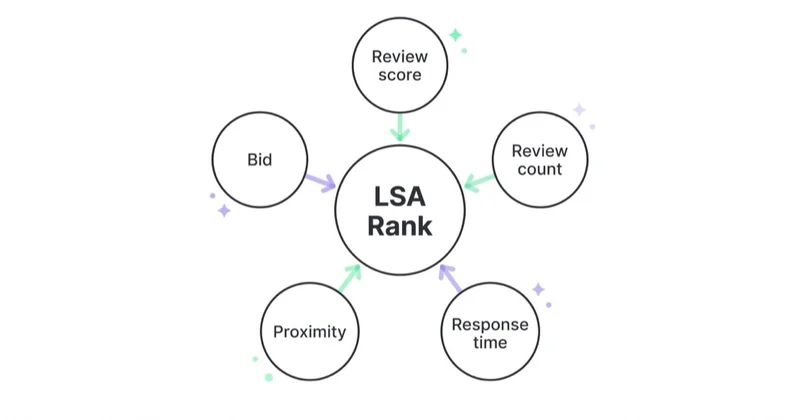
Google lists ranking factors including:
- the bid;
- responsiveness to customer enquiries and requests;
- whether missed calls affect responsiveness;
- the customer's search context, including service, time, location and other characteristics;
- relevance between the query and services or business bio;
- enabling message and booking leads, which can give customers more ways to contact the business;
- rating and number of reviews;
- average response time;
- use of high-quality images;
- completed verification checks and other profile information.
This is where LSA differs from Search. A higher bid can help, but it does not repair weak intake or a poor profile. A business that misses calls, has thin reviews and incomplete profile data may struggle even with budget.
Control what can be controlled:
| Lever | Practical action |
|---|---|
| Responsiveness | Answer calls, return missed calls quickly, respond to messages |
| Reviews | Ask satisfied customers consistently and keep review flow current |
| Profile quality | Add clear services, accurate business bio and high-quality photos |
| Verification | Complete all required checks and respond to re-verification requests |
| Service relevance | Keep job types accurate and remove services not actually offered |
| Service area | Keep geography tight enough to serve profitably |
| Bid and budget | Use a mode that fits current lead volume and commercial tolerance |
Bidding and Budget Modes
Google's LSA bidding documentation describes three bid modes:
- Maximize leads: automated bidding where Google sets bids to get the most leads for the budget. Google recommends a minimum budget of 10 leads per week for optimal results.
- Target cost per lead: automated bidding with an optional target CPL. Google uses the selected or recommended target around the average amount paid for leads.
- Max per lead: manual bidding where the advertiser sets the highest amount they are willing to pay for a lead.
Google also says the model needs about two weeks to adjust and learn about the business. This is important for expectations. Changing budget, service areas or lead handling every few days makes it harder to know what is working.
Use budget from the business model:
Target lead volume = desired booked jobs / lead-to-booking rate
Working weekly budget = target leads x expected cost per lead
Then measure the real output. If LSA produces calls but booked jobs do not increase, the bottleneck may be intake, service fit, pricing or follow-up speed, not only the ad product.
LSA vs Search Ads
LSA and Search overlap, but they should not be treated as substitutes in every account.
Use LSA when:
- the category and location are eligible;
- the business can pass verification;
- the buyer intent is local and immediate;
- phone intake is strong;
- reviews and response process can support ranking;
- the business wants a Google-hosted profile with a verification badge.
Use Search when:
- keyword and landing-page control matters;
- the service has educational or comparison-stage demand;
- the business needs negative keywords;
- the category is not eligible for LSA;
- the advertiser wants to send users to a specific offer, quote page or booking flow;
- offline conversion tracking is already strong.
Run both when the economics justify it. LSA can capture contact-ready demand at the top of the results page. Search can cover the long tail, brand, competitor, service-specific and informational searches that LSA does not handle with the same control.
The shared metric should be booked work. Comparing LSA cost per lead with Search cost per form fill is not a fair comparison unless both are tied back to booked jobs.
Intake Is a Ranking and Revenue Problem
LSA is unforgiving when the business cannot answer. Google explicitly includes responsiveness in ranking, and commercially the first provider to answer often has the advantage in urgent categories.
Minimum operating rules:
- answer during advertised hours;
- return missed calls quickly;
- monitor messages and booking requests;
- pause ads or reduce hours when the business cannot take work;
- train intake staff to qualify service, location, urgency and booking potential;
- record lead outcome in the CRM.
This is why LSA is not only a media-buying channel. The ad can create demand, but the phone process converts it.
A Practical Setup Checklist
- Check eligibility. Confirm that the category and service area are supported before planning budget.
- Prepare documentation. Gather licences, insurance, business registration and profile access.
- Complete screening. Pass all required verification steps and monitor re-check requests.
- Build the profile. Add accurate services, business bio, service area, hours, photos and review links.
- Define lead handling. Decide who answers, how fast missed calls are returned and how bookings are recorded.
- Set a budget mode. Start with Maximize leads if volume is low, then consider Target CPL when there is enough history.
- Track booked outcomes. Measure charged leads, credited leads, qualified enquiries, booked jobs and revenue.
- Refine service area and job types. Remove poor-fit geography and services before they become ongoing cost.
Common Mistakes
| Mistake | Better approach |
|---|---|
| Selling the old Google Guarantee as a current protection | Explain Google Verified accurately and avoid outdated guarantee language |
| Judging LSA only on lead volume | Judge it on booked jobs and job value |
| Leaving broad job types active | Select only services the business actually wants |
| Setting a service area larger than operations can serve | Match geography to profitable response and fulfilment |
| Missing calls during advertised hours | Fix intake before raising bids |
| Treating automated credits as a quality-control system | Use profile precision and lead feedback to prevent poor-fit leads |
| Comparing LSA to Search on shallow metrics | Compare both on qualified and booked outcomes |
How Space Ads Approaches LSA
Space Ads treats Local Services Ads as a lead-quality and intake channel, not only an ad placement. The first check is whether the business can handle the enquiries it is paying for: answer rate, response speed, service fit, service area, booked-job rate and CRM visibility.
Only after that does bidding matter. A higher bid can increase exposure, but it will not fix poor reviews, missed calls, loose job types or a service area that produces low-margin work. The work is to connect LSA, Search and CRM reporting so the business can see cost per booked job across channels.
That is the lens used in Google Ads management and in a marketing audit: where does the paid enquiry become real revenue, and where does the signal break?
FAQ
What are Google Local Services Ads?
Google Local Services Ads are pay-per-lead ads for eligible local service businesses. They can show in a Local Services unit on Google Search and allow potential customers to call, message or book with the business through the ad profile.
Is Google Guaranteed still available?
Google Guaranteed should now be treated as legacy language. Google says it is simplifying advertiser badging with a single Google Verified badge. It also says the Money Back Guarantee associated with the Google Guarantee badge is being discontinued, with reimbursement requests tied to eligible services booked before December 7, 2025.
What is the Google Verified badge?
Google Verified is the current Local Services badge for eligible advertisers who complete Google's screening and verification requirements. Existing eligible advertisers can earn it automatically if they already completed requirements; new advertisers need to pass the Local Services verification process.
How does LSA pricing work?
Advertisers pay for valid leads, not clicks. Google says lead prices can vary by location, job type, lead type and bidding mode. The useful business metric is cost per booked job, because not every paid lead becomes revenue.
Can bad LSA leads be credited?
Some can be. Google uses automated lead credits and may credit invalid or low-quality charged leads. However, credits are not available for health care verticals, tax specialists or advertisers in EMEA, and Google no longer supports credits for "job type not serviced" and "geo not serviced" leads.
What affects Local Services Ads ranking?
Google says ranking considers bid and overall profile quality. Factors include responsiveness, search relevance, reviews, average response time, high-quality images, completed verification checks and other profile information.
Should a local business run LSA or Search Ads?
Often both. LSA is useful for eligible, high-intent local enquiries. Search Ads are better when keyword control, negative keywords, landing pages and detailed measurement matter. Both should be compared using qualified and booked outcomes.
In Short
- Local Services Ads are pay-per-lead ads for eligible local service businesses.
- Google Verified is the current badge; Google Guaranteed and Google Screened should be treated as legacy terms unless explaining history.
- The Money Back Guarantee associated with the old Google Guarantee badge is being discontinued.
- Ranking depends on bid, responsiveness, reviews, profile quality and completed verification.
- Lead credits are automated and limited; service area and job-type precision are the first defence.
- LSA should be measured by booked jobs and revenue quality, not only charged lead volume.
Sources
- Google Local Services Help - About Google Verified badge
- Google Local Services Help - Getting started with Local Services Ads
- Google Local Services Help - How leads work
- Google Local Services Help - About ad rankings
- Google Local Services Help - How bidding works for Local Services Ads
- Google Local Services Help - About Automated Local Services Ads lead credits
- Google Local Services Help - Understand the screening and verification process
Continue Learning
Continue reading
Google Local Services Ads: The Pay-Per-Lead Channel for Local Businesses
A current guide to Google Local Services Ads and pay-per-lead Performance Max: eligibility, Google Verified, screening, billing, ranking, lead credits, migration and measurement beyond raw leads.
Electrician Marketing: Google Ads and Local Services for Steady Jobs
Electrician marketing should produce profitable completed work, not just cheap calls. Learn how to connect Google Ads, Local Services Ads, dispatch capacity and job economics.
Google Ads for Local Businesses and Contractors: Calls, Leads and Booked Jobs
Local Google Ads should be judged on qualified enquiries and booked jobs, not clicks. This guide explains how to structure Search, calls, location targeting, negatives, landing pages and offline conversion feedback for service businesses.