Google Ads for local businesses, home services and contractors is not an e-commerce problem. There is usually no online checkout, no instant revenue value and no clean ROAS number inside the account. The commercial event happens later: a call is answered, a quote is booked, a technician arrives, the job closes and revenue is recorded somewhere outside Google Ads.
That changes how the account should be built. Clicks are not the outcome. Raw form volume is not the outcome. The useful path is cost per qualified enquiry first, then cost per booked job, and finally cost per closed job value where the CRM can support it.
The technical work is not glamorous, but it decides whether the account can learn. Calls need to be tracked. Forms need to pass usable first-party data. Offline outcomes need to return to Google Ads. Location settings need to match the real service area. Search terms need to be protected from job seekers, DIY searches and irrelevant services. Without that, automation optimises toward whatever is easiest to count.
Key Takeaways
- Local service campaigns should be judged downstream. The account should move from calls and forms to qualified enquiries, booked appointments and closed jobs.
- Phone calls are often the highest-intent conversion. Google call reporting can count calls from ads and website numbers when they meet a minimum duration.
- Enhanced conversions for leads and offline imports matter. Google now recommends enhanced conversions for leads for many offline setups, and offline uploads are moving to the Data Manager API from June 15, 2026.
- Location targeting needs business discipline. Google's default can include people interested in a location; many local service businesses should test or use "Presence" when they only serve people in a defined area.
- Search and Local Services Ads do different jobs. Local Services Ads charge for valid leads where available. Search gives more control over keywords, landing pages, exclusions and service-specific messaging.
- Performance Max can work only after the signal is clean. Google itself says PMax for lead generation depends on accurate conversion data and deeper-funnel goals such as qualified or converted leads.
- Negative keywords protect margin. Careers, salary, DIY, free templates, parts and wrong-service queries should not be funded by a contractor's acquisition budget.
Why Local Google Ads Break When Measurement Is Too Shallow
Many local accounts are technically "tracking conversions" and still optimising to the wrong thing. A five-second wrong-number call, a price-only form, a job-seeker enquiry and a booked appointment can all look similar if the account only sees top-level conversions.
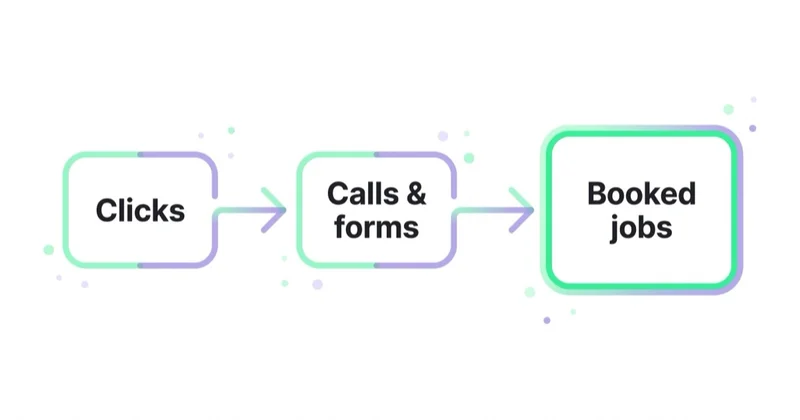
For a local service business, the conversion hierarchy should usually look like this:
| Stage | Example | How useful it is for bidding |
|---|---|---|
| Click | Someone visits the site | Too shallow |
| Call click | Someone taps the number | Better, but not always a real call |
| Qualified call | Call lasts long enough or is reviewed as relevant | Useful |
| Form enquiry | Someone submits details | Useful if spam is controlled |
| Qualified enquiry | Human or CRM marks it as real | Strong |
| Booked job / appointment | The business schedules work | Stronger |
| Closed job value | The job is completed and revenue is known | Best signal where available |
Google's automated bidding can only optimise to the signals it receives. If every form is treated as equal, it will look for more forms. If every short call is counted, it will look for more short calls. If booked jobs are imported with value, the system has a better chance of finding demand that actually fits the business.
The strategic question is therefore not "Should we use automation?" The better question is "What are we teaching the automation to value?"
Search vs Local Services Ads
Local businesses often compare Search campaigns with Local Services Ads, but they are not the same product.
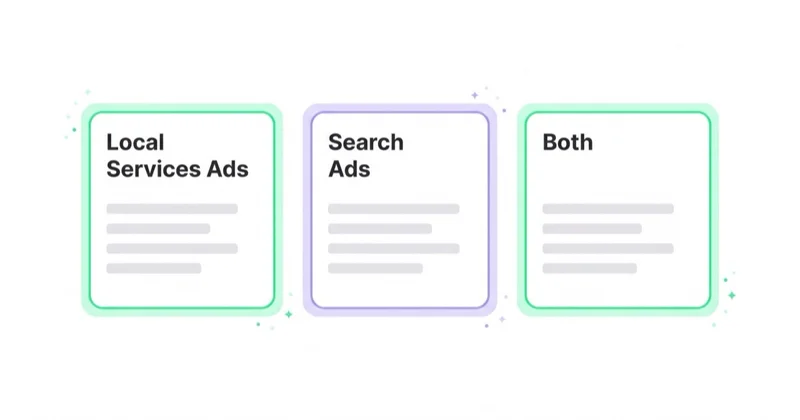
Local Services Ads are built around valid leads. Google's Local Services documentation says advertisers pay for valid leads, set an average weekly budget and can be charged for customer contacts such as calls, messages, voicemail or booking requests where supported. LSA can be valuable for trades and local services where the category is available, but the advertiser gives Google more control over query matching and presentation.
Search campaigns are the normal keyword auction. They are pay-per-click, but they give the advertiser more control over:
- which services are separated into campaigns or ad groups;
- which search terms are excluded;
- which landing page receives the click;
- which calls, forms and offline outcomes are counted as primary conversions;
- how budgets are split by service, location and schedule.
The practical setup is often both: LSA for eligible hire-now demand, Search for service-specific intent, longer-tail queries, brand protection, non-LSA categories and stricter control. The dedicated LSA mechanics are covered in Google Local Services Ads: LSA and Google Verified guide.
The Measurement Stack
Before changing bids, build the measurement layer.
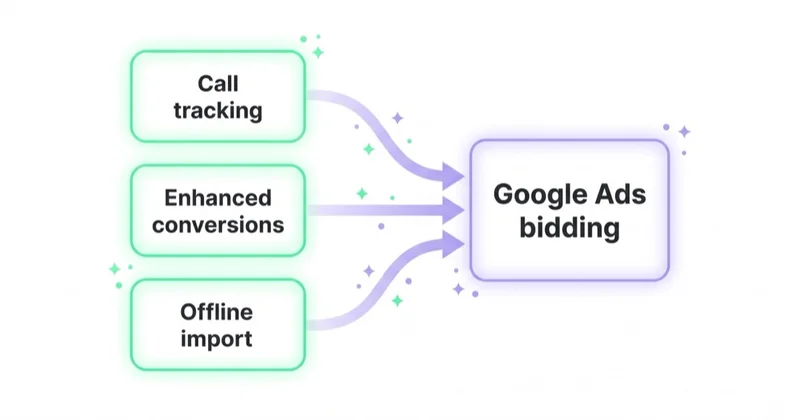
1. Call Conversion Tracking
Google's phone call conversion tracking supports calls made directly from call ads, call assets and location assets, calls to a number on the website after an ad click, clicks on a mobile number, and imported call conversions from another system.
Call reporting uses Google forwarding numbers. When enabled, it can record call duration, start time and connection details, and advertisers can count calls of a specified duration as conversions. That minimum duration is important. A contractor may not want every tap on a phone number counted. A 60- or 90-second threshold is often a better proxy for a meaningful enquiry than all calls.
For more control, import call outcomes from a CRM or call-tracking system. A reviewed call marked as "booked service visit" is a stronger signal than a raw call duration.
2. Enhanced Conversions for Leads
Enhanced conversions for leads uses hashed first-party user data, such as an email address or phone number, to help match a later offline outcome back to the original ad interaction. Google describes it as an upgraded version of offline conversion import.
This matters for forms. A form submission is the start of the sales process, not the end. When the business later knows whether that person became a customer, enhanced conversions for leads can help attribute the offline event back to Google Ads more accurately.
Two 2026 details should be reflected in new setups:
- Google says offline conversion import and enhanced conversions for leads uploads migrate to the Data Manager API and are blocked in the Google Ads API from June 15, 2026.
- Google says enhanced conversions for web and leads are being combined into a single on/off setting, with user-provided data accepted from tags, Data Manager and API connections.
That makes Data Manager the safer default for new implementations.
3. Offline Conversion Import
Offline conversion import connects Google Ads with what happened after the enquiry. For GCLID-based imports, auto-tagging must be enabled, the click ID must be captured on the site, stored with the prospect in the lead system and uploaded when an offline event happens.
For a local business, useful offline events might be:
- qualified enquiry;
- appointment booked;
- estimate attended;
- job won;
- job completed;
- revenue value.
Do not wait for the ideal setup. If closed revenue takes too long to arrive, import a reliable mid-funnel event first and add value later. The account needs a signal inside the practical attribution window.
Location Targeting and Service Areas
Local businesses lose money when location settings are broader than the real service area.
Google's advanced location options distinguish between people in or regularly in a location and people who have shown interest in that location. The default "Presence or Interest" setting can be useful in some industries, but a plumber, HVAC company or contractor may only want people physically in the service area.
Use location settings deliberately:
- define the true service area, not the area the business wishes it could serve;
- use radius targeting around the office, depot or high-margin zones where appropriate;
- exclude areas that create travel time without margin;
- review location reports by booked job quality, not only click volume;
- consider "Presence" targeting when out-of-area interest creates wasted enquiries.
For many home services, distance changes profitability. A click 35 miles away can be cheap and still be a bad lead if drive time removes the margin.
Campaign Structure by Service Line
Do not put every service into one general campaign. Local service intent is specific, and the account should reflect that.
Example structure for a plumbing business:
| Campaign or ad group | Intent | Landing page |
|---|---|---|
| Emergency plumber | Urgent service now | Emergency plumbing page |
| Drain cleaning | Specific problem | Drain cleaning page |
| Water heater repair | Repair intent | Water heater repair page |
| Water heater installation | Installation quote | Installation page |
| Brand | Searches for the business | Homepage or contact page |
The point is message match. Someone searching "water heater installation cost near me" should not land on a generic services page. They should see the service, area, proof, contact options and qualification details relevant to that job.
This also helps budget control. Emergency work, installation work and low-margin repairs should not all compete for the same daily budget if their economics are different.
Keywords and Negative Keywords
Local campaigns should start narrow enough to learn. Exact and phrase match on high-intent service terms are usually easier to control at launch. Broad match can be useful later, but only once conversion data and negatives are mature.
Searches to prioritise:
- emergency service + city;
- service + near me;
- repair / installation / replacement + service;
- quote / appointment / contractor + service;
- brand and competitor comparison where legally and commercially appropriate.
Searches to block early:
| Waste pattern | Examples | Common negatives |
|---|---|---|
| Careers | "hvac jobs", "plumber salary" | jobs, careers, salary, hiring, apprenticeship |
| DIY | "how to fix ac", "unclog drain yourself" | how to, diy, yourself, tutorial |
| Free resources | "free estimate template", "invoice template" | template, pdf, free guide |
| Parts and supplies | "buy furnace filter", "plumbing parts wholesale" | parts, supplies, wholesale, for sale |
| Wrong service | Queries outside the offer | service-specific exclusions |
Mine the search terms report weekly. A local account often improves faster from removing poor-fit demand than from rewriting ads.
Landing Pages for Local Intent
The landing page should make the next action obvious and reduce the buyer's risk.
Essential elements:
- service-specific headline matching the query;
- visible phone number and tap-to-call on mobile;
- short form with only necessary fields;
- service area and response expectations;
- licence, insurance or certification details where relevant;
- reviews or testimonials tied to the local service;
- clear explanation of what happens after contact;
- realistic exclusions, such as areas not served or services not offered.
Avoid generic claims. A homeowner or facilities manager does not need "quality service you can trust" repeated six times. They need to know whether the business handles the problem, serves the location, can respond in time and has proof.
Performance Max for Local Lead Generation
Performance Max can be useful for local lead generation, but it should not be the first thing used to cover weak measurement.
Google's PMax lead generation guidance is explicit: AI-powered campaigns need accurate conversion tracking and clearly defined conversion actions. Google recommends steering campaigns toward lead generation goals such as Contact, Submit Lead Form, Book Appointment, Request Quote, Qualified Lead or Converted Lead, and optimising to deeper funnel actions where possible.
That is the practical rule. If PMax is pointed at every form fill, it will optimise toward form fills. If it receives qualified or converted lead data, lead scores or value signals, it can work with stronger inputs.
Use PMax when:
- call, form and offline tracking are working;
- Search campaigns have enough history to define good demand;
- creative assets are available;
- the business can review lead quality;
- budget is large enough to let the campaign learn.
Do not use PMax as a replacement for a clean Search structure in the first week of a local account.
How to Think About Budget
Start with service economics, not a generic spend number.
Basic calculation:
Required enquiries = target booked jobs / enquiry-to-booking rate
Working budget = required enquiries x expected cost per qualified enquiry
Then check whether the service line can support enough data. If a campaign only produces a handful of conversions per month, automated bidding will learn slowly and swings will look larger. It may be better to start with the highest-margin, highest-intent service line rather than spread budget across every service.
Budget should also follow capacity. A contractor with two crews should not create demand the operations team cannot answer. Missed calls, slow callbacks and unqualified service areas are media waste, even when the Google Ads account looks busy.
A 30-Day Setup Plan
Week 1: Measurement and CRM
Enable auto-tagging. Set up call reporting and phone call conversions with a realistic minimum duration. Configure form tracking and enhanced conversions for leads. Define CRM stages for qualified enquiry, booked job and closed job. Decide which stages will be imported to Google Ads.
Week 2: Structure and Local Targeting
Build Search campaigns by service line. Set location targeting to match the service area. Add exclusions where travel time or low-margin jobs make demand unattractive. Create a shared negative list before launch.
Week 3: Landing Pages and Ads
Map each ad group to a specific page. Add call assets and location assets where appropriate. Write ads that mention the service, area and proof points without overclaiming. Keep forms short and the phone action visible.
Week 4: Feedback Loop
Review calls and forms manually. Upload qualified enquiries or booked jobs through Data Manager or the chosen integration. Compare search terms, locations, devices and schedules by quality. Move budget toward service lines and locations that produce booked work, not only cheap enquiries.
By the end of 30 days, the account should have a cleaner learning loop. It may not yet be fully scaled, but it should be optimising toward business outcomes instead of shallow activity.
Common Mistakes
| Mistake | Better approach |
|---|---|
| Counting every call click as a valuable conversion | Count meaningful calls by duration or imported call outcome |
| Treating all form submissions equally | Import qualified and booked stages from the CRM |
| Using broad location targeting without review | Match targeting to the real service area and check location quality |
| Sending every click to the homepage | Use service-specific pages with local proof |
| Launching PMax before conversion quality is clear | Start with Search and add PMax once deeper signals exist |
| Ignoring job-seeker and DIY searches | Build negatives before launch and review search terms weekly |
How Space Ads Approaches Local Google Ads
For local and service businesses, Space Ads starts with the commercial feedback loop. The account has to know which calls and enquiries were real before bidding can improve. That means reconciling Google Ads conversions with call data, CRM stages and booked revenue, not accepting the platform number at face value.
The work then becomes much clearer: separate service lines, protect location targeting, remove poor-fit searches, improve landing pages and feed qualified outcomes back into Google. The aim is not more visible activity in the account. It is a lower cost per booked job with a measurement system the business can defend.
This is also where a marketing audit is useful. Many local accounts do not need a new campaign structure first. They need to find where the signal breaks between the call, the form, the CRM and the Google Ads account.
FAQ
Is Google Ads worth it for local businesses?
It can be, when the account is measured against qualified enquiries and booked jobs. It is usually not worth judging on clicks or raw form volume, because local service revenue happens offline. The business needs call tracking, form tracking and CRM feedback to understand whether Google Ads is producing work, not only activity.
What should a contractor track in Google Ads?
At minimum: calls from ads, calls from the website after an ad click, form submissions, qualified enquiries and booked jobs. Where possible, closed job value should be imported as well. The deeper the signal, the less the account has to rely on shallow proxies.
Should local businesses use Local Services Ads or Search?
Both can be useful. Local Services Ads are pay-per-valid-lead where available and can capture high-intent local demand. Search campaigns give more control over keywords, negatives, landing pages, budgets and conversion goals. The better decision is usually not LSA versus Search, but which role each channel should play.
What location setting should local service businesses use?
Many should test or use "Presence" when they only want to reach people in or regularly in the service area. Google's default can also include people who have shown interest in the location. That may be useful in some verticals, but it can create waste for trades and contractors that only serve nearby customers.
Does Performance Max work for home services?
It can work after measurement is reliable. Google recommends strong conversion tracking and deeper funnel goals for PMax lead generation, such as qualified or converted leads. If the campaign only sees raw forms, it may optimise for volume instead of job quality.
How much should a small local business spend?
Work backward from job targets and close rates. Estimate how many qualified enquiries are needed to book the desired number of jobs, then multiply by the expected cost per qualified enquiry. Start with the service line that has enough margin and demand to support learning.
What negative keywords should contractors add first?
Start with job-seeker terms, salary terms, DIY searches, free templates, parts, supplies, wholesale queries and services the business does not offer. Then review the search terms report weekly and add account-specific negatives.
In Short
- Local Google Ads should be judged on qualified enquiries, booked jobs and closed value where available.
- Calls need proper tracking; duration thresholds or imported outcomes are better than raw call clicks.
- Enhanced conversions for leads and offline imports help Google learn from CRM outcomes.
- Location targeting should match the real service area, not broad interest in the city.
- Search, LSA and PMax can all play roles, but only after the measurement signal is clean.
- Negative keywords and service-specific landing pages protect budget and improve enquiry quality.
Sources
- Google Ads Help - About phone call conversion tracking
- Google Ads Help - About call reporting
- Google Ads Help - About enhanced conversions for leads
- Google Ads Help - About offline conversion imports
- Google Ads Help - Set up offline conversions using GCLID
- Google Ads Help - About advanced location options
- Google Ads Help - Performance Max best practices for lead generation
- Local Services Help - How leads work
Continue Learning
- Google Local Services Ads: LSA and Google Verified guide
- Enhanced conversions in Google Ads: what they are and how to set them up
- What is a landing page and how to build one
- Keyword match types in Google Ads and how to choose them
- What is a Google Ads audit and how to do it
- Google Ads management for local lead generation
- Marketing audit: find where the enquiries leak
Continue reading
Med Spa Marketing: Booked Appointments, Local Trust and Repeat Value
Med spa marketing should be built around booked appointments, show rate, treatment starts and repeat value. This guide covers Google Search, Meta, reviews, booking flow and measurement for medical spas.
Google Local Services Ads (LSA): Google Verified, Leads and When to Use Them
Local Services Ads are Google's pay-per-lead format for eligible local service businesses. The current trust badge is Google Verified, and performance depends on screening, profile quality, responsiveness and booked-job economics.

Language School Marketing: Two Businesses, One Building
Language schools often combine consumer enrolment and corporate training. Market them as separate buying journeys, then connect campaigns to attendance, enrolment, group contribution and continuation.