Attribution can tell a convincing story while the business result barely moves. Meta reports a strong ROAS, Google Ads claims revenue through brand search, GA4 splits credit across channels, and the finance team asks the only question that matters: how much revenue would not have happened without the ads?

That is the job of incrementality testing. Instead of asking which click or impression should receive credit, incrementality asks whether advertising caused additional conversions, revenue or profit compared with a credible baseline.
Incrementality testing measures the causal impact of advertising by comparing a test group exposed to media with a control group that is not exposed, or by comparing test and control geographies. Geo experiments are one of the most practical methods when user-level tracking is limited, sales happen across channels, or the goal is to test the impact of a whole media channel rather than one ad.
TL;DR
- Incrementality testing measures whether advertising generated additional business outcomes that would not have happened anyway.
- Attribution assigns credit. Incrementality estimates causal lift.
- The main methods are user-level lift tests, geo experiments, campaign holdouts and experiments used to calibrate Marketing Mix Models.
- Google Conversion Lift can measure lift at user level or geography level, but availability depends on account eligibility and study requirements.
- Geo experiments are useful when the objective is to measure a channel, region, offline effect or cross-platform campaign.
- Google announced Meridian GeoX in May 2026 as a geographic incrementality tool connected with Meridian, with testing expected later in 2026.
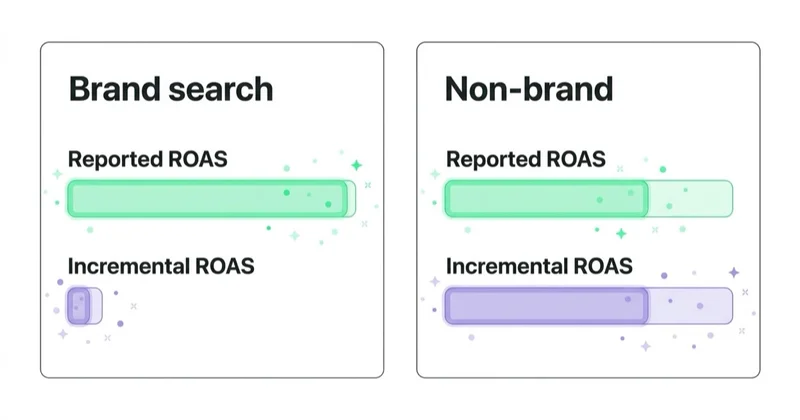
- Platform ROAS can be high while incremental ROAS is low, especially in brand search, remarketing and warm-audience campaigns.
- A good test starts with a business decision, not a dashboard curiosity.
What Is Incrementality Testing?
Incrementality testing is a measurement approach that estimates the additional business outcome caused by marketing activity. The logic is simple:
- Define the activity to test.
- Create a test group and a control group.
- Expose only the test group to the media change.
- Measure the difference in outcomes.
- Interpret the difference as incremental lift, with uncertainty.
The outcome can be revenue, qualified leads, new customers, app installs, store visits, subscriptions or any other business KPI that can be measured reliably.
The difference from attribution is fundamental:
| Question | Attribution | Incrementality |
|---|---|---|
| Core question | Which touchpoint gets credit? | Did the media cause extra results? |
| Typical data | Clicks, impressions, paths, conversions | Test/control outcomes or modeled baseline |
| Main use | Daily campaign reporting | Budget decisions and channel evaluation |
| Weakness | Can over-credit easy demand | Requires scale, design and patience |
Why Platform Attribution Is Not Enough
Attribution is useful for daily optimisation, but it can exaggerate the value of channels that capture demand already likely to convert.
Common examples:
- Brand search captures users already searching for the brand.
- Remarketing reaches people who recently visited the site or added products to cart.
- Dynamic product ads show products to users who already viewed them.
- Marketplace ads can move demand between organic and paid placements.
- Seasonal campaigns can receive credit for demand caused by discounts, email, PR or Black Friday.
- AI bidding systems optimise toward available signals, which may not always represent incremental profit.
This is why a channel can show a strong platform ROAS while total business revenue, margin or blended MER does not improve proportionally.
User-Level Lift Tests
User-level lift tests split eligible users into treatment and control groups. The treatment group can see the ads. The control group is withheld from the campaign. The lift is calculated from the difference in downstream outcomes.
Google describes Conversion Lift as a way to measure incremental conversions directly driven by people seeing ads. Google documentation also distinguishes between user-based and geography-based Conversion Lift.
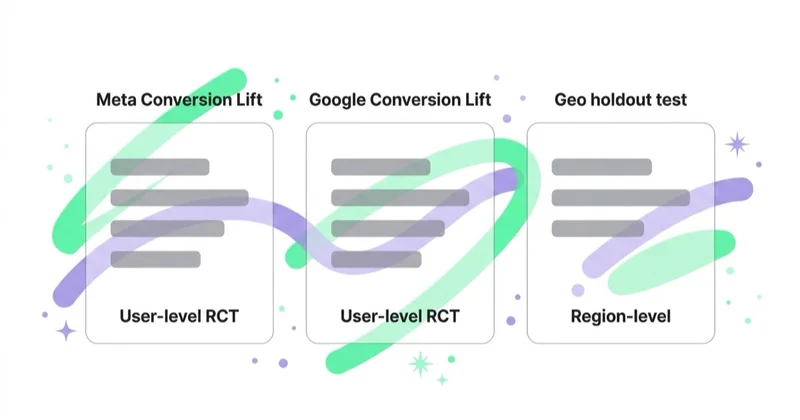
Meta lift studies follow a similar causal logic: compare users eligible to see ads against a no-ad control group. This is different from a regular A/B test where both groups may still see ads, just different versions.
User-level lift tests work best when:
- the platform has enough eligible users;
- conversion volume is high enough;
- campaign objective is stable;
- measurement events are reliable;
- the business can tolerate a holdout group;
- the question is about one platform or campaign family.
The limitation is scale. If there are too few conversions, the confidence interval will be too wide to support a budget decision.
Geo Experiments And Geo Holdouts
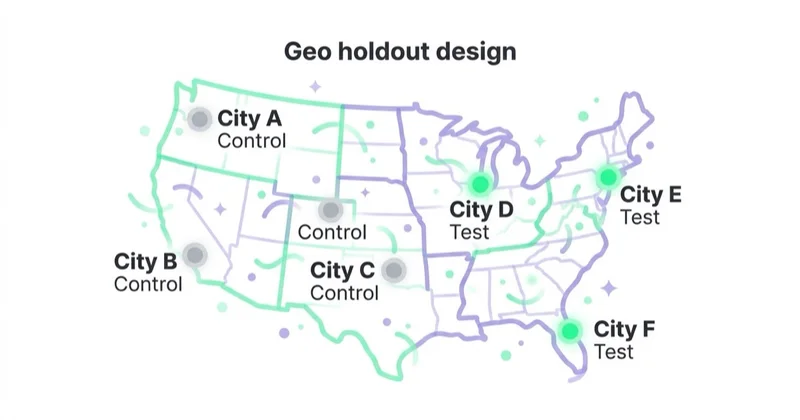
Geo experiments use geography as the unit of testing. Some regions are exposed to a media change, while comparable regions act as control. The analysis estimates what would have happened in the test regions without the change.
This is useful when:
- the campaign runs across several platforms;
- offline sales matter;
- user-level tracking is incomplete;
- the channel is upper-funnel or cross-device;
- the test is about total business impact;
- privacy rules limit user-level measurement.
Google's documentation for geography-based Conversion Lift explains that it measures causal, incremental impact by aggregating unattributed conversions into non-overlapping geographic regions and comparing baseline with exposed areas. It also notes that geography-based lift usually requires higher budgets than user-based alternatives.
For international brands, geo tests can be designed at different levels:
- US states or DMAs,
- UK regions or cities,
- Australian states or metro areas,
- Polish voivodeships or city clusters,
- store catchment areas,
- postal code clusters.
The smaller the market, the more careful the design needs to be. Poland, for example, may require grouped regions rather than individual small cities if conversion volume is limited.
Meridian GeoX: What Changed In 2026?
Google announced Meridian GeoX in May 2026 as part of its broader measurement and Meridian roadmap. Google positioned GeoX as a geographic incrementality tool that can provide signals for Meridian, Google's open-source Marketing Mix Model.
The important caveat: GeoX should not be described as universally available production tooling for every advertiser. Google's announcement said GeoX would begin testing later in 2026. That makes it strategically important, but not something every account can immediately rely on.
The practical implication is clear: brands should prepare the data foundation now.
That means:
- clean regional sales data,
- stable campaign naming,
- correct conversion values,
- consistent UTMs,
- reliable GA4 and CRM data,
- documented promotions and price changes,
- good consent and server-side measurement where appropriate.
For measurement foundations, see Server-side tagging, Consent Mode v2 and GA4 implementation.
How To Design A Geo Experiment
1. Start With A Decision
A good incrementality test should change a decision. Examples:
- Should brand search budget be reduced?
- Does Meta prospecting drive new customers?
- Does YouTube increase later search demand?
- Is Performance Max cannibalising Shopping?
- Does retail media grow total SKU sales?
- Should Black Friday budget be shifted from remarketing to prospecting?
If the test result would not change anything, the test is not worth running.
2. Define The KPI
Choose one primary KPI:
- revenue,
- contribution margin,
- new customers,
- qualified leads,
- pipeline,
- store visits,
- subscriptions,
- app installs.
Secondary metrics can help interpretation, but the primary KPI should be decided before the test.
3. Choose Test And Control Regions
Regions should be similar before the test. Look at historical sales, seasonality, category mix, media spend, customer density and logistics. Avoid regions with unusual promotions, stock issues or local events.
4. Estimate Minimum Detectable Effect
Minimum detectable effect is the smallest lift the test can reasonably detect. If the campaign would need to create a 30% lift to be measurable, but the business expects 5%, the design is too weak.
5. Freeze Campaign Rules
During the test, avoid changing too many variables. Creative refreshes, budget shifts, landing page changes, pricing changes and stockouts can contaminate results.
6. Include A Cooldown Window
Some conversions happen after exposure. Google documentation also references cooldown periods for geography-based Conversion Lift when conversion cycles are longer. For B2B, high-ticket purchases and video campaigns, cooldown matters.
Example: Brand Search Incrementality
A company spends heavily on brand search because ROAS looks excellent. The issue: many brand search users would have clicked organic results or gone direct anyway.
A geo experiment could:
- reduce brand search spend in test regions;
- keep brand search unchanged in control regions;
- measure total revenue, organic traffic, direct traffic and paid search revenue;
- compare changes against historical baseline;
- evaluate incremental revenue and margin, not just Google Ads ROAS.
Possible outcomes:
- High incrementality: total revenue drops when brand search is reduced.
- Low incrementality: organic and direct traffic absorb most of the demand.
- Mixed result: brand search is important for competitor defence but not for pure navigational queries.
This type of test can free budget for non-brand search, Microsoft Ads, YouTube, Meta or marketplace channels if brand search is over-credited.
How To Interpret Results
Key metrics:
- Incremental conversions: extra conversions caused by the tested activity.
- Incremental conversion value: extra revenue or value from the test.
- Incremental cost: additional media cost versus control.
- iROAS: incremental conversion value divided by incremental cost.
- iCPA: cost per incremental conversion.
- Confidence interval: range of likely outcomes.
- Business significance: whether the result matters financially.
The last point is essential. A result can be statistically positive but financially weak after margin, discounts and operational cost. The goal is not to prove that ads did something. The goal is to decide whether the next dollar should go there.
How we approach this at Space Ads
In agency practice it pays to first decide which budget calls are genuinely risky. Incrementality testing isn't needed for every small change in an account. It earns its place where the result of the test could shift the allocation of real money.
The areas we test most often:
- whether remarketing deserves its own budget,
- how much brand search really defends against competitors,
- whether Meta prospecting builds new customers,
- whether Performance Max is cannibalising Shopping and brand,
- whether YouTube supports later demand in search,
- whether seasonal Black Friday pushes lift margin, not just volume.
For big seasonal events it's worth pairing the test with campaign planning — our separate guide on Black Friday 2026 for e-commerce covers that.
Common Mistakes
Testing Too Small A Budget
Small tests often produce uncertain results. Directional learning is useful, but major budget changes need enough signal.
Changing Campaigns Mid-Test
Multiple changes make the result hard to interpret. Keep the test clean.
Measuring The Wrong KPI
Cheap leads are not always good leads. Revenue without margin can mislead. Platform conversions are not always business outcomes.
Ignoring Seasonality
Promotions, holidays, weather, payday effects and stockouts can distort results.
Treating No Lift As Failure
No significant lift may mean the channel is weak, but it can also mean the test was underpowered or the KPI has a long lag.
FAQ
What is incrementality testing?
Incrementality testing measures the additional business results caused by marketing activity compared with a control group or modeled baseline.
What is a geo experiment?
A geo experiment measures lift by comparing regions exposed to a media change with comparable control regions. It is useful when user-level tracking is limited or when the effect spans multiple channels.
Is incrementality better than attribution?
It answers a different question. Attribution helps with reporting and daily optimisation. Incrementality helps with causal budget decisions.
What is iROAS?
iROAS is incremental return on ad spend. It measures additional conversion value divided by incremental media cost.
Is Google Meridian GeoX available to everyone?
Google announced Meridian GeoX in May 2026 and said it would begin testing later in 2026. It should be treated as an important measurement direction, not assumed to be available in every account.
Which campaigns should be tested first?
Start with areas where attribution is most likely to over-credit performance: brand search, remarketing, warm-audience campaigns, Performance Max, retail media and large seasonal campaigns.
Key Takeaways
Incrementality testing is becoming essential because platform attribution is not enough for budget decisions. It helps separate true growth from demand that would have converted anyway.
Geo experiments are especially useful when the question is bigger than one ad set: Does a channel work? Does a region respond? Does a marketplace campaign grow total sales? Does a seasonal budget increase create profit?
The best measurement system combines operational reporting, clean tracking and causal testing. Attribution keeps campaigns running. Incrementality keeps budgets honest.
If you want to know what truly drives results on the account versus what just collects attributed conversions, start with a marketing audit of Google, Meta and TikTok accounts.
Sources and further reading
- Google Ads Help: About conversion lift
- Google Ads Help: Conversion Lift based on geography measurement data
- Google Ads & Commerce Blog: Meridian GeoX and Meridian Studio
- Google for Developers: Meridian
- Google Research: Randomized paired geo experiments
- Meta Business Help: About Conversions API
- arXiv: Characterizing and minimizing divergent delivery in Meta advertising experiments
Continue Learning
Continue reading

Why Is My ROAS Dropping? The Usual Suspects, in Order
A ROAS decline can come from reporting, media cost, traffic mix, conversion, order value or a changed business context. Use this diagnostic sequence to protect downside, compare mature data and isolate the real driver.

Brand Strategy vs Performance: How Brand Work Actually Shows Up in Revenue
Brand building and sales activation serve different time horizons, but neither belongs to a single channel. Learn how to set objectives, use the 60/40 finding responsibly, connect brand indicators to commercial outcomes, and measure incremental impact.

Marketing Attribution for Executives: Why Your Dashboards Disagree
Marketing attribution assigns conversion credit to touchpoints; it does not prove which channel caused the outcome. This guide shows executives how to use last-click, data-driven attribution, incrementality, and MMM for different decisions.