
Search advertising in Google Ads means showing paid ads to people who are actively searching for products, services, brands or information. It is one of the highest-intent advertising channels because the user expresses demand through a search query.
Effective search advertising is not just buying keywords. It requires matching search intent, keyword strategy, responsive search ads, ad assets, landing pages, bidding, budgets and conversion tracking to a business goal. When those pieces do not align, even high-intent traffic can become expensive noise.
TL;DR
- Search advertising captures active demand from people who are already searching.
- Google Ads Search campaigns use keywords, match types, responsive search ads, assets and landing pages to answer that demand.
- Brand, generic, product, local, competitor and comparison searches should be reported separately.
- Search Ads work best when the landing page matches the query and ad promise.
- Smart Bidding can help, but only when conversion tracking and data quality are strong.
- Search is not a full-funnel replacement. It usually works with SEO, Shopping, Performance Max, YouTube, Display and remarketing.
- CTR is not the goal by itself. Lead quality, sales, conversion value, CPA, ROAS and profit matter more.
- For ecommerce, Search is strongest where message control matters, while Shopping and Performance Max often cover product-feed scale.
What is search advertising?
Search advertising is paid visibility on search results and search-related surfaces. In Google Ads, the most common form is a Search campaign that shows text ads when user queries match advertiser keywords or related signals.
Search ads are useful because they appear close to the moment of need. A person searching "emergency plumber near me", "google ads audit", "running shoes waterproof" or "best crm for small business" is already showing intent.
That intent makes Search powerful, but it also makes the channel competitive. If several advertisers want the same high-value query, the auction can become expensive. The account needs strong relevance, not just budget.
How Google Ads Search works
A basic Search campaign includes:
- campaign goal;
- budget;
- bid strategy;
- location and language settings;
- ad groups;
- keywords;
- match types;
- negative keywords;
- responsive search ads;
- ad assets;
- landing pages;
- conversion actions;
- audiences or observation segments where relevant.
When a user searches, Google Ads evaluates whether an ad is eligible for the auction. Eligibility and position depend on factors such as bid, expected performance, relevance, landing page experience, ad assets and auction context.
For the network-level explanation, read What Is the Google Search Network and How to Use It?.
When search advertising makes sense
Search Ads are usually a good fit when:
- people already search for the product or service;
- demand has clear commercial intent;
- the business can respond quickly to leads;
- there is a landing page for the query;
- conversion value can be measured;
- the product or service has enough margin to support paid acquisition;
- the business needs predictable demand capture.
Search can be weaker when:
- nobody knows the category yet;
- the offer needs education before search demand exists;
- CPC is too high for the margin;
- the website cannot convert;
- tracking is unreliable;
- the sales team cannot qualify leads;
- the market is dominated by brand loyalty and low switching intent.
In those cases, Search may still help, but channels such as content, YouTube, Demand Gen, PR, social or partnerships may need to create demand first.
Types of search intent
| Intent type | Example | Strategy |
|---|---|---|
| Brand | "space ads agency" | Protect navigation and message |
| Generic | "google ads agency" | Acquire new demand |
| Product | "waterproof hiking boots" | Match category or product page |
| Local | "dentist in manchester" | Use location and call assets |
| Comparison | "shopify vs woocommerce" | Use educational landing page |
| Problem | "why google ads not converting" | Offer guide, audit or service |
| Competitor | "alternative to brand x" | Use caution and clear positioning |
The same campaign should not mix all of these without reporting separation. Brand traffic usually converts differently from generic traffic. Competitor traffic usually behaves differently from category traffic.
Campaign structure by intent
Search campaigns are easier to manage when structure follows intent. A simple structure might separate:
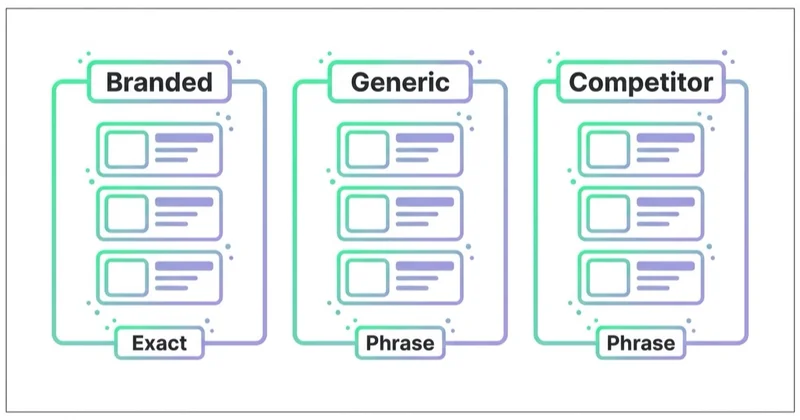
- brand terms;
- high-intent generic terms;
- product or service categories;
- local modifiers;
- competitor or alternative queries;
- informational problem queries;
- remarketing lists for search ads where relevant.
This separation helps with budgets, bidding, landing pages, ad copy and reporting. Brand campaigns can protect navigation and message control, but they should not be mixed into generic acquisition results. Generic campaigns show the real cost of winning new demand. Competitor campaigns need careful copy and realistic expectations. Informational queries may need educational pages, not hard-sell landing pages.
Over-segmentation is also a risk. Campaigns and ad groups should be specific enough to match intent, but not so fragmented that Smart Bidding cannot learn or the account becomes hard to maintain.
Keyword strategy
Keywords should be selected by intent, not only by volume.
A useful keyword process:
- Start with business goals.
- List products, services, categories and problems.
- Separate brand, generic, competitor, local and informational intent.
- Check landing page fit.
- Choose match types based on risk and data quality.
- Add negative keywords before launch.
- Review search terms after launch.
Broad match can work well with strong Smart Bidding and reliable conversion data. Exact match gives more steering but less reach. Phrase match sits between them, but it still needs search term review.
For the full topic, read What Are Keyword Match Types in Google Ads and How to Choose Them?.
When to use broad match
Broad match is not automatically good or bad. It depends on data quality and account maturity.
Broad match is safer when:
- conversion tracking is reliable;
- the account has meaningful conversion volume;
- Smart Bidding optimizes toward valuable actions;
- negative keywords are maintained;
- landing pages cover the broader intent;
- search term quality is reviewed regularly;
- budgets can absorb learning.
Broad match is risky when:
- the account tracks weak micro-conversions;
- sales feedback is missing;
- budget is very small;
- the offer has many irrelevant adjacent meanings;
- the landing page is too narrow;
- the campaign needs tight legal, medical or regulated wording;
- the advertiser cannot review queries frequently.
Exact and phrase match can provide more steering during early testing. Broad match can expand reach later, but it should be treated as an optimization decision, not a default shortcut.
Search terms and negative keywords
Search term review is where keyword theory meets real user language.
Review search terms for:
- irrelevant meanings;
- job, student, free, template or DIY intent;
- support intent that should not receive acquisition budget;
- competitor terms that need separate reporting;
- local modifiers outside the service area;
- product variants that need better landing pages;
- repeated questions that deserve content or FAQ sections;
- high-converting queries that should receive dedicated coverage.
Negative keywords should protect spend without blocking useful discovery. The goal is not to make the account as narrow as possible. The goal is to keep paid search aligned with business value.
Responsive search ads
Responsive search ads are the standard Search ad format. Advertisers provide multiple headlines and descriptions, and Google tests combinations.
Good RSA copy should:
- reflect the query intent;
- include a clear offer;
- explain the differentiator;
- add proof or trust;
- avoid duplicate headlines;
- make sense in different combinations;
- lead naturally to the landing page;
- respect policy and legal requirements.
Example for "google ads audit":
- "Google Ads Audit"
- "Find Wasted Spend"
- "Review Tracking, Search Terms and ROAS"
- "Get a Clear Optimisation Plan"
Weak copy says everything to everyone. Strong copy answers the specific search.
Read more in What Are Responsive Search Ads in Google Ads?.
Ad assets
Ad assets add extra information to the Search ad. They can include:
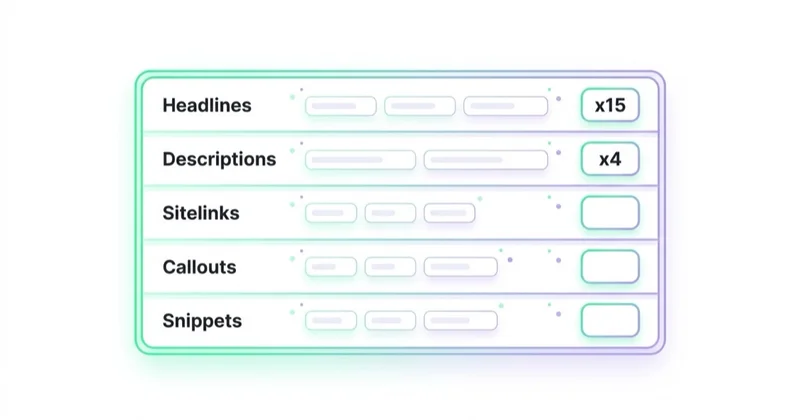
- sitelinks;
- callouts;
- structured snippets;
- calls;
- locations;
- prices;
- promotions;
- lead forms where eligible;
- app assets.
Assets should make the ad more useful. A service business might use sitelinks for pricing, case studies and contact. An ecommerce store might use promotion, price and category sitelinks. A local business might use call and location assets.
Read more in What Are Google Ads Extensions (Assets) and How to Use Them?.
Landing page fit
The landing page is part of the ad system. It should answer the same intent that triggered the click.
Bad match:
- Query: "google ads audit price"
- Ad: "Google Ads Audit"
- Page: generic homepage with no audit details
Better match:
- Query: "google ads audit price"
- Ad: "Google Ads Audit and Pricing Process"
- Page: audit page explaining scope, deliverables, timeline and quote process
Landing page checks:
- query-specific message match;
- clear headline;
- same offer as the ad;
- fast mobile load;
- trust signals;
- visible CTA;
- proof or examples;
- no irrelevant friction;
- conversion tracking works.
Budget and bidding
Search costs depend on competition, geography, match type, Quality Score, conversion rate, lifetime value and margin. There is no universal CPC that makes Search cheap or expensive.
Common bidding approaches include:
- Manual CPC for controlled early tests in some accounts;
- Maximise clicks for traffic goals, used carefully;
- Maximise conversions when conversion tracking is reliable;
- Target CPA when there is enough conversion volume and a realistic target;
- Maximise conversion value or Target ROAS for ecommerce and value-based accounts.
The bid strategy must match the conversion goal. If the account optimises for weak micro-conversions, Smart Bidding may learn to generate more weak actions.
Budget allocation
Budget should usually be allocated by intent and business value, not spread evenly.
| Segment | Budget logic | Reporting note |
|---|---|---|
| Brand | Protect navigation and message control | Report separately from acquisition |
| High-intent generic | Main acquisition area | Monitor CPA, ROAS and search terms closely |
| Competitor | Test cautiously | Expect different conversion rate and legal review |
| Informational | Use when content or nurture path exists | Measure assisted value, not only direct sales |
| Local | Match service area and capacity | Track calls, maps, appointments and lead quality |
| Remarketing search | Re-engage known visitors | Watch audience size and incrementality |
If brand traffic consumes most spend, the account may look efficient while underinvesting in new demand. If generic traffic receives budget before the landing page can convert, the account may look expensive even though the issue is post-click relevance.
Search for ecommerce
In ecommerce, Search Ads can support:
- brand terms;
- category terms;
- product type terms;
- sale queries;
- competitor comparison;
- high-margin categories;
- premium products;
- local pickup queries;
- queries not handled well by Shopping or Performance Max.
Search is often strongest when wording matters. For example, a category query such as "women's leather hiking boots" may need controlled ad copy and a category landing page, while Shopping handles product cards from the feed.
Read How to Use Google Shopping Campaigns Effectively? for the product-feed side.
Search for B2B and services
B2B and service Search campaigns should focus on lead quality.
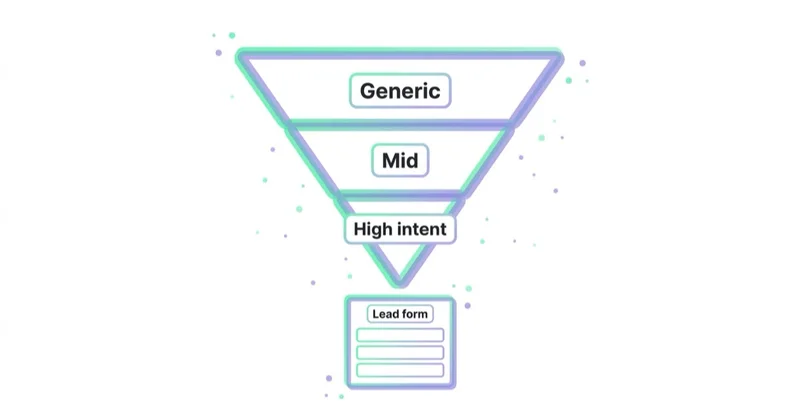
Useful controls:
- exclude student, job and free-intent searches where irrelevant;
- separate research and buying intent;
- track calls and forms properly;
- import offline conversions where possible;
- review lead quality with sales;
- create landing pages by service and use case;
- avoid broad match until data quality is sufficient.
A campaign that produces many cheap leads can still fail if the leads are not sales-qualified.
Lead quality feedback loop
For services and B2B, the campaign should learn from sales outcomes, not only form submissions.
A useful feedback loop includes:
- form or call tracking;
- UTM capture in CRM;
- lead source and search intent recorded;
- sales-qualified lead status;
- disqualified reason;
- booked call or proposal stage;
- closed-won and closed-lost values;
- offline conversion import where possible;
- regular review between marketing and sales.
This prevents a common paid search problem: optimizing toward the cheapest form submissions while sales receives poor-fit contacts. If the campaign can distinguish qualified leads from weak enquiries, bidding, keyword decisions and landing pages become more accurate.
How to measure Search Ads
Important metrics:
- cost;
- impressions;
- clicks;
- CTR;
- CPC;
- conversions;
- CPA;
- conversion value;
- ROAS;
- impression share;
- search terms;
- network performance;
- Quality Score diagnostics;
- landing page conversion rate;
- lead quality;
- offline sales;
- profit or contribution margin.
Do not combine brand and non-brand into one success story. Brand campaigns often look efficient because the user already knows the business. Generic campaigns show the cost of acquiring demand.
For diagnostics, read Quality Score in Google Ads: What It Is and How to Improve It.
Search campaign QA checklist
Before launch or scale-up, check:
- campaign objective matches the business goal;
- brand and non-brand are separated in reporting;
- locations match real service or delivery areas;
- language settings are intentional;
- keywords are grouped by intent;
- match types are chosen deliberately;
- negatives are added before launch;
- RSA assets are varied and relevant;
- ad assets support the user journey;
- landing pages match query and ad promise;
- conversion actions are primary only when they matter for bidding;
- Consent Mode and analytics setup are working where relevant;
- budget is enough for the chosen scope;
- search terms will be reviewed after launch.
This QA process is basic, but it catches many expensive mistakes before the first click is bought.
Common mistakes
| Mistake | Why it hurts | Better approach |
|---|---|---|
| Buying keywords without intent mapping | Budget goes to weak searches | Segment by intent |
| Sending all clicks to the homepage | Relevance drops | Match landing pages to queries |
| Mixing brand and generic results | Performance looks misleading | Report separately |
| No negative keywords | Irrelevant traffic accumulates | Review search terms |
| Optimising for clicks | Clicks do not equal revenue | Optimise for business conversions |
| Using broad match too early | Automation has weak signals | Build data and exclusions first |
| Weak RSA copy | Ads do not answer the query | Write modular, intent-led copy |
| No offline quality feedback | Lead volume hides poor fit | Connect sales feedback |
How we approach this at Space Ads
At Space Ads, Search campaigns start with intent architecture. We separate brand, generic, product, local, competitor and problem-led searches because each segment has a different role, cost and landing-page requirement. Before increasing budget, we check the search term report, negative keywords, RSA coverage, assets, Quality Score diagnostics, conversion tracking and post-click quality. For ecommerce, Search is strongest where controlled text can explain category value, delivery, fit, warranty or use case alongside Shopping and Performance Max. For B2B and services, the feedback loop has to include CRM quality and offline outcomes, because a campaign optimized for raw forms can become efficient at finding the wrong enquiries.
FAQ
What is search advertising in Google Ads?
It is paid advertising that shows ads to people who are searching on Google or eligible search-related surfaces for products, services, brands or information.
Is search advertising the same as SEO?
No. Search advertising is paid visibility through Google Ads. SEO is organic visibility. They can support each other, but they are different channels.
How fast do Search Ads work?
Traffic can start quickly after approval, but useful optimisation takes data. Early weeks should focus on search terms, tracking, landing pages and conversion quality.
Are Search Ads good for small businesses?
Yes, when scope is controlled. Small budgets need tight locations, high-intent keywords, strong negatives and clear conversion tracking.
Should brand keywords be advertised?
Often yes, especially when competitors bid on the brand, sitelinks are useful or the brand wants message control. Results should be reported separately from generic acquisition.
What matters more: CPC or conversion rate?
Both matter, but CPC alone is not enough. A high CPC can be profitable with strong conversion value. A low CPC can be wasteful if traffic is irrelevant.
Does Search still matter with Performance Max?
Yes. Performance Max can cover many Google surfaces, but Search campaigns still provide query and message control for important intent areas.
How often should search terms be reviewed?
New or high-spend campaigns should be reviewed frequently during the learning period. Mature campaigns can be reviewed on a regular schedule, but query quality should still be checked after budget, match type, landing page or bid strategy changes.
Should Search campaigns optimize for leads or qualified leads?
Qualified leads are usually better when the data is available. Optimizing only for raw form submissions can increase volume while reducing sales quality.
Conclusion
Search advertising is one of the clearest ways to capture active demand, but it rewards precision. The best campaigns align query intent, keywords, ad copy, assets, landing pages, bidding and measurement.
Use Search for demand that already exists. Separate brand from generic. Build landing pages that answer the search. Track real business value, not only clicks. Then connect Search with Shopping, Performance Max, YouTube, Display, remarketing, SEO and analytics so paid search becomes part of a complete growth system.
Running Google Ads search campaigns — from keyword research to conversion measurement — is something you can hand to a team.
Sources and further reading
- Google Ads Help: Create a Search campaign
- Google Ads Help: About the Google Search Network
- Google Ads Help: About keywords in Search Network campaigns
- Google Ads Help: About keyword matching options
- Google Ads Help: About responsive search ads
- Google Ads Help: About Quality Score for Search campaigns
Continue learning
- What Is the Google Search Network and How to Use It?
- What Are Keyword Match Types in Google Ads and How to Choose Them?
- What Are Responsive Search Ads in Google Ads?
- What Are Google Ads Extensions (Assets) and How to Use Them?
- Quality Score in Google Ads: What It Is and How to Improve It
- How to Use Google Shopping Campaigns Effectively?
Continue reading
What Are Dynamic Search Ads (DSA) and Are They Worth Using?
Dynamic Search Ads use website content to match searches, generate headlines and choose landing pages. In 2026, DSA strategy should focus on AI Max migration and URL control.
What Are Keyword Match Types in Google Ads and How to Choose Them?
Google Ads keyword match types control how search queries match keywords. Learn broad, phrase, exact, negatives, Smart Bidding, campaign structure and search term workflows.

What Are Programmatic Campaigns and Are They Worth Using?
Programmatic campaigns automate digital media buying across display, video, CTV, audio and more. Learn when they make sense, how buying models work and what risks to control.


































