
Responsive search ads are the standard text ad format in Google Ads Search campaigns. Instead of writing one fixed ad, advertisers provide multiple headlines and descriptions. Google Ads can then assemble different combinations based on the search query, device, user context and auction signals. A good RSA is not a random pile of headlines. It is a modular message system.
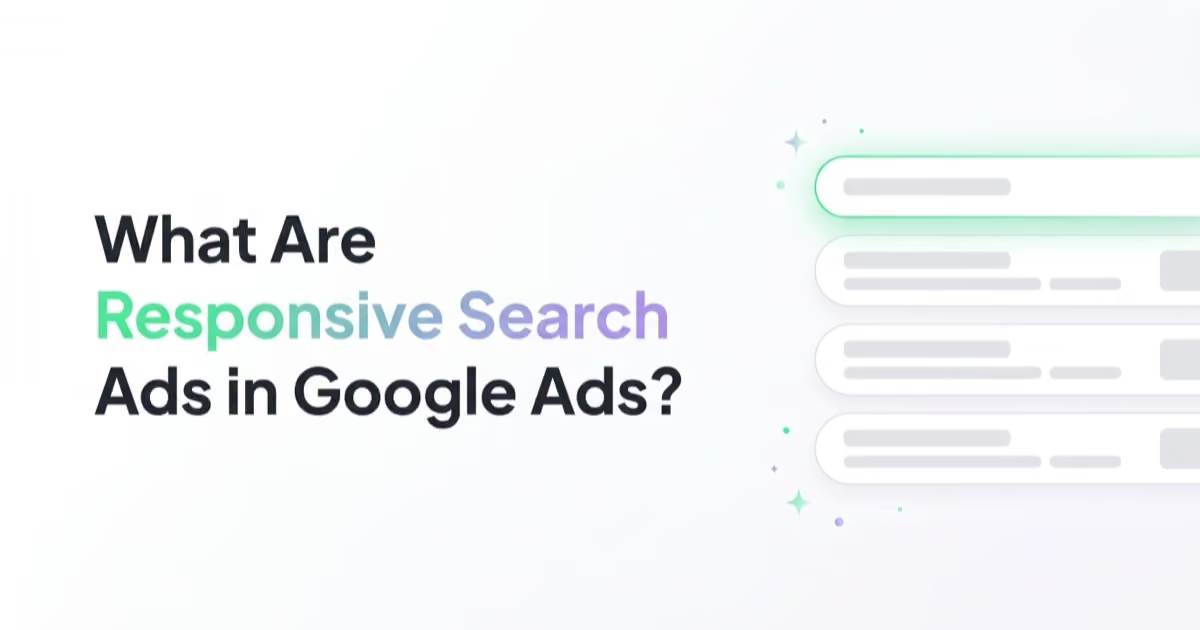
Responsive search ads work best when the ad group has a clear intent, the keywords are thematically close, the landing page matches the promise and the assets cover different useful angles: query relevance, value proposition, proof, qualification, urgency and call to action. Automation can test combinations, but it cannot invent a strong strategy from weak or repetitive copy.
TL;DR
- Responsive search ads, or RSAs, are asset-based text ads for Google Search campaigns.
- You can provide multiple headlines and descriptions. Google can show different combinations, usually up to three headlines and two descriptions when space allows.
- Each asset must work independently. Headlines and descriptions can appear in different orders and combinations.
- Pinning gives control but reduces flexibility. Use it for mandatory brand, legal or compliance text, not as a default.
- Ad Strength is a diagnostic tool. It helps identify missing or repetitive assets, but it is not the same as profit, lead quality or conversion value.
- RSA quality depends on ad group structure. One RSA cannot serve many unrelated intents well.
- Landing page match matters. A strong search ad can still fail if the page does not deliver the same promise.
What responsive search ads are
Responsive search ads are Google Ads text ads built from advertiser-provided assets. The assets are:
- headlines;
- descriptions;
- final URL;
- display path fields;
- optional customizers or automatically created text assets depending on campaign settings.
Google Ads can combine these assets into different ads for different searches. The system can favor combinations that appear more likely to match a query and meet the campaign goal.
In practical terms, RSAs replaced the old mindset of writing one perfect static ad. The new task is to create a controlled set of text modules that can be combined without losing meaning.
How responsive search ads work
Google Ads uses RSA assets at auction time.
The workflow is:
- The advertiser creates an ad group and keywords.
- The advertiser writes multiple headlines and descriptions.
- Google Ads evaluates the query, context and available assets.
- Google selects a combination that can fit the available ad space.
- Performance data and signals influence future combinations.
Google Ads documentation and API references describe RSAs as ads where the system automatically favors headline and description combinations that work well together. RSAs can display up to three headlines and two descriptions at serve time, although the exact appearance depends on space and context.
RSA vs old expanded text ads
| Area | Responsive search ads | Expanded text ads |
|---|---|---|
| Creative model | Multiple assets, many combinations | One fixed ad layout |
| Testing | Automated combinations | Manual ad variants |
| Control | Partial, with pinning | High |
| Scalability | Strong | Limited |
| Risk | Bad combinations if assets are weak | Less combination risk |
| Best practice | Modular, varied assets | Complete ad copy variants |
RSAs create more flexibility, but they require discipline. If the headline set mixes unrelated services, inconsistent claims and generic CTAs, the system has more ways to create mediocre ads.
How many headlines and descriptions should be added?
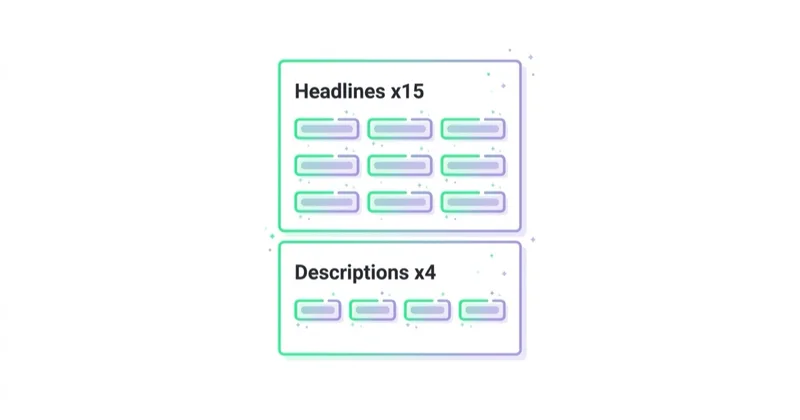
Google allows advertisers to add many headline and description assets, commonly up to 15 headlines and 4 descriptions. The goal is not to fill every slot with near-duplicates. The goal is to provide enough distinct, relevant options.
Useful asset categories:
- keyword or query relevance;
- offer;
- value proposition;
- audience;
- proof;
- differentiation;
- risk reduction;
- CTA;
- location;
- price or eligibility where relevant;
- brand.
For many ad groups, a strong RSA can start with 8-12 genuinely different headlines and 3-4 descriptions. More is not automatically better if the extra assets weaken clarity.
How to write RSA headlines
1. Search intent headlines
These reflect what the user is looking for.
Examples:
- "Google Ads Audit"
- "Ecommerce PPC Agency"
- "B2B Lead Generation Ads"
- "Performance Max Support"
- "Google Ads for SaaS"
Intent headlines help the ad feel relevant. They should match the keyword theme and landing page.
2. Value proposition headlines
These explain why the offer matters.
Examples:
- "Find Wasted Ad Spend"
- "Improve Lead Quality"
- "Scale Campaigns With Better Data"
- "Turn Tracking Into Better Bidding"
- "Prioritize What To Fix First"
Avoid vague claims such as "Best Marketing Solutions" unless supported by proof and context.
3. Proof headlines
Proof reduces risk.
Examples:
- "GA4 And CRM-Based Audits"
- "Feed, Tracking And PPC Review"
- "Data-Led PPC Strategy"
- "Clear Action Plan After Audit"
- "Built For Growth Teams"
Proof should be real. Do not invent numbers, awards or guarantees.
4. Qualification headlines
These help attract the right users and filter poor-fit clicks.
Examples:
- "For Ecommerce Teams"
- "For Accounts Ready To Scale"
- "For B2B Lead Gen Campaigns"
- "For Shopify And WooCommerce"
- "For Monthly PPC Budgets"
Qualification can reduce click volume but improve lead quality.
5. CTA headlines
These tell users what to do next.
Examples:
- "Book A PPC Review"
- "Request A Campaign Audit"
- "Get A Growth Plan"
- "See What To Improve"
- "Talk To A Specialist"
Use action language that matches the landing page. If the page offers a consultation, do not promise an instant quote unless that is true.
For copy principles, see How to Write Ad Copy That Converts and What Is Benefit-Led Copywriting and How to Use It?.
How to write RSA descriptions
Descriptions should support headlines with more context. They are longer, so they can explain process, audience, proof or next step.
Useful description angles:
- what the service includes;
- who it is for;
- what the user receives;
- what happens after clicking;
- why the offer is credible;
- what makes the page relevant to the search.
Examples:
- "Audit campaigns, tracking and landing pages before increasing budget. Get a prioritized plan based on revenue and lead quality."
- "Improve Google Ads decisions with cleaner conversion data, search query analysis and landing page recommendations."
- "For ecommerce teams that need better Shopping, Search, Performance Max and feed performance."
Descriptions should not simply repeat headlines. They should add substance.
Pinning in responsive search ads
Pinning lets advertisers force a headline or description to appear in a specific position.
Use pinning when:
- a legal disclaimer must appear;
- brand wording must be fixed;
- a regulated category requires specific text;
- an offer condition must be visible;
- a headline must always appear in a certain position for clarity.
Use it carefully. Google Ads Help notes that pinning is not recommended for most advertisers because it reduces the number of asset combinations that can match a search. If text must be pinned, it is often better to pin multiple suitable variants to the same position rather than a single line.
Practical pinning examples:
- Brand name pinned to headline position 1 in a brand campaign;
- Legal condition pinned to description position 1;
- Two or three compliant offer variants pinned to the same headline position;
- Location pinned only in location-specific campaigns.
Avoid pinning every position unless there is a strong reason. At that point, the RSA behaves more like a static ad and loses much of its testing flexibility.
Ad Strength: useful but not the final KPI
Ad Strength gives feedback on relevance, quantity and diversity of RSA assets. Ratings can range from incomplete or poor to excellent. It is useful during setup because it catches obvious issues such as missing final URL, missing keywords, weak variety or redundant copy.
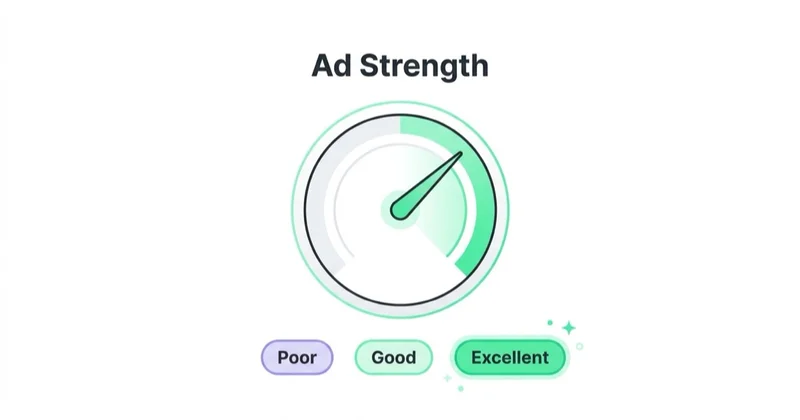
But Ad Strength is not the same as business performance.
An ad can have strong Ad Strength and still generate poor leads if:
- keywords are too broad;
- landing page is weak;
- tracking is wrong;
- offer is misaligned;
- audience intent is low;
- competitors have stronger proof;
- leads are unqualified.
Use Ad Strength as a diagnostic checklist. Use conversion value, lead quality, revenue, margin and search term quality as performance metrics.
For broader account diagnosis, see What Is a Google Ads Audit and How to Do It?.
RSA and keyword structure
Responsive search ads depend heavily on ad group structure. If one ad group contains many unrelated keywords, no single RSA can be highly relevant to all of them.
Good ad group structure:
- groups similar search intent;
- maps to one landing page or very close variants;
- uses consistent terminology;
- separates brand, competitor, category and problem terms where needed;
- supports specific ad copy.
Poor ad group structure:
- mixes services with different buyer intent;
- sends many keywords to one generic landing page;
- combines research queries and high-intent purchase queries;
- uses one RSA for many unrelated products.
For keyword foundations, read What Are Keyword Match Types in Google Ads and How to Choose Them? and Quality Score in Google Ads: What It Is and How to Improve It.
RSA and landing page experience
Search ads are only the promise. The landing page must deliver it.
Check:
- Does the landing page headline match the ad intent?
- Is the offer visible above the fold?
- Is the CTA consistent with the ad?
- Is pricing, eligibility or process clear?
- Does the page load quickly on mobile?
- Is conversion tracking working?
- Does the page answer objections raised by the query?
- Does the form or checkout work?
If the ad says "Google Ads audit for ecommerce", the page should explain the audit, ecommerce scope, deliverables, process and next step. Sending that user to a generic agency homepage wastes relevance.
For page improvement, see What Is a Landing Page and How to Build One?.
RSA with Smart Bidding
Responsive search ads and Smart Bidding are often used together. RSAs provide message flexibility; Smart Bidding uses auction-time signals to optimize bids toward conversion goals.
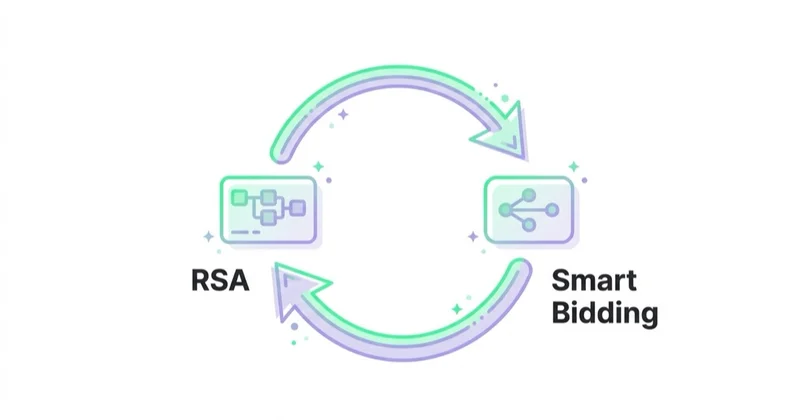
This does not mean campaign structure no longer matters. Smart Bidding works better when:
- conversion tracking is reliable;
- conversion actions represent real value;
- offline conversions or lead quality are imported where relevant;
- keywords are not chaotic;
- budgets are sufficient;
- landing pages match intent;
- ad assets are relevant.
If the conversion signal is weak, the bidding system can optimize toward the wrong outcome. For example, it may chase cheap form submissions that sales never qualify.
For measurement context, see Enhanced Conversions in Google Ads: What They Are and How to Set Them Up and What Is Conversion Rate and How to Increase It?.
RSA in ecommerce
In ecommerce, RSAs are useful when search intent needs more control than Shopping, Performance Max or Demand Gen provides.
Use cases:
- brand search;
- category search;
- high-margin product categories;
- competitor terms where allowed and appropriate;
- seasonal promotions;
- local inventory;
- product problem searches;
- search campaigns supporting Shopping.
Ecommerce RSA copy should reflect:
- product category;
- delivery promise;
- returns;
- availability;
- price or promotion where accurate;
- product range;
- trust proof;
- landing page relevance.
Do not advertise a promotion that is no longer visible on the landing page. Do not promise availability that the feed or website cannot support.
For ecommerce advertising context, read What Is Google Merchant Center and How to Manage It? and Performance Max Campaigns: What to Know and How to Create Them.
RSA reporting and optimization
Review:
- asset performance labels;
- combinations where available;
- search terms;
- conversion rate;
- cost per conversion;
- conversion value;
- lead quality;
- landing page performance;
- Quality Score components;
- impression share;
- device performance;
- campaign and ad group structure.
Optimization actions:
- replace repetitive assets;
- add missing intent headlines;
- remove misleading claims;
- test stronger proof;
- align landing page copy;
- split ad groups by intent;
- review search terms;
- adjust match types;
- import better conversion signals;
- use pinning only where necessary.
Do not optimize RSA only for CTR. A higher CTR can bring lower-quality traffic if the ad overpromises or becomes too broad.
How we approach this at Space Ads
A responsive search ad, to us, is a kit of parts for the system rather than one finished ad. So it gets real choice: a dozen headlines saying genuinely different things — price, delivery, guarantee, a specific benefit — not one idea reworded ten times. We pin sparingly, only where something has to appear for legal or brand reasons, since every pin takes testing room away from the system. Ad Strength we read as a hint about coverage and variety, not a score to max out for its own sake. And we hold the rule that matters most: one ad group, one intent. That's when the system assembles headlines that fit the query instead of blending messages.
Common mistakes
| Mistake | Why it hurts | Better approach |
|---|---|---|
| Fifteen similar headlines | No real testing value | Write distinct message angles |
| Too many intents in one ad group | Ad cannot match all searches | Split by intent and page |
| Excessive pinning | Reduces combination flexibility | Pin only mandatory text |
| Optimizing only for Ad Strength | Ignores business quality | Track conversions, value and leads |
| Ad promise differs from page | Low relevance and trust | Match ad, keyword and landing page |
| Generic CTAs | Weak next-step clarity | Use action tied to offer |
| No search term review | Bad queries waste spend | Review and exclude regularly |
| Weak conversion signal | Smart Bidding learns the wrong goal | Audit and improve tracking |
FAQ
What are responsive search ads?
Responsive search ads are Google Search text ads built from multiple headlines and descriptions. Google Ads combines assets into different ad variations depending on query and context.
How many headlines can an RSA have?
Responsive search ads can use multiple headlines, commonly up to 15. The goal is meaningful variety, not filling every slot with repeated wording.
How many descriptions can an RSA have?
Responsive search ads commonly allow up to 4 descriptions. Descriptions should add context, not repeat the same claim.
Should headlines be pinned?
Only when necessary. Pinning is useful for brand, legal or mandatory wording, but it reduces flexibility. If pinning is required, consider pinning multiple acceptable variants to the same position.
Does Ad Strength affect ad rank?
Ad Strength is a diagnostic and optimization tool. It is useful for improving asset coverage and relevance, but it should not be treated as the final performance metric.
Is one RSA enough per ad group?
Often one strong RSA per tightly themed ad group is a good starting point. Additional RSAs should have a clear test hypothesis, not be near-duplicates.
What makes a good RSA?
A good RSA has distinct assets, matches the search intent, includes useful proof, avoids overpromising, supports the landing page and is measured by conversion quality.
Are RSAs good for ecommerce?
Yes, especially for brand, category, promotion and high-intent search campaigns. They should be aligned with product availability, feed data, pricing and landing pages.
Conclusion
Responsive search ads reward structured messaging. The strongest RSAs are built from assets that can stand alone, combine naturally and reflect real user intent. Automation handles combinations, but the advertiser still controls the quality of the ingredients.
The best approach is to build tightly themed ad groups, write varied assets, use pinning only when required, treat Ad Strength as a diagnostic and measure outcomes beyond CTR. A search ad does not end at the click. It has to lead to a page, conversion path and business result that match the promise made in the search results.
We write and test RSAs within Google Ads campaigns, based on a messaging strategy rather than the sheer number of variants.
Sources and further reading
- Google Ads Help - How to steer AI-powered search ads
- Google Ads Help - About Ad Strength for responsive search ads
- Google Ads API - Responsive Search Ads overview
- Google Ads Help - Keyword matching options
- Google Ads Help - Smart Bidding best practices
Continue learning
- What Are Keyword Match Types in Google Ads and How to Choose Them?
- Quality Score in Google Ads: What It Is and How to Improve It
- How to Write Ad Copy That Converts
- What Is a CTA and How to Create an Effective Call to Action?
- What Is a Landing Page and How to Build One?
- What Is a Google Ads Audit and How to Do It?
Continue reading

What Are Sponsored Links and How to Use Them?
Sponsored links are paid search ads shown near organic results, but their performance depends on intent, query quality, ad relevance, landing pages and measurement. This guide explains how sponsored links differ from SEO, when to use them, how to launch them in Google Ads and how to judge results by leads, sales, value and margin rather than clicks.
What Is the Google Search Network and How to Use It?
The Google Search Network shows ads around active search intent. Learn how it works, where ads appear, how search partners behave and how to structure Search campaigns.
What Are RLSA Campaigns? Remarketing Lists for Search Ads
RLSA uses audience lists in Google Search campaigns so previous visitors can be treated differently when they search again. Learn Observation vs Targeting, use cases and setup.


































