Wedding venue marketing should fill the calendar with qualified tours and signed bookings, not just inquiries. A venue has a limited number of valuable dates. Once a Saturday in peak season is booked, it cannot be sold again. Once a winter Friday, weekday, Sunday or short-notice date remains empty, that revenue may disappear permanently.
That makes the economics different from most lead-generation campaigns. A cheap inquiry is not automatically good. The useful conversion is a qualified couple with a realistic date, guest count, budget range and willingness to tour. The business outcome is a signed contract, deposit or booked date. The strongest marketing systems connect the whole path: discovery, shortlist, gallery view, inquiry, tour, proposal, follow-up, contract and calendar yield.
This article is the English-market counterpart of our Polish guide to advertising a wedding venue. The strategic base is the same - the tour is the key intermediate conversion - but the EN market usually gives more weight to wedding marketplaces, Instagram, Pinterest, Google Business Profile, long research cycles and non-wedding event demand.
TL;DR
- The tour is the main conversion. Forms and calls are early signals; qualified tours and signed bookings decide revenue.
- Calendar value is uneven. Peak Saturdays, off-peak dates, weekdays, Sundays and short-notice openings need different campaigns.
- Search captures active intent. Location, style, capacity, budget, date-availability and non-wedding event queries should not sit in one generic ad group.
- Visual proof does most of the selling. Real-wedding galleries, venue walkthroughs, ceremony options, table layouts and guest-flow photos matter more than broad copy.
- Marketplaces are useful, but not owned. The Knot, WeddingWire, Zola and local directories should be measured separately from direct demand.
- Measurement has to follow the sales process. Track inquiry, qualified lead, tour booked, tour attended, proposal, deposit and signed booking.
Why Wedding Venue Marketing Is Different
Wedding venues combine high booking value, limited inventory, emotional decision-making, visual comparison and long consideration cycles. That combination makes standard local lead generation too shallow.
First, every date has a different value. A peak Saturday, off-season Friday, holiday weekend, winter date and last-minute opening do not create the same margin or urgency. Campaigns that treat all inquiries equally can overfund easy dates and ignore the dates that actually need demand.
Second, the decision is collaborative. Couples may involve parents, planners, friends and vendors. One person can discover the venue on Instagram, another may compare packages on the website, and the final decision may happen after a tour, a proposal and several follow-ups. Attribution has to survive that messy path.
Third, wedding venues are intensely visual. Couples want to imagine the ceremony, reception, cocktail hour, photos, rain plan, guest movement, food service, dance floor, lighting and overnight stay if accommodation exists. Stock-style images and thin galleries create distrust because the venue itself is the product.
Fourth, a wedding is not the only use case. Corporate events, private parties, showers, rehearsal dinners, elopements, micro weddings and social events can fill gaps. Non-wedding demand is often less romantic, but it can improve calendar utilization.
The Venue Funnel
A healthy venue funnel is not "ad to form." It is a staged sales process.
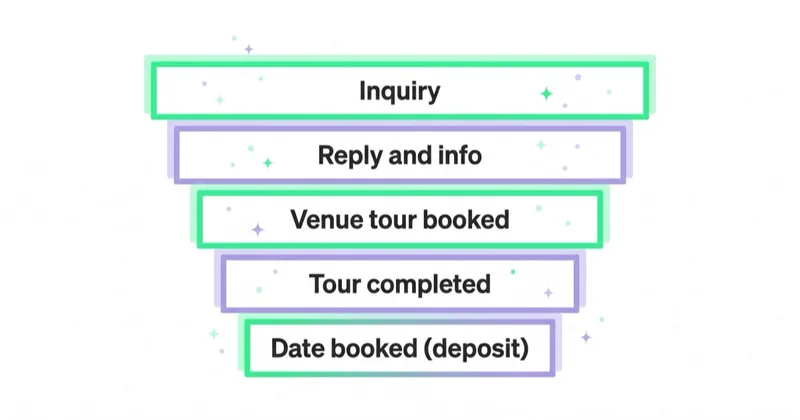
| Stage | What the Couple Needs | Venue Asset |
|---|---|---|
| Discovery | A reason to shortlist the space | Search ad, marketplace listing, Instagram, Pinterest, GBP |
| Comparison | Proof the venue fits style, guest count and budget | Gallery, packages, capacity, FAQs, reviews |
| Qualification | Date, guest count, budget and event type alignment | Smart inquiry form and fast follow-up |
| Tour | Confidence after seeing the space | Tour booking, reminders, sales script, proposal process |
| Booking | Clear terms and next step | Proposal, contract, deposit, date hold |
| Yield management | Filling the right dates | Off-peak, weekday, non-wedding and short-notice campaigns |
Marketing has to support every stage. If ads create demand but the website hides capacity, pricing context and availability logic, the sales team receives weak inquiries. If the tour process is slow, even strong leads cool down. If CRM stages are not tracked, budget keeps flowing to channels that look busy but do not book dates.
Channel Mix for Wedding Venues
| Channel | Best Role | Main Risk |
|---|---|---|
| Google Search | Active local, style, capacity and availability intent | Wasted spend without segmented intent and negatives |
| Google Business Profile | Local trust, reviews, photos, calls and directions | Weak photos or stale hours reduce conversion |
| Wedding marketplaces | Discovery, reviews and comparison | Lead quality varies; the platform owns the relationship |
| Instagram / Meta | Visual demand, retargeting, open days, date pushes | Pretty reach without tour tracking |
| Early inspiration and style discovery | Weak if galleries are not organized by style and use case | |
| Email / CRM | Follow-up, tour reminders, open days, date releases | Missed revenue if leads are not segmented |
The broader local advertising framework is covered in Google Ads for local businesses. Wedding venues add calendar yield, galleries, marketplace management and a longer sales cycle. The category also overlaps with catering marketing, hotel and hospitality marketing and restaurant marketing because venues often sell food, lodging or event experiences alongside the room.
Google Search: Segment Intent Before Scaling Budget
Search campaigns work best when the structure reflects how couples and event planners actually search.
| Intent | Example Queries | Landing Page Need |
|---|---|---|
| Location | "wedding venues [city]," "wedding venue near [area]" | Photos, address, region, capacity, tour CTA |
| Style | "barn wedding venue," "garden wedding venue," "industrial wedding venue" | Style-specific gallery and real weddings |
| Capacity | "wedding venue for 200 guests," "intimate wedding venue" | Guest counts, layouts, ceremony/reception flow |
| Budget | "affordable wedding venue [city]," "all-inclusive wedding venue" | Pricing context, packages, what is included |
| Availability | "wedding venue with 2027 dates," "last minute wedding venue" | Availability workflow and date request form |
| Non-wedding | "corporate event venue," "private party venue," "shower venue" | Event-specific page and packages |
Negative keywords protect budget. Common exclusions include jobs, careers, DIY decorations, dress, photographer, DJ, florist, invitation, playlist, vows, free, template, Airbnb when irrelevant, and city names outside the service area. Wedding search demand is broad; not every wedding query is a venue query.
Landing pages should not all point to the same home page. A garden venue ad should show garden ceremony photos, rain-plan information and real outdoor weddings. A capacity query should show layouts and guest-flow details. A budget query should provide at least pricing guidance, package structure or factors that influence quotes. A non-wedding event query should not land on a page that speaks only to couples.
Google Business Profile and Local Trust
Google Business Profile often becomes a comparison page before the couple ever submits a form. Google describes local ranking through relevance, distance and prominence, but for a venue the conversion layer is just as important: photos, reviews, categories, phone number, website link, hours and directions.
A venue profile should include:
- accurate category and service-area information;
- current opening and tour hours;
- phone number and UTM-tagged website link;
- exterior, ceremony, reception, cocktail, accommodation, parking and rain-plan photos;
- recent reviews with professional responses;
- posts for open days, new galleries, seasonal availability or date releases;
- answers to common questions about capacity, tours, parking and accessibility.
Photos should show the full decision, not only one hero angle. Couples and planners need to understand the entrance, ceremony setup, reception layout, restrooms, bar, food service, dance floor, guest movement, parking, overnight rooms if relevant and backup plan for weather. These details are CRO assets, not decoration.
Wedding Marketplaces: Treat Them as a Channel, Not a Strategy
The Knot, WeddingWire, Zola, Hitched and regional directories can help venues get discovered, especially when couples are building an initial shortlist. A strong listing with current photos, reviews, packages, location information and quick responses can produce valuable tours.
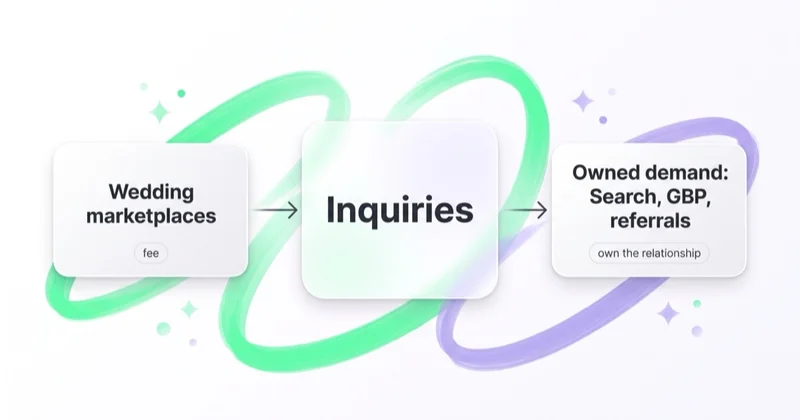
The risk is dependence. Marketplace leads often arrive beside competitors, may be sent to several vendors and can vary in quality. The venue also has less control over the relationship, data and follow-up journey than with direct traffic.
The practical approach is simple:
- keep listings current and visually strong;
- respond quickly and consistently;
- tag every marketplace lead source in the CRM;
- measure cost per qualified inquiry, tour and booking by marketplace;
- compare marketplace tour-to-booking rate with direct Google, organic, Meta and referral leads;
- use the venue website and email process to own the relationship after the first contact.
Marketplaces can be profitable. They should not be allowed to hide weak lead quality behind raw inquiry volume.
Instagram, Meta and Pinterest: Visual Proof and Return Visits
Visual platforms matter because couples often choose with images before they compare details. The strongest creative assets are specific and real:
- full real-wedding galleries by style, season and guest count;
- short venue walkthroughs that show ceremony, reception, bar, rooms and outdoor areas;
- ceremony-to-reception transformations;
- rain-plan and backup setup examples;
- table layouts for different capacities;
- food, drinks, lodging, transport and guest-flow details;
- testimonials or vendor collaborations where permissions are clear;
- open-day, showcase and newly released date campaigns.
Meta is useful for retargeting, open days, visual storytelling and date-specific pushes. Pinterest is useful earlier in the inspiration process when couples are saving venue ideas, color palettes, tablescapes and ceremony styles. Both channels work better when galleries are organized around searchable concepts: intimate wedding, garden ceremony, winter wedding, black-tie wedding, rustic venue, industrial venue, micro wedding or destination-style weekend.
The mistake is treating visual platforms as awareness only. A couple who watched a walkthrough, saved a gallery, returned to the pricing page and booked a tour has shown intent. The CRM and analytics setup should preserve those signals where platform rules and consent allow.
Venue Website and CRO
The website should answer the questions that otherwise flood the inbox. A beautiful gallery is important, but conversion depends on practical clarity.
High-converting venue pages usually include:
- location and travel context;
- guest capacity for ceremony, dinner and evening reception;
- indoor and outdoor options;
- rain plan or weather contingency;
- package structure and what is included;
- pricing guidance or quote drivers if exact pricing is not published;
- catering, bar, lodging and supplier policy;
- parking, accessibility and transport notes;
- real-wedding galleries by season and style;
- reviews and press mentions;
- FAQ about deposits, date holds, tours and payment schedule;
- form fields for date, guest count, event type, budget range and phone;
- clear next step: tour, availability check, quote or open day.
There is no universal rule that every venue must publish a full price list. But total opacity usually creates more low-fit inquiries. Even a range, package explanation, minimum spend, seasonal pricing note or "from" context can reduce wasted sales time.
For AEO and LLM SEO, the same practical details help AI systems understand the venue. Pages that clearly state location, capacity, event types, ceremony options, accommodation, parking, pricing context, accessibility, FAQs and real examples are easier to retrieve and summarize than pages built only around mood copy.
Calendar Fill: Peak Dates Are Not the Whole Business
Venue marketing should help manage inventory. Peak Saturdays may sell with less effort, while winter dates, weekdays, Sundays, short-notice openings and smaller events may require more deliberate demand creation.
Useful campaign segments include:
- peak-season dates with premium positioning;
- off-season weddings with visual seasonal proof;
- Friday, Sunday and weekday wedding packages;
- short-notice availability for flexible couples;
- micro weddings and elopements;
- corporate events, parties, showers and rehearsal dinners;
- open days for specific seasons or released dates.
Each segment needs its own value model. A lower-margin weekday booking may still be attractive if it fills otherwise empty inventory. A corporate event may not look like a wedding lead, but it can improve utilization and introduce the venue to future private-event buyers.
Follow-Up and CRM
Wedding venue leads need disciplined follow-up because the buying process is emotional, collaborative and slow. A venue that responds after two days often loses to a competitor that answers within an hour, sends useful details and offers tour slots.
Minimum CRM stages:
- new inquiry;
- qualified inquiry;
- date unavailable;
- date available;
- tour offered;
- tour booked;
- tour attended;
- proposal sent;
- date held;
- deposit paid;
- contract signed;
- lost - budget;
- lost - date;
- lost - capacity;
- lost - no response;
- lost - competitor.
These stages make performance marketing more accurate. A channel that sends many inquiries for unavailable dates is not the same as a channel that sends fewer, better-matched couples who tour and sign. Lead source, date type, guest count, budget range, package, sales owner and reason lost should all be easy to review.
Measurement: From Inquiry to Booking Value
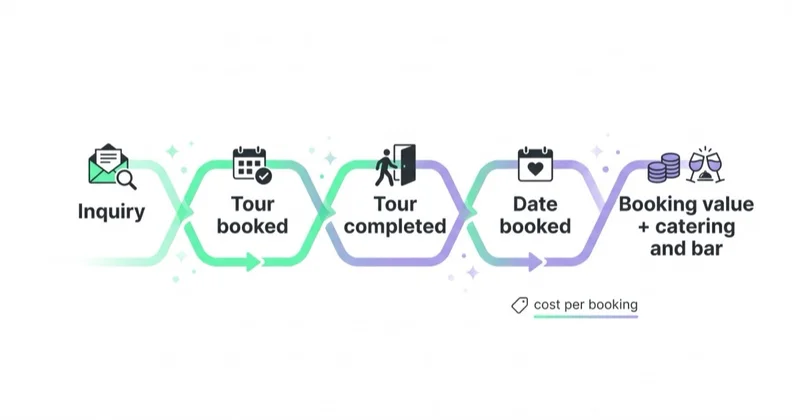
Google call reporting and offline conversion imports can connect calls, tour bookings and signed contracts back to ad interactions. For wedding venues, importing later-stage outcomes is especially important because the first form submission is a weak proxy for revenue.
| Event | Meaning | Use in Optimization |
|---|---|---|
inquiry |
Form or call | Early signal |
qualified_inquiry |
Date, guest count and budget are plausible | Better lead signal |
tour_booked |
A site visit is scheduled | Primary conversion signal |
tour_attended |
The couple actually toured | Strong quality signal |
proposal_sent |
Sales process is active | Pipeline signal |
deposit_paid |
Date is commercially committed | Revenue signal |
booking_signed |
Contract is complete | True outcome |
booking_value |
Revenue or margin by date type | Value-based optimization signal |
Attribution windows need to match the sales cycle. Some bookings happen quickly; others happen after weeks of comparison. The goal is not perfect attribution. The goal is to stop optimizing to the cheapest inquiry and start optimizing toward tours, deposits and calendar value.
How Space Ads Approaches Wedding Venue Accounts
For wedding venues, the Space Ads approach starts with inventory and sales process. The first questions are about calendar value, available dates, guest capacity, package economics, CRM stages, response time, tour process, photo assets and source quality.
Only then does channel scaling make sense. Google Search captures active venue intent. Google Business Profile and reviews support local trust. Marketplaces are measured as separate acquisition channels. Meta and Pinterest distribute visual proof and support return visits. CRM feedback connects spend to tours, deposits and signed bookings.
For an existing venue, a marketing audit should reveal whether spend is filling the calendar or merely creating inquiries. Ongoing execution can connect Google Ads, Meta Ads and performance marketing with creative, landing pages and CRM reporting so the account learns from real bookings.
30-Day Improvement Plan
- Days 1-3: map the calendar. Separate peak dates, off-peak dates, weekdays, short-notice gaps, non-wedding events and margin by event type.
- Days 4-7: clean tracking and CRM stages. Track inquiry, qualified lead, tour booked, tour attended, proposal, deposit and signed booking by source.
- Days 8-11: upgrade visual assets. Build galleries by style, season, capacity and event type; add walkthrough video and rain-plan proof.
- Days 12-16: rebuild Search. Separate location, style, capacity, budget, availability and non-wedding campaigns; add negative keywords.
- Days 17-21: improve the website. Add capacity, package, pricing context, FAQ, availability workflow, tour CTA and stronger forms.
- Days 22-25: audit marketplaces. Update listings, response templates, source tagging and cost-per-tour reporting.
- Days 26-30: launch calendar pushes. Promote open days, off-peak dates, weekday packages, short-notice availability and non-wedding events.
Common Mistakes
| Mistake | Better Approach |
|---|---|
| Optimizing to raw inquiries | Optimize to qualified tours, deposits and signed bookings |
| Treating every date equally | Segment campaigns by calendar value and availability |
| Hiding capacity and pricing context | Give enough detail to qualify serious couples |
| Using one generic gallery | Build galleries by style, season, guest count and event type |
| Depending only on marketplaces | Build direct search, social, email and referral demand |
| Weak follow-up after inquiry | Use CRM stages, fast responses and tour reminders |
| Ignoring non-wedding events | Fill gaps with corporate and private-event campaigns |
FAQ
What is the most important metric in wedding venue marketing?
Cost per qualified tour and cost per signed booking are usually more useful than cost per inquiry. A raw form can come from a couple with the wrong date, guest count or budget. A qualified tour shows stronger intent, and a signed booking shows whether the calendar and revenue goals are actually being met.
How should a wedding venue use Google Ads?
Google Ads should be split by intent: location, style, capacity, budget, availability and non-wedding event demand. Each segment needs a matching landing page and negative keywords. A couple searching for a garden ceremony needs different proof than a corporate planner searching for a private event venue.
Are wedding marketplaces worth it for venues?
They can be, but only when measured properly. Marketplaces can help with discovery and reviews, but lead quality varies and the platform owns much of the first relationship. The venue should tag marketplace leads in the CRM and compare cost per qualified inquiry, tour and signed booking against direct channels.
How can a venue fill off-peak dates?
Off-peak dates need specific positioning rather than leftover messaging. Useful angles include winter galleries, Friday or Sunday packages, weekday incentives, micro weddings, elopements, short-notice availability, corporate events and private parties. The campaign should promote the dates that actually need demand.
How important are Instagram and Pinterest for wedding venues?
Very important when the creative is real and specific. Couples use visual platforms to understand style, atmosphere and guest experience before they contact a venue. Walkthroughs, real-wedding galleries, table layouts, ceremony options and seasonal visuals work better than generic inspirational posts because they answer practical selection questions.
What should a wedding venue inquiry form ask?
The form should qualify without becoming exhausting. Core fields include name, email, phone, planned date or date range, guest count, event type and budget range. Optional fields can include ceremony type, accommodation needs, preferred tour time and how the couple found the venue. The form should lead into a fast follow-up and clear tour-booking process.
In Short
- Wedding venue marketing should optimize for qualified tours and signed bookings, not raw inquiries.
- Calendar value changes by date type, season and event type.
- Google Search captures active intent, while GBP, marketplaces, Instagram and Pinterest shape trust and comparison.
- Real visual proof, capacity details, pricing context and fast follow-up are core CRO assets.
- Marketplace, direct, paid social, organic and referral leads should be measured separately.
- CRM feedback should connect marketing spend to tours, deposits, contracts and booking value.
Sources
- Google Ads Help - About call reporting
- Google Ads Help - About offline conversion imports
- Google Business Profile Help - Improve local ranking on Google
- Meta Business Help - About Meta Pixel
- Vogue Business - Pinterest-backed 2026 wedding trends coverage
Continue Learning
Continue reading
Weight Loss Clinic Marketing: GLP-1 Demand Without Risky Claims
Weight loss clinic marketing in the GLP-1 era has to generate qualified consultations without risky body claims, prescription-drug shortcuts or privacy leakage. This guide covers Meta, Google Search, telehealth funnels, HIPAA-conscious tracking and program LTV.
Catering Marketing: Google Ads, Meta and Booked Events
Catering marketing works when event catering, corporate accounts and drop-off orders are measured separately. This guide covers Google Search, Meta, marketplaces, food trust, seasonality, quote quality and booked-event value.
Home Remodeling Marketing: High-Ticket Leads from Google and Meta
Home remodeling marketing should turn search and visual interest into qualified consultations, delivered proposals and profitable completed projects. Learn how to connect Google, Meta, project proof, financing disclosures, lead handling and CRM values.