
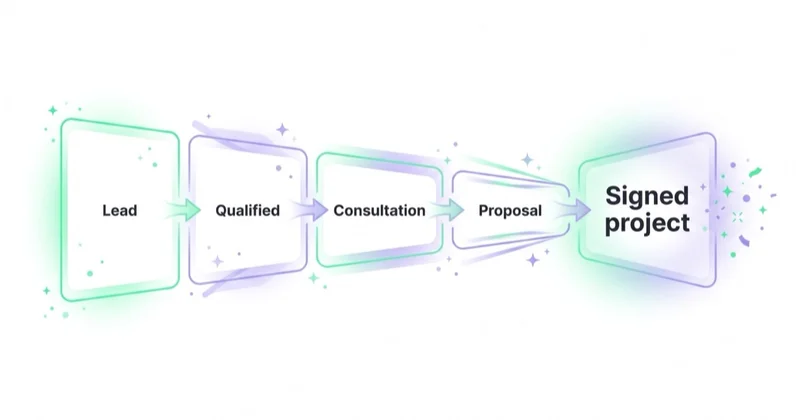
Home remodeling marketing is high-ticket local lead generation with a long trust cycle. A homeowner may research kitchen remodel ideas for months, save bathroom inspiration, compare financing options, read reviews, request several estimates and only then commit to a contractor. The business outcome is not a cheap form fill. It is a qualified consultation that becomes a proposal and, eventually, a signed project.

That makes remodeling different from many urgent trades. A remodeler often wins through accumulated evidence: relevant project galleries, authentic reviews, applicable credentials, process clarity, consultation quality, financing transparency and consistent follow-up. Search can capture active planning; Meta and Instagram can demonstrate the transformation. The CRM and project system then have to show which enquiries became profitable completed work—not merely busy calendars or signed revenue that later changed.
TL;DR
- Home remodeling marketing should optimize for projects, not leads. The useful metrics are qualified consultations, proposals, signed projects and project value.
- Google Search captures active planning. Kitchen, bathroom, addition and whole-home renovation queries need separate structure, landing pages and budgets.
- Meta sells the transformation. Real before/after creative, project walkthroughs, design process videos and retargeting fit the long consideration cycle.
- Trust is a conversion asset. Applicable licensing and insurance, authentic reviews, written estimates, contracts, warranties and process clarity reduce perceived risk.
- Financing can expand demand, but copy must be precise. Monthly-payment framing should not hide terms, eligibility or material conditions.
- Call quality matters. Missed calls, slow callbacks and unqualified service areas turn strong media into wasted spend.
- Downstream conversion data closes the loop. Send qualified and converted outcomes back only with appropriate consent, governance and platform-compliant implementation.
- Signed value is not realized value. Reconcile scope changes, cancellations, cost overruns, collections and contribution after completion.
Why Home Remodeling Marketing Is Different
Home remodeling sits between local services, visual commerce and consultative sales. The contractor is selling a disruptive, expensive project in the customer's home. That creates five marketing realities.
First, project value varies widely. A small bathroom refresh, full kitchen remodel, basement conversion, home addition and whole-home renovation do not have the same revenue, margin, cycle length or operational complexity. A campaign that treats every lead equally can overfund small projects and underfund the work the business actually wants.
Second, the sales cycle is multi-step. A typical path may look like:
- inspiration and research;
- local contractor search;
- gallery and review comparison;
- inquiry or phone call;
- qualification;
- design consultation or in-home visit;
- estimate or proposal;
- financing discussion;
- contract and schedule.
Third, the purchase is trust-heavy. The homeowner is not only buying cabinets, tile or labor. They are choosing who can enter the home, manage disruption, protect the budget and finish the work. That is why proof, process and communication matter as much as ad copy.
Fourth, visuals create demand. Remodeling is one of the categories where images are not decoration. A strong before/after set, project video or material selection story can make the buyer understand the outcome before they search for a contractor.
Fifth, operations affect marketing performance. A remodeler with limited design capacity, long lead times or slow call handling can make a strong campaign look weak. Media cannot compensate for unreturned calls, unclear estimates or a sales process that fails to follow up.
Channel Roles
The channel mix should mirror the buying journey rather than copy a generic home-services setup.
| Channel | Best Role | Main Measurement |
|---|---|---|
| Google Search | capture active project planners | qualified calls, consultations, project type |
| Local Services Ads | generate calls or messages in eligible categories and markets | qualified leads, booked consultations, downstream value |
| Google Business Profile | support local trust and discovery | calls, direction requests, profile engagement |
| Meta and Instagram | create visual demand and retarget | qualified lead forms, gallery visits, consultation starts |
| YouTube | explain process, show projects, build familiarity | engaged views, assisted consultations |
| Organic content | answer cost, process and design questions | local visibility, assisted conversions |
| Email and SMS nurture | convert slower researchers | consultation bookings, proposal follow-up |
Local Services Ads changed materially before 2026. Eligible advertisers now use the Google Verified badge after completing the relevant screening and verification. Google's former money-back guarantee ended for services booked after 7 December 2025. Do not describe the badge as a Google endorsement or promise customers reimbursement; use only the representations and brand assets permitted by the current policy.
The general framework for contractor acquisition is covered in Google Ads for local businesses, home services and contractors. Remodeling needs an extra layer because project proof, scope fit and design confidence are central to conversion.
Google Search For Remodeling Leads
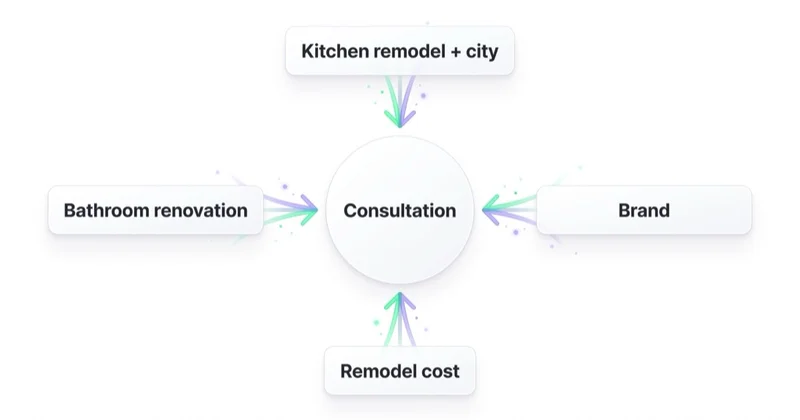
Search campaigns should be structured by project type, intent and geography. A single "remodeling" campaign usually hides which services are profitable and which searches waste budget.
| Intent Type | Example Search Pattern | Better Landing Page |
|---|---|---|
| Kitchen remodel | kitchen remodel city, kitchen renovation contractor | kitchen gallery, process, budget ranges, consultation CTA |
| Bathroom remodel | bathroom remodel near me, walk-in shower remodel | bathroom examples, accessibility options, timeline, estimate process |
| Whole-home renovation | home renovation company, full home remodel | larger project proof, design-build capability, project management |
| Home addition | home addition contractor, room addition city | permitting, design, structural process, feasibility call |
| Cost research | kitchen remodel cost, bathroom remodel estimate | cost drivers, ranges, financing and consultation path |
| Contractor comparison | remodeling contractor reviews, remodeling company ratings | reviews, credentials, warranties, project case studies |
| Brand | company name, company reviews, company financing | direct booking path and trust reinforcement |
Project separation supports better bidding. A bathroom campaign may produce many inquiries but smaller jobs. A whole-home renovation campaign may have fewer leads but higher value. A kitchen campaign may need showroom, design or financing messaging. The account should not force all three into one target cost per lead.
Negative keyword work should remove traffic that clearly does not match the business model. Common candidates include jobs, careers, DIY, tutorials, free plans, materials only, wholesale, commercial work for a residential-only contractor and unserved locations. Review the actual query in context before excluding it: “template” may be irrelevant, while a cost-planning query may begin a valuable high-ticket journey.
Landing pages should match intent. A search for "walk-in shower remodel" should not land on a generic home page. A search for "kitchen remodel cost" should not land on a form with no pricing context. The page needs enough detail for the homeowner to understand fit before contacting the company.
Meta And Instagram For Visual Demand
Meta and Instagram work because remodeling is easy to visualize and hard to decide. The channels are strongest when they show transformation, explain process and retarget people who already showed project interest.
Useful creative formats include:
- real before/after images with consistent framing;
- room-by-room carousel galleries;
- short project walkthrough videos;
- designer or project manager explanation clips;
- material selection and showroom content;
- client review overlays with project context;
- timeline or process explainers;
- retargeting ads for people who viewed galleries or cost pages.
Creative should be real, specific and local where relevant. “Modern kitchen remodel in Austin with custom cabinetry and quartz counters” gives the buyer more useful context than “dream kitchen transformation.” Identify renders and staged concepts where their presentation could otherwise imply completed work. Obtain the homeowner's permission for recognizable interiors, addresses, people and testimonials, and clear rights from the photographer or designer before using assets in paid media.
Meta lead forms can work, but qualification and privacy need to be designed together. Ask only what the business needs at that stage: project type, approximate budget band, timing, service ZIP code and preferred consultation route may be enough. Explain how submitted details and photos will be used, secure the data, restrict access and do not collect sensitive household information merely because the form allows it. A longer form does not automatically produce a better lead; validate each question against progression and completion rates.
Retargeting should reflect the decision stage:
| Audience | Better Message |
|---|---|
| homepage visitors | brand proof and project categories |
| kitchen gallery visitors | kitchen consultation, design process, kitchen case study |
| bathroom gallery visitors | bathroom examples, accessibility or walk-in shower proof |
| cost-page visitors | budget ranges, financing clarity, estimate process |
| form starters | consultation reminder and trust proof |
| past leads not closed | new project proof, seasonal availability, showroom invitation |
Financing As A Demand Lever
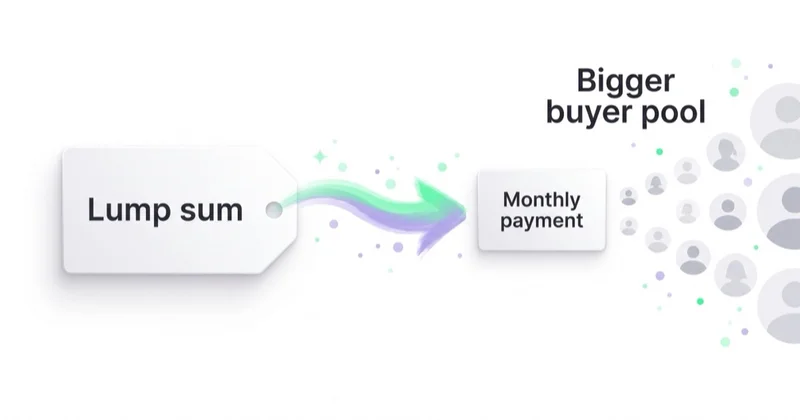
Financing can make a large remodel feel more approachable, but it is also an area where careless copy can damage trust. Monthly-payment framing is useful only when the conditions are clear and accurate.
Financing rules vary by product, lender, state and the contractor's role. Review offers and advertising with the lender and qualified legal or compliance advisers. At minimum, content should clarify:
- whether financing is offered directly, through a partner or only as a referral;
- whether approval is required;
- whether rates, terms or promotional periods vary;
- the material assumptions behind any advertised payment example;
- whether the project scope affects final pricing;
- whether the homeowner should compare terms before agreeing.
The FTC advises homeowners to understand financing terms and compare options before agreeing to contractor-arranged financing. Certain products create additional risks: for example, the Consumer Financial Protection Bureau warns that PACE financing is repaid through property taxes and can put the home at risk if payments become unaffordable. Do not generalize one payment illustration across products or use “as low as” language without the conditions necessary to understand it.
Financing can also create useful content:
- "what affects kitchen remodel cost";
- "how bathroom remodel financing usually works";
- "when to remodel before selling";
- "how to compare estimates";
- "what is included in a design-build proposal";
- "how to plan a renovation timeline."
Those topics support organic visibility and make paid traffic convert better because homeowners arrive with clearer expectations.
Trust Signals That Convert
Home remodeling has a high perceived risk. The marketing has to answer the objections a homeowner may not say out loud:
- Will the contractor finish the work?
- Will the final cost change?
- Will the team respect the home?
- Are licenses and insurance current?
- Is the estimate detailed enough?
- Are the reviews real and relevant?
- What happens if the timeline slips?
- Who manages permits and subcontractors?
The landing page and sales process should provide concrete proof:
| Trust Signal | Why It Matters |
|---|---|
| Applicable license, registration and insurance details | helps the buyer verify basic contractor eligibility |
| Detailed portfolio by project type | shows relevant experience |
| Reviews with project detail | makes proof more believable |
| Written estimate process | sets expectations before the consultation |
| Contract and scope clarity | reduces fear of vague work |
| Warranty or workmanship policy | addresses post-project risk |
| Team and project management explanation | shows who will handle communication |
| Start-to-finish timeline | makes disruption easier to understand |
| Financing disclosures | avoids surprise or pressure |
The FTC's home improvement guidance tells consumers to consider applicable licensing and insurance, read reviews critically, obtain several estimates and review contracts carefully. Make verification easy, but do not imply that one badge eliminates the buyer's need for diligence.
Reviews need their own controls. The FTC's Consumer Reviews and Testimonials Rule has applied since October 2024 and addresses fake or false reviews, purchased sentiment, certain insider reviews and review suppression. Ask every customer through a consistent process, do not condition incentives on a positive opinion, disclose material connections and preserve criticism rather than selectively hiding it.
Landing Pages For High-Ticket Remodeling
A remodeling landing page should help a homeowner self-qualify. It should not be a thin form page.
Strong pages usually include:
- project-specific headline and location signal;
- real gallery for the project type;
- range-based cost education or cost drivers;
- consultation process;
- design-build or contractor model explanation;
- financing information where applicable;
- reviews and local proof;
- applicable license, registration, insurance and warranty details;
- service area map or location list;
- FAQ for budget, timeline, permits and process;
- primary CTA for consultation;
- secondary CTA for gallery, cost guide or phone call.
The CTA should match the project. "Book a design consultation" is stronger for high-value remodeling than a generic "get a quote" when the business needs to understand scope, space, materials and timeline. For smaller services, an estimate request may be enough. For additions or whole-home work, a feasibility call may be a better first step.
For conversion structure, see what a landing page is and how to build one.
Measurement: From Lead To Signed Project
The measurement system should match the sales process. A remodeling lead is not a result until the business knows whether it became qualified work.
| Stage | Meaning | Platform Use |
|---|---|---|
lead |
form, call, lead ad or chat | early signal only |
qualified_lead |
service area, project type, budget and timeline fit | stronger optimization signal |
consultation_booked |
design or in-home consultation scheduled | useful bidding signal |
consultation_held |
homeowner actually met the team | stronger commercial signal |
proposal_sent |
scope and estimate delivered | deep-funnel signal |
project_signed |
contract signed and any required conditions recorded | strong sales outcome, not yet delivered value |
project_value |
expected contribution based on known scope and costs | provisional value for bidding and forecasting |
project_completed |
work completed and accepted | delivery outcome |
realized_contribution |
collected revenue less discounts, refunds and variable delivery cost | strongest value for economic review |
Google's enhanced conversions for leads can connect later CRM outcomes with ad interactions by using first-party data and identifiers. A material 2026 implementation change took effect on 15 June: for most integrations, relevant offline and enhanced-conversion uploads moved to the Data Manager API and are blocked in the Google Ads API unless legacy access applies. Audit the live data path rather than relying on an old integration diagram.
Hashed data is still personal data in many legal frameworks and hashing does not replace a lawful basis, notice, consent where required, minimization or retention controls. Call reporting can support campaign operations, but call recording and transcription rules vary by jurisdiction. Tell callers where required and restrict access to recordings.
This matters because project value is uneven. A small refresh, a full bathroom and an addition should not carry the same value. Do not upload contract revenue as though it were profit. Start with a documented expected contribution model, then adjust or retract outcomes after cancellation or material scope changes and reconcile bidding values with completed-project economics.
Local SEO, Google Business Profile And Reviews
Paid media performs better when the local trust layer is strong. Google Business Profile, reviews, photos, service categories and local pages all influence how homeowners evaluate a contractor before they call.
Google's local ranking documentation describes local results as based mainly on relevance, distance and prominence. For a remodeler, that translates into practical work:
- complete and accurate Google Business Profile data;
- project categories and services that match real work;
- high-quality project photos;
- review generation and review response process;
- accurate name, address, phone, website and service-area information;
- location pages for served markets;
- content that answers local remodeling questions;
- links and mentions from local organizations where relevant.
Reviews can inform copy when themes are genuine and representative. If customers repeatedly praise communication, clean job sites or design guidance, investigate and substantiate the pattern before turning it into an advertising claim. Quote only with permission and without changing the review's meaning.
How Space Ads Approaches Remodeling Accounts
At Space Ads, we treat home remodeling accounts as offline acquisition and delivery systems. The audit covers project economics, service areas, capacity, qualification, phone handling, CRM stages, landing pages, proof rights and sales follow-up—not only the ad accounts.
The media structure then follows the business model. Google Search is divided by project type, intent and geography. Meta is built around authorized project proof, design education and retargeting. Financing is handled with product-specific conditions and landing-page support. Tracking connects leads, calls, consultations, proposals, signed projects and realized outcomes with appropriate data governance.
That is the difference between buying "remodeling leads" and building a growth system for profitable projects. A marketing audit can show whether current spend is producing qualified consultations or just form volume. Execution then connects Google Ads, Meta Ads, performance marketing and landing-page improvements.
30-Day Optimization Plan
- Map project economics. Break down revenue, margin, close rate and capacity for kitchens, bathrooms, additions and whole-home work.
- Define qualification rules. Document service area, minimum project size, budget range, timeline and project types to prioritize.
- Audit calls and follow-up. Review missed calls, response time, appointment setting and no-show rate.
- Upgrade project proof. Organize galleries by project type, location, budget range, materials and outcome.
- Rebuild Search structure. Separate project types, brand, cost research, contractor intent and location campaigns.
- Clean negative keywords. Remove jobs, DIY, templates, materials-only searches and unserved areas.
- Strengthen landing pages. Add process, trust signals, cost drivers, financing clarity and consultation CTAs.
- Launch Meta retargeting. Segment gallery viewers, cost-page visitors, form starters and past leads.
- Import deeper conversions. Validate the Data Manager integration and send qualified, held, signed and adjusted outcomes where permitted.
- Review realized value. Compare channels by consultation quality, close rate, delivery, collections and contribution—not only cost per lead or contract value.
Common Mistakes
| Mistake | Why It Hurts | Better Approach |
|---|---|---|
| Optimizing to raw form fills | fills the calendar with weak leads | optimize to consultations, proposals and signed projects |
| Sending all traffic to the homepage | hides project-specific proof | use kitchen, bath, addition and whole-home pages |
| Using stock-style visuals | weakens trust in a visual category | show real projects, rooms, materials and teams |
| Competing mostly on price | attracts low-margin shoppers | sell process, proof, design value and fit |
| Overpromising financing | creates trust and compliance risk | explain terms, approval and conditions clearly |
| Ignoring calls | many serious buyers call first | track call quality and outcome |
| No CRM feedback | platforms learn from shallow signals | import consultation and signed-project events |
| Treating Google Verified as a guarantee | misstates the current LSA program | describe only completed verifications and current terms |
| Buying or filtering review sentiment | creates legal and trust risk | request honest feedback consistently and disclose connections |
| Uploading every signed dollar as profit | teaches bidding from inflated values | model and reconcile realized contribution |
| Weak local proof | homeowners doubt credibility | improve reviews, GBP, service pages and local examples |
FAQ
What is home remodeling marketing?
Home remodeling marketing is the system used to generate qualified kitchen, bathroom, addition and renovation opportunities. It combines local Search, visual paid social, project proof, reviews, consultation funnels and CRM feedback so the contractor can measure signed projects rather than only lead volume.
Which channels work best for home remodeling leads?
Google Search is usually strongest for active project planners because it captures people already searching for remodelers, costs or project types. Meta and Instagram are strong for visual demand, retargeting and proof. Google Business Profile and local SEO support trust before the homeowner contacts the company.
What should a remodeling landing page include?
A strong page should include real project galleries, project-specific copy, service area, cost drivers, consultation process, financing information where relevant, reviews, license and insurance references, warranty or workmanship information, FAQs and a clear consultation CTA.
Should remodeling companies use before/after ads?
Real project transformations can be effective because they make the result concrete. Use actual work, label renderings, avoid misleading edits, obtain homeowner and asset permissions, add relevant context and route the visitor to matching proof.
How should remodeling companies measure marketing?
Track lead, qualification, booked and held consultation, proposal, signed contract, completion, collected revenue and realized contribution. Cost per lead is an early diagnostic; cost per completed profitable project is closer to the economic outcome.
Does financing help remodeling marketing?
Financing can make a project accessible to more eligible homeowners, but it needs product-specific terms, material assumptions, eligibility conditions and no pressure-based framing. The contractor and lender should review marketing for the applicable product and jurisdiction.
How can remodeling campaigns reduce low-quality leads?
Qualification should be built into ads, forms and pages: project type, budget range, timeline, service area, homeownership and design needs. Campaigns should also use negative keywords, project-specific landing pages and CRM feedback so platforms learn from leads that became real consultations and signed projects.
In Short
- Home remodeling marketing should optimize toward consultations, proposals and signed projects.
- Google captures active demand; Meta and Instagram create visual demand and retarget slower buyers.
- Trust signals such as authentic reviews, applicable credentials, written estimates, contracts and process clarity are conversion assets.
- Financing can help when it is accurate, transparent and integrated into the buyer journey.
- Privacy-aware CRM feedback, value adjustments and completed-project economics turn lead generation into a better decision system.
Sources
- Federal Trade Commission - How To Avoid a Home Improvement Scam
- Federal Trade Commission - Consumer Reviews and Testimonials Rule Q&A
- Consumer Financial Protection Bureau - What to consider before using PACE financing
- Google Ads Help - About enhanced conversions for leads
- Google Ads Help - About call reporting
- Google Business Profile Help - Improve local ranking on Google
- Local Services Help - About the Google Verified badge
Continue Learning
- Google Ads for local businesses, home services and contractors
- Interior designer marketing on Google and Meta
- Roofing company marketing and lead generation
- Landscaping and garden center marketing
- Call tracking for PPC and lead generation
- Negative keywords in Google Ads
- Google Ads · Meta Ads · Performance marketing · Marketing audit
Continue reading

Weight Loss Clinic Marketing: GLP-1 Demand Without Risky Claims
Weight loss clinic marketing in the GLP-1 era has to generate qualified consultations without risky body claims, prescription-drug shortcuts or privacy leakage. This guide covers Meta, Google Search, telehealth funnels, HIPAA-conscious tracking and program LTV.

Wedding Venue Marketing: Tours, Dates and Signed Bookings
Wedding venue marketing should fill the calendar with qualified tours and signed bookings, not just raw inquiries. This guide covers Google Search, Google Business Profile, wedding marketplaces, Instagram, Pinterest, galleries, off-peak dates, CRM follow-up and measuring tour-to-booking value.

Catering Marketing: Google Ads, Meta and Booked Events
Catering marketing works when event catering, corporate accounts and drop-off orders are measured separately. This guide covers Google Search, Meta, marketplaces, food trust, seasonality, quote quality and booked-event value.


































