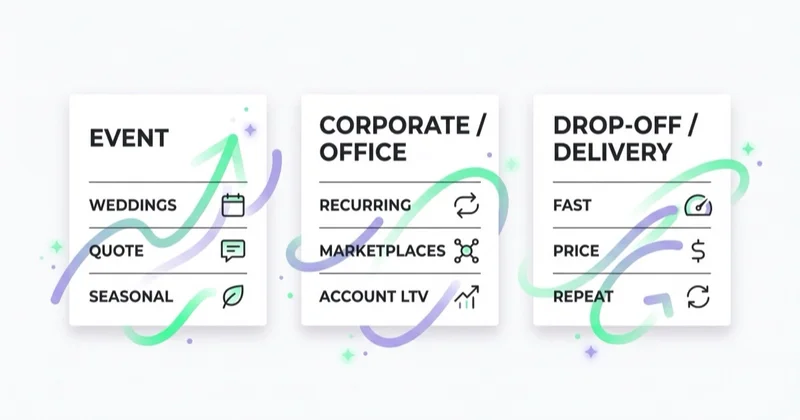
Catering marketing should not start with a channel decision. It should start with the orders the business can deliver profitably. Event catering, corporate catering and drop-off catering may all use food photography, menus and inquiry forms, but they have different buying journeys, seasonality, lead times, operational constraints and economics.

An event client may be planning a wedding, gala, memorial, graduation party or private celebration months ahead. A corporate buyer may need reliable office lunches, meeting catering, invoices, dietary handling and repeat delivery. A drop-off customer wants clear menu choices, an accurate delivered price and a low-friction order. Treating all three as one “catering” campaign makes it difficult to control which dates, locations, order sizes and service types media generates.
The goal is not the lowest cost per lead. It is contribution after food, labour, delivery, rentals, marketplace fees, cancellations and media—within the kitchen, vehicle and staffing capacity available for that day.
TL;DR
- Catering has several commercial models. Event, corporate and drop-off orders need separate offers, pages, qualification rules and values.
- Google Search can capture active demand. Queries such as “wedding catering near me,” “corporate catering [city]” and “boxed lunch catering” should not all land on the same page.
- Meta and Instagram can build familiarity and evidence. Real food, setup, service and delivery creative helps buyers assess fit before they inquire.
- Food safety and logistics are conversion factors. Menus, allergens, delivery radius, staffing, storage and timing are part of the buying decision.
- Seasonality has to be planned early. Weddings, holiday parties, graduations, conferences and office cycles require budget and creative before demand peaks.
- Local visibility must reflect the real operation. A caterer that does not receive customers at its kitchen should not display that address as a Google storefront.
- Marketplaces need their own P&L. They can add demand, but fees, discounts, refunds and customer access change the economics.
- Measurement should reach contribution, not stop at revenue. Qualified inquiry, deposit, booked event, fulfilled order and recurring account are more useful than raw forms.
Why catering marketing is different
Catering is not one purchase type. It combines food, service, logistics, trust and timing.
Event catering is a considered purchase. The buyer may compare menus, photos, reviews, availability, staffing, tasting options, rentals, service style and venue requirements. The value can be high, but many inquiries are unqualified because the date is unavailable, the guest count is too low, the venue is outside the service area or the budget does not match the offer.
Corporate catering is closer to B2B account acquisition. An office manager, HR lead, executive assistant or procurement contact may care about reliability, invoicing, dietary labeling, recurring orders, setup, punctuality and the ability to handle changes. A first order can be valuable if it becomes weekly or monthly revenue.
Drop-off catering is faster and more transactional. The buyer usually wants menu clarity, price, delivery area, minimum order, lead time and reviews. It can create repeat demand, but it also attracts price comparison and marketplace competition.
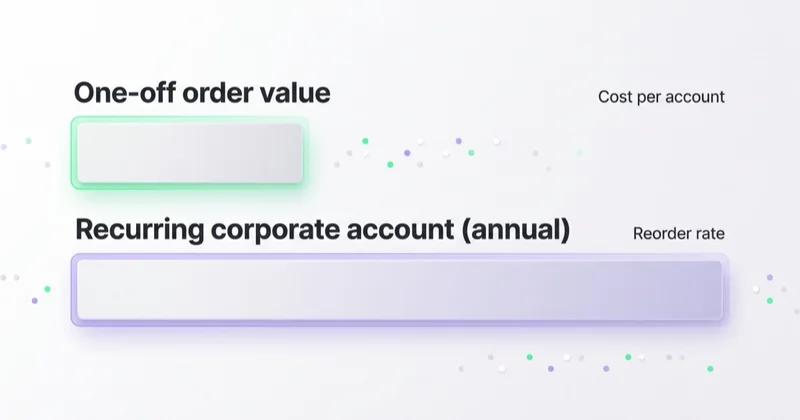
Because the economics differ, blended reporting hides the truth. A $70 lunch order, a $4,000 private event and a monthly corporate account should not share the same conversion value or acquisition target. Revenue alone is not enough either: two $4,000 events can have very different contribution after staffing, rentals, travel and waste.
The core catering models
| Model | Typical buyer | Useful acquisition routes | Primary business outcome |
|---|---|---|---|
| Wedding and private events | couples, families, planners | Search, local discovery, social proof, referrals | deposit-secured event and contribution |
| Corporate catering | office managers, executive assistants, HR, procurement | Search, direct outreach, referrals, marketplaces | profitable account and repeat order rate |
| Drop-off catering | teams, households, local buyers | Search, local discovery, ordering platforms, remarketing | contribution per delivery route and reorder rate |
| Meal plans or subscriptions | consumers or employers | Search, social, referral, email or SMS with permission | retained subscriber and cohort contribution |
| Venue or planner partnerships | venues, planners, production agencies | relationship development, events, referrals | accepted partner bookings and margin |
Many caterers operate across more than one model. The point is not to choose only one; it is to define an offer, service boundary and P&L for each. Before buying media, establish minimum order or guest count, lead time, delivery zones, venue limitations, maximum daily capacity and the margin floor below which the order should be declined or repriced.
Google Search: match intent to an order the business can accept
Search can be effective because many catering buyers already know the occasion, place and approximate date. The campaign and landing page should mirror that intent rather than send every query to a generic menu.
| Search intent | Example queries | Landing page need |
|---|---|---|
| Wedding | "wedding catering [city]," "wedding buffet catering" | galleries, menus, date, guest count, tasting |
| Private events | "party catering near me," "graduation catering" | packages, minimums, delivery/service area |
| Corporate | "corporate catering [city]," "office lunch catering" | ordering process, invoices, dietary handling |
| Drop-off | "boxed lunch catering," "sandwich platters delivery" | menu, pricing, delivery radius, lead time |
| Holiday / seasonal | "holiday party catering," "Christmas catering" | deadlines, menus, availability |
| Cuisine-specific | "BBQ catering," "Italian catering," "vegan catering" | menu proof, photos, reviews |
Each segment needs relevant ad copy, exclusions, location rules, schedule and conversion value. Wedding searches may justify a higher acquisition cost only if qualified-to-booked rates and contribution support it. Drop-off orders need tighter control over delivered margin. Corporate demand should be evaluated using a realistic probability of repeat orders—not an assumed lifetime value attached to every first order.
Review search terms rather than relying on a static negative-keyword list. Typical exclusions may include jobs, recipes, equipment hire, wholesale supplies, DIY and food trucks where irrelevant. Location targeting also needs care: target people in or regularly in the service locations when that matches the business, and audit queries, calls and form addresses for leakage. A city name in a keyword does not guarantee that the customer or venue is inside the delivery area.
For calls, run call assets and call-focused activity only when someone can answer or return the call promptly. Record calls only where lawful and after giving any required notice. Track call quality by the same date, location, size and service criteria used for forms.
Google Business Profile and local discovery
A complete, accurate Google Business Profile can support Maps and local discovery, but it must represent the real business. Under Google's current guidelines, a caterer that delivers or serves customers elsewhere but does not receive customers at its kitchen should use an eligible service-area setup and hide the address. A hybrid business may show its address only when customers are actually served there and the location meets the storefront requirements. Virtual offices and keyword-stuffed business names are not shortcuts; they can put the profile at risk.
Keep categories, service areas, hours, phone, menu or service information and photos current. Use genuine images and request reviews without incentives or review gating. Respond factually, especially when a complaint concerns lateness, an allergen conversation or an order discrepancy; never disclose private customer or health information in a public reply.
Meta and Instagram: show the experience, not just a close-up
Food is visual, but a polished close-up cannot prove punctuality, portion scale or service. Strong creative helps a buyer picture the complete experience and verify that the caterer has delivered comparable work.
Useful creative categories:
- real event tables, buffets and plated service;
- menu close-ups with scale and presentation;
- behind-the-scenes kitchen and prep footage;
- delivery, packaging and setup proof for corporate orders;
- team and service staff in real environments;
- testimonials used with the customer's permission;
- seasonal menus and deadline reminders;
- before/after setup for venues and office spaces.
Meta can support event discovery, retargeting, seasonal reminders and proof-building. It can also introduce a corporate offer to relevant buyers, but it does not create operational fit by itself. Judge creative by qualified and booked outcomes after enough time has passed—not by engagement or the cheapest form.
An instant form reduces friction; a website form gives a high-consideration buyer more room to review menus, minimums and evidence. Test both where volume permits. Forms should ask only for information needed at that stage, such as date, venue or delivery postcode, guest count, service style, budget range and recurring need. Do not ask for detailed medical information in an advertising form. Collect dietary and allergen requirements later through a controlled operational process.
If the CRM returns qualified and booked stages to Meta through Conversions API, use an appropriate legal basis, clear notices, data minimisation and the platform's terms. Hashing identifiers does not remove privacy obligations. Meta itself states that Conversions API is not a way to bypass European privacy rules or device controls.
For broader Meta mechanics, see what is Facebook Ads Manager and how to use it.
Event catering: quote quality and seasonality
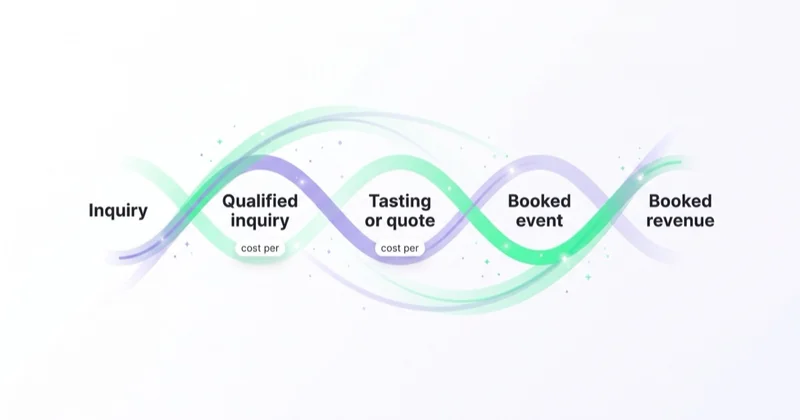
Event catering should be measured by qualified quote, tasting and booked event. The first form submission is only a filter.
A strong event landing page usually includes:
- event types served;
- real galleries by event type;
- sample menus and service styles;
- service area and venue constraints;
- guest-count minimums or guidance;
- date availability prompts;
- tasting process, price and what it does or does not reserve;
- reviews and planner/venue proof;
- form fields for date, venue, guest count, service style and budget range;
- deposit, cancellation and material change terms before commitment; and
- a clear explanation of what a quoted package includes.
Seasonality matters, but the calendar matters more. Plan wedding, graduation, holiday party and conference activity backwards from historical inquiry lead time and remaining capacity. Suppress or narrow dates, geographies and service types that are already full. When a peak date has little capacity left, the correct decision may be a higher minimum, a waitlist or no media at all—not more leads.
This overlaps with the buying journey covered in wedding venue marketing.
Corporate catering: B2B account value
Corporate catering is not only a menu sale. It is a repeated operations promise, often to several people: the organiser, approver, recipient and finance team.
Corporate buyers often care about:
- punctual delivery;
- a documented process for dietary requests and allergen information;
- vegetarian, vegan, gluten-free and other menu options;
- invoices and payment terms;
- recurring ordering;
- minimums and delivery fees;
- contact person and issue resolution;
- packaging, setup and cleanup expectations;
- ability to serve multiple offices or recurring meetings.
The page should address those points directly. An initial corporate form can ask about office location, headcount, frequency, meal type, date and whether the buyer is seeking a one-off order or recurring account. Detailed dietary requirements belong in the confirmed-order workflow, where staff can review changes and communicate limitations accurately.
Marketplaces can provide access to buyers who already prefer procurement-style ordering. Evaluate each one after commission, sponsored placement, discounts, refunds, error charges, payment delay, packaging and incremental labour. Compare truly incremental orders with customers who would otherwise have ordered directly. Follow the platform agreement on customer data and do not assume the business may remarket to marketplace buyers.
For recurring accounts, record order frequency, contribution, service incidents, late payment and concentration risk. A large account with bespoke menus and constant exceptions can be less attractive than several predictable mid-sized accounts.
Drop-off catering and online ordering
Drop-off catering behaves closer to local ecommerce. The buyer wants the menu, price, minimum order, delivery area, timing and ordering process quickly.
Key page elements:
- category menus by use case: breakfast, lunch, boxed meals, platters, desserts;
- minimum order, delivery fee and any other mandatory charge shown before checkout;
- lead time and order cutoff;
- dietary filters and access to current allergen information;
- delivery radius or zip code coverage;
- corporate invoice options where relevant;
- reorder or saved-menu functionality if available;
- clear contact path for larger orders.
Search and marketplace traffic can work here, but profit depends on contribution per order, delivery density, on-time performance, refunds and repeat rate. Analyse orders by postcode, daypart and basket composition. A campaign that creates many small, distant orders may increase revenue while weakening route economics and service quality.
Make the mobile checkout usable and accessible. The customer should be able to see the delivered price, cutoff, substitution policy and confirmation status without calling. “Order received” should not be confused with “order accepted” if the kitchen still needs to confirm capacity.
Food safety and allergen information are operations—not ad claims
Trust in catering is practical. A buyer is not only asking whether the food tastes good. The buyer is asking whether the company can deliver safe, clearly labeled food at the right time, in the right condition, for the right number of people.
Requirements differ by country, state and food format, so a global marketing guide cannot determine compliance. In the US, FDA rules and state or local requirements may apply differently to packaged food and food prepared after an order. In the UK, the Food Standards Agency says allergen information for distance sales must be available before purchase and again at delivery; buffet items require item-level information, and prepacked-for-direct-sale food has specific ingredient-list rules. The business should obtain advice for every jurisdiction and sales model it uses.
Marketing does not need to reproduce a regulatory manual, but it must not improvise safety assurances. “Gluten-free,” “allergen-free” or similar claims should reflect the documented ingredients, preparation environment and applicable legal definition. A generic “may contain” statement is not a substitute for controlling cross-contact.
Useful trust signals:
- current allergen information and a clear route for questions;
- realistic delivery and service areas;
- staff and facility photos where appropriate;
- hygiene rating, registration or licensing information where relevant, accurate and current;
- real event/customer reviews;
- cancellation, substitution and change policy;
- contact process for custom needs;
- menu details that match what is actually delivered.
This is practical evidence of experience and trust. The website promises only what the operation can consistently deliver; training, recipes, supplier information, labels and order notes carry that promise through fulfilment.
Measurement: from inquiry to fulfilled contribution
Catering measurement should distinguish low-quality activity from bookings.
| Signal | Meaning | Use |
|---|---|---|
| inquiry | raw form or call | early demand signal |
| qualified inquiry | date, area, size, budget and model fit | lead quality |
| tasting booked | event client moves deeper | high-intent signal |
| proposal sent | sales-qualified opportunity | pipeline |
| deposit-secured event | agreed terms and payment | forward booking signal |
| fulfilled event | service delivered and adjustments known | revenue and contribution |
| first corporate order | account opened | B2B activation |
| recurring account | repeat B2B relationship | cohort retention and contribution |
| drop-off order | fulfilled local order | basket and route contribution |
| cancellation, refund or lost reason | negative outcome | quality and budget allocation |
Google Ads call reporting and lead imports can connect phone calls, qualified inquiries and later bookings back to campaigns. Google currently provides qualified-lead and converted-lead goal types for offline stages. Its current documentation also states that, from 15 June 2026, offline conversion and enhanced-conversion-for-leads uploads move to the Data Manager API and are blocked in the Google Ads API except for limited legacy access. Existing integrations should be checked rather than assumed to be working.
Value-based reporting should separate models. A wedding inquiry, a boxed lunch order and a recurring corporate account have different probabilities, values and timelines. Do not assign the full potential event or account value to a raw inquiry. Use expected values calibrated from mature cohorts, then replace them with actual deposit, fulfilled revenue and contribution when available.
Reconcile the CRM, order system, payment data and ad platforms. Platform-attributed revenue is not necessarily incremental revenue, and each platform can claim the same booking under its own attribution rules. Use holdouts or geographic tests where the scale and operation make them feasible; otherwise state the limitation plainly.
At minimum, review:
- qualified rate by model, location, date and source;
- response time and contact rate;
- proposal, deposit and fulfilment rates;
- cancellation, refund and no-capacity loss rate;
- fulfilled revenue and contribution after variable operating cost;
- repeat rate by acquisition cohort; and
- kitchen, staffing and delivery-capacity utilisation on the dates media promotes.
How Space Ads structures catering acquisition
We start with the business model and operating calendar. Event, corporate, drop-off and subscription revenue are separated before campaign structure is chosen. Capacity, delivery zones, minimums, lead times and contribution floors then shape targeting, landing pages, qualification and measurement.
The working model is:
- split event, corporate and drop-off intent before media scaling;
- qualify forms by date, location, headcount, service style and budget range;
- build visual proof through galleries, menus, reviews and service photos;
- use Search for active demand and Meta for visual proof, seasonality and retargeting;
- track qualified inquiries, tastings, proposals, booked events and corporate accounts;
- return qualified, deposit-secured, fulfilled and cancelled outcomes to reporting where the technology and privacy basis allow it;
- reduce or redirect spend when the kitchen, fleet or event calendar cannot accept more of that demand; and
- evaluate profit and repeat behaviour by cohort rather than celebrate raw lead volume.
That connects directly with Google Ads, Meta Ads, performance marketing, and local acquisition strategy covered in Google Ads for local businesses.
Practical setup order
- Define the revenue model split: event, corporate, drop-off, meal prep or partnerships.
- Map service area, minimum order, lead time, date availability, capacity, variable cost and contribution floor.
- Build separate landing pages and forms for event, corporate and drop-off intent.
- Verify menus, mandatory charges, allergen-information workflow, policies, reviews and real galleries.
- Configure an accurate Google Business Profile if the business is eligible.
- Launch Search by intent, service area, schedule and capacity.
- Test Meta for discovery, evidence and retargeting where consent and audience rules permit.
- Connect qualified, deposit, fulfilled and cancelled stages to the CRM and ad reporting.
- Review performance by contribution, repeat behaviour, date and capacity—not raw inquiry count.
Common mistakes
| Mistake | Better approach |
|---|---|
| One campaign for every catering model | separate event, corporate and drop-off intent |
| Optimising to every inquiry | return qualified, deposit, fulfilled and cancelled outcomes |
| Launching seasonal campaigns without capacity data | plan from historical lead time and open dates |
| Using stock food imagery | show real menus, setups, packaging and events |
| Hiding minimums, fees and service area | disclose constraints and delivered price early |
| Displaying a kitchen as a public storefront when it is not one | configure the eligible service-area profile accurately |
| Treating marketplace revenue as direct revenue | include fees, refunds, discounts and data restrictions |
| Treating corporate as a one-off order | measure retained cohort contribution and service cost |
FAQ
What is catering marketing?
Catering marketing is the system used to generate and retain profitable event bookings, orders and accounts. It connects the offer, operating capacity, Search and social media, local discovery, referrals, marketplaces, CRM follow-up and measurement through fulfilment.
What is the best channel for catering leads?
There is no universally best channel. Google Search can capture active local intent; Meta and Instagram can build familiarity and show evidence; referrals, venues and marketplaces may be important in specific models. Compare channels using fulfilled contribution, capacity fit and repeat behaviour—not lead cost alone.
How should event catering campaigns be measured?
Event catering should be measured from qualified inquiry through proposal, deposit, fulfilment, adjustment and contribution. Raw inquiry volume is noisy because many leads are outside the service area, below the minimum, outside budget or tied to unavailable dates.
How is corporate catering marketing different?
Corporate catering is closer to B2B account acquisition. The buyer may care about reliability, invoicing, allergen-information processes, recurring ordering and issue resolution. Measure the first fulfilled order, repeat rate, service cost, payment behaviour and cohort contribution—not only the initial form.
Should catering companies use Meta lead forms?
Meta instant forms can reduce friction, while website forms let buyers review more evidence and conditions. Test the formats against qualified and booked outcomes. Ask only what is needed at that stage, connect follow-up promptly and do not collect detailed health information in the advertising form.
How early should seasonal catering campaigns start?
Use historical inquiry-to-event lead time by occasion, then work backwards from dates with profitable capacity. There is no fixed number of weeks that applies to weddings, office holidays and short-notice drop-off orders. Reduce promotion once the relevant dates or delivery slots are full.
Can a catering company show its kitchen address on Google?
Only when the profile accurately meets Google's eligibility and storefront rules. If customers are not received there, an eligible caterer should generally hide the address and use a service area. A hybrid business may show a staffed customer-facing location that meets Google's requirements. Do not use a virtual office to create local visibility.
In Short
Catering marketing works when each model has its own path. Event catering needs visual proof, a qualified quote funnel and booked-event measurement. Corporate catering needs a B2B account process. Drop-off catering needs clear ordering, delivery and repeat-order economics.
The strongest systems connect media to operations: availability, service area, minimums, kitchen and delivery capacity, accurate allergen information, CRM stages, payments, cancellations and fulfilled contribution. That is how catering advertising supports a reliable operation instead of creating a collection of inquiries the business cannot serve.
Sources
- Google Business Profile Help - Tips to improve your local ranking on Google
- Google Business Profile Help - Manage service areas
- Google Business Profile Help - Guidelines for representing your business
- Google Ads Help - About qualified leads and converted leads
- Google Ads Help - About offline conversion imports
- Meta Business Help Center - About Conversions API
- FDA - Food allergies and labelling
- Food Standards Agency - Allergen guidance for food businesses
Continue Learning
Continue reading
Weight Loss Clinic Marketing: GLP-1 Demand Without Risky Claims
Weight loss clinic marketing in the GLP-1 era has to generate qualified consultations without risky body claims, prescription-drug shortcuts or privacy leakage. This guide covers Meta, Google Search, telehealth funnels, HIPAA-conscious tracking and program LTV.

Wedding Venue Marketing: Tours, Dates and Signed Bookings
Wedding venue marketing should fill the calendar with qualified tours and signed bookings, not just raw inquiries. This guide covers Google Search, Google Business Profile, wedding marketplaces, Instagram, Pinterest, galleries, off-peak dates, CRM follow-up and measuring tour-to-booking value.

Home Remodeling Marketing: High-Ticket Leads from Google and Meta
Home remodeling marketing should turn search and visual interest into qualified consultations, delivered proposals and profitable completed projects. Learn how to connect Google, Meta, project proof, financing disclosures, lead handling and CRM values.