A strong business blog should answer the questions people actually ask before they buy, compare, contact, implement or recommend a solution. Blog topics should not come only from keyword volume. The best topics connect user needs, business goals, expertise, sales conversations, support data and search demand.

In 2026, a blog is not a place for random posts written only "for SEO". It should build topical authority, support the sales journey, help users make decisions and create content that can be understood by search engines, AI Overviews, ChatGPT, Perplexity and other answer systems.
The practical question is not just "what should the blog post be about?" The better question is: "Which user question, business problem or decision point should this page solve better than the alternatives?"
TL;DR
- Blog topics should come from user questions, business goals and search demand.
- Keyword volume is useful, but intent and business relevance matter more.
- The best content plans are built around topic clusters, not isolated posts.
- Good sources of topics include sales calls, support tickets, Search Console, Google Ads search terms, CRM notes and competitor gaps.
- Useful blog post types include how-to guides, definitions, comparisons, checklists, pricing posts, buying guides, mistakes, case studies and FAQs.
- E-E-A-T matters because content should show experience, expertise, authority and trust signals.
- AI can help with structure and research, but editorial responsibility, fact-checking and examples must stay with the business.
- English-language content needs localisation for US, UK, AU and global terminology.
- LLM-friendly content should include clear answers, structured sections, examples, sources and internal links.
- A smaller number of strong posts is usually better than a large number of thin posts.
Start with the purpose of the blog
Before choosing topics, define what the blog needs to do.
Possible goals:
- attract qualified organic traffic;
- educate buyers before sales contact;
- reduce repetitive support questions;
- support paid campaigns with better landing content;
- explain technical topics;
- build authority in a niche;
- improve internal linking;
- support product categories or services;
- capture comparison searches;
- generate leads;
- help existing customers get better results.
Different goals require different topics. A blog built for B2B lead generation will not look the same as a blog built for ecommerce buying guides, local services or SaaS onboarding.
Where to find blog post ideas
1. Sales conversations
Sales calls are one of the best sources of content ideas.
Useful questions:
- How much does it cost?
- How long does implementation take?
- What is included?
- What is the difference between option A and option B?
- Is this right for a small business?
- What results are realistic?
- What needs to be prepared before starting?
- What happens after signing up?
If the sales team answers the same question every week, that question is usually a blog topic.
2. Customer support and live chat
Support questions reveal friction after purchase or during implementation.
Topic examples:
- how to set up a feature;
- common mistakes;
- troubleshooting guide;
- return or warranty explanation;
- onboarding checklist;
- integration instructions;
- account setup guide;
- terminology glossary.
Support-led content can reduce tickets and improve customer experience.
3. Google Search Console
Search Console shows queries, pages, clicks, impressions, CTR and average position. It can reveal:
- queries where the site already appears but has low CTR;
- pages with impressions but weak clicks;
- topics close to page one;
- questions without a dedicated page;
- pages that need refresh or consolidation;
- countries and devices where performance differs.
Search Console is especially useful because it shows real search data for the site, not only external estimates.
4. Google Ads search terms
Paid search data can show commercial language faster than SEO tools. Search terms from Google Ads can reveal:
- high-intent phrases;
- confusing queries that need negative keywords;
- product or service wording users actually use;
- comparison queries;
- location modifiers;
- pricing and cost searches;
- questions that could become landing pages or blog posts.
This data should be filtered by conversion quality, not only clicks.
5. Keyword research
Keyword research helps estimate demand and group topics. It should not be used mechanically.
Look for:
- main terms;
- long-tail questions;
- modifiers such as cost, best, vs, checklist, template, examples;
- location terms;
- comparison terms;
- problem-led terms;
- implementation terms;
- industry-specific terms.
For the broader process, see keyword research in marketing.
6. Existing content audit
Sometimes the best new topic is not new. It is an old post that should be updated, merged or rewritten.
Look for:
- outdated facts;
- weak introductions;
- thin articles;
- duplicate topics;
- cannibalisation;
- missing FAQ sections;
- missing internal links;
- broken sources;
- posts that rank but do not convert;
- posts with impressions but low CTR.
For a broader audit process, see SEO audit.
7. Product, service and use-case mapping
Every product, service, feature or use case can generate a cluster:
- what it is;
- who it is for;
- how it works;
- when to use it;
- when not to use it;
- cost;
- mistakes;
- checklist;
- comparison;
- examples;
- implementation process;
- FAQ.
This keeps the blog connected to business value rather than general publishing.
Blog post types worth planning
| Post type | Best use | Example |
|---|---|---|
| Definition | Users are learning a concept | What is Consent Mode v2? |
| How-to guide | Users want implementation steps | How to create UTM links for GA4 |
| Checklist | Users need quality control | Google Ads audit checklist |
| Comparison | Users are evaluating options | GA4 vs platform reporting |
| Mistakes | Users want to avoid problems | Common landing page mistakes |
| Pricing/cost | Users are close to a decision | How much does an SEO audit cost? |
| Buying guide | Users need selection criteria | How to choose a PPC agency |
| Case study | Users need proof | How a GA4 setup was fixed after migration |
| FAQ | Users repeat practical questions | Google Ads billing FAQ |
| Template | Users need a starting point | Content calendar template |
| Glossary | Users need vocabulary | PPC glossary for founders |
The best content plan usually mixes several types. A blog made only of definitions will feel shallow. A blog made only of sales pages will miss early-stage demand.
Topic clusters: the best way to plan a blog
A topic cluster is a group of pages around one larger topic. It usually includes a broad pillar page and several supporting pages.
Example: Google Analytics 4 cluster
- pillar: Google Analytics 4 guide;
- supporting: GA4 audit;
- supporting: UTM parameters in GA4;
- supporting: payment gateway referrals;
- supporting: Consent Mode v2;
- supporting: enhanced conversions;
- supporting: Looker Studio dashboard;
- supporting: GA4 ecommerce tracking checklist.
Each post has a different intent and links to the others. This helps users continue learning and helps search engines understand topical depth.
For planning clusters, see keyword matrix and keyword n-gram analysis.
Match blog topics to the funnel
Blog topics should support the full journey.
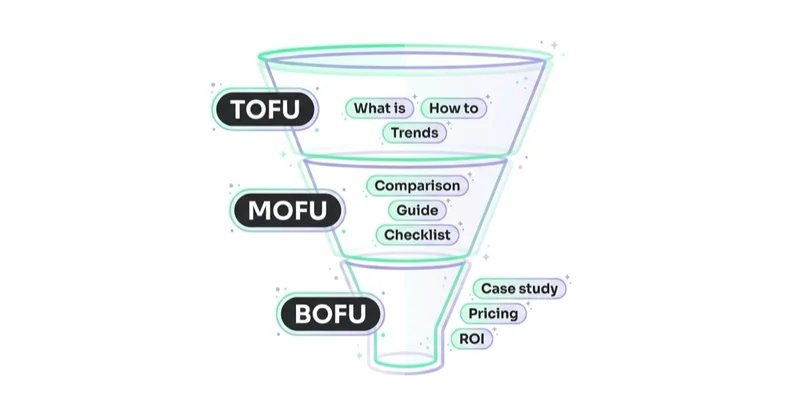
| Funnel stage | User question | Blog topic examples |
|---|---|---|
| Awareness | What is the problem? | What is conversion tracking? |
| Interest | How can this be solved? | How to measure micro conversions |
| Consideration | Which option is better? | Google Ads vs Meta Ads for lead generation |
| Decision | What will it cost or involve? | How much does a Google Ads audit cost? |
| Retention | How can results improve? | How to review search terms monthly |
This prevents a common mistake: writing only early-stage educational content that never supports buying decisions, or writing only sales-led content that has no audience yet.
For funnel planning, see sales funnel strategy.
Blog ideas for B2B and services
For B2B and service businesses, good blog topics usually reduce uncertainty before contact.
Topic patterns:
- how the service works;
- how long implementation takes;
- what the process includes;
- how pricing is calculated;
- what to prepare before a project;
- how to compare providers;
- common mistakes;
- internal checklist;
- case study;
- industry-specific use case;
- glossary for non-specialists;
- "do we need this?" guide.
Examples:
- How to choose a Google Ads agency for B2B lead generation.
- What should be included in a GA4 audit?
- How to prepare for a CRO project.
- Google Ads audit: checklist for marketing managers.
- Why lead quality matters more than lead volume.
These topics support trust because they explain process, scope and expectations.
Blog ideas for ecommerce
Ecommerce is one important context, but it should not dominate every general marketing topic. For ecommerce blogs, topics should support category demand, product selection and post-purchase confidence.
Topic patterns:
- buying guides;
- comparisons;
- product use cases;
- materials and sizing;
- care instructions;
- compatibility guides;
- gift guides;
- seasonal guides;
- problem-solving posts;
- FAQs around delivery, returns and warranty;
- category-level educational content.
Examples:
- How to choose running shoes for winter training.
- Ceramic vs stainless steel coffee grinders.
- What size rug works in a small living room?
- How to care for leather boots.
- Best accessories for a beginner camera kit.
The goal is not to write generic SEO posts, but to help shoppers choose with confidence.
Blog ideas for SaaS
SaaS blogs should connect problems, use cases and product education without becoming only release notes.
Topic patterns:
- use-case guides;
- integration guides;
- workflow examples;
- comparison pages;
- onboarding tutorials;
- metric explainers;
- templates;
- automation examples;
- security and compliance content;
- customer stories.
Examples:
- How to build a lead scoring workflow in a CRM.
- Best dashboard metrics for ecommerce retention.
- How to connect GA4 events with product analytics.
- CRM implementation checklist for small teams.
SaaS content should often include screenshots, workflows and clear examples because users need to understand how the product fits into their work.
Blog ideas for local businesses
Local businesses need practical, trust-building topics.
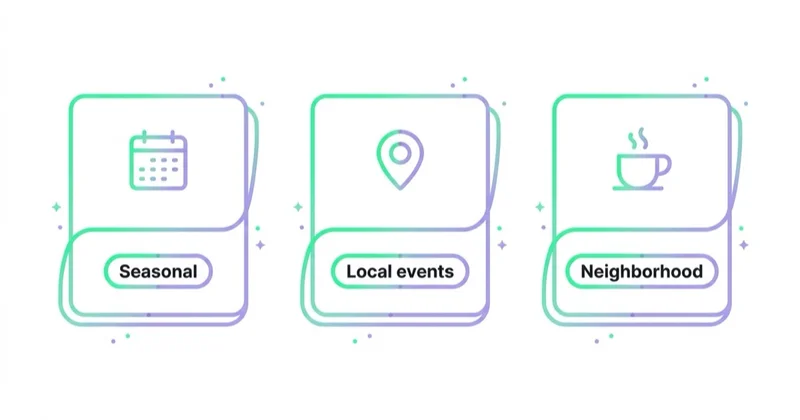
Topic patterns:
- service area guides;
- pricing explainers;
- preparation checklists;
- seasonal advice;
- before-and-after examples;
- local regulations or requirements;
- FAQ;
- what to expect during the appointment;
- comparison of service options.
Examples:
- How to prepare for a home energy audit in Manchester.
- How much does commercial cleaning cost in Sydney?
- What to check before booking a dental implant consultation.
Local content should be genuinely useful for the area served, not just doorway pages with city names swapped.
Blog topics for English-language markets
For English content, topic planning should account for language differences across markets.
Consider:
- US spelling vs UK spelling: optimization vs optimisation;
- regional terms: agency, consultant, firm, provider;
- business language: PPC, paid search, Google Ads management;
- location modifiers: near me, London, New York, Sydney, Melbourne;
- pricing language: cost, pricing, rates, fees;
- buying language: best, top, compare, alternatives;
- industry terms: ecommerce, e-commerce, online store.
Do not force every variation into one paragraph. Use natural phrasing and choose the version that fits the target market. When a page is meant for global English users, include both common variants where helpful.
Blog topics for AI Search and LLM SEO
Answer systems favour content that is easy to parse, attribute and summarise.
Strong patterns:
- concise definition near the top;
- TL;DR;
- structured headings;
- tables;
- examples;
- step-by-step instructions;
- FAQ;
- sources;
- clear dates when information changes;
- internal links to related pages;
- author or business expertise signals;
- caveats where the answer depends on context.
Weak patterns:
- vague introductions;
- keyword stuffing;
- unsupported statistics;
- generic AI-generated paragraphs;
- no sources;
- no examples;
- no clear answer;
- page created only because a tool found a keyword.
For E-E-A-T, trust is the central issue. Show what is known, where it comes from and when an expert review is needed.
How often should a business publish blog posts?
There is no universal publishing frequency that works for every site.

A practical approach:
- publish only when the topic has a clear purpose;
- update important existing posts before adding weaker new ones;
- prioritise clusters over isolated posts;
- keep a sustainable editorial rhythm;
- review performance monthly or quarterly;
- refresh technical topics when platform rules change.
For a small expert team, two strong posts per month can be more valuable than eight generic posts. For a larger publication or ecommerce site, a higher volume may make sense if research, editing and updating can be maintained.
Google does not reward content simply because it is long or fresh. Content should be complete, useful and maintained when facts change.
How to prioritise blog ideas
Score each topic using:
- user intent;
- business value;
- search demand;
- competition;
- sales relevance;
- support relevance;
- expertise available;
- content freshness need;
- internal linking value;
- conversion path.
A simple priority model:
| Score area | Question |
|---|---|
| User need | Does this answer a real question? |
| Business fit | Does it connect to the offer or customer journey? |
| Search opportunity | Is there discoverable demand? |
| Expertise | Can the business add original insight? |
| Conversion support | Does it help a future action? |
| Maintenance | Can it be kept accurate? |
The best topics usually score well across several areas, not only search volume.
Standard structure for a strong blog post
A good blog post should usually include:
- direct introduction;
- clear answer near the top;
- TL;DR or key takeaways;
- definitions where needed;
- structured headings;
- examples for the right business type;
- practical steps;
- mistakes to avoid;
- measurement or evaluation section;
- FAQ;
- credible sources;
- internal links;
- conclusion.
This structure helps users, SEO and answer engines. It does not replace expertise, but it makes expertise easier to consume.
How we approach this at Space Ads
We pick blog topics by commercial intent and customers' real questions, not by traffic for its own sake. We take the questions from where they actually come up: sales conversations, search queries, chatbot and support logs. A post that brings 200 readers ready to buy is worth more to us than one that pulls 5,000 random visitors who never convert. So the blog isn't a traffic farm for us — it's a way to attract the right people, who can then be caught with remarketing and closed. We map topics to the funnel stage and to phrases with commercial value — some for awareness, some for a specific buying decision. Traffic alone is easy to buy and easy to admire in a report; the harder, more valuable thing is attracting traffic that actually means something for the business.
Common mistakes in blog topic planning
Choosing topics only from SEO tools
SEO tools are useful, but they do not know margin, lead quality, sales objections or customer frustration.
Publishing isolated posts
Disconnected posts rarely build topical authority. Clusters are stronger.
Writing every topic as ecommerce
Ecommerce examples are useful only when the topic is ecommerce-related. A general topic should cover broader business contexts first.
Ignoring existing content
Old posts may need refresh, consolidation or deletion. New posts are not always the answer.
No fact-checking
Technical and platform topics need sources and review. Outdated instructions reduce trust.
AI without editorial control
AI can speed up research and structure, but unreviewed AI content often lacks experience, nuance and accuracy.
No internal linking
Internal links help users continue learning and help search engines understand topic relationships.
FAQ
What should a business blog post be about?
It should answer a real user question that connects to the business, product, service, category, buying process or customer problem.
How many blog topics should be planned at once?
Plan at the cluster level. A practical starting point is one pillar topic with five to ten supporting posts, then expand based on performance and business needs.
Should blog topics be based only on keywords?
No. Keywords are useful, but topics should also come from sales, support, customer research, product strategy and analytics.
Are short blog posts bad for SEO?
Not automatically. A post should be as long as needed to answer the query properly. Some questions need 700 words; technical guides may need 2,500 or more.
Can AI write blog posts?
AI can assist with outlines, research, variants and editing. Final content still needs human review, fact-checking, examples, sources and alignment with business experience.
What blog topics work best for LLM SEO?
Topics that answer clear questions with structured, sourced and specific information work best: definitions, how-to guides, comparisons, checklists, FAQs, examples and troubleshooting content.
Conclusion
The best blog topics sit at the intersection of user intent, business value and expertise. Keyword volume helps, but it should not lead the whole process. A useful blog answers real questions, reduces uncertainty and supports decisions across the funnel.
Plan topics in clusters, use Search Console and sales data, show experience, cite sources and update important posts when facts change. A strong blog is not a publishing calendar full of random ideas. It is a knowledge system that helps users and supports the business at the same time.
Sources and further reading
- Google Search Central: Helpful, reliable, people-first content
- Google Search Console Help: Performance report
- Google Search Central: SEO Starter Guide
- Google Trends Help: Compare search terms
Continue learning
Continue reading

What Is Inbound Marketing and How to Use It?
Inbound marketing attracts potential customers through useful content, SEO, education, trust, email, CRM and customer experience instead of only interruptive promotion.

What Is an SEO Audit and How to Do It Properly?
An SEO audit is a structured review of crawlability, indexation, content quality, search intent, internal links, Core Web Vitals, E-E-A-T and business impact.

Is Google Trends Worth Using and What Are the Alternatives?
Google Trends shows relative search interest, not exact search volume. Learn when to use it, how to interpret the 0-100 scale and which alternatives work better for volume, SEO and sales.