Category descriptions can help ecommerce SEO when they help shoppers choose, compare and understand products. They are not useful when they are just keyword-stuffed text blocks placed under a product grid. A strong category page should combine products, filters, internal links, concise buying guidance, technical SEO and structured data that matches what is actually visible on the page.

The best category descriptions do not try to hide a wall of SEO copy at the bottom of a page. They answer commercial questions, explain differences between product types, support long-tail intent and make the category easier for people and search systems to interpret. For AI search and answer engines, clear category-level explanations also help define entities, attributes, use cases and decision criteria.
TL;DR
- Category descriptions are useful for ecommerce SEO when they add real buying context.
- The description should not push products below the fold on important commercial pages.
- A short intro above the product grid plus a deeper guide below the grid usually works better than one long block at the top.
- Good category content explains selection criteria, product differences, use cases, sizing, compatibility, materials, delivery or other decision factors.
- Faceted navigation, canonical URLs, pagination and internal links can matter as much as the text itself.
- Breadcrumb structured data is a safe Google-documented enhancement for ecommerce hierarchy.
- ItemList or CollectionPage markup may help describe a page semantically, but it is not a guaranteed rich-result shortcut.
- The goal is not more words. The goal is a category page that satisfies commercial intent better than a thin product listing.
What is a category description?
A category description is content placed on an ecommerce category, collection or product listing page. It explains what the category contains and helps a shopper choose from the available products.
Examples include:
- a short intro on a "running shoes" category;
- a buying guide below a "office chairs" product grid;
- a comparison section on a "protein powder" collection;
- sizing advice on a clothing category;
- compatibility notes on an electronics category;
- care instructions on a furniture or textiles category;
- FAQ content for delivery, returns, materials or use cases.
A category description is different from a product description. The product page explains one item. The category page explains a group of products and the decision process around that group.
For product-level copy, read How to Write a Product Description That Sells and What It Must Include.
Why category descriptions can help SEO
Many commercial searches are category-level searches. A person searching for "waterproof hiking boots", "standing desks", "women's linen shirts" or "ceramic plant pots" usually wants a set of products, not one exact item. A category page can satisfy that intent better than a product page because it lets the shopper compare options.
However, a product grid alone may not explain:
- which features matter;
- which variant is right for which use case;
- how sizes, materials or compatibility work;
- what makes products different;
- which filters are useful;
- whether the category fits a beginner or advanced buyer;
- what delivery, returns or warranty details matter;
- what related categories should be considered.
The description adds context around the product list. Search systems can already crawl product names and links, but useful explanatory content helps connect the category with broader topics, attributes and questions.
For answer engines and LLMs, this context matters because category pages are often difficult to summarize if they contain only product cards. A clear explanation gives machine readers better information about the category's purpose.
When category descriptions do not help
Category text can fail or even make the page worse.
Common weak patterns include:
- generic copy that could fit any store;
- repeating the category keyword in every sentence;
- hiding 1,000 words under the product grid with no real shopping advice;
- writing only for search engines and not for users;
- duplicating the same paragraph across many categories;
- adding text that contradicts product availability;
- describing brands, sizes or features that are not actually present;
- pushing products too far down on mobile;
- ignoring filters, internal links and canonical logic.
Google's helpful content guidance focuses on creating content for people rather than content made primarily to attract search traffic. A category description should therefore make the buying process easier. If a paragraph can be removed and no shopper would lose anything, it probably should be rewritten or removed.
Recommended category page structure
A strong ecommerce category page usually has several layers.
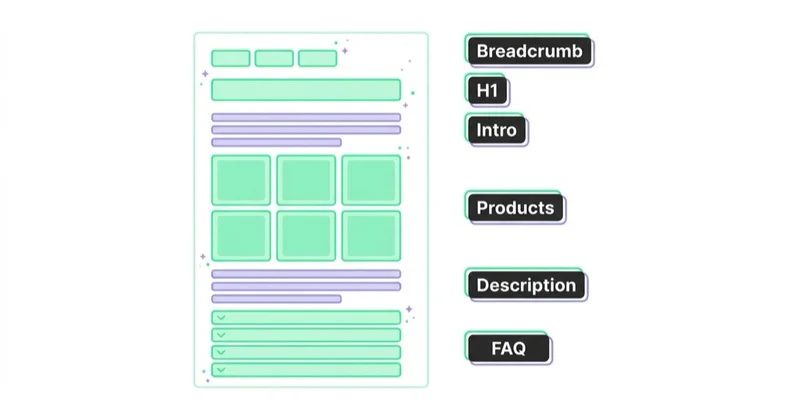
1. H1 and short intro
The H1 should name the category clearly. Under it, add two to four sentences that explain what the category contains and how to start choosing.
The intro should be short enough to keep products visible, especially on mobile. It can include the main keyword naturally, but it should sound like buying guidance, not an SEO template.
Example:
"Explore waterproof hiking boots for day hikes, mountain routes and wet city commutes. Compare ankle height, sole grip, membrane type and weight to choose a pair that fits the terrain and season."
2. Product grid
The product grid is the main commercial content. It should be crawlable, fast and easy to use. Product cards should include meaningful product names, prices, availability, images and links to product pages.
3. Filters and sorting
Filters should support real shopping behaviour: size, colour, brand, price, rating, material, compatibility, gender, use case, availability or delivery speed. SEO decisions around filters should be deliberate. Not every filtered page deserves indexing.
4. Buying guide below the grid
Below the initial product experience, add a deeper guide. This is where the page can answer the long-tail questions that do not fit above the grid.
Useful sections include:
- how to choose products in the category;
- comparison of variants;
- key specifications;
- common mistakes;
- use cases;
- material or size advice;
- compatibility notes;
- care instructions;
- delivery and returns context;
- related categories.
5. FAQ
FAQ can support users and answer engines, but it should answer real questions. Do not add FAQ just to repeat keywords.
6. Internal links
The category should link to relevant subcategories, filters that deserve indexation, buying guides, brand pages and complementary categories. Internal links should help shoppers move forward.
What to write in a category description
The content should be based on the decision process. A practical framework is:
| Section | Purpose | Example questions |
|---|---|---|
| Category intro | Confirm what the page offers | What products are here? Who are they for? |
| Selection criteria | Help comparison | Which features matter most? |
| Use cases | Match products to needs | Which product fits which scenario? |
| Variants | Explain differences | What is the difference between sizes, materials or models? |
| Trust factors | Reduce risk | What about returns, warranty, delivery or authenticity? |
| Related paths | Improve navigation | What should be viewed next? |
| FAQ | Answer common objections | How to choose, measure, maintain or compare? |
The strongest category descriptions usually come from real customer questions, search data, onsite search terms, reviews, support tickets, sales calls and product returns. SEO keyword research is useful, but it should be combined with what customers actually need to know.
How long should a category description be?
There is no universal ideal word count. A small category with simple products may need only 150-300 words. A complex category with expensive, technical or high-consideration products may need 800-1,500 words across an intro, guide, tables and FAQ.
Length should follow complexity:
- simple commodity category: short intro and links may be enough;
- fashion category: material, fit, styling, sizing and occasion guidance may help;
- electronics category: compatibility, specs and comparison guidance matter;
- supplements category: ingredients, goals, warnings and trust signals matter;
- B2B category: use cases, standards, delivery, bulk pricing and documentation may matter;
- furniture category: dimensions, materials, room fit and care advice matter.
The mistake is making every category the same length. Top-level categories, subcategories, brand collections and filtered landing pages have different jobs.
Where should the text be placed?
Placement should balance SEO and conversion.
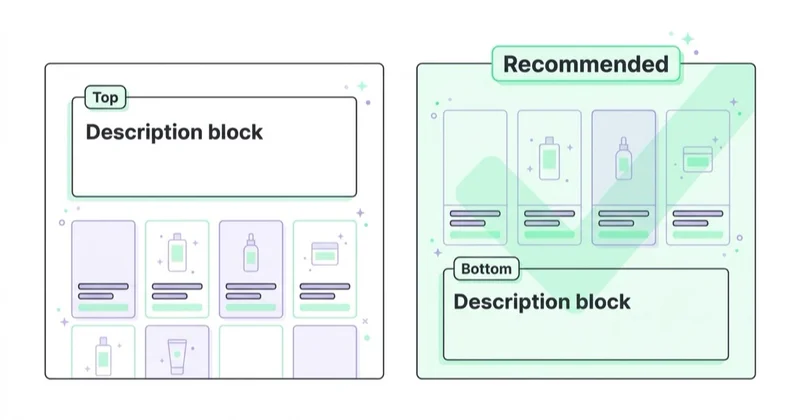
A good pattern is:
- short explanatory intro above the grid;
- product grid and filters near the top;
- deeper buying guide below products or after an initial product section;
- FAQ near the bottom;
- related categories and internal links where helpful.
On mobile, avoid forcing users to scroll through long text before seeing products. If the text is genuinely useful but long, use clear headings, jump links or expandable sections carefully. Do not hide all content in a way that makes it inaccessible or useless.
Faceted navigation, filters and canonical URLs
Category descriptions cannot fix a broken crawl structure.
Faceted navigation can create thousands of URLs: size, colour, brand, price, sorting, availability, rating and combinations. Some filtered URLs deserve indexation because they match real search demand, such as "black leather ankle boots" or "oak dining tables". Many others do not, such as temporary sort orders, session IDs or arbitrary price ranges.
A practical rule:
- index category and filter pages only when they have distinct search demand, useful product sets and unique content;
- use canonical URLs consistently for duplicate or near-duplicate variations;
- avoid internally linking to temporary parameters;
- keep indexable pages in sitemaps;
- do not rely on URL fragments for content that should be indexed;
- use crawlable links for important categories and pagination.
Google's ecommerce URL documentation recommends consistent URLs across links, sitemaps and canonical tags, and warns about URL structures that create duplicate or infinite crawl paths. This matters because a category page with good copy may still underperform if Google wastes crawl resources on weak filter URLs.
Structured data for category pages
Structured data should describe what is actually on the page. It should not be used to pretend that a category page is one product or to create eligibility that the page does not deserve.
For ecommerce categories, the safest Google-documented structured data element is usually BreadcrumbList. It helps describe the site's hierarchy and may help Google display a more meaningful breadcrumb path in search results.
Product structured data belongs primarily on product pages. If a category page lists products, product markup may exist on product cards in some implementations, but it must accurately represent visible products and follow Google's structured data guidelines. It should not turn the whole category into one fake Product entity.
ItemList, CollectionPage and related schema.org types can help describe list structure for semantic clarity, internal systems or other consumers, but they should not be treated as a guaranteed Google rich-result feature for ordinary category pages. Schema is a supporting signal, not a replacement for useful content and crawlable product listings.
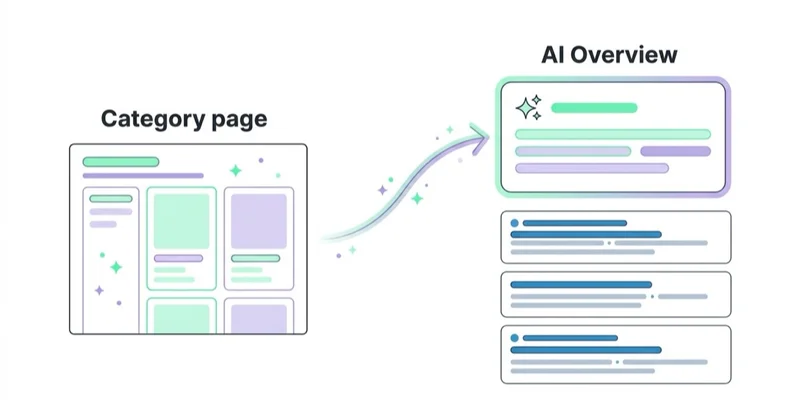
How category descriptions support AI search and AEO
Answer engines need clear, extractable information. Category pages can support this by explaining:
- what the category is;
- what product types it contains;
- how the products differ;
- what criteria matter;
- which products fit which use cases;
- what common mistakes should be avoided;
- what related topics or categories exist.
This is not about writing robotic FAQ blocks. It is about making the category easy to understand. Tables, concise definitions, comparison sections and direct answers help both users and machine readers.
For content planning around answer engines, read What to Write Blog Posts About?.
Internal linking from category descriptions
Category descriptions are useful places for internal links because they sit close to commercial intent.
Good internal links can point to:
- subcategories;
- important filters or landing pages;
- brand pages;
- buying guides;
- comparison articles;
- size guides;
- product care guides;
- complementary categories;
- bestseller collections;
- sale or seasonal collections.
Anchor text should describe the destination. "See waterproof trail running shoes" is more useful than "click here". Google's SEO Starter Guide also recommends meaningful link text that helps users and search engines understand the linked page.
Do not overdo it. A category description with 40 internal links can become harder to use. Link where the next step is genuinely useful.
How to measure whether category descriptions work
Measurement should combine SEO, UX and revenue data.
Track:
- impressions and clicks in Google Search Console;
- ranking movement for category-level keywords;
- click-through rate changes after title and snippet improvements;
- organic sessions to category pages;
- product-list click rate;
- add-to-cart rate from category visitors;
- conversion rate and revenue;
- assisted conversions;
- scroll depth and interaction with guide sections;
- internal search usage;
- filter usage;
- crawl and indexation issues.
Do not judge a rewritten category description after a few days. Category SEO changes often need time to be crawled, indexed and tested by users. Also separate the effect of text from other changes such as product assortment, stock, price, page speed, metadata and internal linking.
For analytics context, read What Is Ecommerce Analytics and Why Is It So Important?.
How we approach this at Space Ads
Category pages are e-commerce's most valuable SEO surface: they catch the highest commercial-intent queries ("hiking boots", "wedding dresses") that convert far better than blog traffic. We treat the category description as both SEO and a selling element, not a wall of text shoved under the products "for Google". Placement is deliberate: a short intro up top, the rest below the listing, and never the products pushed off the screen, because that wrecks the very conversion we came to improve. We prioritise categories by revenue potential, starting with the ones that catch the largest, most profitable demand. A missing or generic description on a key category is queries left on the table, and they're among the most valuable in the whole store's SEO.
Common mistakes
| Mistake | Why it hurts | Better approach |
|---|---|---|
| Writing only for keywords | The page becomes unhelpful and repetitive | Write around buying decisions and product differences |
| Putting a long text block above products | Mobile users may not see the product grid quickly | Use a short intro and deeper guide lower on the page |
| Duplicating text across categories | Pages look thin and interchangeable | Write unique guidance for each meaningful category |
| Indexing every filter combination | Crawl waste and duplicate pages | Index only valuable filtered pages |
| Marking the whole category as Product | Misleading structured data | Use accurate markup and documented schema types |
| Ignoring internal links | Category pages become isolated | Link to subcategories, guides and related categories |
| Not checking Search Console | Problems stay invisible | Monitor queries, pages, indexing and CTR |
| Treating all categories the same | Important pages stay underdeveloped | Prioritise by demand, margin and strategic value |
FAQ
Are category descriptions still useful for SEO?
Yes, if they help users choose and compare products. They are not useful when they are generic keyword text with no practical value.
Should category descriptions be above or below products?
A short intro above the products is usually helpful. Longer buying guidance often works better below the product grid so users can see products quickly, especially on mobile.
How many words should an ecommerce category description have?
Use as many words as the category needs to answer important buying questions. Simple categories may need a few hundred words. Complex categories may need a longer guide, tables and FAQ.
Should every filtered category page be indexed?
No. Only filtered pages with distinct demand, useful products and unique value should usually be indexable. Temporary, duplicate or low-value filters should be controlled with canonical, noindex or crawl strategy depending on the case.
Does schema markup make category pages rank higher?
Structured data helps search engines understand content, but it is not a ranking shortcut. BreadcrumbList is useful for hierarchy. Other markup should be accurate and should not misrepresent the page.
Can AI-generated category descriptions be used?
AI can support drafting, clustering and rewriting, but the final text should be checked against real products, customer questions, brand tone, legal constraints and current stock. Generic AI text is rarely enough for competitive categories.
Summary
Category descriptions are useful for ecommerce SEO when they make the category page more helpful, not merely longer. The best pages combine a clear intro, product visibility, useful filters, buying guidance, internal links, technical SEO and accurate structured data.
For competitive ecommerce, category pages often become commercial hubs. They should explain the product group, answer decision-making questions and guide shoppers toward the right next step. A thin product grid is rarely enough. A long SEO text block is not enough either. The page needs to work as a useful shopping experience.
Sources and further reading
- Google Search Central: Creating helpful, reliable, people-first content
- Google Search Central: SEO Starter Guide
- Google Search Central: Structured data for ecommerce sites
- Google Search Central: Breadcrumb structured data
- Google Search Central: Designing a URL structure for ecommerce sites
- Google Search Central: Pagination and incremental page loading
- Google Search Central: AI features and your website
Continue learning
Continue reading

Schema Markup: Which Structured Data Types Actually Do Something
Useful schema markup starts with the page and a supported outcome, not a universal checklist. Learn when WebSite, Organization, Product, Article, breadcrumbs and LocalBusiness are worth implementing — and when markup only adds maintenance.

What Is an SEO Audit and How to Do It Properly?
An SEO audit is a structured review of crawlability, indexation, content quality, search intent, internal links, Core Web Vitals, E-E-A-T and business impact.

Shopify SEO: The Checklist That Matches How the Platform Actually Works
Shopify handles several SEO basics automatically, but rankings still depend on the decisions it cannot make for you. Use this checklist to audit indexation, collections, products, filters, variants, performance and international stores in the right order.