Auto repair shop marketing has one commercial job: keep profitable bays booked by people who need a real service in the shop's real catchment area. A call is useful only when it becomes a booked repair order. A booked repair order is useful only when the job fits the shop's capacity, margin, equipment and retention model.
That is why a strong auto repair account is not judged by clicks alone. The important questions are more practical: which services create profitable repair orders, which calls are qualified, which zip codes produce customers who show up, which jobs turn into repeat visits, and which channels support trust before the driver calls?
Auto repair also has a trust problem that many local services do not have at the same level. Drivers often worry about surprise bills, unnecessary work, unclear diagnostics and poor communication. Reviews, photos, estimates, warranties, certifications, service-specific pages and a complete Google Business Profile are therefore conversion assets, not cosmetic additions.
TL;DR
- Auto repair marketing should optimize toward booked repair orders. Calls and forms are early signals; the business outcome is a completed job with known value.
- Search intent is local and service-specific. "Brake repair near me," "check engine light diagnosis" and "European car mechanic" need different campaigns and landing pages.
- Google Business Profile is part of the funnel. Accurate hours, categories, services, photos and review responses affect whether a driver trusts the shop after seeing the ad.
- Phone tracking needs a quality threshold. Very short calls, wrong-area calls and parts-only requests should not train bidding the same way as booked appointments.
- Call-only ads are being phased out. Responsive search ads with call assets are now the practical phone-led Search setup.
- Job value varies heavily. Oil changes, diagnostics, brakes, tires, engine work and fleet maintenance should not carry the same conversion value.
- Retention is the margin engine. Service reminders, deferred-work follow-up and reactivation turn one repair into a customer relationship.
Why auto repair marketing is different
Auto repair combines urgent local demand, broad service variety and trust-sensitive decision-making.
A driver with a brake warning light is not researching the same way as a driver planning an oil change. A customer looking for "transmission repair" may be comparing proof, warranty and financing. A fleet manager cares about turnaround time, invoicing and reliability. A luxury or European specialist needs to prove capability and equipment. One generic "mechanic near me" campaign cannot serve all of those intents well.
The economics are also uneven. A low-margin maintenance job may be valuable because it starts a long relationship. A diagnostic may be valuable because it leads to a larger repair. A big-ticket repair may require more trust and a different close process. Fleet work may have lower acquisition volume but much higher lifetime value. Bidding all of these as equal leads teaches the ad platform to buy easy activity instead of profitable work.
The third difference is local proof. Auto repair shoppers compare distance, open hours, reviews, response quality, photos, certifications and service clarity quickly. Paid search can win the click, but Google Business Profile and the landing page usually win the call.
Channel roles for an auto repair shop
| Channel | Best role | What to control |
|---|---|---|
| Google Search | capture repair, maintenance, emergency and specialist intent | service structure, location, negatives, call assets |
| Google Business Profile | support Maps, reviews, trust and local comparison | categories, services, hours, photos, review responses |
| Local Services Ads | add lead volume where the category and market are eligible | lead quality, booked jobs, dispute workflow |
| Meta Ads | promote maintenance, seasonal offers, reminders and reactivation | audience quality, offer clarity, CRM exclusions |
| Email / SMS / CRM | retain existing customers and follow up deferred work | consent, cadence, service history |
| SEO and service pages | capture non-paid local and service queries | page depth, schema, internal links, reviews |
For most shops, Google Search and Google Business Profile are the dependable core. Local Services Ads can be tested where available and commercially justified, but eligibility and category coverage vary. Meta is strongest for reminders, seasonal services, reactivation and visual trust; it is rarely the primary channel for urgent repair intent.
The broader local acquisition model is covered in Google Ads for local businesses, home services and contractors.
Search campaign structure: service, urgency and value
Search campaigns should follow service economics, not internal website navigation. A strong structure usually separates:
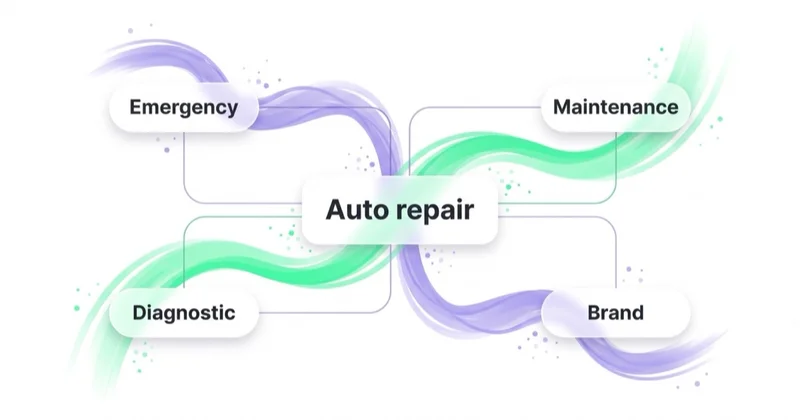
| Segment | Example queries | Landing page priority | Main conversion |
|---|---|---|---|
| Urgent repair | "mechanic open now," "car won't start," "brake repair today" | phone, hours, availability, towing context | qualified call |
| Core repair | "brake repair [city]," "suspension repair near me" | service explanation, estimate, warranty, reviews | booked repair order |
| Diagnostics | "check engine light diagnosis," "car diagnostic test" | process, tools, next steps, diagnostic fee | booked diagnostic |
| Maintenance | "oil change near me," "tire rotation," "AC recharge" | convenience, booking, price range, hours | appointment |
| Specialist | "European car mechanic," "diesel mechanic," "hybrid repair" | capability, equipment, certifications, proof | qualified enquiry |
| High-value repair | "transmission repair," "engine replacement cost" | trust, warranty, financing, consultation | qualified appointment |
| Fleet / commercial | "fleet maintenance provider," "commercial vehicle repair" | SLA, invoicing, turnaround, account setup | B2B lead |
This separation improves ad relevance, landing-page match and bidding quality. A campaign for "oil change near me" can compete on convenience and booking. A campaign for "transmission repair" needs reassurance, diagnostic process, warranty and a way to speak with the shop. A fleet campaign should not send traffic to a consumer coupon page.
Negative keyword work is just as important as the initial structure. Auto repair campaigns easily spend on parts, DIY, jobs, training, complaints, manuals, forums and dealership warranty queries. Search term reviews should remove patterns that do not lead to appointments: "how to," "brake pads price," "mechanic jobs," "auto parts," "course," "diagram," "manual," and similar intent groups.
For match-type control, see keyword match types in Google Ads.
Google Business Profile and local trust
Google Business Profile is a conversion layer for the ad account. A driver may click a Search ad, then check the shop in Maps before calling. If hours are wrong, reviews look unmanaged, photos are weak or services are unclear, the paid click loses confidence.
Key GBP work for auto repair:
- primary and secondary categories aligned with the shop's services;
- accurate address, phone number and opening hours;
- special hours for holidays and seasonal peaks;
- service listings for high-value and recurring work;
- photos of the exterior, bays, reception, team and parking;
- review response process with professional, specific replies;
- clear explanation of estimates, warranties and diagnostics;
- links to service-specific pages or booking where available.
Google's local ranking documentation emphasizes complete, accurate business information, up-to-date hours, reviews, photos and local ranking factors such as relevance, distance and prominence. For auto repair, that translates into a practical rule: the Business Profile has to confirm what the ad claims.
Calls, call assets and phone quality
Auto repair is phone-heavy. Drivers want to ask whether the shop can take the car, how soon an appointment is available, whether towing is needed, what the diagnostic process looks like and whether the repair fits the shop's specialization.
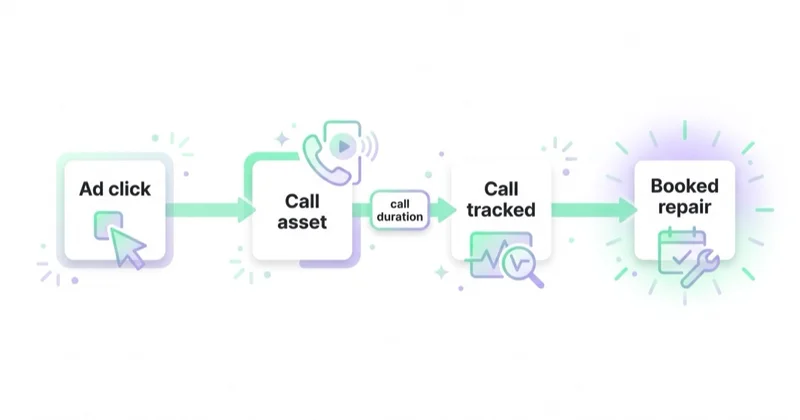
Google Ads call reporting can measure calls from call assets, location assets and call ads through Google forwarding numbers. It can also count calls of a chosen duration as conversions. That matters because a tap on a phone number is not always a lead. A five-second wrong-number call should not have the same value as a multi-minute conversation that books a diagnostic.
The phone setup should answer four questions:
- What call duration suggests a real repair conversation?
- Which calls are out of area, out of scope or parts-only?
- Which calls become booked appointments or repair orders?
- Which campaigns produce completed jobs and repair-order value?
There is also an important format change. Google is phasing out call-only ads: new call-only ad creation was removed in February 2026, and existing call-only ads are scheduled to stop receiving impressions in February 2027. For phone-led search, the practical setup is responsive search ads with call assets, backed by call reporting and a landing page that still supports the decision.
For implementation context, see call tracking for PPC and lead generation.
Landing pages for services, not a generic shop page
A shop's homepage usually cannot answer every search intent. Service-specific pages improve both conversion and query relevance.
Useful service pages include:
- brake repair;
- oil change and maintenance;
- tires and rotation;
- check engine light diagnostics;
- AC service;
- suspension and steering;
- transmission repair;
- battery and starting issues;
- European, diesel, hybrid or EV specialization;
- fleet maintenance.
Each page should confirm the service, location, shop capability and next step. Strong pages usually include service explanation, symptoms, diagnostic process, warranty or guarantee language where accurate, photos, reviews, booking or phone contact, and clear service area. The page does not need to over-explain mechanics. It needs to make a driver confident enough to contact the shop.
For higher-value repairs, the page should reduce anxiety. That means explaining what happens before a quote, how diagnostics are handled, what can affect price, and what warranty or approval process applies. Overpromising a fixed price before inspection may create more sales friction than it removes.
Seasonality and capacity
Auto repair demand has seasonal patterns. Tires, AC service, batteries, inspections before travel and winter readiness all create recurring peaks. Marketing should follow capacity, not just search volume.
| Period | Common demand | Campaign implication |
|---|---|---|
| Spring | tires, AC checks, post-winter issues | ramp before appointments fill |
| Early summer | AC, road-trip checks, brakes | service pages and booking availability |
| Late summer | diagnostics, tires, school-season maintenance | reminders and local Search |
| Fall | tires, batteries, brakes, winter prep | budget shift into seasonal services |
| Winter | batteries, starting issues, heating, urgent repairs | phone-first messaging and hours |
| Year-round | oil, brakes, diagnostics, fleet | baseline campaigns and retention |
The account should not push aggressively into services that the shop cannot schedule. If bays are full, campaigns can shift toward future maintenance, higher-value jobs, or service reminders rather than creating calls that staff cannot handle.
Fleet and commercial accounts
Fleet work deserves its own marketing path. A fleet lead is not just a bigger retail customer. The decision-maker cares about downtime, repeatability, priority scheduling, reporting, invoicing, communication and predictable standards.
Dedicated fleet campaigns can target:
- delivery businesses;
- contractors and trades;
- local service fleets;
- medical or care transport;
- property management fleets;
- small business vehicle pools.
The landing page should speak to business needs: maintenance plans, inspection cadence, repair documentation, account setup, billing, turnaround expectations and a direct contact path. A signed fleet relationship can change the shop's revenue mix, so it should not be measured like an oil-change lead.
Retention and deferred work
Auto repair profitability often compounds after the first visit. Retention is not just a CRM task; it is part of marketing economics.
High-value retention flows include:
- mileage or time-based service reminders;
- follow-up for declined or deferred work;
- seasonal reminders for tires, AC, batteries and pre-trip checks;
- reactivation for customers who have not visited in a set period;
- review requests after completed jobs;
- reminders for multiple vehicles in a household or business.
This changes acquisition math. A first oil change may look low-margin in isolation but valuable if it starts a multi-year customer relationship. A diagnostic may look modest until downstream repairs are included. Reporting should separate first-visit acquisition from repeat revenue.
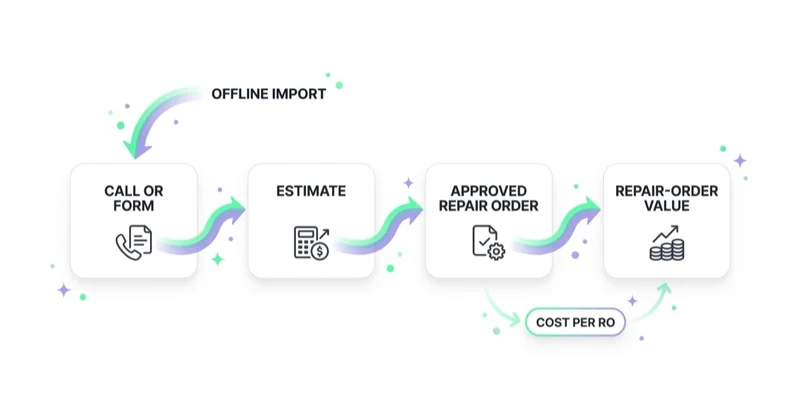
Measurement: from call to repair-order value
The measurement model should reflect how the shop makes money.
| Signal | What it means | Reporting use |
|---|---|---|
| call click | early interaction | directional only |
| qualified call | in-area, in-scope repair conversation | lead quality |
| booking request | appointment intent | bidding signal |
| booked repair order | scheduled work | strong conversion |
| completed repair order | work delivered | business outcome |
| repair-order value | revenue or margin proxy | value-based reporting |
| return visit | retention | lifetime value |
| fleet account | B2B relationship | separate pipeline |
Offline conversion imports are important because the ad platform does not automatically know which calls became completed jobs. CRM or shop-management data should return booking status, completed repair order and value where the data is reliable. If value is not available, stage-weighted values are still better than treating every call equally.
When automated bidding receives only call volume, it can learn to buy easy calls. When it receives booked repair orders or repair-order value, optimization moves closer to the shop's actual economics.
How Space Ads approaches auto repair marketing
At Space Ads, auto repair work starts with the operating model: service mix, job value, local catchment, phone handling, review strength, appointment capacity and retention. Campaign structure comes after those inputs are clear.
The working model is:
- separate urgent repair, maintenance, diagnostics, specialist and fleet intent;
- connect calls to booking and repair-order outcomes;
- keep Google Business Profile aligned with ad promises;
- build service pages for the jobs worth acquiring;
- use Meta and CRM for reminders, reactivation and seasonal work;
- report booked repair orders, completed jobs and value instead of call volume alone.
That connects directly with our work across Google Ads, Meta Ads, performance marketing, and local acquisition strategy in Google Ads for local businesses.
Practical setup order
- Map services by value, capacity, margin and retention role.
- Audit Google Business Profile, reviews, hours, photos and service listings.
- Define call quality thresholds and connect calls to booked appointments.
- Build Search campaigns by service and urgency, with negative keyword routines.
- Create or improve service-specific landing pages.
- Add offline conversion imports for booked and completed repair orders.
- Build retention flows for service reminders, deferred work and reactivation.
- Test fleet campaigns separately from retail repair demand.
Common mistakes
| Mistake | Better approach |
|---|---|
| Optimizing for every call | count qualified calls, bookings and completed jobs |
| Sending all traffic to the homepage | use service pages that match search intent |
| Mixing maintenance and high-value repairs | separate campaigns, values and pages |
| Ignoring Google Business Profile | manage reviews, hours, services and photos as conversion assets |
| Running broad keywords without negatives | remove DIY, parts, jobs, training and warranty noise |
| Treating fleet leads like retail leads | create a separate B2B path and measurement model |
| Measuring only first visits | include return visits and deferred-work follow-up |
FAQ
What is auto repair shop marketing?
Auto repair shop marketing is the system used to bring qualified local drivers into the shop for maintenance, diagnostics, repairs and repeat service. It usually combines Google Search, Google Business Profile, service pages, reviews, call tracking, CRM reminders and retention.
What is the best advertising channel for auto repair shops?
Google Search is usually the strongest paid channel for active repair and maintenance intent because drivers are already searching for a service nearby. Google Business Profile supports local trust and Maps visibility. Meta is more useful for reminders, seasonal services, reactivation and brand familiarity than for urgent repair demand.
What should an auto repair shop measure in Google Ads?
The account should measure qualified calls, booked appointments, completed repair orders, repair-order value and return visits. Cost per click and cost per call are useful diagnostics, but they do not show whether the shop booked profitable work.
How important are reviews for auto repair marketing?
Reviews are central because auto repair is a trust-sensitive category. Drivers often compare shops quickly before calling. Recent reviews, professional responses, real photos and clear service information help convert search demand into calls and appointments.
Should auto repair shops use call-only ads?
Call-only ads are being phased out by Google. The practical setup is responsive search ads with call assets, call reporting and a landing page that confirms hours, services, reviews and booking options.
How can a repair shop get more repeat customers?
Retention usually comes from service reminders, follow-up on deferred work, seasonal reminders, review requests and reactivation of lapsed customers. The marketing system should track return visits so acquisition is judged by lifetime value, not only first repair.
In Short
Auto repair shop marketing works when local intent, trust and repair-order economics are connected. Google Search captures service demand, Google Business Profile supports local confidence, call tracking filters phone quality, service pages match the searcher's need, and offline conversion data shows which leads became completed repair orders.
The best starting point is not more channels. It is better measurement: qualified calls, bookings, completed repair orders, repair-order value and return visits. Once those signals are clear, campaigns can scale the services that actually keep profitable bays booked.
Sources
- Google Business Profile Help - Tips to improve your local ranking on Google
- Google Ads Help - About call reporting
- Google Ads Help - How to transition from call ads to call assets
- Google Ads Help - Target ads to geographic locations
- Google Ads Help - About offline conversion imports
Continue Learning
Continue reading
Wedding Venue Marketing: Tours, Dates and Signed Bookings
Wedding venue marketing should fill the calendar with qualified tours and signed bookings, not just raw inquiries. This guide covers Google Search, Google Business Profile, wedding marketplaces, Instagram, Pinterest, galleries, off-peak dates, CRM follow-up and measuring tour-to-booking value.
Optometry Marketing: Eye Exams, Optical Retail and Patient Value
Optometry marketing should fill the exam schedule, increase optical capture and grow recurring patient value without exposing health data to ad platforms. This guide covers Google Search, local trust, retail eyewear, specialty services, recall and privacy-safe measurement.
Moving Company Marketing: Capture High-Intent Movers in Google
Moving company marketing is won through high-intent Search, fast quoting, local trust and booked-move measurement. This guide covers Google Ads, Local Services Ads, local vs long-distance intent, interstate trust signals, seasonality, capacity and CRM feedback.