Car dealership PPC is not normal local advertising with a larger ticket size. The campaign is built around live inventory, local intent, finance behaviour, trade-in demand and sales outcomes that usually happen in the CRM or showroom after the ad click.
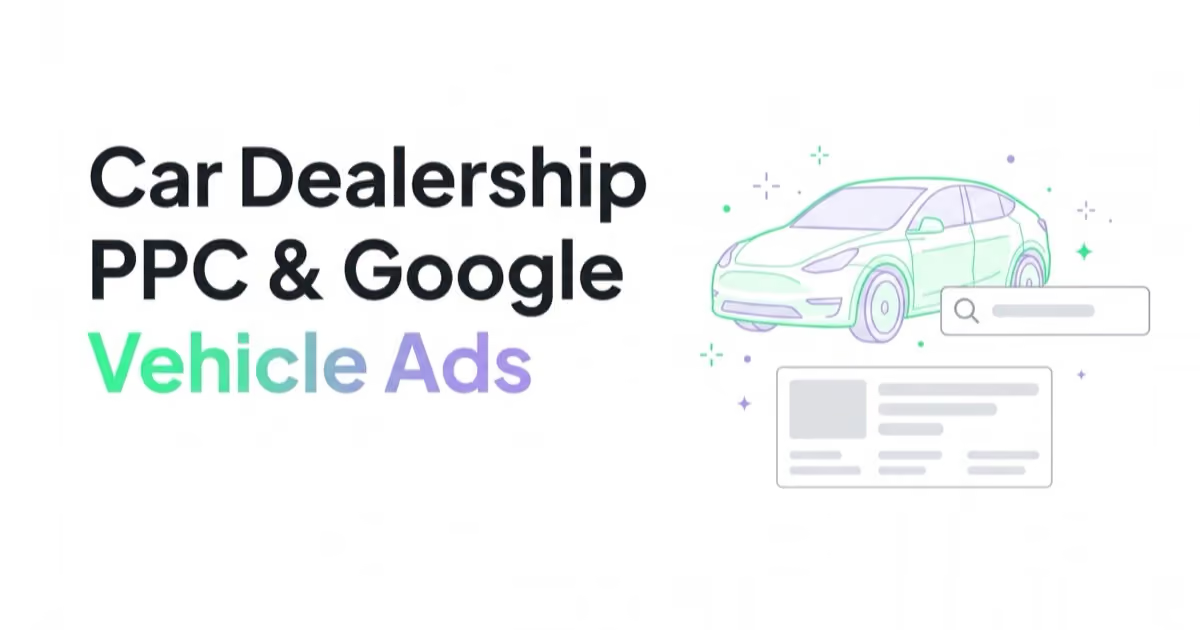
The central question is simple: can the ad account promote the right vehicle, to the right local shopper, with accurate price and availability, then learn which enquiries become appointments and sold units? If the answer is no, more spend usually produces more noise.
Key Takeaways
- Inventory data is the foundation. Year, make, model, trim, price, mileage, VIN, images, location and availability must stay accurate.
- Google Vehicle Ads are built for eligible passenger vehicle inventory. They show vehicle details from Merchant Center and send shoppers to the vehicle detail page.
- Paid search still matters. Vehicle Ads do not replace campaigns for brand, model, "near me", finance, lease, trade-in and service demand.
- CRM feedback decides lead quality. Calls and forms are early signals; appointments, show rate, finance approvals and closed units are better business signals.
- Reporting should separate demand capture from demand creation. Brand and remarketing can make acquisition look cheaper than it is.
- Compliance is operational. OEM rules, co-op requirements, offer language, price parity and disclaimers need to be built into templates.
Why dealership PPC is different
Most paid media assumes stable products and online checkout. A car dealership has changing stock, specific VIN-level units and an offline sales process. A campaign can be well structured and still underperform if sold vehicles remain advertised, prices do not match landing pages or CRM stages never return to the ad platforms.
The dealership system has four connected layers:
| Layer | What it controls | Risk when weak |
|---|---|---|
| Inventory feed | which vehicles can be advertised | sold, mispriced or unavailable units keep spending |
| Website and VDPs | how shoppers validate each vehicle | low enquiry rate and poor trust |
| Media campaigns | where demand is captured or created | brand demand hides weak prospecting |
| CRM and sales process | whether enquiries become revenue | platforms optimise to cheap forms |
Car dealership PPC should be judged by qualified enquiries, booked appointments, show rate, showroom visits, finance progress and closed units. Clicks and form count are useful only when they help explain those outcomes.
Google Vehicle Ads: what they are for
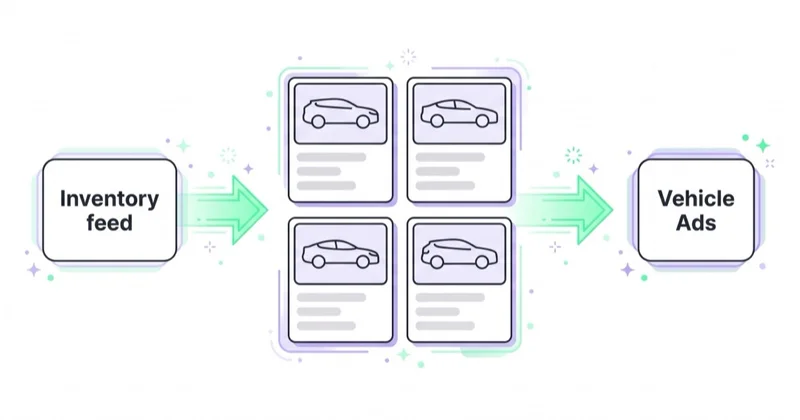
Google Vehicle Ads are a lower-funnel ad format for eligible auto advertisers. They show shoppers an image of a vehicle with details such as make, model, price, mileage and advertiser name. The click sends the shopper to the vehicle description page on the dealer website.
The format runs from vehicle data in Merchant Center and can serve through Google Ads. It is not a generic product feed and it is not the right answer for every vehicle-related business. Google says Vehicle Ads may be used to promote non-commercial passenger vehicles and lists unsupported examples such as motorcycles, motor bikes, boats, planes, farm vehicles, go-karts and race cars.
For a car dealership, the setup usually requires:
- Vehicle Ads enabled in Merchant Center.
- Google Ads linked to Merchant Center.
- store data or Google Business Profile connection where required;
- vehicle inventory data source with required attributes;
- vehicle detail pages that match the submitted feed data;
- campaign structure through Performance Max or Standard Shopping, depending on control needs.
Performance Max can give broader reach and automation. Standard Shopping can provide more control over product grouping and query visibility. Neither will fix bad inventory data.
The vehicle feed is a sales asset
Inventory data is not a technical chore. It decides whether Google can understand the vehicle, whether shoppers trust the ad and whether the campaign can scale without creating sales friction.
| Field | Why it matters |
|---|---|
| Year, make, model, trim | matches specific shopper intent |
| VIN or vehicle ID | prevents duplicate or ambiguous inventory |
| Condition | separates new, used and certified units |
| Price and sale price | qualifies the shopper and supports compliance |
| Mileage | critical for used inventory |
| Images | drives first impression and click quality |
| Location and store code | routes demand to the right rooftop |
| Availability | prevents spend on sold or reserved vehicles |
Google's policy documentation is explicit about data accuracy: prices in the data source and structured data should match the website, landing pages should accurately reflect the advertised vehicle, mileage should be accurate and required attributes such as images and availability must be present.
This is where many accounts lose money quietly. The campaign reports clicks, but the salesperson receives enquiries for a vehicle that sold, changed price or has a weak detail page. Paid media then gets blamed for a trust problem created upstream.
Paid search still has a clear role
Vehicle Ads are inventory-led. Search campaigns are intent-led. A dealership usually needs both.
Useful search groups:
- dealership brand and location searches;
- make, model and trim queries;
- new and used vehicle category queries;
- "near me" and city-based dealership searches;
- lease, finance and monthly payment intent;
- trade-in and valuation queries;
- service, parts and accessories when the dealership wants those enquiries;
- competitor campaigns only where compliant and commercially justified.
Search also gives better query-level learning. It reveals how shoppers talk about budget, body type, finance, condition and local availability. That language should feed VDP copy, ad copy, negative keywords and sales scripts.
Brand search should be reported separately. It protects demand that often already exists. Non-brand search, model campaigns and inventory-led activity show the true cost of acquisition.
Meta and social support the car-buying journey
Meta is useful for car dealerships, but it rarely replaces Google intent capture. Its best roles are visual discovery, remarketing, lead forms, inventory reminders, trade-in messages, model launches, service campaigns and finance awareness.
The technical layer is catalog and event consistency. Product or vehicle IDs used in the catalog should match the IDs passed by site events where dynamic ads or catalog-driven activity is used. If the platform cannot connect viewed units, lead events and inventory groups, remarketing becomes less precise.
Good Meta work for car dealerships usually includes:
- inventory or model-specific creative;
- trade-in and appraisal campaigns;
- finance or lease education where compliant;
- remarketing for VDP visitors;
- service and maintenance campaigns for existing owners;
- CRM exclusions for sold customers or active opportunities where data use is permitted.
The measurement standard should still be CRM quality. A cheap lead form can create a long sales queue with little commercial value if the dealership cannot see which leads book appointments and close.
CRM feedback: from form to sold unit
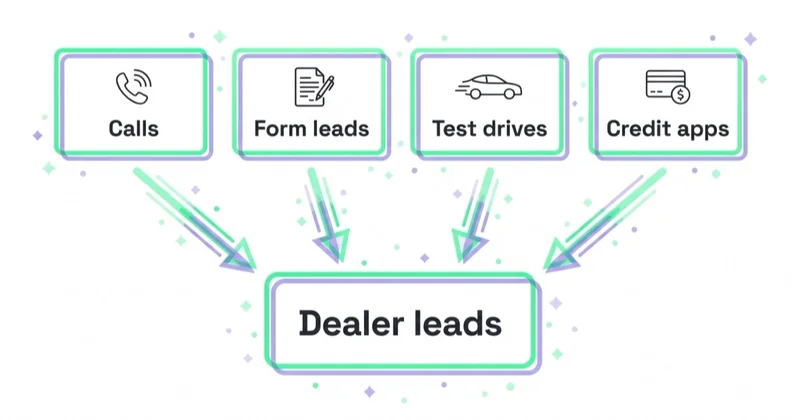
The ad account sees calls and forms first. The dealership cares about sold units, gross profit and repeat service. The gap is where waste appears.
Use a conversion hierarchy:
| Signal | Use in bidding and reporting |
|---|---|
| Page view or VDP view | diagnostic only |
| Call click or call duration | early lead signal |
| Form submission | useful but noisy |
| finance or trade-in form | stronger intent |
| booked appointment | strong optimisation signal |
| showroom visit | strong business signal |
| closed sale and margin | best reporting signal |
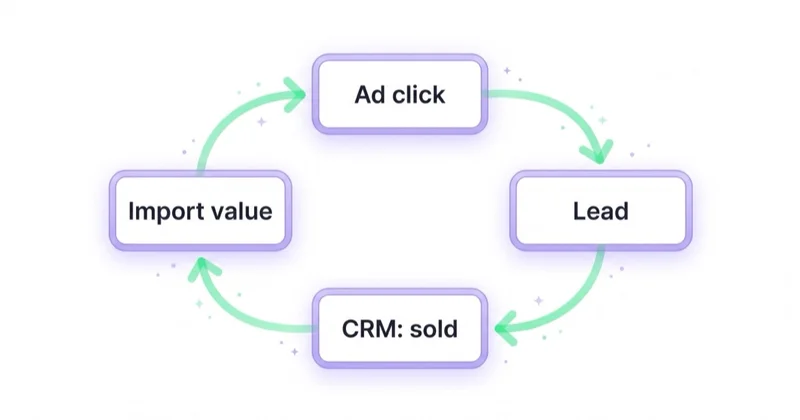
If every form is treated equally, campaigns learn to buy easy forms. If the CRM sends back booked appointments, qualified visits and closed units, bidding can move closer to business value.
For long sales cycles or low event volume, stage-weighted values are useful. A finance application can be worth more than a generic contact form. A shown appointment can be worth more than a booked appointment. A closed unit can carry revenue or margin where the data is reliable.
Local catchment and rooftops
Dealerships have physical gravity. Some shoppers travel for rare used inventory, but many searches have a realistic local radius. New vehicles, used vehicles, service, parts and finance may each draw from different geographies.
Questions before setting location:
- Which zip codes produce sold units, not only forms?
- Which areas generate enquiries that never answer or never show?
- Are multiple rooftops competing for the same query?
- Which vehicles justify a wider radius?
- Do OEM territory, co-op or brand rules affect geography?
- Should service and sales have different catchments?
One large radius can make reporting look simple and economics look vague. Strong dealership accounts often separate geography by business objective.
OEM, co-op and offer compliance
Dealership advertising often sits inside manufacturer rules. Co-op spend can change the economics, but it usually brings requirements around logos, disclaimers, model naming, finance language, landing pages, price display and approved creative.
Compliance should not be a final manual check. It should be built into campaign templates, ad copy patterns and landing-page modules. If a campaign performs well but does not qualify for reimbursement, the real CAC changes. If finance language is unclear, the campaign can create trust and regulatory risk.
How Space Ads approaches car dealership PPC
At Space Ads, car dealership PPC starts with the operating inputs: inventory freshness, VDP parity, local catchment, conversion definitions and CRM feedback. Campaign structure comes after those inputs are trustworthy.
The working model is:
- clean and monitor vehicle data;
- separate inventory-led campaigns from controlled search demand;
- protect brand without letting it hide acquisition cost;
- connect calls, forms, appointments and closed units;
- use Meta where visual discovery and remarketing help the buying journey;
- report on appointment quality and sold units, not only forms.
That connects directly with our work across Google Ads, Meta Ads, performance marketing, and local acquisition strategy covered in Google Ads for local businesses.
Practical setup order
- Audit inventory data, VDP parity, price, mileage, VIN and availability.
- Enable and verify Vehicle Ads where the inventory is eligible.
- Separate brand, non-brand, model, finance, trade-in and service search campaigns.
- Add Meta for inventory reminders, trade-in, finance and remarketing.
- Connect CRM stages to reporting and, where possible, bidding.
- Separate rooftops and catchments by business objective.
- Build OEM and co-op rules into copy and creative templates.
FAQ
What is car dealership PPC?
Car dealership PPC is paid advertising for new and used vehicle inventory, finance, trade-in, service and local dealership demand. It is usually measured by qualified enquiries, appointments, showroom visits and closed units rather than clicks alone.
What are Google Vehicle Ads?
Google Vehicle Ads are a lower-funnel format that uses vehicle inventory data in Merchant Center to show vehicle details such as image, make, model, price, mileage and advertiser name. The click leads to the vehicle detail page.
Do Google Vehicle Ads replace paid search?
No. Vehicle Ads cover inventory-led demand. Paid search is still useful for brand, model, trim, finance, trade-in, local "near me" searches and service demand where direct query control matters.
What should dealerships optimise toward?
Start with calls, forms, finance enquiries and test-drive requests, but move reporting toward booked appointments, show rate, showroom visits, closed units and margin. Those outcomes are closer to the business than form volume.
Why do car dealership campaigns need CRM imports?
Because the ad platform cannot know which form became a real buyer unless the CRM sends that information back. CRM imports help separate cheap enquiries from qualified appointments and sales.
In Short
Car dealership PPC works when inventory, search intent and CRM outcomes describe the same reality. Google Vehicle Ads can promote eligible passenger vehicle inventory, paid search controls explicit local demand, Meta supports discovery and remarketing, and CRM feedback tells the account which enquiries become business.
Sources
- Google Merchant Center Help - Vehicle ads overview
- Google Merchant Center Help - Vehicle ads policies
- Google Merchant Center Help - Vehicle ads activation
- Google for Developers - Vehicle listings feed setup
- Meta for Developers - Catalog reference
Continue Learning
Continue reading

Powersports Dealership Marketing: Motorcycle, ATV and UTV Demand
Powersports dealerships need a different paid media plan than car dealers. Motorcycles, ATVs, UTVs and personal watercraft are driven by seasonality, community, visual creative, service and accessories.

Language School Marketing: Two Businesses, One Building
Language schools often combine consumer enrolment and corporate training. Market them as separate buying journeys, then connect campaigns to attendance, enrolment, group contribution and continuation.

Driving School Marketing: Selling Instructor Hours, Not Courses
A practical system for growing a driving school around real instructor capacity: local demand, transparent lesson offers, compliant proof, responsive booking and completed-pupil value.