Customer retention marketing is the coordinated work of helping suitable customers continue the relationship: using the product successfully, buying again when the need returns, renewing a subscription, or choosing the brand for another relevant purchase. It includes product experience, service, lifecycle communication, segmentation, loyalty, and offer design.
Repeat revenue is not automatically profitable. A returning customer can still require paid media, support, discounts, returns, or expensive fulfilment. The goal is therefore not retention at any cost, but greater incremental customer contribution from relationships worth maintaining.
TL;DR
- Retention and acquisition are connected. Better repeat economics can support a higher allowable CAC, but neither is always the larger growth lever.
- The economics must be measured, not assumed. Include discounts, returns, fulfilment, service, messaging, and reacquisition media in customer contribution.
- Metrics depend on the model. Repeat purchase and purchase frequency suit ecommerce; renewal, logo churn, revenue retention, or usage may matter more for subscriptions and services.
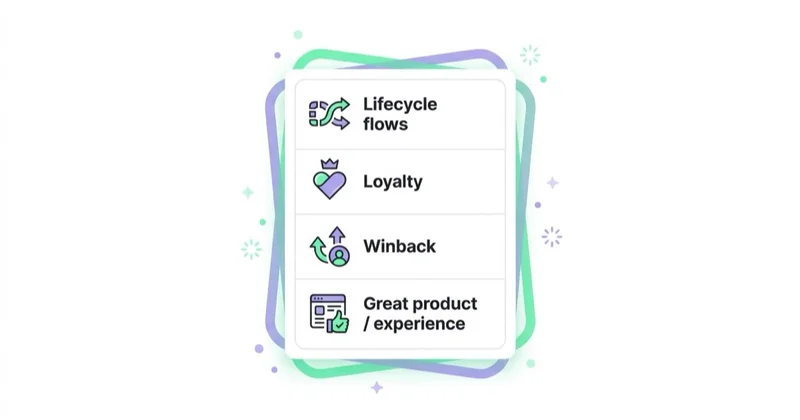
- The system is a set of flows: post-purchase, replenishment/winback, VIP and loyalty — automated sequences triggered by behaviour, not one-off campaigns.
- Segmentation makes it work. RFM (recency, frequency, monetary) separates VIPs from lapsing customers so each gets the right message.
- Cohorts expose lifecycle differences. Compare customers from equivalent first-purchase periods, products, and acquisition sources at the same age.
- LTV is an estimate, not a fact about the future. State whether it uses revenue, gross profit, or contribution margin and whether it is historical or predicted.
- Discounts are a tool, not a strategy. Test them against incremental contribution and customer behavior, not attributed revenue alone.
When retention can improve profit
An existing customer may already know the product, have a saved account, and be reachable through a permissioned owned channel. Those advantages can make a repeat order less expensive to stimulate than a first purchase. They do not eliminate costs or guarantee another order: category need, product satisfaction, price, availability, service, and competition still determine the outcome.
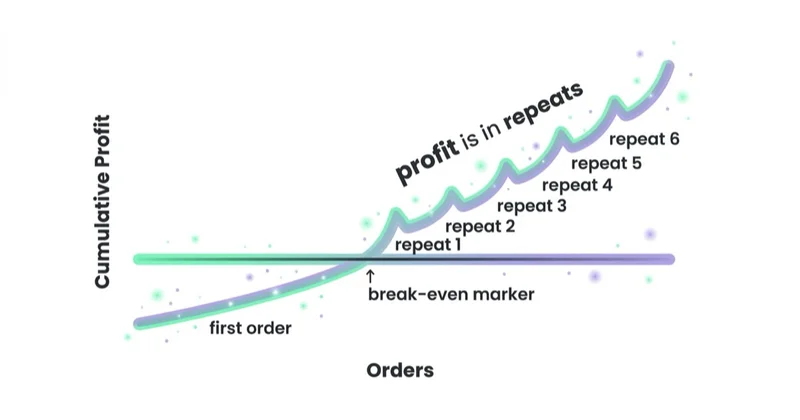
There is no universal formula that converts a higher retention rate into profit. The result depends on margin structure, purchase cycle, cost to serve, and which customers return. Retaining an unprofitable customer or buying the next order with an excessive discount can increase repeat revenue while reducing contribution.
Retention deserves an explicit diagnosis and budget when it is a real constraint. Compare marginal investment in product, service, lifecycle marketing, and acquisition rather than assuming a universal winner. This connects directly to unit economics: allowable CAC depends on expected customer contribution, payback period, cash flow, and risk—not a revenue-only LTV figure.
The four levers retention marketing actually moves
Retention is not a single metric. For a repeat-purchase ecommerce model, four useful levers are:
| Lever | What it means | How retention marketing moves it |
|---|---|---|
| Repeat-purchase rate | Share of customers who buy again | Post-purchase flows, replenishment reminders, relevant recommendations |
| Churn | Rate at which customers stop buying | Win-back flows, addressing why they lapsed |
| Average order value (AOV) | Average spend per order | Cross-sell, bundles, thresholds, VIP tiers |
| Purchase frequency | How often customers buy | Replenishment timing, loyalty, lifecycle nudges |
These measures must be interpreted together. AOV can rise while purchase frequency or margin falls; repeat rate can rise because the acquisition mix changed; a discount can increase orders while reducing contribution. Subscription businesses should add customer and revenue churn, renewal, expansion, contraction, and net revenue retention where relevant.
The system: flows, not campaigns
Automation helps respond to lifecycle events consistently, but product quality and service do more retention work than a message can. Useful flows to evaluate include:
- Post-purchase flow. Confirm expectations, support product use, answer common questions, and ask for feedback at an appropriate time. Do not rush every buyer into another order.
- Replenishment / repeat flow. For consumable or repeatable products, a reminder timed to when the customer is likely to run out or want more — timing beats frequency here.
- Win-back flow. Trigger it after the expected purchase interval, not a universal number of days. Suppress people with unresolved service issues and test whether contact creates incremental return.
- VIP / loyalty flow. Recognise customers who are valuable on contribution and relationship—not revenue alone—and ensure the benefits have sustainable economics.
The technical foundation matters: reliable order and refund events, product and subscription data, channel permission, suppression after purchase or complaint, frequency controls, and clear ownership. Connecting these flows to the rest of the customer journey is central to CRM and marketing automation, email, and SMS.
Segmentation: RFM is the workhorse
RFM—recency, frequency, and monetary value—is a practical starting segmentation when transaction data is available. It can identify new customers, frequent purchasers, high spenders, and people whose usual purchase pattern has slowed.
Do not equate high historical revenue with future profit or willingness to receive more messages. Add margin, returns, product category, predicted need, consent, service status, and customer preferences where useful. Keep segments large enough to operate and test; excessive personalisation can add complexity without measurable value.
Glossary
- Retention marketing — keeping existing customers buying through owned-channel communication, offers and experience.
- Repeat-purchase rate — the share of customers who make more than one purchase.
- Churn — the rate at which customers stop buying (or cancel, for subscriptions).
- Customer lifetime value (CLV/LTV) — an estimate of future customer value under defined revenue, margin, horizon, and discounting assumptions.
- RFM — segmentation by recency, frequency and monetary value.
- Flow / automation — a behaviour-triggered message sequence, as opposed to a broadcast campaign.
- Cohort analysis — tracking a group of customers acquired in the same period to see how they retain over time.
Measure retention on cohorts and LTV, not opens
Group customers by first purchase or another meaningful start event, then compare cohorts at the same lifecycle age. Shopify's cohort reports, for example, can show retention, sales, AOV, orders, and amount spent by first-order cohort. Segment further by acquisition source, first product, discount status, geography, or subscription so a changing customer mix does not masquerade as better retention.
Measure repeat purchase or renewal, time to second order, purchase frequency, customer and revenue churn, contribution per customer, and payback as appropriate. Opens and clicks help diagnose delivery and response but do not establish value. Where volume permits, randomise eligible customers into treatment and holdout groups; report incremental contribution after discounts, returns, channel costs, and fulfilment. This follows the same principle as web analytics tied to revenue.
Use discounts selectively
A discount can accelerate a purchase, clear inventory, reward a segment, or test price sensitivity. It can also subsidise an order that would have happened, compress margin, and change customers' reference price. The effect is empirical, not automatically good or bad.
Test the offer against no offer and compare incremental contribution, repeat behavior after redemption, and segment response. Also improve the reasons to return without a coupon: product utility, availability, service recovery, useful education, relevant replenishment, and appropriate recognition.
How Space Ads approaches customer retention
At Space Ads, retention work starts with the buying cycle and data model: what counts as a repeat opportunity, when it normally occurs, which events and costs are available, and which customer groups are commercially worth serving differently. We audit experience and service issues before assuming that another flow is the answer.
The operating plan links acquisition cohorts to repeat behavior, contribution, and payback. Automations are designed around verified lifecycle moments, permission, and suppression rules, then evaluated with a holdout where volume permits. That work lives in marketing automation and email marketing.
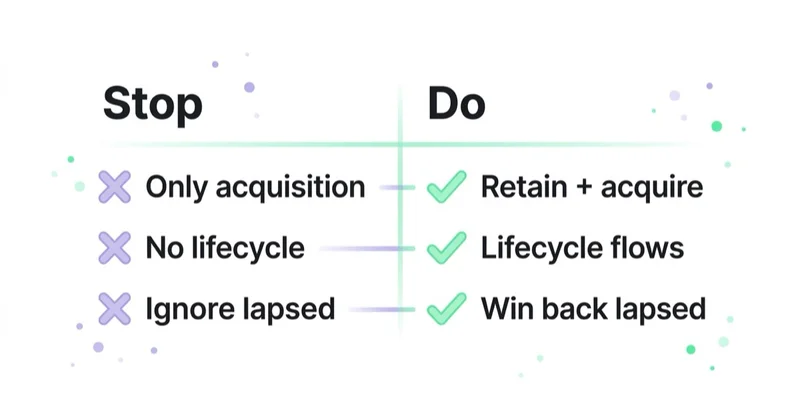
Stop doing / Do instead
| Stop doing | Do instead |
|---|---|
| Treating retention as an afterthought or automatic priority | Compare its marginal opportunity with acquisition and product investment |
| Sending everyone the same newsletter | Segment with RFM and match the message to the relationship |
| Relying on manual broadcasts | Build post-purchase, replenishment, win-back and VIP flows |
| Defaulting to discounts | Test offers on incremental contribution and later behavior |
| Judging retention on opens and clicks | Measure matched-age cohorts, repeat behavior, and customer contribution |
| Crediting flows with all "recovered" revenue | Read win-back against a holdout for incrementality |
Common mistakes
Common mistakes include comparing immature and mature cohorts, using revenue-only LTV, ignoring refunds and service cost, sending a win-back before the normal repurchase window, calling high spenders “VIP” despite poor margin, and crediting every attributed repeat order to a flow. Another is treating a low repeat rate as a messaging problem when the product is naturally infrequent or the first-purchase experience is weak.
FAQ
What is customer retention marketing?
Customer retention marketing coordinates product experience, service, lifecycle communication, segmentation, loyalty, and offers to increase the value of appropriate customer relationships. The relevant outcome may be repeat purchase, renewal, usage, expansion, or reduced churn depending on the model.
Why is retention cheaper than acquisition?
It can be cheaper because awareness, trust, account setup, and permission already exist. But repeat orders still carry messaging, media, discount, service, returns, and fulfilment costs, and not every retained customer is profitable. Compare incremental contribution rather than relying on a general rule.
What are the main customer retention metrics?
For ecommerce, start with repeat-purchase rate, time to second order, purchase frequency, AOV, contribution per customer, and cohort value. For subscriptions, add customer churn, revenue churn, renewals, expansion, contraction, and net revenue retention. Opens and clicks are diagnostic channel measures.
What retention flows should an ecommerce store have?
Common candidates are post-purchase education, replenishment where the product has a predictable cycle, win-back after an evidence-based lapse point, review or feedback requests, and VIP communication for customers with sustainable value. Build only the flows supported by the product, data, consent, and economics.
Is discounting good for retention?
A discount can work, but evaluate it against a no-offer control and include margin, returns, and later purchase behavior. Use it selectively when it creates enough incremental customer contribution, rather than assuming every attributed order is additional.
How is retention different from loyalty programs?
A loyalty program is one tool within retention marketing, not the whole of it. Retention includes post-purchase communication, segmentation, replenishment, win-back and experience — the loyalty program is the formal rewards layer for the best customers. A points scheme without the underlying flows and relevance rarely produces retention on its own.
Key takeaways
- Retention should increase incremental customer contribution, not repeat revenue at any cost.
- Select metrics for the business model and compare cohorts at the same lifecycle age.
- RFM is a useful starting point, enriched by margin, returns, category, preferences, and service status.
- Lifecycle automations require reliable events, permission, suppression, and a real customer need.
- Treat LTV as a defined estimate and test discounts or flows against a holdout where possible.
Sources and further reading
- Shopify Help Center — Customer and cohort reports
- Klaviyo Help Center — Understanding cohort analysis
Continue learning
Continue reading
The Welcome Email Series That Converts New Subscribers
A welcome series should deliver the signup promise, establish expectations and help an eligible subscriber take the next useful step. Learn how to design, sequence, govern and measure it without relying on a universal template.
Klaviyo Flows Every Ecommerce Store Needs (and the Order to Build Them)
Klaviyo flows automate relevant email and SMS messages around key customer actions. This guide explains which flows to prioritise, how to set their triggers and exclusions, and how to measure their real contribution to revenue.
Email Authentication Explained: SPF, DKIM and DMARC for Marketers
SPF authorises sending infrastructure, DKIM signs selected message content, and DMARC connects those results to the domain recipients see in From. Learn how alignment works, what Gmail, Yahoo and Outlook require, and how to move from inventory to monitored enforcement safely.