ChatGPT can help manage Google Ads, but not in the way the question usually implies. It's genuinely useful for analyzing exported data, explaining what a metric means, drafting ad copy and reasoning through a strategy. What it should not do is act directly and unsupervised on a live account — changing budgets or bids without limits, previews or a log — because a chat model has no business context and no guardrails by default. The safe and useful version isn't "ChatGPT runs your account." It's a guarded agent pattern: the AI proposes, a human approves, and a system enforces the limits. This guide separates what AI chat does well from what it shouldn't do alone.
TL;DR
- ChatGPT can analyze and advise; it shouldn't act unsupervised on live spend. Analysis is safe; unconstrained write access to budgets is not.
- What it does well: explaining metrics, analyzing exported or connected data, drafting ad copy, and reasoning through strategy.
- What it does badly: judgement without context (margin, brand, seasonality) and any action without guardrails.
- Connectors change the picture safely. A read-only connector lets AI query live account data without being able to change anything.
- Acting on accounts needs a guarded agent. Limits, previews, verification and an audit log — not a raw model with API write access.
- The reliable pattern is propose → approve → enforce. AI finds and drafts, a human decides, the system enforces boundaries.
- AI changes the specialist's job, it doesn't remove it. The judgement moves up; the manual labour moves to the machine.
For the broader picture, see AI for Google Ads: native AI vs a control layer.
A quick glossary
- Chat model (ChatGPT, Claude, Gemini) — a general-purpose AI you interact with in natural language; powerful at reasoning and language, with no account access by default.
- Connector — an integration that gives a model access to live data; can be read-only or change-capable.
- Read-only connector — lets AI query account data but not change it, like the official Google Ads MCP server.
- Agent / agentic workspace — AI that can take actions (not just chat), ideally within defined limits and approvals.
- Guardrails — the limits, previews, verification and audit log that constrain what an acting AI can do.
- GAQL — the query language used to read Google Ads data through the API.
What ChatGPT does well for Google Ads
Used as an analyst and assistant rather than an operator, a chat model is genuinely valuable:
- Explaining and teaching. "What does a low Quality Score actually cost me?" or "explain this campaign's performance" — clear, fast, on demand.
- Analyzing data you give it. Paste an export or connect it read-only, and it will spot patterns, summarize, and flag anomalies competently.
- Drafting creative. Ad copy, headline variations, RSA assets — a strong first draft to edit, covered in our AI ad copywriting guide.
- Reasoning through strategy. A thinking partner for structure, budget allocation logic, or how to approach a problem.
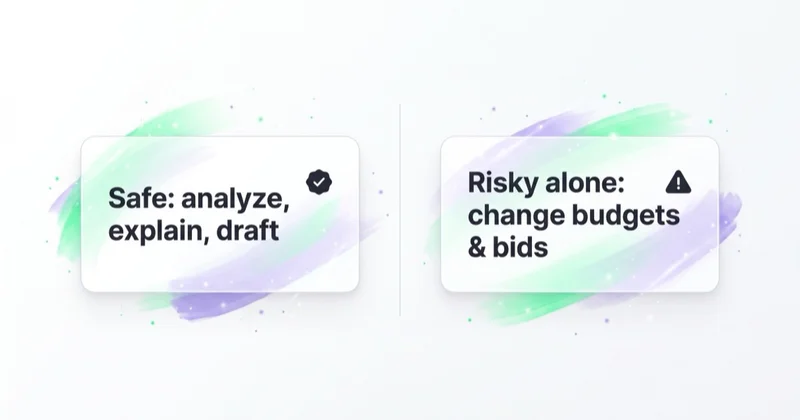
In all of these, the AI informs a human who decides. Nothing happens to the account without a person acting on the advice. That's the safe zone, and it's a big zone.
What ChatGPT shouldn't do unsupervised
The risk appears the moment you give a chat model the ability to change a live account on its own. Two problems make this unsafe by default:
No business context. A model sees the numbers, not the business. It doesn't know you're protecting margin this quarter, that a "low-converting" campaign is a deliberate brand play, or that a client forbids touching a certain budget. So it produces confident, plausible recommendations that are sometimes exactly wrong — and confidence is not correctness.
No guardrails by default. A raw model with API write access has no concept of a maximum change, no preview step, no verification, no log. One misread instruction and it can move real money across real accounts with nothing to catch it.
Neither problem means "don't use AI." They mean "don't give an unconstrained model the keys." The fix is structural, not a matter of trusting a better model.
| Task | ChatGPT alone | With guardrails |
|---|---|---|
| Explain a metric | ✅ Safe | ✅ Safe |
| Analyze exported data | ✅ Safe | ✅ Safe |
| Read live account data | ⚠️ Needs a connector | ✅ Read-only connector |
| Draft ad copy | ✅ Safe (human edits) | ✅ Safe |
| Change a budget or bid | ❌ Risky | ✅ With limits + approval + log |
| Apply changes across accounts | ❌ Dangerous | ✅ With per-account caps + audit log |
The guarded agent pattern
The version of "AI managing Google Ads" that actually works is narrow and deliberate. It looks like this:
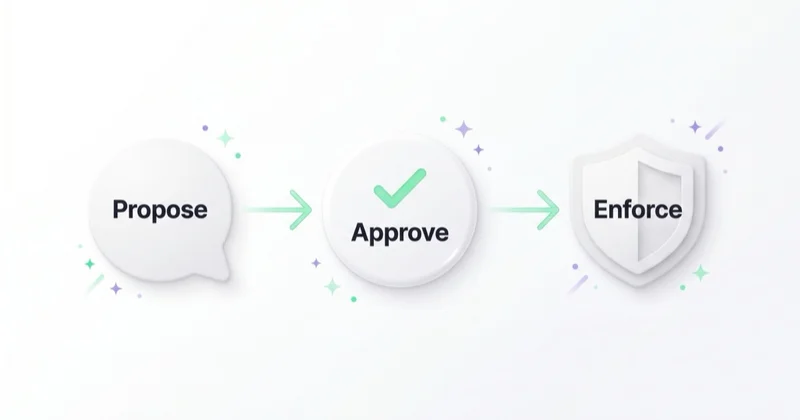
- The AI reads the account — through a connector, not a copy-paste — so it reasons on live, complete data.
- The AI proposes a specific change, showing exactly what would happen.
- A human approves (or rejects), bringing the business context the model lacks.
- The system enforces boundaries — per-account limits, a verification step, and a complete audit log.
This keeps the speed of AI (it can read every account and draft changes in seconds) while keeping the safety of human judgement and hard limits. The difference between this and "ChatGPT runs your ads" is the difference between a useful tool and an incident.
What we see when teams try raw ChatGPT on ads
Across the accounts we work with, the pattern is consistent: teams that use ChatGPT as an analyst get real value, and teams that try to wire a raw model directly into account changes eventually get burned. The failure is rarely dramatic — it's a plausible recommendation acted on without context, like cutting a campaign that looked inefficient on last-click but was doing the upper-funnel work that fed everything else. The model wasn't "wrong" given what it could see; it just couldn't see enough. That's the whole case for the guarded pattern: the model's reach (every account, instantly) is real, and so is its blind spot (no business context), so you build a workflow that uses the first and covers the second. The teams that thrive treat AI as a fast, tireless junior analyst whose work is always reviewed — not an autonomous operator.
How to use ChatGPT for Google Ads, safely
- For analysis and learning: use it freely on exported data or via a read-only connector. Low risk, high value.
- For creative: use it to draft, always edit. It's a strong first draft, not a finished asset.
- For changes: never give a raw chat model unconstrained write access. Use a purpose-built workspace where it proposes and you approve within limits.
- For scale: if you want AI acting across many accounts, the guardrails matter more, not less — per-account caps and a full audit log are non-negotiable.
Stop doing / do instead
| Stop doing | Do instead |
|---|---|
| Giving a raw model API write access | Use a guarded agent: propose → approve → enforce |
| Acting on AI advice without business context | Keep a human who knows margin, brand, seasonality in the loop |
| Copy-pasting stale exports for analysis | Use a read-only connector for live, complete data |
| Trusting confident recommendations as correct | Treat AI output as a reviewed draft, not a decision |
| Publishing AI ad copy unedited | Draft with AI, edit with judgement |
| Assuming a smarter model removes the risk | The risk is structural — fix it with guardrails, not a better model |
Where Space Ads OS fits
Space Ads OS is the guarded agent pattern, built for Google Ads (and Meta, TikTok and GA4) specifically. You work with it in chat the way you'd hope to use ChatGPT — ask for an analysis, get findings, request a change — but the change doesn't go out as a raw model action. It goes through a per-account limit, a preview of exactly what will happen, a verification step, and a logged reason. The AI proposes; you approve; the system enforces.
The reason it's built that way is everything above: the model's reach is genuinely useful and its lack of business context is genuinely dangerous, so the workflow is designed to use one and contain the other. It's the answer to "can AI manage my Google Ads?" that doesn't end in an incident — AI that acts at the speed you want without the control you'd lose handing the keys to a raw chat model. You can see how it works here.
FAQ
Can ChatGPT manage Google Ads campaigns?
ChatGPT can analyze Google Ads data, explain performance, draft ad copy and reason through strategy — all valuable as an assistant to a human. What it shouldn't do is change a live account unsupervised, because it has no business context and no guardrails by default. The safe way to have AI act on campaigns is a purpose-built workspace where the AI proposes changes and a human approves them within set limits, not a raw model with write access.
Is it safe to connect ChatGPT to my Google Ads account?
Connecting it read-only is safe — the AI can query your data through the API but cannot change anything, like the official Google Ads MCP server. Connecting it with write access is only safe inside a system that enforces guardrails: per-account limits, a preview of each change, verification, and an audit log. A raw model with unconstrained write access to live spend is not safe.
What can AI do for Google Ads that's actually useful?
The reliably useful tasks are analysis (spotting patterns and anomalies across accounts), explanation (making performance and concepts clear), drafting (ad copy and asset variations to edit), and continuous monitoring (catching tracking breaks or anomalies a person would miss on a busy week). The common thread is that AI informs or proposes, and a human decides — which is where the value sits without the risk.
Will AI replace Google Ads managers?
No — it changes the job rather than removing it. With the platforms automating bidding and AI handling analysis and monitoring, the human work moves up: defining objectives, judging trade-offs the model can't see (margin, brand, seasonality), and approving changes. AI replaces the manual labour and the tireless watching, not the judgement that decides what should actually happen.
What's the difference between ChatGPT and an AI tool built for Google Ads?
ChatGPT is a general-purpose model with no account access and no guardrails by default — excellent for reasoning and language. An AI tool built for Google Ads connects to the account through the API and, if it can act, wraps that in limits, previews and an audit log. The purpose-built tool is what makes AI safe to act on spend; the general model is best kept to analysis and drafting unless it's inside such a system.
How do I let AI make changes to ads without losing control?
Use the guarded agent pattern: the AI reads the account and proposes a specific change, you (a human with business context) approve or reject it, and the system enforces hard limits and logs every change with its reason. This keeps AI's speed and reach while keeping decisions and boundaries with you — the opposite of handing a raw model the keys.
In short
- ChatGPT is a strong analyst and drafter for Google Ads; it's a poor unsupervised operator.
- The two risks are no business context and no guardrails — both structural, not fixed by a smarter model.
- Read-only connectors make live analysis safe; write access needs limits, previews and a log.
- The pattern that works is propose → approve → enforce.
- Treat AI as a fast, tireless analyst whose work is always reviewed.
- AI moves the specialist's job up to judgement; it doesn't remove it.
Sources and further reading
- Google Ads Developers — Google Ads API overview
- Google Ads Help — About automated bidding
- OpenAI — Models documentation
- Space Ads — Google Ads MCP server: connecting AI to your data
- Space Ads — AI for Google Ads: native AI vs a control layer
Continue learning
Continue reading
AI for Google Ads in 2026: Google's Native AI vs a Control Layer on Top
Google's AI and third-party AI tools solve different problems. This guide draws the line between platform automation that already controls bidding and creative assembly, and external control layers that audit, explain, propose changes and help teams govern execution.
Google Local Services Ads: The Pay-Per-Lead Channel for Local Businesses
A current guide to Google Local Services Ads and pay-per-lead Performance Max: eligibility, Google Verified, screening, billing, ranking, lead credits, migration and measurement beyond raw leads.
Google Ads Benchmarks by Industry (CTR, CPC, Conversion Rate)
Google Ads benchmarks can provide context, but only when the campaign type, market, conversion action, attribution and time period match. Learn how to make a valid comparison and turn it into a useful decision.