AI ad copywriting is not about asking ChatGPT, Claude or Gemini to "write better headlines". That usually produces generic benefits, recycled marketing language and claims that still need to be checked. The useful version is a repeatable creative process: feed the model with product evidence, customer objections, channel constraints and a clear testing plan.
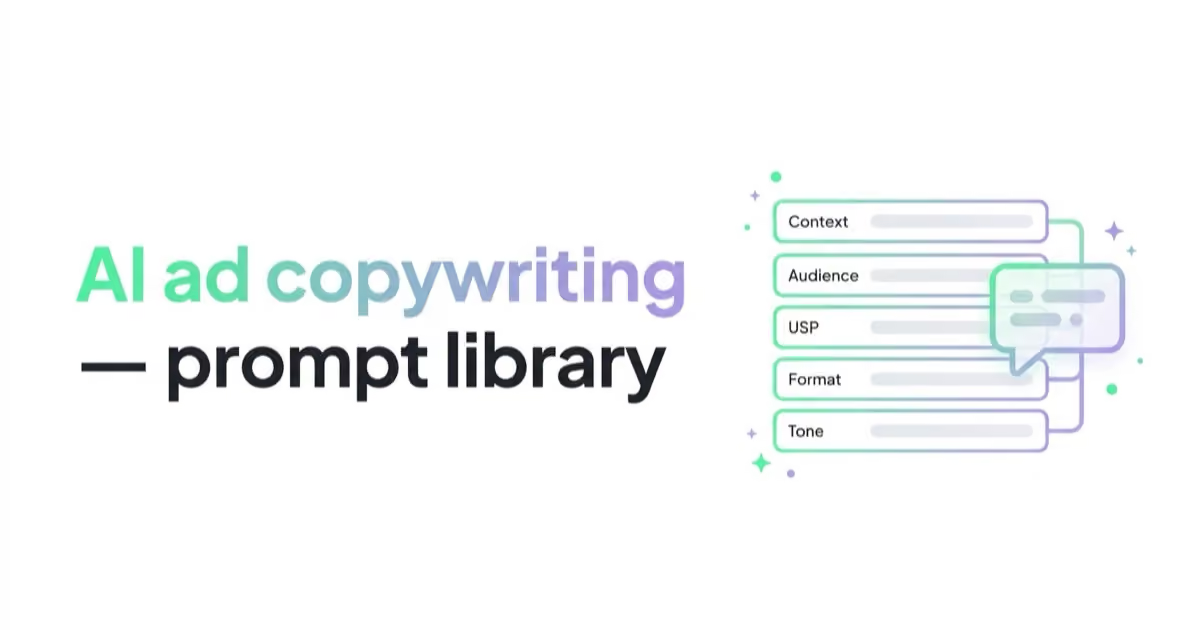
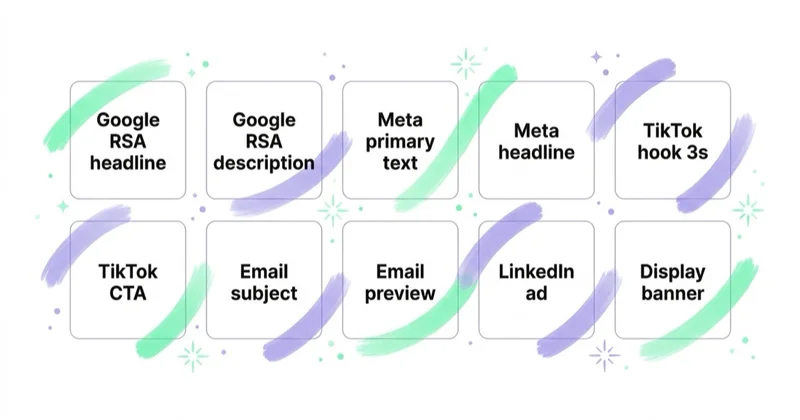
In paid media, AI copy is valuable because modern platforms need more creative variation than most teams can produce manually. Google Search needs relevant responsive search ad assets. Meta campaigns need many hooks and angles because creative fatigue arrives quickly. TikTok needs native, direct, video-first language. Email and landing pages need message consistency so the click does not collapse after the ad.
The goal is not to replace the strategist. The goal is to shorten the route from customer insight to testable variants. Strong AI ad copywriting still needs human judgement, source material, platform knowledge and performance feedback.
TL;DR
- AI copywriting works best when it is treated as a briefing and testing workflow, not a one-line prompt.
- A useful prompt should include product context, target audience, buying stage, customer objections, proof points, channel format, character limits and forbidden claims.
- ChatGPT, Claude and Gemini can all support ad copy generation, but none should be trusted with unsupported claims or final compliance checks.
- The highest-quality outputs usually come from source material: search terms, reviews, sales calls, FAQs, landing pages, competitor positioning and previous winning ads.
- Google Search prompts should produce many constrained assets, not one "perfect" ad.
- Meta prompts should create distinct creative angles, not small wording variations of the same claim.
- TikTok prompts should start with video hooks, creator direction and the first three seconds, not only caption copy.
- AI copy should be evaluated against conversion data, brand voice, policy risk and landing page match.
- A prompt library is useful only when learnings from live campaigns are added back into it.
- AI is a production accelerator. The strategic advantage comes from better inputs, better review and faster iteration.
What AI copywriting is useful for
AI copywriting is useful when the task is structured and the model has enough context. In advertising, this usually means:
- generating many first-draft variants;
- turning one positioning idea into several angles;
- rewriting copy for different levels of awareness;
- adapting a message to Google Search, Meta, TikTok, LinkedIn or email;
- extracting objections and benefits from reviews or sales notes;
- creating hook libraries for video ads;
- localising copy for UK, US, Canadian, Australian or European audiences;
- finding clearer ways to express an offer;
- producing alternative calls to action;
- summarising test learnings into the next creative brief.
AI is much weaker when the input is vague. A prompt such as "write 10 high-converting ads for a SaaS tool" gives the model permission to invent a generic SaaS promise. A prompt based on real pricing, use cases, objections, testimonials, competitors, search terms and landing page sections gives the model material it can actually use.
This is especially important in accounts shaped by automation. Google AI Max for Search can expand matching and text customisation, but the account still needs strong message assets. Meta Andromeda rewards richer creative input, but weak angles do not become strong just because delivery is automated.
The anatomy of a good advertising prompt
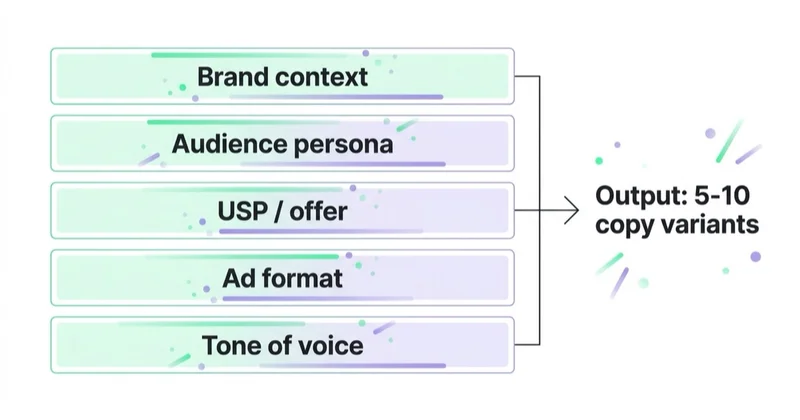
A good AI copywriting prompt has seven parts.
| Prompt part | What it should include | Why it matters |
|---|---|---|
| Business context | Product, offer, price range, category, market | Prevents generic copy |
| Audience | Role, pain, buying stage, objections | Aligns message with intent |
| Proof | Reviews, numbers, guarantees, case studies, differentiators | Reduces hallucinated claims |
| Channel | Google Search, Meta, TikTok, email, landing page | Matches the format |
| Constraints | Character limits, banned words, legal limits, tone | Makes output usable |
| Variation logic | Angles, hooks, objections, benefits, urgency | Avoids repeated copy |
| Evaluation criteria | What makes a variant worth testing | Makes the model self-filter |
The key is to brief the model like a junior strategist, not like a magic headline generator. The output should be a structured draft that a marketer can review and test.
Prompt template for Google Search ads
Responsive search ads need many assets because Google can assemble different combinations. Google documentation notes that responsive search ads require at least 3 headlines and can include up to 15, plus at least 2 descriptions and up to 4. That format changes how prompts should be written: the task is not to write one ad, but to create a useful asset set.
Use this prompt as a starting point:
You are a senior PPC copywriter. Create responsive search ad assets for Google Ads.

Business:
[describe product, offer, location, pricing, differentiators]

Audience and intent:
[describe search intent, buyer stage, key objections, alternatives considered]

Landing page proof:
[paste specific claims, benefits, guarantees, reviews, product details]

Keyword themes:
[paste keyword groups or search terms]

Task:
Write 15 headlines up to 30 characters and 4 descriptions up to 90 characters.

Rules:
- Do not invent claims, numbers, awards or guarantees.
- Use a mix of keyword relevance, benefit-led copy, proof-led copy and CTA.
- Avoid exaggerated claims such as "best" unless the source material proves it.
- Make the first 3 headlines able to work together.
- Mark which headlines are brand, benefit, proof, offer, urgency or CTA.
- Return the output in a table with character counts.
After generation, remove duplicates and assets that only repeat the keyword. Good search copy usually balances relevance with commercial clarity. A headline that matches the query but says nothing about the offer may win clicks and still lose conversions.
For more on this format, see Responsive Search Ads in Google Ads.
Prompt template for Meta Ads
Meta copy should not be produced as minor variations of one message. In broad campaigns and Advantage+ setups, the account needs genuinely different creative angles: problem, outcome, objection handling, comparison, social proof, offer, founder POV, product demo and UGC-style scripts.
Use this prompt:
You are a performance creative strategist for Meta Ads.

Product and offer:
[describe what is being sold, margin sensitivity, pricing, promotion]

Audience:
[describe current customers, prospect audience, purchase triggers, objections]

Proof and source material:
[paste reviews, FAQs, sales notes, support questions, competitor gaps]

Task:
Create 12 Meta ad concepts, not just copy variations.

For each concept include:
- creative angle;
- first line of primary text;
- short primary text under 125 characters;
- longer primary text under 280 characters;
- headline under 40 characters;
- CTA;
- suggested visual or UGC direction;
- why this angle is worth testing.

Rules:
- Do not use unsupported claims.
- Do not overpromise results.
- Make at least 4 concepts objection-led.
- Make at least 3 concepts proof-led.
- Make at least 3 concepts product-demo led.
The most useful output is the "why this angle is worth testing" column. It forces the model to connect copy to a hypothesis. That makes creative review easier and turns results into reusable learning.
For broader creative strategy, connect this workflow with Meta Advantage+ and AI UGC ads.
Prompt template for TikTok hooks
TikTok copy begins before the caption. The first frame, first sentence and first visual action matter more than polished ad text. A good prompt should generate hooks and video directions, not only captions.
You are a TikTok performance creative strategist.

Product:
[describe product, category, price, target market]

Audience:
[describe pain, desire, objections, awareness level]

Source material:
[paste reviews, FAQs, previous comments, creator notes, product demos]

Task:
Write 20 TikTok ad hooks for the first 3 seconds.

For each hook include:
- spoken hook;
- on-screen text;
- first visual action;
- creator direction;
- caption;
- CTA;
- best fit: problem, comparison, demo, proof, myth-busting or offer.

Rules:
- Keep hooks direct and native to TikTok.
- Avoid corporate language.
- Do not invent statistics or claims.
- Include at least 5 hooks that challenge a common assumption.
This prompt works well when paired with creative research from TikTok Creative Center and campaign structure from TikTok Ads. If creator permissions and organic posts are involved, Spark Ads should also be considered.
Prompt template for email subject lines
Email is useful for testing concise positioning because subject lines expose whether the benefit is clear. Use AI to generate variants by angle, then test them with a clean naming convention.
You are a lifecycle marketing copywriter.

Campaign:
[describe campaign goal, audience segment, offer and timing]

Brand voice:
[describe tone, banned words, level of urgency, examples of good copy]

Source material:
[paste offer details, objections, product benefits, proof]

Task:
Write 25 subject lines and 25 preheaders.

Group them by:
- benefit-led;
- curiosity-led;
- proof-led;
- urgency-led;
- objection-led.

Rules:
- Keep subject lines under 50 characters where possible.
- Do not use fake urgency.
- Do not imply a personal relationship that does not exist.
- Include a short rationale for each group.
For reporting, keep campaign tracking clean with UTM parameters. AI-generated variants become much more useful when naming conventions make results easy to read later.
How to evaluate AI-generated copy
AI output should not go directly into ads. Use a review checklist before testing:
- Does every claim exist in the landing page, product data, legal copy or customer proof?
- Does the ad match the actual offer and post-click experience?
- Is the copy appropriate for the target market, including spelling and wording differences between the US, UK, Canada and Australia?
- Does it avoid sensitive personal attributes and platform policy issues?
- Is the promise specific enough to be useful but not exaggerated?
- Are the variants meaningfully different, or just rephrased?
- Is the copy mapped to a test hypothesis?
- Can the result be measured cleanly?
Performance review should separate creative quality from media noise. If one AI headline wins in a weak campaign structure, that does not prove the prompt is strong. If a consistent angle wins across several audiences, placements or geos, that learning is worth adding back into the prompt library.
For larger accounts, the same discipline should connect to incrementality testing, especially when a channel appears to perform well in platform reporting but does not create incremental revenue.
A practical agency workflow
Use this workflow when building AI-assisted ad copy for a client or in-house brand.
1. Collect source material
Gather landing pages, product feeds, customer reviews, sales call notes, FAQs, objections, search terms, competitor claims, offer terms and previous winning ads. This is the most important step.
2. Build a message map
Group the source material into pains, outcomes, proof, objections, differentiators and forbidden claims. The message map prevents every AI output from becoming a random creative idea.
3. Generate by channel
Use different prompts for Google Search, Meta, TikTok and email. Do not ask one model for "ad copy for all platforms" unless the goal is only rough ideation.
4. Review manually
Remove unsupported claims, weak hooks, duplicated angles and copy that does not fit the brand. Shortlist only variants that have a clear reason to exist.
5. Launch controlled tests
Do not test 40 variants with no structure. Group copy by angle and match it with creative, landing page and audience assumptions. That makes the result interpretable.
6. Feed learnings back into prompts
The best prompt library is not static. Add winning phrases, losing angles, policy notes, objections and new proof after every campaign cycle.
How we approach this at Space Ads
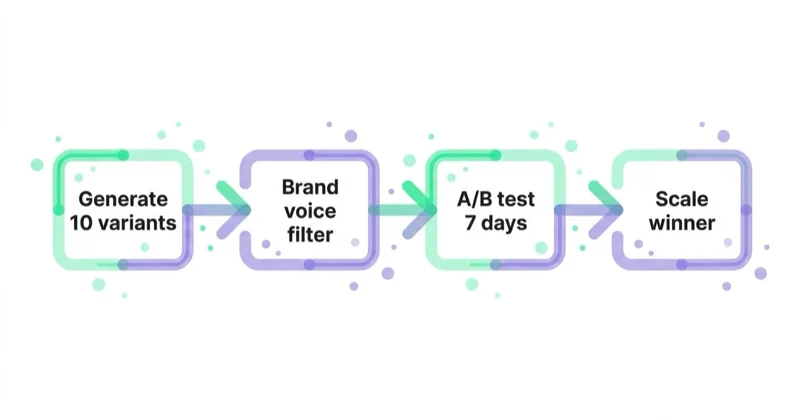
AI gives copywriting two things: volume and speed — a dozen angles in minutes rather than one in an hour. We use it as an engine for drafts, though, never as the decision-maker. A prompt library keeps the copy in the brand's voice and on a specific message, instead of sounding like everything else a model produces. Every variant passes a human: we check the promises, the compliance (especially in regulated categories), and whether the ad claims something the product can't deliver. Only then do variants go to test, where the data picks the winner, not anyone's taste. AI multiplies how much we can try; it doesn't decide what works. The gain comes from pairing the model's speed with human judgement on the message, not swapping one for the other.
Common mistakes
Asking for copy before providing evidence
The model cannot know what is true about the product unless the prompt includes source material. Without evidence, it will default to generic marketing language.
Confusing volume with strategy
Generating 100 headlines is easy. Selecting 12 that test distinct hypotheses is the actual work.
Ignoring character limits
AI often violates character limits unless the prompt asks for counts. Always require tables with character counts for Google Search and tight paid social placements.
Letting AI invent proof
Claims about rankings, savings, ROI, customer counts or time saved must come from verified material. If the proof does not exist, the copy should not imply it.
Using the same voice everywhere
Google Search, Meta, TikTok and email have different jobs. Search copy should answer intent quickly. TikTok hooks should feel native to video. Email should protect trust with the list.
FAQ
Can AI write high-converting ad copy?
AI can write useful draft copy, but it does not know what will convert until the copy is tested. The strongest results come from prompts based on real customer insight, clear constraints and campaign feedback.
Is ChatGPT better than Claude or Gemini for ad copywriting?
There is no universal winner. ChatGPT is often strong for structured generation and iteration, Claude can be useful for longer briefs and tone control, and Gemini can be useful inside Google-oriented workflows. The better question is which tool produces usable variants from the available source material.
Should AI-generated ad copy be disclosed?
Usually ad copy itself does not need a label just because AI helped draft it, but platform rules, industry regulation and local law still apply. Synthetic people, manipulated media and regulated claims may require additional disclosure or review.
How many AI-generated variants should be tested?
Test enough variants to cover distinct hypotheses, not every output the model produces. For many accounts, 5 to 12 strong variants per concept group is more useful than 50 minor rewrites.
Can AI replace a copywriter?
AI can replace some drafting work, but it does not replace positioning, research, brand judgement, compliance review or performance interpretation. In paid media, those parts decide whether the copy is worth testing.
Key Takeaways
- AI ad copywriting should start with source material and customer insight.
- The best prompts define audience, proof, channel, constraints and evaluation criteria.
- Google Search, Meta, TikTok and email need different prompt structures.
- AI copy should be reviewed for claims, brand fit, platform policy and landing page match.
- The prompt library should evolve with campaign results, not remain a static document.
Conclusion
AI copywriting becomes valuable when it is connected to a performance workflow. The model can produce variants quickly, but the advantage comes from better briefs, sharper angle selection and cleaner testing.
For paid media teams, the practical approach is simple: collect evidence, build a message map, generate channel-specific drafts, review manually, test with discipline and feed results back into the prompt library. That turns AI from a content shortcut into a creative testing system.
Sources and further reading
- OpenAI: Prompt engineering best practices for ChatGPT
- OpenAI: Best practices for prompt engineering with the OpenAI API
- Anthropic: Prompt engineering overview
- Google Cloud: Best practices with large language models
- Google Ads Help: About responsive search ads
- TikTok Ads: Creative best practices for performance ads
Continue Learning
Continue reading
How to Choose a TikTok Ads Agency (and When You Actually Need One)
Choose a TikTok Ads agency by examining creative research and production, creator rights, Spark Ads, measurement, Business Center access and commercial judgment—and decide whether an agency is the right model.
Black Friday 2026 for E-Commerce: Timeline, Budgets and Campaign Structure
A practical Black Friday 2026 planning guide for e-commerce teams: September-to-November timeline, Google, Meta, TikTok and retail media structure, budget rules and tracking checklist.
ChatGPT Ad Formats and Character Limits: What Actually Fits
A ChatGPT ad appears below the response and carries six elements, with specific limits: title 3–50 characters, body up to 100. The "24 / 48 character" figures in trade coverage do not match the documentation, so this guide gives the full limits table, shows how to fit a useful message, and covers the image, product ads and end-to-end consistency with the landing page.