
Agentic AI in marketing means using AI systems that can take a goal, inspect data, choose tools, perform steps and return a useful output with less manual prompting. It is different from asking a chatbot for advice. A marketing agent can read campaign data, compare it with business rules, draft a recommendation, create a task, prepare a report, or in controlled cases call an API.
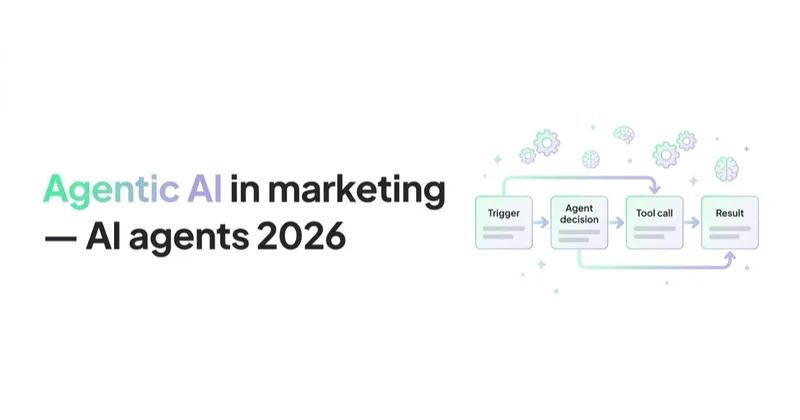
That does not mean giving an AI system unlimited access to ad accounts. In 2026, the practical value of agentic AI is not "set and forget" media buying. The value is removing repetitive analysis, QA and preparation work so strategists can spend more time on decisions that actually need judgement.
For agencies and in-house teams, the best use cases are narrow, auditable and connected to existing workflows: weekly reporting, search query analysis, creative iteration, tracking QA, anomaly alerts, budget pacing and first-draft recommendations.
TL;DR
- Agentic AI is a workflow layer where an AI model can use tools, data and instructions to complete multi-step marketing tasks.
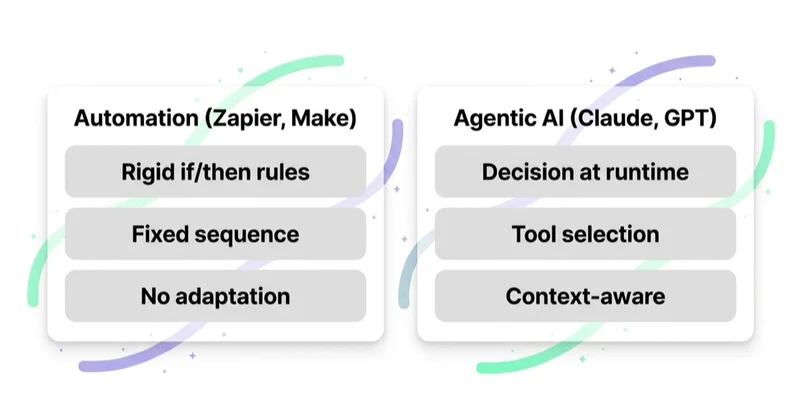
- It differs from classic automation because the agent can interpret context and choose a route, while automation usually follows fixed rules.
- The safest marketing agents start as read-only assistants that analyse data and create recommendations.
- Google Ads API, GA4 exports, CRM data, Looker Studio, spreadsheets, Slack, n8n, Make, Zapier and MCP-style tool connections can become part of the agent workflow.
- Human approval should stay in place for budget changes, campaign edits, exclusions, sensitive copy, tracking changes and client-facing conclusions.
- The best first use case is not "run the account". It is "find issues, explain them and prepare the next action".
- Agentic workflows need permission design, logging, rollback plans and clear ownership.
- AI agents can support MMM, incrementality and creative production, but they should not replace measurement strategy.
- ROI should be measured in saved hours, faster detection, fewer reporting errors and better test velocity.
- The main risk is not that the agent is too weak. The main risk is giving a poorly scoped agent too much authority.
What is agentic AI in marketing?
Agentic AI is a system that combines a model with instructions, memory or context, tools and a loop for completing tasks. In a marketing environment, that toolset may include analytics data, ad platform reports, product feeds, CRM records, spreadsheets, task management systems and APIs.
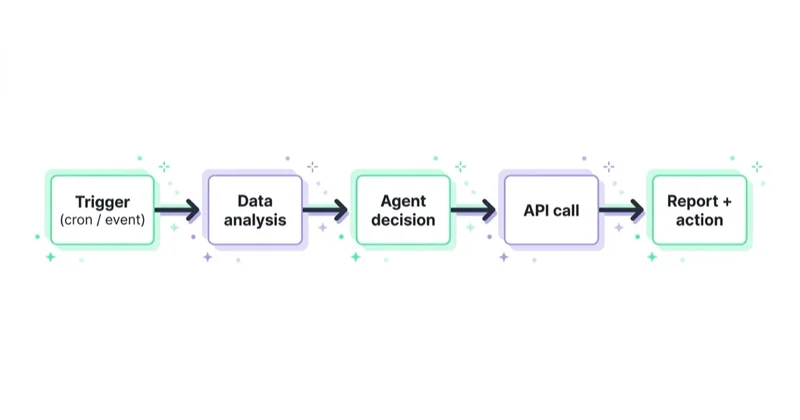
A simple chatbot responds to a prompt. A marketing agent can work through steps:
- Pull yesterday's spend and revenue by channel.
- Compare it with budget pacing rules.
- Detect campaigns outside tolerance.
- Check whether the deviation is caused by tracking, spend, conversion rate or average order value.
- Draft an explanation.
- Create a task for the account manager.
- Ask for approval before any account change.
That is the useful version. The dangerous version is an agent with unclear instructions, broad permissions and no audit trail.
Agentic AI vs classic automation
Classic marketing automation is rule-based. If a condition is true, the system performs an action. For example: if daily spend is above a threshold, send a Slack alert. This is still useful and should not be replaced where rules are stable.
Agentic AI is more flexible. It can inspect context, decide which data is needed, summarise messy information and produce a recommendation. It is better for tasks where the path is not always identical.
| Workflow type | Best for | Example |
|---|---|---|
| Rule automation | Stable, repeatable conditions | Alert when spend exceeds daily budget by 20% |
| AI assistant | Drafting and analysis with manual prompting | Summarise campaign performance from exported data |
| AI agent | Multi-step tasks with tools and constraints | Pull data, diagnose issue, draft action plan and create a task |
| Autonomous execution | High-trust, low-risk, reversible actions | Usually limited to narrow internal processes |
In paid media, most teams should move from assistant to agent gradually. Start read-only, then add draft actions, then add approved execution for low-risk tasks.
Where AI agents fit in an agency workflow
The most practical agency workflows are not glamorous. They are the recurring tasks that happen every week and often decide account quality.
1. Weekly performance analysis
An agent can pull exports from Google Ads, Meta Ads, GA4 and a CRM, then produce a structured report:
- what changed week over week;
- which campaigns caused the change;
- whether the change came from spend, conversion rate, CPC, CPA, ROAS or revenue quality;
- which anomalies need human review;
- what action is recommended next.
This does not replace a strategist. It replaces the first hour of spreadsheet preparation and lets the strategist review a cleaner starting point.
If reports depend on campaign URLs, keep tracking consistent with UTM parameters. If data quality is uncertain, start with a Google Analytics audit before building agents around broken data.
2. Search query mining and negative keyword drafts
For Google Ads accounts, an agent can inspect search terms, group irrelevant patterns and prepare negative keyword recommendations. The safe version is:
- read search term data;
- classify terms by intent;
- flag low-intent or irrelevant clusters;
- estimate spend affected;
- draft negatives;
- ask for human approval.
Execution can later be connected through the Google Ads API, but that should not be the first step. Automated query exclusion can damage performance if the agent misunderstands a niche term, competitor query or assisted conversion path.
This workflow becomes more important as Google AI Max for Search expands matching and text customisation. Automation creates more reach. Agents can help keep the review loop fast enough.
3. Creative production and refresh planning
AI agents can connect creative analysis with production. A practical workflow can:
- read ad-level performance data;
- group creatives by angle, format and hook;
- identify fatigue patterns;
- compare winning copy with current landing page sections;
- create a new brief for the next batch of assets;
- generate first-draft copy using the current prompt library.
The agent should not decide creative strategy alone. It should prepare the evidence. The strategist still decides whether the next test should focus on proof, objection handling, offer, product demo, comparison or UGC.
For related workflows, see AI ad copywriting, AI UGC ads and AI video generators for ads.
4. Tracking QA and measurement alerts
Marketing agents are useful for monitoring measurement quality because tracking issues often appear as patterns:
- conversions drop to zero in one platform but continue in another;
- consent mode signals change after a website release;
- UTMs disappear from a campaign;
- server-side events are duplicated;
- Meta CAPI event match quality drops;
- GA4 revenue differs from backend sales beyond a threshold.
An agent can inspect logs, exports and dashboards, then create an alert with likely causes. It should not silently change tracking containers. Tagging changes should remain controlled because one wrong edit can affect all channels.
For infrastructure, connect this with server-side tagging, Consent Mode v2 and enhanced conversions.
5. Incrementality and MMM preparation
AI agents can help prepare data for advanced measurement. They can check whether spend, revenue, promotions, holidays and channel data are complete before a modelling project starts. They can also flag gaps that would weaken the analysis.
This does not mean an agent should "do MMM" without supervision. Measurement design still requires statistical and business judgement. But agents can reduce the operational pain of collecting and cleaning inputs.
For strategic measurement, see incrementality testing and geo experiments and marketing mix modeling.
Example architecture for a marketing agent
A useful agency agent usually has six layers.
| Layer | Purpose | Examples |
|---|---|---|
| Data sources | Provide facts | GA4, Google Ads, Meta exports, CRM, product feed, backend revenue |
| Orchestration | Controls workflow | n8n, Make, Zapier Agents, custom code |
| Model | Interprets and drafts | OpenAI, Claude, Gemini or approved enterprise model |
| Tools | Allow action or retrieval | API calls, database queries, MCP servers, file search |
| Approval | Keeps control | Human review, Slack approval, ticket workflow |
| Logging | Creates accountability | Run logs, prompts, tool calls, outputs, decision history |
This architecture matters because agentic AI is not just a model choice. The real work is tool design, data access, review flow and accountability.
Tools: Claude, n8n, Zapier, Make, MCP and APIs
Several tool categories matter in 2026.
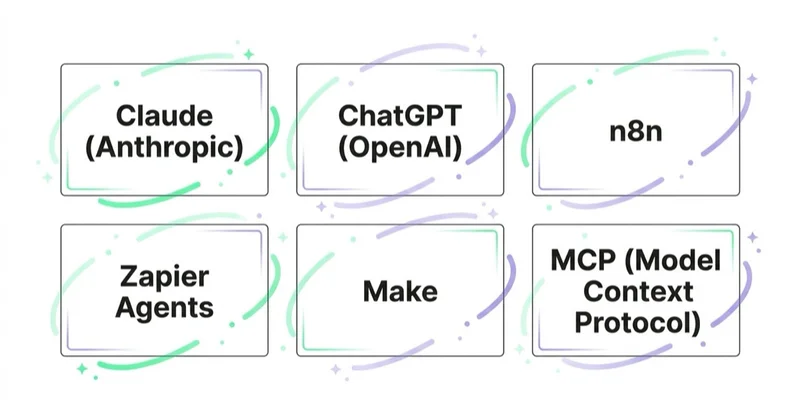
OpenAI's agent tooling and Responses API can support systems that use tools such as file search, web search, function calling and remote MCP connections. Anthropic documents computer use and tool use patterns for Claude. n8n, Make and Zapier provide workflow orchestration for teams that need to connect many apps without building everything from scratch.
MCP-style connections are especially important because they expose tools and resources to AI systems in a more standardised way. That also creates a governance requirement. Tool access should be scoped. Credentials should be limited. Production accounts should not be exposed with broad edit rights unless the workflow has been tested, logged and approved.
The practical rule: if an intern should not have permission to perform the action unsupervised, an AI agent should not have that permission either.
How to build the first marketing agent
Start with a narrow workflow that is frequent, valuable and low risk.
1. Choose the workflow
Good first candidates:
- weekly performance summary;
- budget pacing alert;
- search query review draft;
- creative fatigue detection;
- UTM QA;
- tracking anomaly summary;
- product feed error triage;
- client meeting preparation.
Avoid starting with automatic budget changes, campaign pausing or broad account edits.
2. Define the output
The agent should produce a predictable artifact: a Slack alert, report section, spreadsheet tab, task, recommendation table or client-ready draft. If the output is vague, the workflow will be hard to evaluate.
3. Define permissions
Use read-only access first. Then allow draft actions. Only later consider approved execution. Permissions should be specific to the task, not broad access to the whole marketing stack.
4. Add review gates
Human approval should be required for:
- budget and bid changes;
- negative keyword uploads;
- campaign pauses;
- tracking container edits;
- client-facing claims;
- legal or regulated copy;
- audience exclusions;
- feed changes that affect many SKUs.
5. Log every run
Store input data, prompt version, tool calls, outputs, approvals and final actions. Without logging, it is impossible to debug a bad recommendation or prove what happened.
6. Measure ROI
Track:
- hours saved;
- errors caught;
- issue detection time;
- number of useful recommendations;
- action acceptance rate;
- campaign review frequency;
- speed from insight to test.
If the agent saves time but creates noisy recommendations, the prompt or workflow needs tightening.
Governance checklist
Before using agentic AI in a real marketing operation, answer these questions:
- What exact task does the agent perform?
- Which data can it access?
- Which actions can it take?
- Which actions require approval?
- Who owns the workflow?
- Where are logs stored?
- How are prompt versions tracked?
- What happens if the agent produces a wrong recommendation?
- Can changes be rolled back?
- Are client, customer and platform policy constraints respected?
- Does the workflow use only the data it actually needs?
The governance layer is not bureaucracy. It is what makes agentic AI usable in client work.
How we approach this at Space Ads
This isn't theory for us: we built our own system that connects to Google Ads, Meta and GA4 and runs the analysis through AI agents. The agents carry the repetitive, high-volume work — pulling data daily, running audits, catching anomalies across many accounts at once — so our people spend their time on strategy and decisions rather than shuffling reports. The hard part was never the AI; it's the guardrails. Every real change to an account passes through human review and approval, and the agent works inside strict safety limits. Agentic AI buys us scale and vigilance, since the system sees more and faster than anyone reviewing accounts by hand, but the final call stays with us. We automate the watching, not the responsibility.
When not to use agentic AI
Do not use an agent when the data is unreliable, the business rules are undefined, the action is high risk, the team cannot review the output, or the workflow requires legal judgement. Also avoid agents for tasks where a simple automation rule is enough.
Agentic AI should be introduced where interpretation adds value. If the task is stable and deterministic, classic automation is cheaper, faster and easier to audit.
FAQ
What is agentic AI in marketing?
Agentic AI in marketing is the use of AI systems that can complete multi-step marketing tasks with tools, data and instructions. Examples include campaign analysis, reporting, creative briefing, search query review and tracking QA.
Is agentic AI the same as marketing automation?
No. Marketing automation usually follows fixed rules. Agentic AI can interpret context, choose tools and create recommendations. The two should work together: automation handles stable rules, while agents handle messy analysis and preparation.
Can AI agents manage Google Ads automatically?
Technically, agents can be connected to APIs, but fully automatic account management is risky. A safer path is read-only analysis first, draft recommendations second and human-approved execution only for narrow, reversible tasks.
Which tools are useful for marketing agents?
Common options include OpenAI agent tooling, Claude, n8n, Make, Zapier Agents, MCP servers, Google Ads API, GA4 exports, CRM data, spreadsheets and task management systems. The best stack depends on data access, security and team workflow.
What is the best first AI agent for an agency?
A weekly performance analysis agent is often the best first project. It is frequent, valuable, measurable and relatively low risk when it only reads data and drafts recommendations.
What are the main risks?
The main risks are bad data, excessive permissions, prompt injection, unsupported conclusions, lack of logging, compliance issues and silent account changes. These are workflow design problems, not only model problems.
Key Takeaways
- Agentic AI is most useful when it supports specific marketing workflows, not vague automation ambitions.
- The safest starting point is read-only analysis with human approval.
- Agencies can use agents for reporting, query review, creative workflows, tracking QA and measurement preparation.
- API access and MCP-style tools increase power, but they also increase governance requirements.
- A strong agent workflow needs data quality, clear permissions, logs and ownership.
Conclusion
Agentic AI will not remove the need for marketing strategy. It will change the operating system around it. Teams that use agents well will review accounts faster, catch issues sooner, create better creative briefs and spend less time preparing repetitive reports.
The practical path is incremental: choose one recurring workflow, give the agent limited access, log every run, keep approval in place and measure whether the output improves decisions. That is how agentic AI becomes operational leverage rather than another experimental tool.
Sources and further reading
- OpenAI Agents SDK documentation
- OpenAI: Using tools in the Responses API
- OpenAI: A practical guide to building agents
- Anthropic: Computer use tool
- n8n Docs: Set up and use n8n MCP server
- Zapier Help: Build an agent in Zapier Agents
- Make: AI Agents
- Google Ads API: Mutating resources
Continue Learning
Continue reading
SMS & RCS Marketing: Revenue From a List You Already Own
SMS and RCS are permissioned direct channels with provider costs and platform dependencies. This guide explains consent, suppression, measurement, RCS capabilities and safe fallback design.
ChatGPT Ad Formats and Character Limits: What Actually Fits
A ChatGPT ad appears below the response and carries six elements, with specific limits: title 3–50 characters, body up to 100. The "24 / 48 character" figures in trade coverage do not match the documentation, so this guide gives the full limits table, shows how to fit a useful message, and covers the image, product ads and end-to-end consistency with the landing page.
OpenAI Ads Manager: How to Set Up Your First ChatGPT Ads Campaign
OpenAI Ads Manager has three campaign levels, but launch also requires advertiser verification, billing, landing-page checks, measurement and deliberate choices for settings that cannot be changed later. This guide covers the setup sequence, budgets, context hints, oCPC, targeting, review and Ads API workflows.


































