Commercial cleaning marketing is the process of winning and retaining suitable cleaning contracts—not collecting inexpensive forms. It differs from residential cleaning and one-off local jobs because a business buyer may need a site survey, scope of work, proof of insurance, safety documentation, procurement approval and a credible mobilisation plan before signing.
That distinction should shape the entire account. A facility manager looking for nightly office cleaning, a property manager looking after a portfolio, a medical office evaluating compliance-sensitive cleaning and a warehouse manager needing industrial floor care are not the same buyer. They have different contract values, risk concerns, sales cycles and qualification criteria.
A sound acquisition system can use Google Search to capture active demand, LinkedIn to reach a defined buying group and retargeting to remain visible during evaluation. Those channels are optional; clean CRM definitions, sales follow-up and contract economics are not. Media should learn from qualified opportunities, completed walkthroughs, proposals, won contracts and early retention—not from every form containing the word “cleaning.”
TL;DR
- Measure the commercial result, not just pipeline. A signed contract still needs to mobilise successfully, retain and produce contribution after labour, supervision, supplies and travel.
- Several people may shape the decision. Facility, office, operations, property, procurement, finance and security teams can care about different risks.
- Google Search and LinkedIn play different roles. Search can capture active vendor demand; LinkedIn can reach a defined buying group before or during a review cycle.
- Residential intent must be filtered aggressively. House cleaning, maid service, one-off domestic jobs, cleaning supplies and job-seeker queries can drain a B2B budget.
- Lead forms should qualify contract value. Facility type, square footage, number of sites, cleaning frequency, current vendor status and timeline matter more than lead volume.
- Deeper outcome feedback is essential. Google and LinkedIn can receive qualified-lead data, but only lawful, accurate and sufficiently frequent signals should be used for optimisation.
Why Commercial Cleaning Marketing Is Different
Commercial cleaning is a local or regional B2B service with recurring-revenue economics. It sits closer to B2B lead generation than to a simple consumer booking because scope, risk, mobilisation and contract terms matter alongside price.
The important differences:
| Commercial cleaning trait | Marketing implication |
|---|---|
| Recurring monthly contracts | Contribution and retention matter more than first lead cost |
| Professional buyer | Messaging should speak to risk, reliability, compliance and vendor management |
| Facility-specific scope | Office, healthcare, school, warehouse and retail accounts require different proof and may face different rules |
| Longer sales cycle | Walkthrough, proposal, negotiation and renewal must be tracked in CRM |
| Local delivery | Service area, staffing density and route economics affect profitability |
| High switching friction | Buyers need evidence that transition, staffing and issue resolution are controlled |
A janitorial lead can look expensive beside a residential inquiry, but lead cost is the wrong comparison. Estimate contract contribution after direct labour, payroll burden, supplies, equipment, supervision, travel, quality rework and sales cost. Then apply a conservative retention curve and probability of winning. Do not value every new inquiry as if the account will remain for years.
Two contracts with the same monthly revenue can have very different economics. A dense route with stable access and a standard scope may be attractive; a distant site with difficult keys, bespoke reporting, frequent complaints and high staff turnover may not be. Marketing needs these distinctions before it can decide what a “good lead” is.
Define The Ideal Contract Before Buying Traffic
The media plan should start with the commercial cleaning company's ideal customer profile. Without that, platforms will optimize toward whatever converts most easily, and that often means small, low-value, one-off or residential-style inquiries.
Useful ICP questions:
- Which facility types are most profitable: offices, medical practices, schools, gyms, warehouses, retail, multifamily, industrial, hospitality, banks or public buildings?
- What is the minimum square footage or monthly contract value worth pursuing?
- Which locations can be served profitably with current staffing and route density?
- Is the company strongest at nightly janitorial, day porter service, floor care, post-construction cleaning, disinfection, window cleaning or specialty work?
- Does the sales team want RFPs, direct quote requests, multi-site accounts or smaller local contracts?
- How long does the typical contract last, and what is the churn risk by facility type?
- What makes the company credible: insurance, bonding, background checks, training, supervision, quality audits, industry experience or references?
- Which requirements can the company genuinely meet: access control, background screening, union or prevailing-wage terms, chemical documentation, infection-control protocols or procurement onboarding?
- What are the mobilisation cost, cancellation terms, payment period and minimum gross contribution?
This thinking should appear in the campaign structure. A company seeking healthcare contracts should not run the same funnel as one focused on warehouse floor care. “Medical-grade,” “hospital-grade,” “disinfects” and pathogen claims are not decorative copy. In the US, for example, disinfectants must be EPA-registered for the intended claim and used according to the product label; healthcare facilities also have setting-specific infection-control procedures. Similar jurisdiction-specific rules apply elsewhere. Advertise only capabilities that the operating team, products, training and contract can support.
Channel Mix For Commercial Cleaning
Most commercial cleaning companies need several channels working together, but each should have a clear job.
| Channel | Best role | Main risk | Better KPI |
|---|---|---|---|
| Google Search | Capture active vendor searches | residential, DIY, employment and wrong-area waste | qualified opportunity and walkthrough rate |
| Google Business Profile | Local trust and branded validation | incomplete profile or weak reviews | calls, profile-assisted inquiries, review quality |
| LinkedIn Ads | Reach a defined buying group or named accounts | low volume, high cost and weak intent | qualified account engagement and opportunities |
| Retargeting | Stay visible during comparison and RFP cycles | generic reminders without next step | return visits, booked walkthroughs, proposal requests |
| SEO | Build durable local and facility-type demand | thin city pages and generic service copy | organic qualified inquiries |
| Email / ABM | Develop named accounts and property portfolios | unlawful outreach, poor data or weak follow-up | meetings, reactivation, RFP invitations |
Do not force every channel into one cost-per-lead benchmark. Search may produce fewer but more urgent vendor evaluations. LinkedIn may introduce the company before an active search, while local and organic results may validate it later. Attribution reports can show touches, but do not prove that a channel caused the contract. Compare mature cohorts, use target-account or geographic tests where feasible and disclose the limitation where they are not.
Google Search: Capture Active Commercial Intent
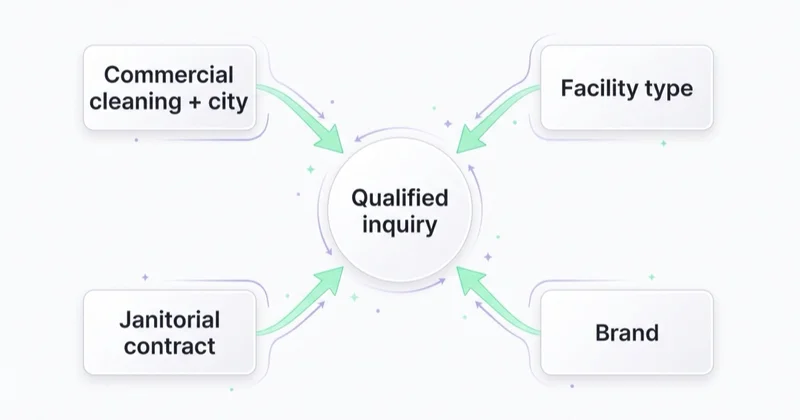
Google Search can provide high-intent demand because it reaches people already looking for a provider. It is not automatically profitable: broad cleaning language, job seekers, consumer searches and areas the business cannot staff can absorb the budget. Structure campaigns around commercial intent, facility type, service and genuinely serviceable geography.
| Search intent | Example queries | Landing page requirement |
|---|---|---|
| Commercial cleaning | commercial cleaning services, commercial cleaning company near me | B2B proof, service area, quote or walkthrough CTA |
| Office cleaning | office cleaning services, nightly office cleaning | office-specific scope, schedule, references |
| Janitorial contracts | janitorial services, janitorial company, contract cleaning | recurring service framing, supervision, quality control |
| Facility type | medical office cleaning, school cleaning, warehouse cleaning | relevant scope, procedures, proof and limitations |
| Specialty services | floor stripping and waxing, post-construction cleaning | equipment, process, before/after proof |
| Property management | cleaning for property managers, multi-site janitorial | account management, reporting, multi-location capability |
| Brand | company name, reviews, phone number | direct quote path and reputation proof |
The landing page should match the query. A medical office search should not land on a generic “we clean everything” page or unsupported infection-prevention claims. A warehouse page should explain equipment, floor care, safety, shift timing and how disruption is controlled. A broader page should help the buyer self-select by facility type and service frequency.
Negative keywords are a major lever. Commercial cleaning accounts often need exclusions for:
- house cleaning, maid service, domestic cleaning and apartment cleaning;
- jobs, careers, salary, hiring, training and franchise opportunities;
- cleaning supplies, equipment, chemicals and wholesale products;
- DIY, how to clean, templates and checklists;
- one-off small jobs if the company only wants contracts;
- unsupported towns, counties or service areas;
- unrelated industries such as carpet cleaner rental or car cleaning.
The negative keyword workflow should be reviewed frequently while the account is learning. Also inspect location reports, call outcomes and form addresses: a city name in a query does not prove that the site is within a profitable route. Do not add a competitor's brand casually as a keyword theme; assess trademark rules, intent, economics and the risk of low-quality comparison traffic first.
LinkedIn Ads: Reach The Buying Committee
LinkedIn can be useful when the buying group, account list and offer are specific. It is less about immediate “janitorial near me” intent and more about reaching people who may influence an upcoming vendor review. Job titles are imperfect and not every targeted member has purchasing authority, so validate audience quality through actual accounts and opportunities.
Relevant audiences often include:
- facility managers;
- office managers and workplace managers;
- operations leaders;
- property managers;
- building managers;
- procurement and vendor management roles;
- healthcare administrators;
- school or campus operations teams;
- real estate and multi-site portfolio managers.
LinkedIn is useful for:
- promoting a facility-specific case study;
- offering a cleaning vendor checklist or RFP readiness guide;
- retargeting visitors who viewed commercial cleaning services;
- reaching named property portfolios or target account lists;
- educating buyers on reliability, staffing, security and quality control;
- staying visible before renewal or vendor-switching windows.
Because the reachable audience may be small and expensive, the offer and follow-up need to justify the test. A form can identify facility type, approximate size, number of sites, service frequency, current arrangement and timeline, but not every field must be asked upfront.
LinkedIn's current qualified-leads optimisation can use data from Conversions API or CRM Sync. The platform recommends one qualified-lead source to prevent double counting and at least five qualified leads every one to two weeks to support learning. Treat those as platform operating recommendations, not proof of business incrementality. If the account cannot generate enough consistent qualified events, optimise higher in the funnel and judge deeper results manually rather than manufacture a loose definition of “qualified.”
What The Landing Page Should Prove
A commercial cleaning landing page should reduce perceived vendor risk. The buyer is not just asking "what is the price?" They are asking whether the cleaning company will show up reliably, protect the building, communicate problems, pass security requirements and handle complaints without creating more work.
Useful page sections:
| Page element | Why it matters |
|---|---|
| Facility types served | Shows fit and prevents wrong-fit leads |
| Service frequency | Clarifies nightly, weekly, day porter or specialty scope |
| Current insurance, bonding and screening where applicable | Lets buyers verify relevant risk controls |
| Staff training and supervision | Addresses quality consistency |
| Quality control process | Shows how issues are inspected and corrected |
| References or case studies | Builds trust for a vendor switch |
| Industry-specific proof | Shows comparable experience without claiming unsupported certification |
| Walkthrough process | Explains how pricing and scope are created |
| Fast quote path | Gives a clear next step without oversimplifying the sale |
The CTA may be “schedule a walkthrough,” “request a scope review” or “talk to an account manager.” Do not promise an accurate fixed quote before collecting enough information. For larger contracts, provide a secure route for RFP documents and specify the information required to respond. Publish genuine references or case studies with permission; do not expose client security arrangements, access procedures or sensitive facility details.
The page should also explain how transition works. Buyers want to know who owns mobilisation, how keys and access credentials are handled, when staff are introduced, how the first inspections are recorded and how service failures are escalated. Specific process is more persuasive than unsupported phrases such as “highest quality guaranteed.”
Qualification: Separate Revenue From Noise
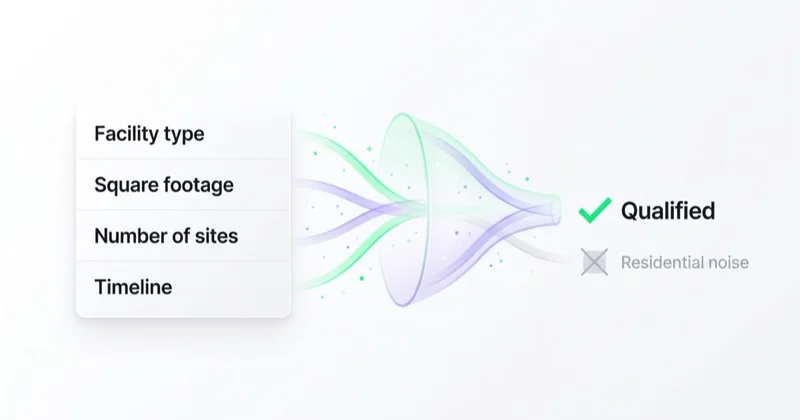
Qualification should be built into the form, the call script and the CRM. Without it, the sales team may waste time on small, residential or wrong-location inquiries while the ad platforms keep optimizing toward them.
The minimum lead qualification model:
| Qualification signal | Why it matters |
|---|---|
| Facility type | Indicates scope, compliance and proof requirements |
| Square footage or approximate size | Predicts contract value and staffing |
| Number of sites | Identifies multi-location potential |
| Site postcode or area | Confirms routing and staffing feasibility |
| Cleaning frequency | Separates recurring contracts from one-off jobs |
| Current vendor status | Shows whether this is a switch, new site or RFP |
| Timeline | Active need, renewal window or early research |
| Decision context | Decision-maker, evaluator, tenant, broker or early researcher |
Not every field belongs in the first step. Collect only what is necessary, explain how the information will be used and qualify promptly by phone or email. Procurement documents, floor plans, access details and employee or patient information require appropriate security and should not be collected through a casual ad form. The CRM stage should reflect an agreed commercial definition, not merely contact capture.
Before sending a proposal, confirm the scope of work: areas, frequencies, task standards, exclusions, consumables, periodic work, access hours, holiday coverage, response obligations, reporting, acceptance process and change-control terms. A vague scope creates underpricing and disputes that no acquisition metric will reveal.
Measurement: From Inquiry To Won Contract
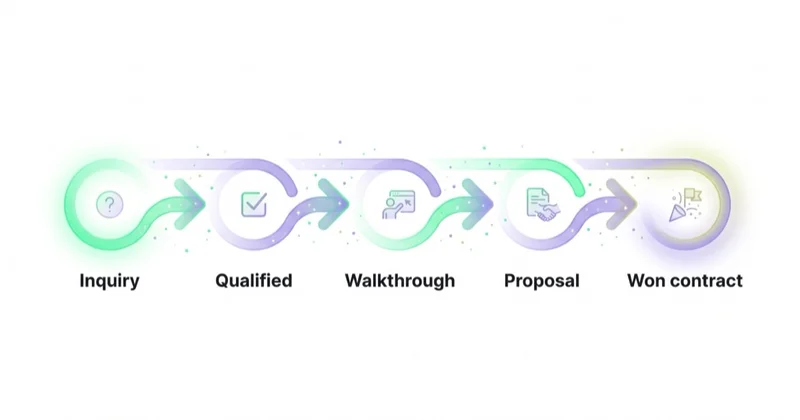
Commercial cleaning has a long enough cycle that ad-platform reporting will be misleading if it stops at the first form. A stronger measurement ladder looks like this:
- Ad click or LinkedIn engagement.
- Website visit or lead form.
- Inquiry or phone call.
- Qualified lead.
- Walkthrough scheduled.
- Walkthrough completed.
- Proposal sent.
- Proposal accepted.
- Contract signed.
- Contract mobilisation completed.
- Monthly revenue, gross contribution, incidents and early retention.
Google Ads qualified-lead and converted-lead goals are designed for paths that close later over the phone or in a CRM. Google's current documentation says that, from 15 June 2026, offline conversion and enhanced-conversion-for-leads uploads move to the Data Manager API and are blocked in the Google Ads API except for limited legacy access. Audit an existing integration rather than assuming uploads still arrive.
LinkedIn supports Insight Tag, Conversions API, CRM Sync and imported routes depending on the event. Use one qualified-lead source for optimisation to avoid duplication. For both platforms, send only data the business is permitted to share, minimise fields and document retention and consent requirements. Hashing identifiers does not make privacy obligations disappear.
For bidding, not every stage should carry the same weight. A simple model:
| Event | Use |
|---|---|
| Inquiry | secondary conversion or early diagnostic |
| Qualified lead | primary once volume is sufficient |
| Walkthrough scheduled | strong primary signal |
| Proposal sent | deep-funnel signal |
| Won contract | deep signal where volume and delay permit |
| Mobilised, retained contract | commercial quality check, usually for reporting |
| Expected contribution | value input only when calibrated and reliable |
Choose the deepest event that is frequent and timely enough for the platform to learn from. A won-contract event that occurs twice per quarter cannot guide daily bidding. In that case, optimise to a strict qualified lead or completed walkthrough and use contract results for budget decisions.
If the CRM is not ready, start with a controlled manual review. Record outcomes, source, contract type, loss reason and value definitions consistently. Do not place customer lists or sensitive facility information in informal spreadsheets or upload files without access controls. Automation can follow, but disciplined stage ownership should begin immediately.
Expected lifetime value needs a cohort model. Use gross contribution, observed retention and the probability that a new contract survives mobilisation and early months. Keep forecast value separate from realised contribution, and revise the model when wage, supply, route or churn economics change.
Google Business Profile And Local Proof
Commercial cleaning is B2B, but it is still local. A facility manager may discover a vendor through Search, then validate it through Google Business Profile, reviews, photos and local reputation. The profile should support the paid funnel.
Important profile details:
- accurate real-world name, category and service area;
- business hours and phone routing;
- photos of teams, equipment, vehicles and real work;
- services listed by facility and specialty;
- review responses that show professionalism;
- posts or updates for specialty services;
- a website and phone number that reach the actual business.
Google describes local results in terms of relevance, distance and prominence, but adding more service areas does not make a company rank everywhere. A cleaning business that travels to customers and does not receive them at its address should use an eligible service-area profile and hide the address. It should not create profiles for virtual offices or unstaffed locations. Google's current guidance generally allows one profile for the service area, with separate profiles only for genuine locations with separate staff and service areas.
Ask real customers for honest reviews without incentives or selective gating. Respond professionally and avoid revealing client names, access arrangements, disputes or other confidential details unless disclosure is authorised.
Sales Follow-Up Is Part Of Media Performance
In B2B cleaning, response quality changes media economics. The best campaign can still fail if leads wait two days for a reply, the first call does not qualify facility size, or walkthrough notes never make it back to the CRM.
The follow-up process should define:
- who owns new inquiries;
- a realistic response standard during staffed hours;
- how the team handles after-hours RFP or quote requests;
- the required qualification questions;
- when a walkthrough is offered;
- how proposals are created and followed up;
- lost-reason categories;
- renewal or reactivation reminders;
- CRM fields that go back to marketing.
Common lost reasons are useful marketing data: too small, residential, outside service area, one-time job, no authority, no timeline, incumbent renewed, requirements not met, price, capacity or no response after walkthrough. Use neutral categories rather than labelling every price-sensitive buyer as “low quality.” Loss data should shape targeting, copy, capacity planning and the offer.
Won deals need feedback too. Compare the promised scope with labour hours, inspection results, complaints, rework and margin after 30, 90 and 180 days. If a campaign repeatedly wins contracts that operations cannot deliver profitably, it is not a successful campaign.
Space Ads Operating Approach
We structure commercial cleaning acquisition as a contract system. Before adding keywords or audiences, the model needs contract economics, target facilities, serviceable geography, route density, mobilisation capacity, sales stages and operational feedback.
The practical sequence is:
- Define the ideal contract and minimum viable account size.
- Separate commercial, facility-type, specialty and brand search intent.
- Build landing pages that speak to facility managers, not consumers.
- Use LinkedIn only where the buyer profile and offer are specific enough.
- Add qualification fields and sales-stage definitions.
- Pass qualified lead, walkthrough, proposal and won-contract data back into reporting.
- Reallocate budget using qualified volume, win rate, realised contribution and early retention—not lead volume alone.
When an existing account has spend but no clarity on pipeline quality, a marketing audit is usually the right starting point. Ongoing acquisition can sit under performance marketing, with Google Ads, LinkedIn, landing page and CRM feedback treated as one system rather than disconnected tactics.
A practical first-month audit and setup
- Map economics and constraints. Define target facilities, minimum contribution, serviceable routes, staffing capacity, mobilisation cost and unacceptable requirements.
- Audit historical cohorts. Classify inquiries through won, mobilised, retained and lost; calculate realised contribution instead of assuming contract lifetime.
- Agree CRM stages. Document the entry rule, owner and timestamp for qualified lead, walkthrough, proposal, win, mobilisation and churn.
- Repair tracking. Verify calls, forms, consent, deduplication and current Google or LinkedIn data connections before changing bids.
- Restructure active demand. Separate commercial, facility, specialty and brand intent; audit search terms and locations manually.
- Improve decision pages. Add real scope, process, proof, constraints, transition and a secure route to a walkthrough or RFP.
- Test additional reach with a hypothesis. Use LinkedIn or retargeting when the audience, offer, sample and review date are clear.
- Review commercial quality. Compare sources by qualification, walkthrough, win, contribution, mobilisation and early retention.
Thirty days may be enough to repair the system, but rarely enough to judge won-contract economics when the sales cycle is longer. Set the evaluation window from actual cohort maturity.
Common Mistakes
| Mistake | Better approach |
|---|---|
| Optimizing to every form fill | Optimize to qualified leads, walkthroughs and won contracts |
| Mixing residential and commercial cleaning | Separate funnels, keywords, pages and budgets |
| Targeting "cleaning" too broadly | Use facility, service and contract-intent themes |
| Treating LinkedIn like direct Search | Use it for decision-maker reach, proof and retargeting |
| Hiding contract qualification | Ask about facility type, size, frequency and timeline |
| Ignoring sales outcomes | Feed CRM stages back into reporting and bidding |
| Competing only on price | Lead with reliability, supervision, insurance and risk reduction |
| Claiming “medical-grade” service without a defined protocol | align claims, products, training and scope with facility and regulatory requirements |
| Valuing every win at projected lifetime revenue | use realised contribution and retention cohorts |
FAQ
What is commercial cleaning marketing?
Commercial cleaning marketing is the process of generating qualified B2B leads for janitorial and facility-cleaning contracts. It focuses on recurring accounts, facility managers, property managers and procurement teams rather than residential cleaning customers.
What is the best channel for commercial cleaning leads?
There is no universal best channel. Google Search can capture active vendor demand; referrals, procurement networks, local discovery, outbound account development and LinkedIn may contribute in other situations. Compare them by qualified opportunities, won and mobilised contracts, realised contribution and retention—not raw leads.
How should a janitorial company qualify leads?
A janitorial company can qualify by facility type, approximate size, number of sites, service frequency, location, timeline, current arrangement, procurement process and decision context. It should also test staffing, route, scope and compliance feasibility before treating the opportunity as commercially qualified.
Is LinkedIn worth using for commercial cleaning marketing?
LinkedIn can be worth testing when the account list or buying group is clear, the offer is useful and contract economics support the cost. If qualified-event volume is low, use it for measured reach and account development rather than pretending it can optimise reliably to rare wins.
How do commercial cleaning companies avoid residential leads?
They should use negative keywords, dedicated B2B landing pages, commercial-focused ad copy and qualification questions. Terms such as house cleaning, maid service, cleaning jobs, cleaning supplies and DIY cleaning should usually be excluded from B2B campaigns.
What should be measured in a commercial cleaning campaign?
Measurement should include inquiry, qualified lead, walkthrough, proposal, win, mobilisation, early retention and realised contribution. Cost per lead is an early diagnostic. Cost per mobilised, retained contract and acquisition payback are closer to the business decision.
In Short
Commercial cleaning marketing is a contract-acquisition and retention problem. The goal is not a low-cost form; it is a contract with a clear scope, viable route and staffing plan, successful mobilisation and healthy contribution.
Search can capture active demand, LinkedIn can reach a defined buying group, decision pages qualify facility needs and CRM plus operations data show which sources produce contracts worth retaining. The strongest systems connect all of that information without confusing platform attribution or projected lifetime value with realised profit.
Sources and further reading
- Google Ads Help - About offline conversion imports
- Google Ads Help - About qualified leads and converted leads
- LinkedIn Marketing Solutions Help - Qualified leads optimisation goal
- LinkedIn Marketing Solutions Help - Conversions API
- Google Business Profile Help - Improve local ranking on Google
- Google Business Profile Help - Manage service areas
- OSHA - Cleaning industry safety and health
- CDC - When and how to clean and disinfect a facility
- CDC - Environmental infection-control recommendations for healthcare facilities
Continue learning
- Demand generation vs lead generation for B2B
- Franchise marketing: Google, Meta and LinkedIn
- Staffing and recruitment agency marketing
- Negative keywords in Google Ads
- Call tracking for PPC and lead generation
- Google Ads for local businesses, home services and contractors
- Google Ads · Marketing audit · Performance marketing
Continue reading
Staffing Agency Marketing: Clients, Candidates and Placements
Staffing growth requires employer demand and placeable candidate supply in the same role, market and period. Learn how to separate the funnels, connect ATS outcomes and scale on placements and gross profit.
Weight Loss Clinic Marketing: GLP-1 Demand Without Risky Claims
Weight loss clinic marketing in the GLP-1 era has to generate qualified consultations without risky body claims, prescription-drug shortcuts or privacy leakage. This guide covers Meta, Google Search, telehealth funnels, HIPAA-conscious tracking and program LTV.
Wedding Venue Marketing: Tours, Dates and Signed Bookings
Wedding venue marketing should fill the calendar with qualified tours and signed bookings, not just raw inquiries. This guide covers Google Search, Google Business Profile, wedding marketplaces, Instagram, Pinterest, galleries, off-peak dates, CRM follow-up and measuring tour-to-booking value.