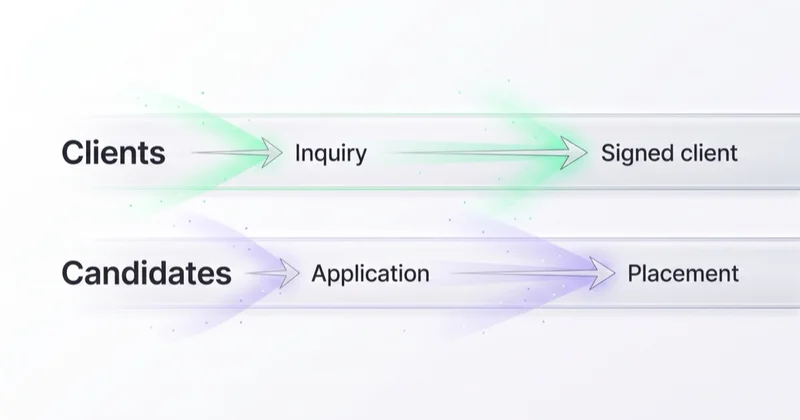
Staffing agency marketing has to create two different kinds of demand at the same time. Employers need confidence that the agency can fill the right roles; candidates need a specific, credible reason to apply and remain engaged. A placement happens only when those two sides match by role, location, timing, terms and quality.

That makes raw lead volume a weak growth measure. One hundred qualified warehouse workers do not solve an unfilled nursing order. Ten employer enquiries do not create revenue if the agency cannot source the skills, shifts or locations requested. The marketing system needs to show which client demand is commercially qualified, which candidates are placeable and where both meet in filled jobs and gross profit.
This guide covers the complete operating model: separate funnels, shared planning, channel roles, compliant employment advertising, landing pages, ATS and CRM feedback, sales and recruiter capacity, and placement-level economics.
TL;DR
- Run employer acquisition and candidate attraction as separate funnels with different audiences, pages, events, permissions and owners.
- Connect them through a demand-and-supply plan by desk, role, location and start date. A global “we need more candidates” target is not actionable.
- Client campaigns should optimise beyond enquiries to qualified opportunities, agreements, job orders, fills and gross profit.
- Candidate campaigns should optimise beyond applications to eligibility, screening, submission, interview, start and retained placement.
- Employment advertising is legally and operationally sensitive. Review copy, targeting, screening, referral practices and data use for each market and platform.
- Specific job and employer propositions improve quality: role, pay where required or appropriate, location, shift, employment type, requirements, process and agency identity.
- Feed CRM and ATS outcomes back to eligible ad platforms, but do not count the same placement twice as independent revenue from both funnels.
- Shift budget according to fillable job demand, candidate scarcity, expected gross profit and recruiter capacity—not last month's cheapest lead.
The two funnels are separate—but the commercial outcome is shared
| Employer funnel | Candidate funnel | Shared outcome |
|---|---|---|
| Relevant company visit | Relevant job or talent-community visit | Matched role, desk and market |
| Employer enquiry | Application or candidate registration | Demand and supply identified |
| Qualified hiring need | Eligible and contactable candidate | Feasible match |
| Opportunity or agreement | Recruiter screen | Agency can represent both sides appropriately |
| Approved job order | Submitted candidate | Client reviews a qualified person |
| Filled job order | Offer accepted and start | Placement |
| Invoiced or retained gross profit | Retained placement or billable hours | Realised commercial value |
Separate campaign reporting prevents job-seeker traffic from being mistaken for employer intent. Shared commercial reporting prevents both marketing teams from claiming the same placement as if each created a separate unit of revenue.
Build the plan at a useful level of detail:
- practice or vertical;
- role family and seniority;
- permanent, temporary, contract or executive search;
- geography and work arrangement;
- required start date and shift;
- active job orders and likely future demand;
- available, contactable and recently screened candidates;
- recruiter capacity and client service level;
- expected fee, spread or gross profit.
This demand-supply matrix determines where marketing can create a fill rather than simply a lead.
Start with the agency's commercial model
Different staffing models need different acquisition decisions.

Temporary and contract staffing
Value accrues through billable hours and spread over time. Speed, attendance, availability, compliance and retention influence gross profit. Marketing should distinguish a completed application from a worker who starts and remains billable.
Contingency recruitment
Several agencies may work the same role and no fee is guaranteed until a candidate is placed. A job order has expected value based on fee, fill probability, competition and delivery cost—not its headline salary alone.
Retained or executive search
Client acquisition has a longer, trust-led cycle and fewer opportunities. Authority, confidentiality, sector knowledge and process evidence matter more than high lead volume.
Recruitment process outsourcing and managed services
Buying committees, procurement, implementation and service capability make the sale closer to complex B2B. Account research, content and sales alignment become central.
Define contribution and capacity with finance and operations before assigning conversion values. A signed client with no live roles is not equivalent to an approved, fillable order; a large order the agency cannot service may have negative operational value.
Employer acquisition: build trust before asking for a vacancy
The buyer can be an HR or talent leader, department head, operations manager, founder, procurement team or site manager. Their question is not simply whether the agency has candidates. They need to know:
- which roles, locations and employment types the agency covers;
- how it sources and assesses candidates;
- what happens after a job order is submitted;
- response, shortlist and communication expectations;
- relevant compliance and worker-management capability;
- commercial model and contractual process;
- evidence from comparable hiring situations;
- how the agency handles an unsuccessful or urgent search.
Positioning should be narrow enough to be credible. “We recruit everyone, everywhere” asks the buyer to do the qualification work. A specialist page can explain the real talent pool, screening method, local coverage and role-specific constraints.
Employer channel strategy
Google Search
Search captures explicit hiring and agency-comparison demand. Structure themes by buyer intent rather than mixing every use of “recruitment”.
| Intent | Example theme | Best destination |
|---|---|---|
| Local supplier | staffing agency in a city or region | Local capability and coverage page |
| Vertical specialist | healthcare, logistics, finance or technology recruiter | Vertical service page with relevant proof |
| Role specialist | sales, engineering, nursing or executive recruiter | Role-family page and process |
| Service model | temp staffing, contract recruitment, retained search | Service-specific page and commercial expectations |
| Urgent operational need | shift cover or high-volume hiring | Capacity and rapid-response route |
Search-term governance is essential because employer and candidate vocabulary overlaps. Add negative keywords based on actual queries and intent; do not use one static list that accidentally blocks legitimate employer demand. Route candidate searches to candidate pages rather than trying only to exclude them.
Calls can be commercially important. Use call reporting and CRM disposition to distinguish employers, candidates, vendors and existing-client support.
LinkedIn and account-based activity
LinkedIn can reach professional buying groups by role, company and sector before they search for an agency. It is most useful when the value of a qualified opportunity supports the media cost and the offer contains specific insight or evidence.
Potential assets include:
- a role-market availability briefing;
- salary and hiring-condition analysis with transparent methodology;
- a workforce or capacity review;
- a case study showing the hiring constraint, method and result;
- a checklist for opening a site or scaling a team;
- an event for a defined hiring problem.
Do not assume a content download is a sales-ready lead. Route by account fit, current hiring signal and declared need. Return opportunity stages and values to campaign reporting where eligibility and consent allow.
Organic search, expertise and referrals
High-quality market pages, role guides, salary methodology, hiring advice and original labour-market insight can create discoverability and demonstrate expertise. Content must be maintained: stale salary ranges or regulatory advice can damage trust.
Client and candidate referrals often have strong trust but need a deliberate process, clear terms and policy review. Attribute them separately so paid media does not receive accidental credit.
Outbound and partnerships
Targeted sales outreach, industry associations, local networks, technology partners and employer events can be important in specialised markets. Coordinate them with paid campaigns at account level; do not let multiple teams contact the same employer with conflicting propositions.
Employer landing pages that qualify without creating friction
A useful employer page answers:
- Who do you recruit for?
- Which roles and locations can you realistically cover?
- What service models are available?
- How do sourcing, screening and submission work?
- What evidence supports the claim?
- What information is needed to assess a vacancy?
- Who responds, and what happens next?
Use verifiable proof: named cases with permission, anonymised cases with enough context, process evidence, recruiter expertise, current accreditations and clearly sourced reviews. Avoid invented candidate counts or unsupported “number one” claims.
The form can ask for company, role family, number of positions, location, employment type, desired start and preferred contact. Do not demand a complete job specification before demonstrating value. Offer a call route for urgent or sensitive needs.
Connect the confirmation page and CRM. A clear acknowledgement, expected response time and assigned owner improve conversion quality more than a generic “thank you”.
Candidate attraction: market a real opportunity, not an application form
Candidates decide quickly whether a role is relevant and credible. A high-quality job destination should state, subject to local legal and client approval:
- job title and actual responsibilities;
- location, travel and remote or on-site arrangement;
- shift, hours and contract type;
- compensation or pay range where required or appropriate;
- essential and desirable requirements, distinguished clearly;
- benefits, training and progression without exaggeration;
- client identity or an honest explanation if confidential;
- the staffing agency's role and employer-of-record status where relevant;
- application, screening and interview steps;
- how candidate information will be used;
- accessibility and accommodation route.
Avoid coded or unnecessarily exclusionary language. Requirements should relate to the work and be reviewed for the applicable market. A copied client specification is not automatically suitable advertising copy.
For temporary work, set realistic expectations about assignment duration, hours, pay, deductions, location and what happens between assignments. For permanent recruitment, explain whether the candidate is applying for one vacancy or joining a broader talent network.
Candidate channel strategy
The appropriate mix depends on role scarcity, seniority, geography and candidate behaviour:
- job platforms and aggregators for active demand;
- Google Search for role-and-location queries and agency job searches;
- Meta or TikTok for eligible awareness and application campaigns;
- LinkedIn for professional and passive candidates;
- organic job pages and structured distribution;
- employee and candidate referrals;
- CRM reactivation of people with appropriate communication permissions;
- specialist communities, associations and training partners.
Do not send every source to one generic “register your CV” page. Route to a current role or relevant job family. Preserve the source through the ATS and avoid republishing closed or duplicate vacancies.
Creative should qualify: role, location, pay basis where shown, shift and essential requirement can reduce raw clicks while improving screened-candidate yield. That is often the right trade-off.
Employment advertising compliance is part of campaign design
Employment marketing is subject to laws and platform policies that vary by jurisdiction. Use qualified legal and HR review. The examples below illustrate why a generic consumer-ad setup is inappropriate; they are not a complete compliance guide.
US employment law example
The US Equal Employment Opportunity Commission states that job advertisements cannot express a preference or discourage applicants based on protected characteristics including race, colour, religion, sex, national origin, age 40 or older, disability and genetic information. It also states that employment agencies may not honour discriminatory employer preferences or classify and refer candidates on protected grounds.
Neutral screening or recruitment practices can also create risk if they cause unjustified adverse impact. Review requirements, audience sources, referral logic and automated decisions—not only the words in the ad.
Platform restrictions
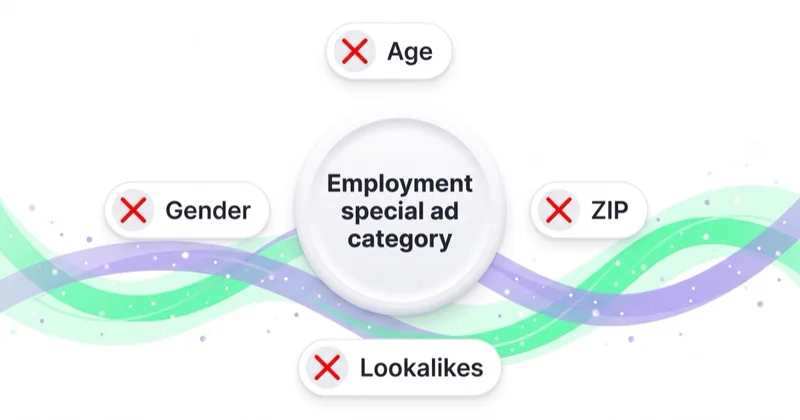
- Meta: advertisers must select the applicable Special Ad Category for campaigns related to employment. Available targeting and audience controls differ from standard campaigns and can change.
- Google Ads: employment opportunities and recruitment are covered by personalised-advertising restrictions. In the US and Canada, Google restricts targeting by age, gender, parental status, marital status and ZIP code for covered employment ads.
- LinkedIn: its policies prohibit discriminatory advertising. Advertisers certify appropriate use for ads relating to employment, and age targeting is unavailable when the objective is talent leads or job recruitment.
Do not infer that a platform-permitted setting is legally safe in every market. Conversely, do not repeat an old blog's list of platform restrictions without checking the current account interface and policy documentation.
Candidate data and screening
Collect only information needed for the stated recruitment purpose, provide required notices, control access and retention, and respect applicable consent or lawful-basis rules. Sensitive information, disability or accommodation requests and right-to-work evidence require appropriate handling.
Do not place personal or sensitive candidate details in URLs, ad-platform event names or campaign parameters. If conversion APIs or offline imports use candidate data, review platform terms, local law, consent choices and data minimisation.
Automated screening and scoring deserve legal and bias review. A model trained on historical placements can reproduce historical exclusion even when protected fields are removed.
Application design that protects candidate and recruiter time
The application should capture enough job-related information to route a candidate, without recreating a full onboarding pack before mutual interest exists.
Potential fields include:
- contact details and preferred method;
- role or job reference;
- location and willingness to travel;
- relevant availability and start date;
- job-related licence, certification or experience;
- CV or profile where necessary;
- work authorisation question drafted for the applicable jurisdiction;
- communication and privacy choices.
Provide accessible labels, instructions and error recovery. Support mobile upload and allow saving or alternative application routes when reasonable. Explain mandatory fields and do not ask candidates to re-enter information already present in an uploaded CV unless necessary.
Measure application starts, errors and completions, but optimise on later ATS quality. A shorter form may increase completion and decrease recruiter productivity; a longer form may exclude good candidates on mobile. Test the whole outcome.
Speed and candidate experience are marketing variables
A paid applicant can accept another role before the first recruiter response. Establish service levels by job type and urgency:
- confirmation immediately;
- review and first contact within the promised window;
- clear status updates;
- interview preparation and feedback;
- closure when the role is filled or the candidate is not progressing;
- a permission-based route to relevant future vacancies.
Track contactability, response time and recruiter attempts. Do not blame the acquisition channel for low screening rates when qualified applications wait unworked.
Candidate experience affects reviews, referrals, future response and the employer proposition. Marketing, recruitment operations and account teams need a shared standard.
Connect CRM and ATS stages to media
Employer stages
- enquiry or tracked call;
- accepted marketing/sales lead;
- qualified hiring need;
- opportunity or proposal;
- agreement;
- approved job order;
- filled order;
- realised fee or gross profit.
Candidate stages
- application or registration;
- eligible and contactable;
- recruiter screen completed;
- qualified for role or talent pool;
- submitted to client;
- interview;
- offer accepted;
- start;
- retention milestone or billable hours.
Define each stage operationally. “Qualified” must mean the same thing across recruiters and branches. Record timestamps, source, campaign, job ID, candidate ID and employer opportunity ID so the eventual placement can be traced without exposing personal data in marketing reports.
Google Ads offline conversion measurement and enhanced conversions for leads can return eligible CRM outcomes; Meta's Conversions API can connect permitted server or CRM events. Implementation needs deduplication, consent handling and monitoring. Read value-based bidding and offline conversion import for the transition design.
Do not double-count a placement
One placement can have an employer-acquisition source and a candidate-acquisition source. Both are useful for optimisation, but summing the full fee or gross profit in both channel reports doubles business value.
Use separate views:
- employer-source contribution: which activity created or influenced the job order;
- candidate-source contribution: which activity sourced the placed candidate;
- placement economics: one financial record for realised fee, hours and gross profit;
- incrementality: whether paid activity created additional orders, candidates or fills.
For bidding, assign each funnel a documented value that reflects its expected contribution to a placement, or use stage-level proxies. For finance and portfolio reporting, reconcile to the single placement record.
Staffing marketing metrics that matter
Employer acquisition
- cost per qualified employer need;
- opportunity and agreement rate;
- cost per approved job order;
- job-order fill rate and time to fill;
- expected and realised gross profit by employer source;
- client retention and repeat job orders.
Candidate attraction
- application start and completion;
- eligibility and contactability rate;
- cost per screened and qualified candidate;
- submission, interview, offer and start rate;
- time from application to first contact;
- cost per start and retained placement;
- gross profit or billable hours by candidate source.
Marketplace and operations
- active fillable orders versus available qualified candidates;
- coverage ratio by role, location and start date;
- recruiter workload and response service level;
- unfilled order value and reason;
- candidate duplication across sources;
- placement gross profit after media and variable acquisition cost.
Report mature cohorts. A candidate sourced today and a client acquired last month may create a placement later; judging only same-week returns favours short cycles and existing demand.
Budget allocation: fund the current matched opportunity
Budget should not simply alternate between “more clients” and “more candidates”. Use the matrix:
| Situation | Diagnosis | Marketing response |
|---|---|---|
| Fillable orders, insufficient qualified candidates | Candidate scarcity in defined roles/markets | Increase eligible role-level sourcing and improve recruiter response |
| Qualified candidates, insufficient suitable orders | Employer-demand gap or poor candidate-to-order match | Build client demand for the relevant desk; reactivate appropriate accounts |
| High volume, low qualification | Proposition, targeting, job detail, screening or source problem | Fix quality before buying more volume |
| Orders and candidates exist, few interviews | Matching, submission quality or client process constraint | Repair operations; media is not the immediate bottleneck |
| Offers made, starts or retention weak | Expectation, pay, onboarding or workplace issue | Fix experience and client conditions before scaling |
| Strong fills and service capacity | Proven matched economics | Scale by profitable desk with monitoring |
Include expected fee or spread, fill probability, media cost, recruiter effort and time to revenue. A hard-to-fill order can justify higher candidate acquisition cost; a low-probability contingency role may not.
The Space Ads operating approach
For staffing and recruitment acquisition, we use an industry-practice framework:
- map commercial models, desks, markets and realised gross profit;
- separate employer and candidate campaigns, destinations and events;
- build a live demand-supply matrix with recruiter and sales capacity;
- review copy, targeting, screening and data flows for platform and legal requirements;
- connect CRM and ATS stages to acquisition sources;
- improve pages and qualification around role-specific evidence;
- return reliable downstream values to bidding where appropriate;
- allocate spend to the matched opportunity and verify placement economics.
Where the agency operates differently, the system should follow its actual contracting, recruitment and fulfilment process—not force every desk into one generic funnel.
A 30-day diagnostic and improvement plan
Days 1–5: define the system
Map service lines, stages, job-order value, candidate quality and data owners. Reconcile a sample of placements through CRM, ATS, timesheet or billing and media source.
Days 6–10: separate and protect
Separate employer and candidate UTMs, pages, events and audiences. Review current employment ads, targeting, forms, privacy notices and screening with responsible specialists.
Days 11–17: repair measurement and routing
Standardise stages, preserve identifiers, fix duplicate records and establish lead/application response monitoring. Configure downstream imports only after data quality passes.
Days 18–24: improve priority journeys
Build or revise the highest-value employer and role pages, search architecture, creative, forms and follow-up. Focus on one or two commercially important desks rather than changing the entire portfolio at once.
Days 25–30: launch controlled tests
Test propositions or channel changes against qualified stages. Review demand-supply coverage, recruiter capacity and early data; set cohort dates for later placement and profit evaluation.
Thirty days can establish a foundation. It may not contain enough time for permanent placements or client sales to mature, so do not promise final ROI on the last day.
Common mistakes
| Mistake | Better practice |
|---|---|
| Blend employer and candidate traffic | Separate funnels and connect them at placement level |
| Optimise to every application | Return eligibility, screening, submission and start outcomes |
| Promote generic “opportunities” | Advertise a truthful role, location, terms and process |
| Use consumer targeting for employment ads | Apply current platform category rules and legal review |
| Copy client job descriptions directly | Rewrite for clarity, inclusion, accuracy and candidate decision needs |
| Attribute the full placement value to both sides | Keep one financial record and distinct optimisation views |
| Scale while recruiters cannot respond | Include capacity and service levels in budget decisions |
| Judge channels before placements mature | Use qualified leading stages and later cohort reconciliation |
FAQ
What is staffing agency marketing?
It is the system used to acquire employer demand and attract, engage and place qualified candidates. It spans positioning, paid and organic channels, job and service pages, CRM and ATS data, employment-ad compliance, sales and recruiter operations, and placement economics.
Which channels work best for staffing client acquisition?
There is no universal winner. Search can capture active agency demand; LinkedIn and account-based programmes can reach buying groups; organic expertise, referrals, partnerships and outbound can build trust. Choose based on buyer behaviour, opportunity value, market and the agency's ability to follow up.
Which channels work best for candidate acquisition?
The answer depends on role, seniority, scarcity, geography and urgency. Job platforms, Google Search, LinkedIn, Meta, TikTok, referrals, organic job pages, communities and a permissioned candidate CRM can all play roles. Compare them on screened candidates, starts and retention—not application cost alone.
Are recruitment ads subject to special rules?
Yes. Employment laws and platform policies can restrict advertising, targeting, screening, referrals and data use. Rules vary by market. Use current Meta, Google and LinkedIn policy documentation and qualified legal or HR review before launch.
How should staffing agencies measure marketing ROI?
Trace employer sources to qualified job orders and candidate sources to qualified starts, then reconcile both to one placement, billed-hours or fee record. Evaluate realised gross profit after media and relevant variable acquisition costs using mature cohorts.
Should employer and candidate campaigns share remarketing audiences?
Usually not by default. Their intent, data permissions and messages differ. Create separate audiences and suppression rules, and combine only when a documented use case and lawful data treatment justify it.
What should be sent back to ad platforms?
Use the earliest reliable stage that predicts value and occurs with enough volume—such as qualified employer need or screened candidate—then update with later outcomes where supported. Send only permitted, minimised data and avoid sensitive candidate information.
Key takeaways
- Staffing growth requires employer demand and placeable candidate supply to meet in the same market and time.
- Separate acquisition funnels, then reconcile them at the single placement and gross-profit record.
- Specific propositions and job details improve both conversion quality and operational efficiency.
- Platform employment categories do not replace legal review of copy, targeting, screening and referral practices.
- ATS and CRM outcomes must reach marketing before automated bidding can optimise for quality.
- Recruiter capacity, response speed and client process can constrain performance more than media.
- Allocate budget by matched commercial opportunity, not the lowest employer lead or application cost.
Space Ads can assess this system through a marketing audit and connect downstream acquisition data through performance marketing. For the B2B demand model, read demand generation vs lead generation.
Sources and further reading
- Coverage of employment agencies — US EEOC
- Prohibited employment policies and practices — US EEOC
- Personalised advertising restrictions for employment — Google Ads Policies
- LinkedIn Ads and discrimination — LinkedIn Help
- Create campaigns and select Special Ad Categories — Meta Help
- Value-based bidding and offline conversion import
- Call tracking for PPC and lead generation
- Meta Conversions API
Continue reading

Commercial Cleaning Marketing: B2B Lead Gen for Janitorial Contracts
Commercial cleaning marketing is B2B lead generation for recurring janitorial contracts, not one-off cleaning jobs. A strong funnel separates facility types, qualifies by contract value, and measures walkthroughs, proposals and won accounts instead of cheap form fills.

Language School Marketing: Two Businesses, One Building
Language schools often combine consumer enrolment and corporate training. Market them as separate buying journeys, then connect campaigns to attendance, enrolment, group contribution and continuation.

Driving School Marketing: Selling Instructor Hours, Not Courses
A practical system for growing a driving school around real instructor capacity: local demand, transparent lesson offers, compliant proof, responsive booking and completed-pupil value.