Consumer lending and BNPL marketing acquires customers for personal and instalment loans, point-of-sale finance and deferred-payment products. Because the marketing encourages a financial obligation, it must explain the product, costs and conditions accurately while meeting consumer-protection law and advertising-platform policies in each target market.
The cheapest application is not necessarily the best result. An enquiry from someone who does not meet the product criteria creates processing cost and ends in a decline. Campaigns should be evaluated using originated loans and later portfolio quality, while keeping marketing optimization separate from the individual credit decision.
TL;DR
- Fair, responsible communication starts in the brief. Marketing should not present credit as a guaranteed solution to financial difficulty or imply certain approval.
- Cost figures trigger disclosure requirements. Exact requirements vary by jurisdiction, but a rate, instalment, “0%” claim or other cost figure commonly requires additional information presented clearly and prominently.
- Platforms restrict lending. Google and Meta limit or prohibit parts of short-term and high-cost lending and require accurate terms; check policy per market and product.
- BNPL is not merely a checkout feature. The EU Consumer Credit Directive expands protection to many BNPL models but includes defined exclusions. In the US, the CFPB withdrew its 2024 BNPL interpretive rule in May 2025.
- The unit is an approved, performing borrower. Application volume, cheap leads and funded-but-defaulting accounts are not the outcome.
- Fair lending and vulnerable-audience care. Don't target or exclude groups unlawfully, and don't aim credit at financial distress.
- Platform requirements are covered separately. This article focuses on strategy and measurement; verification rules are in the financial-services compliance guide.
Define the product, provider and market first
Consumer credit is not one product. Before campaign planning, establish who is acting as lender or intermediary, where the product may be offered, what information must be shown and how creditworthiness or affordability is assessed.
| Product | What is being marketed | Better commercial event |
|---|---|---|
| Personal / installment loan | fixed-term borrowing repaid over time | approved, affordable, performing loan |
| Point-of-sale / retail finance | credit at the moment of purchase | approved borrower who repays, low return/dispute rate |
| BNPL (pay-in-N / longer terms) | deferred or instalment payment at checkout | obligations repaid on time, not only merchant conversion lift |
| Credit card / revolving | ongoing revolving credit | activated, responsibly-used, performing account |
| Debt consolidation | replacing existing debt with a new agreement | customer for whom the new terms genuinely improve the position |
| Very short-term / high-cost | small, short-duration credit | approach only via strict responsible-lending framing; heavily restricted on major channels |
Very short-term or high-cost lending faces particularly restrictive platform rules. Google, for example, does not allow ads for personal loans that require full repayment in 60 days or less. The exact treatment depends on the platform’s product definition and target market.
Plan cost disclosures before writing the advertisement
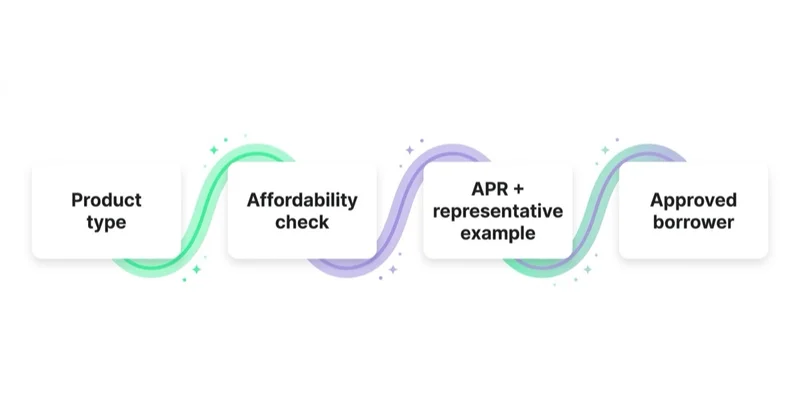
Credit advertising must not mislead customers or make the real cost difficult to assess. Disclosure requirements vary by jurisdiction and by what the promotion says. A communication containing a rate, instalment or other cost figure can trigger additional prescribed information.
- when presenting a rate, instalment, “0%” claim or another cost figure, include all information required for that product and jurisdiction;
- make the cost as prominent as the benefit — no burying fees or the standard rate after an introductory period;
- avoid urgency, pressure and "easy money" framing, and never imply approval is guaranteed;
- describe key eligibility conditions honestly and never imply that completing an application guarantees approval;
- for BNPL, be clear it is credit, state what happens on missed payments, and don't present it as free if fees or interest can apply;
- substantiate approval speed, acceptance and savings claims;
- keep the ad, the landing page, the terms and the application consistent.
Clear terms help people assess the obligation before starting an application and can reduce avoidable enquiries. That improves process quality even if raw application volume falls.
Platform rules and the changing BNPL framework
Lending must satisfy both consumer-credit law and platform policy. Google requires prominent information on destinations promoting personal loans and allows only products requiring full repayment in 61 days or longer. For US-targeted ads it also prohibits personal loans with an APR of 36% or above. Meta applies separate financial-product rules. Always check the current definition and requirements for the product and market.
In the EU, Directive 2023/2225 expands the consumer-credit framework to many BNPL arrangements and small loans. Member States were required to transpose it by 20 November 2025 and must apply the measures from 20 November 2026. The Directive also excludes certain deferred payments offered directly by a merchant without a third-party creditor when defined conditions are met. Not every product labelled BNPL therefore has identical treatment. In the US, the CFPB withdrew its 2024 BNPL interpretive rule on 12 May 2025, so it should not be cited as current binding guidance. Platform verification is explained in the compliance guide.
Channels by product
| Product | Motion | Primary channels |
|---|---|---|
| Personal / instalment loan | customer actively comparing terms | search, permitted comparison services and owned customer communication |
| Point-of-sale / retail finance | merchant-embedded | merchant partnerships, checkout integration, search |
| BNPL | merchant and app distribution | merchant partners, app and social under applicable lending rules |
| Credit card / revolving | acquisition and activation | search, social, customer communication and partnerships |
| Debt consolidation | customer actively seeking different debt terms | search, content and permitted comparison services |
Merchant integrations and visibility at checkout are important sources of BNPL distribution. That does not remove the need for the lender and merchant to explain the obligation and product terms clearly at relevant customer touchpoints.
Glossary
- APR (annual percentage rate) — a standardised measure designed to help customers compare credit cost; when it must appear depends on the jurisdiction and content of the promotion.
- Representative example — prescribed cost and term information based on assumptions representative of the agreements the lender expects to make; this is a UK/EU concept whose exact requirements vary by law.
- Responsible lending / affordability — the expectation that credit is offered only where the borrower can reasonably repay.
- BNPL — buy now, pay later; legal treatment depends on the provider, fees, repayment period, product structure and jurisdiction.
- Fair lending — rules against unlawfully targeting or excluding protected groups in credit marketing.
- Performing account — a loan or credit line that is being repaid as agreed, the real acquisition outcome.
Measurement: originated loans and later portfolio quality
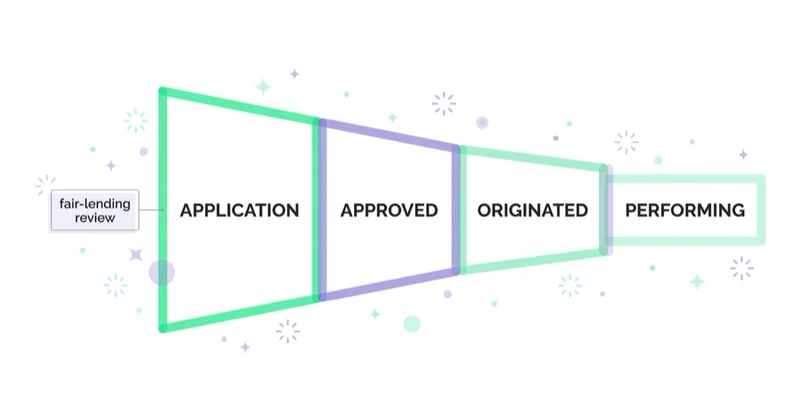
An application is one stage, not the final result. A low-cost enquiry ending in decline creates processing cost. An originated loan that later performs poorly cannot be assessed as a complete marketing success. Measurement needs to include approval, portfolio quality and time.
- Approved, affordable, performing borrowers, after affordability and credit checks — not application volume.
- Acceptance and quality by source: which channels produce applications that become originated loans with acceptable later performance, and which mainly produce declines.
- Default, delinquency and dispute rates among customer groups acquired in comparable periods; risk teams should analyse these without exporting individual financial outcomes to ad platforms.
- Fair-lending monitoring: who is reached, who may be excluded and whether creative or targeting could create unlawful discrimination or exploit financial distress.
- Contribution and payback net of losses, funding, servicing and acquisition cost, on a finance-approved basis.
- Evaluation over a sufficiently long period, because delinquency and portfolio quality emerge over time; controlled tests can provide additional evidence of advertising impact.
Do not optimize only for the cheapest form fill. Where data volume permits, send a later approved event to the advertising system without exposing the individual decision or financial situation. Before scaling, compare customer groups acquired in similar periods and use mature performance data.
Data and vulnerable-audience boundaries
A credit application may contain income, debt, credit-history and identity information. Do not place decisions, scores, form content or financial facts in URLs, event names or audience labels. Review every tag operating on application and authenticated pages. Platforms should receive only approved, necessary events and identifiers. Do not build or purchase audiences that use financial distress, debt or vulnerability as a signal of interest in credit. The compliance guide explains the broader data framework.
How Space Ads approaches consumer lending and BNPL marketing
We begin with legal, compliance and risk stakeholders: which products may be promoted, in which markets, to which audiences and with what disclosures. We separately identify when a cost figure triggers an APR or representative-example requirement under the relevant law. Campaigns are designed around applications likely to become originated loans, not the lowest-cost form fill.
Channels follow the product: search and permitted comparison services for personal loans, merchant integrations for BNPL and point-of-sale finance, and relevant communication to existing customers for revolving credit. Performance marketing and lead generation are tools within this system. Later-stage feedback helps reduce spend on sources producing mainly declines, but it must be shared with platforms without exposing an individual’s credit decision or financial situation. A similar approach is described in our mortgage lead generation guide.
Stop doing / Do instead
| Stop doing | Do instead |
|---|---|
| Pushing credit with "easy money" and urgency | Present honest terms; route unaffordable applicants away |
| Hiding APR, fees and total repayable | Show APR and a representative example next to the claim |
| Treating BNPL as a neutral checkout feature | Explain the obligation, terms and missed-payment consequences required for the product |
| Optimising to application volume | Optimise to approved, affordable, performing borrowers |
| Targeting financial distress or vulnerability | Reach audiences who can responsibly repay; monitor fair lending |
| Advertising short-term lending like a standard loan | Check the platform definition and product-specific restrictions first |
| Sending scores or decisions to ad tools | Share only approved, minimal marketing events |
FAQ
What is consumer lending / BNPL marketing?
It covers the activities used to acquire customers for personal and instalment loans, point-of-sale finance and deferred-payment products. Channels may include search, comparison services, merchant partnerships and communication to existing customers. Campaigns must reflect consumer-credit law, required cost information, platform policies, fair-lending obligations and controls for application data.
Can you advertise loans and BNPL on Google and Meta?
Yes, if the product, advertiser, market, ad and destination satisfy current policy. Google permits personal-loan ads only where full repayment is due in 61 days or longer and requires specified information on the destination. US-targeted ads also face the 36% APR limit. Meta applies separate financial-services rules. BNPL treatment depends on the product structure and target market.
Do you have to show APR in credit ads?
Not every credit advertisement worldwide automatically requires an APR. The obligation depends on local law and what the communication contains. In the UK and EU, a rate, instalment, “0%” claim or another figure relating to cost can trigger prescribed information, commonly including an APR and representative example. US disclosures follow a different legal framework. Review the exact promotion in every target jurisdiction.
Is BNPL regulated like credit now?
In the EU, Directive 2023/2225 brings many BNPL arrangements within the consumer-credit framework but retains defined exclusions for certain merchant-offered deferred payments. The measures apply from 20 November 2026. In the US, the CFPB withdrew its 2024 BNPL interpretive rule in May 2025. The current treatment therefore depends on jurisdiction and product structure, not the BNPL label alone.
What should lending marketing measure?
Measure applications that become originated loans, later performance by source, delinquency, complaints and contribution after funding and servicing costs. The evaluation period must be long enough for differences in portfolio quality to emerge, while fair-lending review remains part of campaign governance.
How should high-cost short-term lending be handled?
First confirm whether the product falls within the platform’s permitted definition. Google does not allow personal-loan ads where full repayment is required in 60 days or less, and applies a separate high-APR restriction in the US. Campaigns should not use financial distress as an interest signal or portray borrowing as a guaranteed solution to debt problems.
Key takeaways
- Consumer lending and BNPL marketing is governed by responsible lending, cost disclosure and platform lending policies before any channel choice.
- Many BNPL models are entering a broader EU credit regime, but treatment depends on product structure and defined exclusions.
- The outcome is an originated loan with acceptable later performance, measured over a sufficiently long period.
- Fair lending and vulnerable-audience care are part of the brief, not an afterthought.
- Clear terms help customers assess the obligation and reduce avoidable applications; short-term products face specific platform restrictions.
Sources and further reading
- Consumer Financial Protection Bureau — Current status of the withdrawn 2024 BNPL interpretive rule
- Consumer Financial Protection Bureau — Equal Credit Opportunity Act resources
- European Commission — Consumer Credit Directive
- Google Ads Help — Financial products and services policy
- Meta — Prohibited financial products and services
Continue learning
Continue reading

Wealth Management and Investment Firm Marketing
Investment firm marketing requires clear communication of risk, costs and past performance. Success is a client who fits the service and retains assets — not simply a lead or account opening.
Bank Marketing: Acquisition and Campaigns for Retail and Business Banks
Bank marketing combines continuous customer acquisition with time-limited product and seasonal campaigns. Success is an active, funded customer relationship — not simply an account opening.
Fintech Marketing: An Acquisition Playbook for Regulated Growth
Fintech marketing starts with the entity, product, partner responsibilities and permitted markets. Build acquisition around approved claims, minimal data sharing and retained customer economics.