Financial-services marketing operates under the law that applies to the product, advertiser and target market, plus each advertising platform's separate policies. On July 23, 2026, Google begins rolling enforcement of expanded financial-services verification in 24 additional EEA markets. The change applies to in-scope advertisers that receive an account notification, not automatically to every advertiser with a connection to finance. Those advertisers first complete G2 verification and then Google's process; agencies managing affected accounts must also satisfy the stated verification requirements. In the UK, FCA rules apply independently. In the US, the relevant federal and state requirements vary by product and activity. Compliance therefore needs a market-by-market operating system, not one disclaimer added after creative production.
TL;DR
- There is no universal “finance approval.” Verification, authorisation, product eligibility and disclosure requirements vary by platform, activity and target market.
- Google begins expanded verification enforcement in 24 additional EEA markets on July 23, 2026. In-scope advertisers should follow the notification and deadline in their own account.
- Platform approval does not establish legal compliance. The advertiser remains responsible for the laws and regulatory rules that apply to the promotion.
- Compliance is the operating condition, not a final check; it shapes creative, targeting and landing pages from the start.
- Clarity and substantiation support conversion. Credentials, security information, balanced benefits and risks, and transparent costs reduce avoidable uncertainty.
- Measurement must match the product journey. A current account, commercial loan and wealth mandate have different qualification events, sales cycles and value models.
- Sub-verticals differ — a neobank, a mortgage broker, a wealth manager and an insurer need different channels and messages.
- Aggressive claims, omitted conditions and outdated approvals create material risk, whether the campaign is optimised for leads, sales or app installs.
Why financial services marketing is different
Financial marketing can affect people's money, debt, insurance and long-term security. The legal perimeter, required disclosures and platform eligibility can change with the product, advertiser status, target location and intended audience. Teams therefore need to establish the applicable rules before briefing media or creative.
On the platform side, financial services is a restricted category. Google may require proof of authorization, an exemption, or a documented relationship with an authorized advertiser. Meta applies product and ad restrictions, but its requirements should not be described as identical to Google's verification program. Certain loans, complex speculative products, and some crypto services may be restricted or prohibited by market. Non-compliance can lead to ad disapproval, limited delivery, or account suspension.
Google's July 2026 verification expansion in the EEA
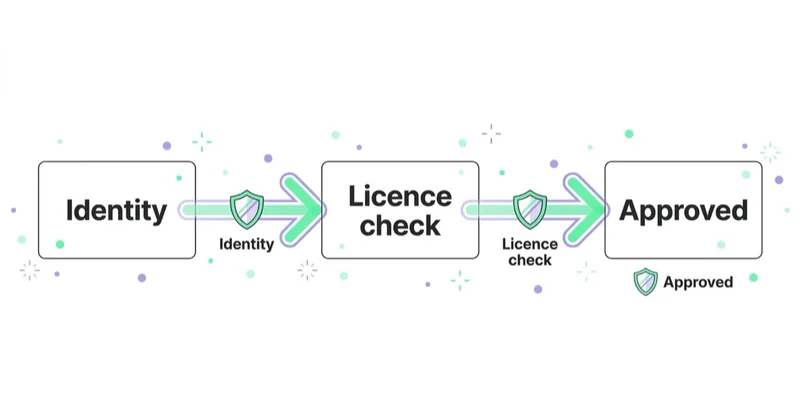
Google's expanded Financial Services Verification covers 24 additional EEA markets, including Poland, the Netherlands and Sweden. G2 began processing applications on June 23, and rolling enforcement starts July 23, 2026. Google says the categories in scope can vary over time and identifies affected advertisers through an in-account notification with a deadline. An in-scope advertiser that misses its specified enforcement date will not be allowed to show financial-services ads in the affected target locations.
The route depends on the advertiser's role:
| Role | Evidence and operating implication |
|---|---|
| First Party or Authorized Advertiser | complete G2 checks, demonstrate direct regulatory authorisation or an exemption, receive a unique code, then apply to Google |
| Approved Third Party Advertiser | cannot apply independently; an eligible First Party or Authorized Advertiser applies on its behalf |
| Agency or other entity managing an affected account | complete the verification Google requires for the in-scope advertiser account |
Before submission, reconcile the consumer-facing brand, legal entity, regulatory registration, domain, Google Ads account and payment profile. Record which entity provides the product and which entity communicates or approves the promotion so that the evidence and consumer journey tell a consistent story.
Build a market-by-market compliance matrix
Every campaign needs four documented approvals:
- Product and authorization — who provides it, under which license or exemption, and in which jurisdiction.
- Platform eligibility — whether the offer is allowed, restricted, certified, or subject to advertiser verification.
- Promotion content — substantiation for claims, representative examples, costs, risks, limitations, and required disclosures.
- Post-click journey — consistency across the ad, lead form, landing page, terms, and sales follow-up.
Approving a banner in isolation is not sufficient. The combined impression of headline, image, CTA, and landing page can materially change a claim. The approval log should retain the approved version, reviewer, date, target market, and legal or policy basis. That record also prevents a later creative optimization from removing a qualifying condition.
For UK campaigns, FCA guidance says financial promotions across advertising channels should be fair, clear and not misleading, support consumer understanding and present a balanced view of benefits and risks. It also warns that an unauthorised person promoting a regulated product without approval from an appropriate FCA-authorised person may commit a criminal offence. US campaigns need a product- and state-specific legal review rather than an imported EEA or UK checklist. International teams should maintain separate approved variants when disclosures, eligibility or risk wording differ.
Google imposes its own destination disclosures. Its policy requires the physical address of the business offering the financial product or service, all associated fees, and evidence for any asserted or implied accreditation or endorsement. Product-specific rules can add more: for example, personal-loan destinations require repayment periods, maximum APR and a representative total-cost example. Disclosures must be clearly and immediately visible rather than hidden behind hover text or another tab.
Legal and platform reviews answer different questions. An approved promotion may still fail a platform policy, while a platform-approved ad may still breach local law. Maintain both decisions in the approval record and trigger a new review when the product, claim, audience, landing page, jurisdiction or responsible entity changes.
Compliance is the operating condition, not a final check
The common failure is treating compliance as a legal sign-off at the end of the creative process. By then the campaign is built on claims that cannot run, and the "review" becomes a demolition. In financial services, compliance has to shape the work from the first brief.
That means confirming product eligibility before designing the campaign, starting required verification early, substantiating claims, reserving sufficient space for prominent conditions and building a post-click journey consistent with the ad. Use locked legal copy blocks where appropriate, but do not let templates replace review of the overall impression. A technically present disclosure can still fail if placement, timing or presentation prevents consumers from understanding it.
Reduce uncertainty without overstating trust
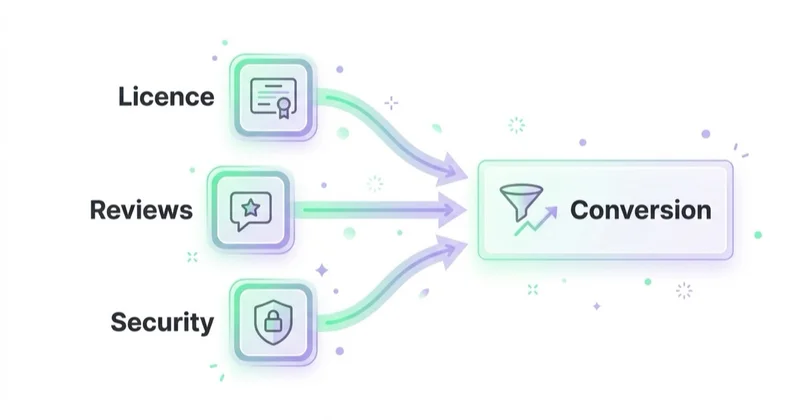
Trust matters, but it is not a single measurable “conversion lever,” and regulated credentials should not be presented as an endorsement. A useful financial journey helps an eligible customer understand the offer and make an informed decision:
- Verifiable identity and permissions — the legal provider, regulatory status and named experts, described accurately.
- Security and safety signals — how money and data are protected.
- Substantiated evidence — relevant outcomes and testimonials used only where the claims, typicality and permissions satisfy applicable rules.
- Clarity — transparent terms, fees and risks, because hidden costs destroy trust instantly.
- Human reassurance — for high-value decisions, access to a person, not just a form.
The execution differs by product. Insurance agency marketing, mortgage lead generation and accounting-firm marketing require different evidence, eligibility questions and handoffs. The common principle is to make the provider, product, costs, risks and next step understandable without turning regulatory status into a performance claim.
Channels by financial sub-vertical
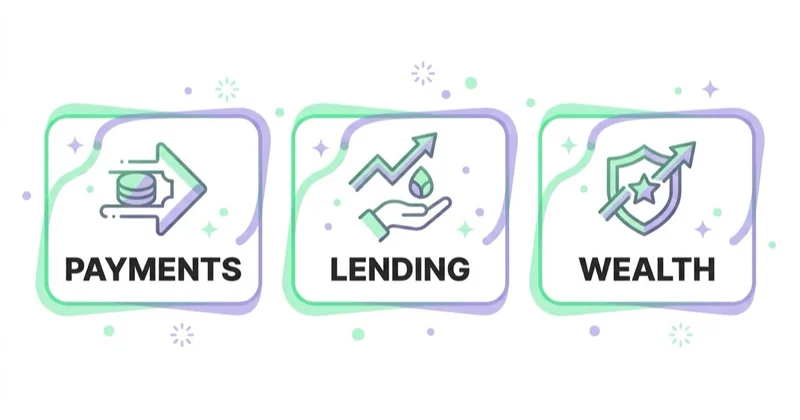
"Financial services" spans very different businesses, and the channel mix changes with each.
| Sub-vertical | Channels to evaluate | Measurement and message emphasis |
|---|---|---|
| Retail bank / neobank | Paid social, search, video, app install | Scale acquisition, brand trust, activation |
| Fintech / SaaS-fintech | LinkedIn, search, content, product-led | B2B pipeline or PLG, category education |
| Mortgage / lending broker | Search (high intent), local, lead gen | Compliant lead capture, speed to contact |
| Wealth / investment management | LinkedIn, search, content, referral | High-value, long consideration, authority |
| Insurance | Search, comparison, local, retargeting | Intent capture, trust, clear terms |
| Financial adviser | Local, search, content, referral | Authority and relationship-led lead gen |
The mistake is treating them as one. A neobank chasing app installs at scale and a wealth manager nurturing a handful of high-net-worth relationships have almost nothing in common operationally, even though both are "financial services". Fintech specifically often behaves more like B2B SaaS than like retail finance — covered in the companion fintech marketing playbook.
Glossary
- Restricted category — an advertising vertical (like finance) with extra platform policies, verification and product limits.
- Advertiser verification — the platform process confirming a financial advertiser's identity and, often, licensing.
- Financial promotion — any marketing communication inviting or inducing financial activity, subject to regulation.
- Clear, fair and not misleading — the core standard financial promotions must meet.
- Risk warning / disclosure — the required statements about risk, fees and terms in financial ads.
- Compliant lead generation — capturing leads in a way that meets both platform policy and regulatory rules.
Measurement: quality over volume, over a long horizon
Some financial journeys complete quickly; others take months and involve advice, underwriting or human review. Measurement should follow the product rather than assume one long funnel. A cheap lead that never meets eligibility criteria and a funded account with sustainable value are not equivalent outcomes. Useful measures include:
- Qualified lead quality, not raw lead count — a compliant funnel that filters for genuine, eligible prospects.
- Cost per approved, funded or activated customer, where that event accurately represents value and can be used lawfully for measurement.
- Cohort value and loss or cancellation quality, using measures appropriate to the product rather than acquisition volume alone.
- A conversion window based on observed delay, with CRM or product events connected to the originating campaign where permitted.
- Compliance operations — disapprovals by reason, expired approvals, review turnaround, unauthorised changes and repeated policy incidents.
How Space Ads approaches financial services marketing
For a regulated campaign, we begin with the product, target market, responsible legal entity and intended customer. Those inputs determine the applicable authorisation, platform route, approval owner, permitted claims, disclosures and measurement events. Media production starts only after those dependencies are mapped.
We use version-controlled approvals across the ad, form, landing page and sales handoff, with evidence for material claims and separate variants where markets differ. Measurement progresses from platform delivery to eligible application, approval, funding or another commercially relevant event, subject to privacy and sector rules. That is performance marketing adapted to a regulated category and implemented through Google Ads or another eligible channel without confusing platform approval with legal sign-off.
Stop doing / Do instead
| Stop doing | Do instead |
|---|---|
| Treating compliance as a final legal check | Make it the design brief from the first draft |
| Running unverified financial ad accounts | Complete platform verification and licensing early |
| Converting with aggressive claims and urgency | Convert with authority, security signals and clarity |
| Measuring on raw lead volume | Measure qualified, funded outcomes over a realistic window |
| Treating all financial services as one | Tailor channels and message by sub-vertical |
| Running finance like ecommerce | Build inside the restricted-category and promotions rules |
FAQ
What makes financial services marketing different from other industries?
Financial-services campaigns must satisfy the laws and regulatory rules that apply to the product, advertiser, communication and target market, plus each platform's separate policies. Requirements can include authorisation, third-party approval, verification, prominent disclosures, product restrictions and limits on targeting. Neither a licence nor platform approval covers the other layer automatically.
Can you advertise financial products on Google and Meta?
Sometimes. Eligibility depends on the product, platform, advertiser status and target market. Google requires location-specific financial-services verification in certain markets and imposes product-specific restrictions and disclosures. Meta has its own advertising standards and restrictions; do not assume Google's verification route applies there. Check the current policy and local law before building the campaign.
What are the rules for financial promotions?
There is no single global rulebook. In the UK, FCA guidance says promotions should be fair, clear and not misleading, support consumer understanding and give a balanced view of benefits and risks. Other jurisdictions and products apply different rules, disclosures and approval regimes. Review the complete journey and overall impression, not just the ad in isolation.
How do you convert customers in financial services marketing?
Help eligible customers understand the provider, product, costs, benefits, risks and next step. Use accurate credentials, relevant security information, substantiated evidence and accessible human support where the journey needs it. Test comprehension and qualified progression rather than relying on pressure or treating a disclosure as sufficient merely because it appears on screen.
Is fintech marketing the same as financial services marketing?
Fintech is a sub-vertical of financial services, but it often behaves more like B2B SaaS or product-led growth than retail finance — with LinkedIn, content and product-led acquisition playing bigger roles. It still faces the restricted-category and regulatory constraints, but the channel mix and motion differ from a retail bank or insurer.
How should financial services campaigns be measured?
Follow the product journey from media delivery to eligible application, approval, funding, activation, retention or another value event. Use an observed conversion delay, reconcile platform and first-party data, and monitor cohort quality. Track approval status, disapproval reasons and unauthorised creative changes as operational controls, not as substitutes for legal compliance.
Key takeaways
- Financial-services campaigns must satisfy market-specific law and separate platform policies.
- Google's new verification enforcement starts on July 23, 2026, for notified, in-scope advertisers targeting 24 additional EEA markets.
- Compliance should shape the product, claim, audience, creative, disclosure, landing page and sales handoff from the start.
- Clarity, balanced information and substantiated evidence reduce uncertainty without turning regulatory status into an endorsement.
- Sub-verticals (bank, fintech, lending, wealth, insurance) need different channels and messages.
- Measure events and cohort quality that match the actual product journey, while monitoring approval and policy operations separately.
Sources and further reading
- Google Ads Help — Financial products and services policy
- Google Ads Help — New EEA verification requirements beginning July 2026
- Meta — Advertising policies: financial products and services
- UK Financial Conduct Authority — FG24/1: financial promotions on social media
- FCA — Financial promotions rules
Continue learning
Continue reading

Fintech Marketing: An Acquisition Playbook for Regulated Growth
Fintech marketing starts with the entity, product, partner responsibilities and permitted markets. Build acquisition around approved claims, minimal data sharing and retained customer economics.
Consumer Lending and BNPL Marketing: Rules and Channels
Consumer lending and BNPL marketing requires clear information about the obligation, costs and terms. Campaigns should be judged by originated-loan quality — not application volume.

Wealth Management and Investment Firm Marketing
Investment firm marketing requires clear communication of risk, costs and past performance. Success is a client who fits the service and retains assets — not simply a lead or account opening.