
Fintech marketing is the work of building demand, acquiring suitable users and growing adoption for a technology-enabled financial product or financial-infrastructure business. The category includes very different models: licensed providers, agents or distributors, lenders, payment companies, wealth platforms, insurance technology, infrastructure vendors and programs delivered with a regulated bank or other partner.
That distinction comes before the channel plan. A product can look like a software app to the customer while its promotion, onboarding, underwriting, data use and disclosures are governed by financial-services rules. Another fintech may sell infrastructure to regulated institutions without itself offering a consumer financial product. The marketing operating model must follow the actual entity, product, customer, jurisdiction and contractual responsibilities—not the “fintech” label.
TL;DR
- Start with the regulatory and contractual perimeter. Identify the licensed entity, partner roles, permitted markets, approval owner and responsibility for each claim.
- There is no default fintech motion. Consumer payments, lending, wealth, insurance and B2B infrastructure need different acquisition systems and decision metrics.
- Compliance is an operating constraint and a source of credible evidence. It should improve clarity and control, but registration or verification must never be presented as a performance or security guarantee.
- Trust claims need substantiation. “Secure,” “protected,” “regulated” and “bank-grade” each require precise meaning, scope and evidence.
- Channels differ by fintech type — a consumer app, a B2B infrastructure API and a lending product acquire differently.
- Measure a product-specific valuable action after quality controls. That could be a verified and funded account, a first successful transaction, an approved suitable borrower or a qualified B2B opportunity.
- Include fraud, losses, servicing and retention. Cheap accounts can be commercially negative after incentives, KYC failure, defaults, chargebacks, support and cost of funds.
Map the fintech perimeter before acquisition
Create a market-by-product matrix with compliance, legal, risk, security and the regulated partner. For each offer, document:
| Question | Why marketing needs the answer |
|---|---|
| Which entity provides the financial product? | The customer-facing brand may not be the licensed provider |
| What is the fintech's role? | Principal, agent, broker, program manager, introducer and software vendor carry different responsibilities |
| Where may it be promoted and delivered? | Authorization, language, disclosure and platform verification vary by market |
| Who approves the promotion? | Every ad, landing page, creator brief and automated variation needs an accountable route |
| What claims are substantiated? | Fees, speed, approval, yield, protection, savings and security need evidence and qualifications |
| Which users are suitable or eligible? | Acquisition should not encourage applications the product cannot lawfully or responsibly serve |
| What partner wording is permitted? | Bank, insurer, card-network and regulatory references often have contractual rules |
| What must be archived? | The final rendered promotion, audience, dates, evidence, approvals and changes may need records |
This matrix is the release gate for experiments. It avoids two expensive errors: launching a global creative under one market's rules, and implying that a partner or regulator endorses the fintech's commercial claims.
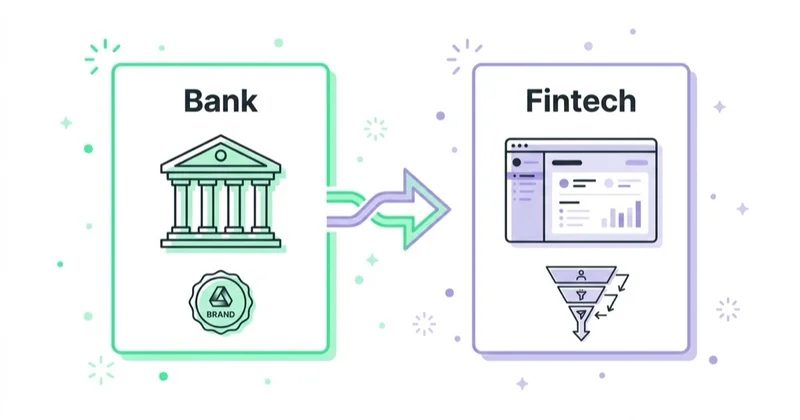
Compliance can help marketing communicate more clearly, but it should not be romanticized as a universal conversion advantage. A license confirms a legal status within a scope; it does not prove the product is safe, suitable, profitable or superior. A platform verification confirms an advertiser process; it does not approve every ad.
Choose the growth motion by product, not fashion
Some infrastructure fintechs do resemble B2B SaaS. Some consumer products have a self-serve journey. Others require advice, underwriting, manual KYB, implementation or a regulated sales process. “Product-led growth” is useful only when a user can reach value through the product with an acceptable risk and support model.
| Fintech model | Typical path to value | Better commercial event |
|---|---|---|
| Consumer payments or account | install → identity checks → funded account → successful use | retained verified transactor after fraud controls |
| Consumer or small-business lending | eligible visit → application → underwriting → funded loan | compliant, performing funded account—not application volume |
| Wealth or investing | education → suitability/onboarding → funding → retained use | suitable funded and retained client under approved value logic |
| B2B payments or treasury | target account → discovery → security/risk review → integration → volume | activated account with realized net revenue and support cost |
| Financial infrastructure API | developer evaluation → technical proof → procurement → production | production customer with durable usage and contribution |
| Insurtech | quote or lead → eligibility → bind → retention | bound, paid and retained policy after acquisition and servicing cost |
The SaaS paid acquisition and product-led growth methods can inform suitable businesses, but financial quality, loss and customer-treatment outcomes must remain in the model.
Turn trust language into verifiable product information
Trust is earned through the product and conduct, not manufactured by adding security icons. Translate broad language into facts a customer can evaluate:
- name the regulated provider and explain the fintech's role in plain language;
- state fees, eligibility, material limitations and relevant risks close to the claim;
- explain how customer funds are held or safeguarded without implying deposit insurance or protection that does not apply;
- describe security controls only to the level approved by security and legal teams;
- distinguish encryption, account protection, regulatory safeguarding and reimbursement policies;
- explain support, complaints and error-resolution routes;
- substantiate customer counts, transaction volume, partner names, ratings and time-saving claims;
- keep status pages, product terms, pricing and marketing consistent.
The US FTC Safeguards Rule can apply to a broader set of non-bank financial institutions than the everyday term suggests and requires covered entities to maintain an appropriate information-security program. That obligation is not a marketing badge. A claim such as “your data is completely secure” would still be misleading because no system can promise zero risk.
Channels by fintech type
"Fintech" spans very different businesses, and the channel mix follows the type.
| Fintech type | Motion | Primary channels |
|---|---|---|
| Consumer app (payments, budgeting, account) | self-serve with onboarding controls | Search, app campaigns, content, partnerships and referral where compliant |
| B2B / infrastructure | sales-assisted, developer-led or partner-led | target-account media, search, developer content, documentation and events |
| Lending / credit | eligibility, application, underwriting and servicing | high-intent search, approved affiliates, education and owned lifecycle |
| Wealthtech / investing | education, suitability, funding and retained use | search, content, referral, social and partner distribution under applicable rules |
| Insurtech | quote, eligibility, bind and renew | search, approved comparison, partnerships and lifecycle |
This table is a starting hypothesis, not a prescribed channel mix. Geography, product restrictions, target economics and distribution partners can change the answer. A channel is appropriate only if the advertiser can lawfully reach the audience, communicate the offer fairly and observe a downstream outcome without excessive data sharing.
Glossary
- PLG (product-led growth) — acquisition driven by the product itself, where signups self-serve to value.
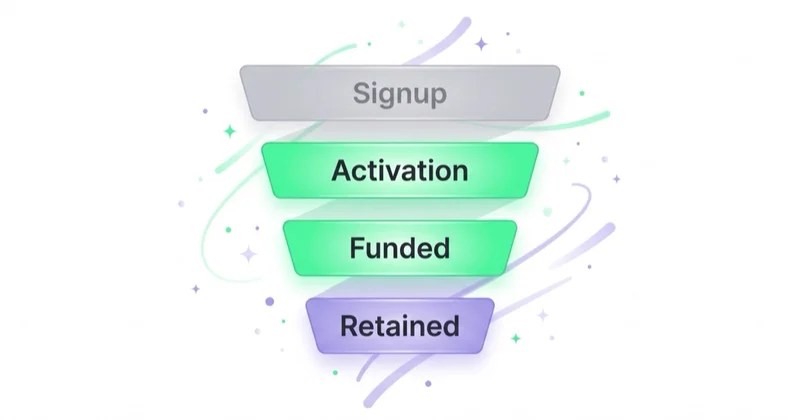
- Activation — the event where a fintech user reaches real value (account funded, first transaction), the metric that predicts retention.
- Restricted category — the platform advertising rules that apply to financial products.
- Safeguarding — a legal or operational arrangement for customer funds whose meaning and protections depend on the product and jurisdiction.
- Qualified opportunity — a B2B fintech lead that has become genuine pipeline.
- ASO (app store optimization) — improving app-store visibility and conversion for consumer fintech apps.
Measurement: activation and funded outcomes, not signups
A signup is a funnel event, not automatically a customer. A downloaded app that never passes identity checks or reaches value, and a B2B trial that never reaches production, should not receive the same bidding value as a retained, economically viable account.
The measures that fit:
- Eligible and verified activation rate: the share reaching a pre-defined valuable action after required checks.
- Funded or production outcomes: product-specific activity that produces genuine customer value.
- Fraud and abuse: incentive abuse, synthetic identity, chargebacks, account takeover and invalid businesses where relevant.
- Credit or insurance quality: delinquency, loss, cancellation or retention metrics governed by the product team—not exported as individual ad-platform data.
- Contribution and payback: net revenue after funding, network, loss, incentive, support, partner and media costs under a finance-approved definition.
- Cohort retention: sustained valuable use after the acquisition and incentive window.
Do not move the bidding event downstream merely because it sounds more commercial. It must occur frequently enough, be uploaded consistently and have a stable definition. Use coarser approved value bands where individual values are sensitive or volatile. Reconcile predicted value with mature cohorts before raising the acquisition ceiling.
Platform-attributed funded users are not automatically incremental users. Attribution identifies a recorded relationship under the platform's rules. Holdouts, geographic tests or other credible designs are needed to estimate how many qualified customers would not have arrived without the spend.
Build the compliance and risk layer into acquisition
Every market needs a matrix covering product authorization, platform eligibility, financial-promotion rules, required disclosures, age and location restrictions, fair-access considerations, onboarding checks and record retention. The consumer-facing brand, licensed or partner entity, domain, app-store listing, payment profile and advertiser verification should reconcile before launch.
Google begins expanded financial-services verification enforcement in 24 additional EEA markets on July 23, 2026. Notified advertisers complete the external compliance-partner review and then Google's process; in-scope agencies may also require verification. Meta requires the Financial Products and Services Special Ad Category where applicable and prohibits specified high-risk products. These platform processes do not replace regulatory authorization.
For UK social campaigns, the FCA says financial promotions must be fair, clear and not misleading, support consumer understanding and present a balanced view of benefits and risks. A constrained social format may not be suitable for a complex offer. In US credit marketing, include fair-lending review in audience, creative, affiliate and funnel decisions. CFPB examination materials explicitly consider who is targeted, who may be missing and whether marketing is reviewed for fair-lending risk.
Data-sharing boundaries
Financial onboarding can contain government identifiers, account details, income, credit information, transaction data and vulnerability indicators. Marketing tools do not need that record. Define a strict event contract:
- share only approved events and the minimum identifiers required;
- never place financial facts or KYC outcomes in URLs, event names, audience labels or custom parameters;
- treat hashing as a transport safeguard, not anonymization or legal permission;
- separate product-risk models from advertising optimization data;
- review pixels, SDKs, session replay, support chat and tag managers on authenticated or application pages;
- set retention, access and incident-response responsibilities with every agency and vendor;
- test deletion, consent withdrawal and source-system corrections.
Since June 15, 2026, Google's current and future offline conversion and enhanced-conversion-for-leads uploads should use the Data Manager API. The migration is an implementation requirement, not a reason to upload more customer data.
How Space Ads approaches fintech marketing
Our standard approach begins with a joint acquisition contract across marketing, product, compliance, risk, finance and the regulated partner. It defines eligible markets and audiences, claims and evidence, approval turnaround, event meanings, fraud and quality guardrails, contribution logic, platform verification and incident ownership.
Only then is the channel system designed. Consumer acquisition can optimize toward an approved verified-value event with fraud and retention monitoring. B2B infrastructure can connect target-account activity with qualified pipeline, production activation and realized usage. Performance marketing, SaaS-style acquisition and LinkedIn are tools inside that operating model—not default prescriptions for every fintech.
Stop doing / Do instead
| Stop doing | Do instead |
|---|---|
| Treating every fintech as a regulated software app | Map entity, product, partner, market and responsibility |
| Using “regulated” or “secure” as vague proof | State the exact status, scope, protection and evidence |
| Optimizing to signups or installs | Use a stable valuable event with quality and fraud guardrails |
| Copying one growth playbook across fintech types | Match the motion and channels to the fintech type |
| Burying material conditions in a footer | Present fees, eligibility, limitations and risks clearly and prominently |
| Chasing cheap volume | Reconcile acquisition with retained contribution, losses and support cost |
| Sending KYC or financial facts to ad tools | Enforce a minimal, approved marketing event contract |
FAQ
What is fintech marketing?
Fintech marketing builds demand and adoption for technology-enabled financial products and infrastructure. The operating model depends on the entity's role, product, customer and jurisdiction. It can involve consumer acquisition, partner distribution, developer adoption, sales-assisted pipeline or retention, all within the applicable promotion, privacy and product rules.
How is fintech marketing different from other financial services marketing?
Fintech spans both regulated consumer products and B2B infrastructure. Some businesses use self-serve or developer-led acquisition; others require underwriting, advice, partner distribution or enterprise implementation. The difference is not the technology label but the path to customer value, risk and revenue.
Is compliance a disadvantage in fintech marketing?
Compliance is necessary and can improve the clarity of the customer experience, but it is not a performance claim. Registration, authorization or platform verification should be described accurately within its scope and never used to imply endorsement, suitability, investment results or zero security risk.
What channels work for fintech marketing?
It depends on the product, market and path to value. Search and app campaigns may suit eligible consumer demand; developer content, partnerships, events, target-account media and LinkedIn may suit infrastructure businesses. Lending, wealth and insurance require product-specific authorization, audience and quality controls. Test the channel against downstream economics rather than copying a category playbook.
What should fintech marketing measure?
Measure an approved valuable action after eligibility and verification, then fraud or loss quality, realized net revenue, servicing cost, contribution, payback and mature retention. The event differs by product. Platform attribution should remain separate from incremental-customer evidence.
How do fintechs balance growth and regulation?
Create a documented release process shared by marketing, compliance, product, risk, security and the regulated partner. Pre-approve claim boundaries and dynamic variations, verify the advertiser where required, minimize shared data, monitor customer and risk outcomes, and retain the final promotion and evidence. Speed then comes from clear decision rights, not skipped controls.
Key takeaways
- Fintech marketing starts with the entity, product, partner responsibilities, market and regulatory perimeter.
- Consumer, lending, wealth, insurance and infrastructure businesses do not share one acquisition motion.
- Regulatory, security and safeguarding language must be precise and substantiated.
- Measure product-specific valuable actions, fraud or loss quality, contribution and mature retention—not signups alone.
- Build speed through approved claim boundaries, minimum data sharing and clear cross-functional decision rights.
Sources and further reading
- Google Ads Help — Financial products and services policy
- Google Ads Help — Expanded EEA verification from July 2026
- Google Ads Help — Offline conversion imports and the 2026 Data Manager API migration
- FCA — Financial promotions on social media
- Consumer Financial Protection Bureau — Equal Credit Opportunity Act resources
- Federal Trade Commission — Safeguards Rule: what covered businesses need to know
- Meta — Prohibited financial products and services
Continue learning
- Marketing for financial services: compliant campaigns in a restricted category
- SaaS paid acquisition: Google and Meta for pipeline, CAC and payback
- Product-led growth still needs paid: how PLG companies acquire
- Go-to-market strategy: the paid-acquisition layer most launch plans skip
- Performance marketing for regulated categories
- LinkedIn Ads for B2B fintech pipeline
Continue reading
Consumer Lending and BNPL Marketing: Rules and Channels
Consumer lending and BNPL marketing requires clear information about the obligation, costs and terms. Campaigns should be judged by originated-loan quality — not application volume.
Wealth Management and Investment Firm Marketing
Investment firm marketing requires clear communication of risk, costs and past performance. Success is a client who fits the service and retains assets — not simply a lead or account opening.
Bank Marketing: Acquisition and Campaigns for Retail and Business Banks
Bank marketing combines continuous customer acquisition with time-limited product and seasonal campaigns. Success is an active, funded customer relationship — not simply an account opening.


































