Bank marketing builds trust in the brand, acquires customers and increases meaningful use of the bank’s products. It can span current and checking accounts, cards, savings, deposits, mortgages, consumer lending, business banking and wealth services. Each line has a different audience, buying process, commercial model and regulatory context.
That creates two distinct modes of work. The first is continuous acquisition and development of existing customer relationships. The second is a time-limited campaign for a new account, a deposit-rate offer, a mortgage season or an SME proposition. An external agency may manage the wider system or take responsibility for one defined campaign with its own objective, deadline and budget.
TL;DR
- Two modes, not one. Continuous acquisition and customer communication sit alongside defined campaigns for product launches, rate changes and seasonal demand.
- The product line sets the motion. A current account, a mortgage, a savings bond and an SME lending offer acquire and convert very differently.
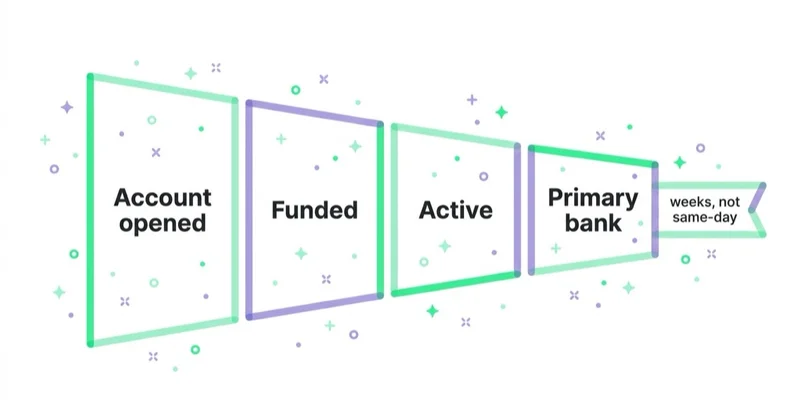
- An active relationship matters more than an opening. The account should be funded and used; over time, the bank may become the customer’s primary financial institution.
- Compliance is a precondition. Advertiser verification, financial-promotion rules and fair treatment shape the message before creative begins — link the mechanics to the financial-services compliance guide.
- Brand and performance media work together. Important financial decisions require both confidence in the institution and clear information about the specific product.
- Time-limited campaigns need their own plan. Define the objective, approved claim, approval route, measurement period and record-keeping before launch.
- Measure over the real decision window. Openings can be same-day; funding, activation and primary-bank status mature over weeks.
Two modes of bank marketing: continuous activity and time-limited campaigns
These two modes should not be planned or evaluated in the same way.
Continuous activity includes brand and product search, presence on permitted comparison services, app growth and relevant communication to existing customers. It should be evaluated using funded active accounts and the proportion of customers who make the institution their main bank.
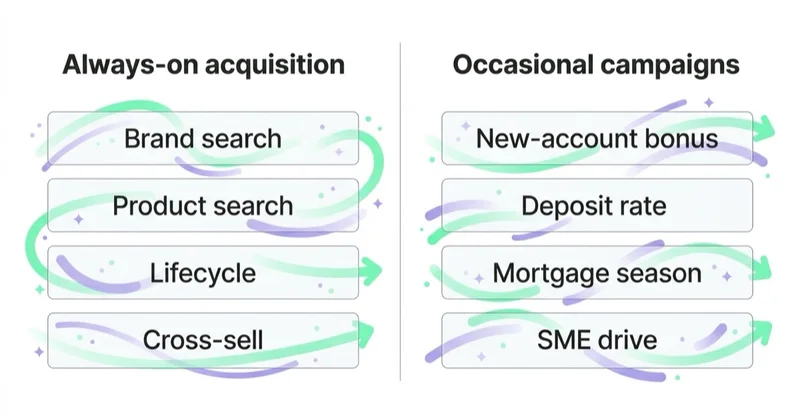
Time-limited campaigns promote a new-account bonus, deposit rate, mortgage offer, card, SME proposition or sponsorship. Each has a start and end date, a specific claim, a dedicated budget and its own success measure. A bank can commission an agency for this project without outsourcing all of its marketing.
| Campaign type | Trigger | Primary objective | Watch-out |
|---|---|---|---|
| New-account acquisition | Bonus / feature launch | Funded, active accounts | Incentive-only openers that never fund |
| Deposit / savings rate | Rate change window | Balances and new savers | Rate-chasers with no wider relationship |
| Mortgage / home lending | Seasonal demand, rate moves | Eligible, approvable applications | Volume of unqualified applications |
| Consumer credit | Product or offer launch | Approved, performing borrowers | Fair-lending and affordability exposure |
| Business / SME banking | New proposition, sector-specific campaign | Activated business relationships | A long sales-assisted cycle judged too early |
| Brand / sponsorship | Reputation, trust, category entry | Salience and consideration | No line of sight to product outcomes |
Match the campaign to the product, not one “bank” template
A bank does not sell one product. Define the audience, decision path and commercially meaningful outcome separately for each product line.
| Product line | Path to value | Better commercial event |
|---|---|---|
| Current / everyday account | ad → application → identity checks → funded account → active use | primary-bank relationship (salary in, regular activity) |
| Savings / deposits | offer → application → funded balance | retained balance beyond the promotional window |
| Cards | application → approval → activation → spend | activated, revolving or transacting card after risk checks |
| Mortgage / home lending | eligibility → application → underwriting → completion | completed, performing loan — not raw application volume |
| Consumer credit | eligibility information → application → affordability assessment → disbursal | originated loan, also evaluated by portfolio quality |
| Business / SME banking | target business → conversation → business verification → activation | active business account with real transactions |
Customers can often open an everyday account or apply for a card without speaking to sales. Mortgages and SME banking usually require specialist support, additional checks and a longer process. Business bank marketing should therefore be measured more like B2B customer acquisition: from a meaningful conversation through verification to an active relationship.
Turn trust language into fair, specific information
Trust is strengthened by accurate information a customer can understand. Rules vary by jurisdiction, but a common principle is that financial promotions must not mislead people about the provider, product, costs, benefits, risks or availability. Replace broad reassurance with useful facts:
- state the rate, the bonus, the eligibility conditions and the end date next to the claim, not in a footnote;
- show representative examples and total cost where credit is advertised;
- explain how deposits are protected and the exact scope of any guarantee scheme, without overstating it;
- separate the headline offer from the ongoing terms (introductory vs standard rates);
- describe security and fraud protection only to the level the security and legal teams approve;
- keep the rate table, product terms and marketing consistent at all times.
Clear terms reduce uncertainty for a customer moving savings or taking on a long-term commitment. Artificial urgency can undermine trust rather than improve the decision.
Compliance and platform verification
Banks must meet both local financial-promotion rules and the policies of each advertising platform. In the UK, FCA rules require financial promotions to be fair, clear and not misleading. In the US, credit marketing also needs review under applicable fair-lending requirements. From 23 July 2026, Google began phased enforcement of expanded financial-services advertiser verification in additional EEA markets; in-scope advertisers and their agencies must complete the process when notified. Meta maintains separate policies for financial products and services. We explain the platform mechanics in the financial-services compliance guide.
Authenticated areas and application forms need a documented review of every pixel, SDK and tag. Balances, application content, credit decisions and verification outcomes should not appear in URLs, event names or audience labels. Advertising platforms should receive only approved, necessary events and identifiers under the organisation’s privacy and consent framework.
Channels by objective
| Objective | Typical channels |
|---|---|
| Brand and consideration | video, audio, out-of-home, sponsorship, high-reach social |
| Everyday-account acquisition | search, social, app campaigns, comparison where permitted |
| Savings / deposits | search, email and permitted communication to existing customers, selective social |
| Mortgage / lending | high-intent search, approved comparison, adviser and branch support |
| Business / SME | search, LinkedIn, campaigns to selected businesses, events and relationship sales |
| Retention and additional products | owned app, email, in-app messaging and service touchpoints |
Communication to existing customers can deepen the relationship at a lower acquisition cost than starting from zero. It does not, however, create permission for unrestricted marketing or use of all customer data. Owned-channel campaigns need the same discipline around audience, purpose, consent and measurement as paid media.
Glossary
- Primary-bank relationship — the customer treats this bank as their main one (salary deposits, regular activity), the outcome most product economics depend on.
- Funded account — an opened account that has received money and is in genuine use, versus a dormant opening.
- Restricted category — the platform advertising rules that apply to financial products and require verification.
- Financial promotion — a regulated communication inviting a financial action; it must be fair, clear and not misleading.
- Fair lending — the expectation that credit marketing does not unlawfully target or exclude groups and is reviewed for that risk.
- Deposit protection — a guarantee scheme covering deposits up to a defined limit; its exact scope must not be overstated.
Measurement: active relationships assessed over the right period
An account opening starts the relationship; it does not prove its value. An unfunded bonus-driven account and a mortgage application that never completes should not carry the same value as an active customer who uses the bank regularly.
Measures that fit:
- Cost per funded, active account, not cost per opening or per click.
- Primary-bank rate — the share of new accounts that become the customer's main bank.
- Completed and performing lending, not application volume, with fair-lending review in the loop.
- Balance and retention beyond promotional windows for deposits.
- Contribution and payback across the relationship, net of incentives, servicing and risk, on a finance-approved definition.
- Brand lift for brand campaigns, measured on its own terms rather than forced into last-click.
Match the evaluation period to the product. An account may open immediately, while regular funding and use become visible over several weeks. A mortgage can take months to complete. Compare customer groups acquired at similar times and, where scale allows, use controlled holdout or geographic tests to estimate the customers generated by advertising.
How Space Ads approaches bank marketing
Space Ads can support a bank continuously or take responsibility for one defined campaign. For a rate promotion, product launch or seasonal push, we begin with the objective, approved claim, eligibility conditions, risk information, approval owners and measurement period. For continuous activity, we connect brand and product search with permitted customer communication and evaluate the result through active relationships.
The channel plan follows only after the product, audience and meaningful outcome are clear. Retail campaigns can optimize toward a funded, verified account with quality and abuse monitoring. Business banking campaigns need to connect activity from selected companies with account activation and real transactions. Performance marketing and lead generation are tools within this system. A bonus or attractive rate may bring customers only for the promotion, so the proposition should also explain the longer-term reason to use the bank.
Stop doing / Do instead
| Stop doing | Do instead |
|---|---|
| Running one template across all bank products | Match the audience, process and measurement to each product line |
| Optimising to account openings | Optimise to funded, active, primary relationships |
| Treating time-limited campaigns as afterthoughts | Define the claim, timetable, approvals and measurement |
| Burying rates, bonuses and conditions in footnotes | State the offer and its conditions next to the claim |
| Judging brand campaigns on last-click | Measure brand on lift and consideration |
| Sending balances or decisions to ad tools | Share only approved, minimal marketing events |
| Chasing cheap openings | Reconcile acquisition with retained relationship value |
FAQ
What is bank marketing?
Bank marketing builds trust in the institution, acquires customers and increases meaningful use of its products. It combines continuous activity with defined campaigns for accounts, cards, deposits, lending and business services. Every campaign must reflect the applicable financial-promotion rules, product terms, platform policies and customer-data controls.
How is bank marketing different from fintech marketing?
A fintech may offer one consumer product or B2B technology, while a universal bank markets a portfolio of regulated services under one brand. Accounts and cards may be largely self-serve, but mortgages and business banking require specialist support and a longer process. Banks also place greater emphasis on the whole customer relationship and product-line campaigns.
Do banks run occasional or seasonal campaigns?
Yes. A new-account bonus, time-limited deposit rate, card launch or SME proposition should have its own claim, deadline, budget and measurement plan. A bank can brief an agency for that campaign alone. The approval process and post-promotion evaluation matter as much as media delivery.
How is retail bank marketing different from business banking?
Retail customers can often open an account, order a card or begin an application online. Business banking usually involves a conversation, business verification and a longer implementation. Its marketing should therefore be measured using activated accounts and real transaction activity rather than form fills.
What should bank marketing measure?
Useful measures include cost per funded active account, the proportion of customers making the institution their main bank, completed lending, balances retained after promotions and relationship value after servicing and risk costs. Evaluation periods should match the product, from several weeks for account activation to months for mortgage completion.
What are the compliance constraints for bank advertising?
Requirements depend on the market and product. UK financial promotions must be fair, clear and not misleading; US credit marketing needs applicable fair-lending review; and Google or Meta may require verification or impose product-specific restrictions. Approval should cover the ad, landing page and relevant customer journey, with records retained under the institution’s policy.
Key takeaways
- Bank marketing runs two systems: always-on acquisition and occasional, high-stakes campaigns.
- A bank is a portfolio — match the motion and the commercial event to each product line.
- The real outcome is a funded, primary-bank relationship, measured over the decision window.
- Brand and performance both matter for high-trust, high-consideration decisions.
- Compliance and fair, specific information come first; artificial pressure can undermine trust.
Sources and further reading
- Google Ads Help — Financial products and services policy
- Google Ads Help — Expanded EEA financial-services verification from July 2026
- FCA — Financial promotions on social media
- Consumer Financial Protection Bureau — Equal Credit Opportunity Act resources
- Meta — Prohibited financial products and services
Continue learning
- Marketing for financial services: compliant campaigns in a restricted category
- Fintech marketing: an acquisition playbook for regulated growth
- Financial advisor marketing: compliant lead gen on Google and Meta
- Performance marketing for regulated categories
- Lead generation for qualified sales enquiries
Continue reading
Consumer Lending and BNPL Marketing: Rules and Channels
Consumer lending and BNPL marketing requires clear information about the obligation, costs and terms. Campaigns should be judged by originated-loan quality — not application volume.

Wealth Management and Investment Firm Marketing
Investment firm marketing requires clear communication of risk, costs and past performance. Success is a client who fits the service and retains assets — not simply a lead or account opening.
Fintech Marketing: An Acquisition Playbook for Regulated Growth
Fintech marketing starts with the entity, product, partner responsibilities and permitted markets. Build acquisition around approved claims, minimal data sharing and retained customer economics.