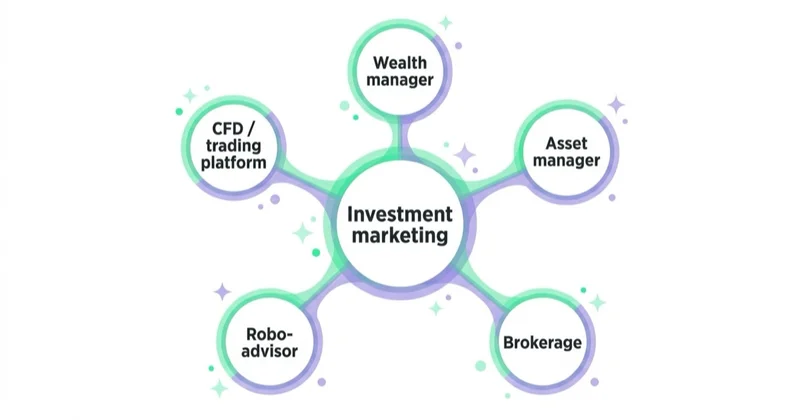
Investment and wealth management marketing acquires and retains clients for investment services. The category includes wealth managers, private banks, asset managers, fund providers, brokerages, robo-advisers and leveraged trading platforms. These businesses differ in their service, target market and regulatory permissions.

The service and jurisdiction shape the campaign before any channel is selected. In the EU, investment-firm marketing communications must be fair, clear and not misleading. Requirements for costs, risk, past performance and client assessment vary with the service and product. A well-designed process protects investors, reduces regulatory exposure and helps the firm reach clients for whom the proposition is intended.
TL;DR
- Identify the firm type and its regulated role first. Wealth manager, asset manager, brokerage, robo-advisor and CFD platform each acquire differently and carry different obligations.
- Risk, costs and past performance must follow the rules applicable to the product. Do not promise certain returns or present benefits in a way that obscures material risk.
- High-risk products face additional restrictions. CFDs, binary options, certain complex instruments and cryptoassets have separate rules that depend on the product, audience and market.
- Target market and required client assessments shape acquisition. Suitability and appropriateness are distinct assessments and apply according to the service being provided.
- The outcome is an appropriate, active and retained client. A lead or account opening alone does not show whether the relationship creates value for the client and firm.
- Trust and time dominate. High-value investment decisions have long consideration windows; brand, credibility and clear information beat pressure.
- Platform requirements are covered separately. This article focuses on acquisition strategy; Google and Meta verification is explained in the financial-services compliance guide.
Define the firm, service and audience first
“Investment marketing” spans very different regulated services. Before campaign planning, document the entity providing the service, its permissions, permitted markets, the product’s target market and the people responsible for approving communications.
| Firm type | What is being marketed | Better commercial event |
|---|---|---|
| Wealth manager / private bank | discretionary management or advice for higher-value clients | a client who fits the service and funds and retains assets |
| Asset manager / fund provider | funds and strategies, often via intermediaries | net new assets from suitable investors/distributors |
| Brokerage / execution | account and platform to trade securities | funded, active account trading suitable products |
| Robo-adviser / digital wealth | automated portfolios and a digital investment journey | funded, retained portfolio after the required client assessment |
| Leveraged trading / CFD platform | complex, high-risk speculative instruments | eligible, retained client under strict marketing limits |
| Investment adviser (advice-led) | recommendations and planning | qualified, suitable advisory engagement |
Two models need particular care. A robo-adviser may look like a consumer app but still provides an investment service with obligations determined by its model. A CFD or leveraged-product platform faces additional restrictions and cannot be promoted to retail clients like a simple savings app.
Build risk and past-performance rules into the brief
In the EU, information from an investment firm to clients or potential clients, including marketing communications, must be fair, clear and not misleading. Marketing must also be identifiable as such. Specific warnings and presentation requirements depend on the product and material, so they need to be established before creative work begins.
- never imply guaranteed, assured or risk-free returns, or that capital is safe when it is not;
- present risk with equal prominence to any benefit — not in a footer;
- when past performance is shown, follow the applicable rules on period, source, costs and the prominent warning that past results are not a reliable indicator of future results;
- describe the target market and eligibility, and avoid encouraging unsuitable clients;
- for leveraged products, carry the standardised risk warning (including the proportion of retail accounts that lose money) where required;
- substantiate any track record, rating, award or assets-under-management figure;
- keep fees, charges and their effect on returns visible and honest.
Clear information about strategy, risk, fees and the firm’s status helps an investor assess the proposition. Unsupported claims can undermine credibility and create regulatory exposure.
Separate rules for speculative products
CFDs and other high-risk products cannot be marketed like a standard investment account. EU product-intervention measures for CFDs offered to retail clients include leverage limits, negative-balance protection, restrictions on incentives and a standardised warning showing the percentage of retail accounts that lose money. Binary options and cryptoassets are subject to separate rules that can vary by market and product structure. Confirm whether a product may be promoted, to which audience and with what mandatory wording before campaign design begins. Platform requirements are covered in the compliance guide.
Channels by firm type
| Firm type | Motion | Primary channels |
|---|---|---|
| Wealth / private bank | relationship, referral, high credibility | search, expert content, events, referrals and selective brand campaigns |
| Asset manager / funds | intermediary and institutional distribution | LinkedIn, trade media, content, adviser and platform relationships |
| Brokerage / execution | self-serve with suitability controls | search, content, education, app campaigns where compliant |
| Robo-adviser / digital wealth | a simple digital journey supported by education | search, content, social and permitted referral activity |
| CFD / leveraged trading | tightly restricted, eligibility-gated | limited to compliant channels, audiences and wording only |
| Investment adviser | trust and local presence | search, content, referral, local presence |
Investment decisions may take months. Reputation, referrals, expert content and credible independent validation therefore work alongside advertising rather than serving as optional extras.
Glossary
- AUM (assets under management) — the total client assets a firm manages; net new AUM is the real acquisition outcome.
- Suitability — the assessment used for services such as investment advice or portfolio management, covering knowledge, experience, financial situation and investment objectives.
- Appropriateness — an assessment of knowledge and experience required for certain non-advised services; its application depends on the service and instrument.
- Target market — the defined type of client a product is designed for, which acquisition should respect.
- MiFID II — the EU framework governing investment services, including marketing, suitability and disclosure.
- CFD — a leveraged contract for difference; a high-risk product with restricted retail marketing.
- Past-performance rule — the requirement that historical returns are shown with the correct disclaimers and presentation, and never as a promise.
Measurement: active clients and retained assets — not raw leads
A lead or account opening is only one stage. A person outside the intended target market, an account abandoned after an incentive or use inconsistent with the product’s purpose should not be treated as a complete success. Measurement needs to reflect the quality and durability of the relationship.
- Clients who meet the service criteria and fund and retain the relationship, or net new AUM, after the assessments required for that model.
- Retention and asset persistence beyond any promotional or acquisition window.
- Client quality: results of required assessments, complaint rates and, for active trading, responsible-use indicators.
- Total acquisition cost against client value over time, using a definition approved by finance.
- Long-window measurement and controlled tests, because decisions mature over months and brand or referral effects are easy to misread.
Do not optimize campaigns only for a cheap form fill. The event sent to the advertising system should have a stable definition and represent value after quality controls, even if evaluation takes longer.
Data boundaries
Opening an account and assessing a client may involve wealth, income, holdings, objectives and identity documents. Advertising tools do not need this information. Do not put portfolio values, answers or verification outcomes into URLs, event names or audience labels. Review every tag on authenticated and application pages. Hashing is a technical safeguard, not consent or anonymisation. Platforms should receive only approved, necessary events and identifiers. See the compliance guide for the wider data framework.
How Space Ads approaches investment and wealth marketing
We begin with the regulated entity and compliance team: which services may be promoted, in which markets, to which target audience and with what mandatory information. We also define who approves ads and landing pages. Only then do we design campaigns around credible information about the service, costs, risk and the firm’s experience.
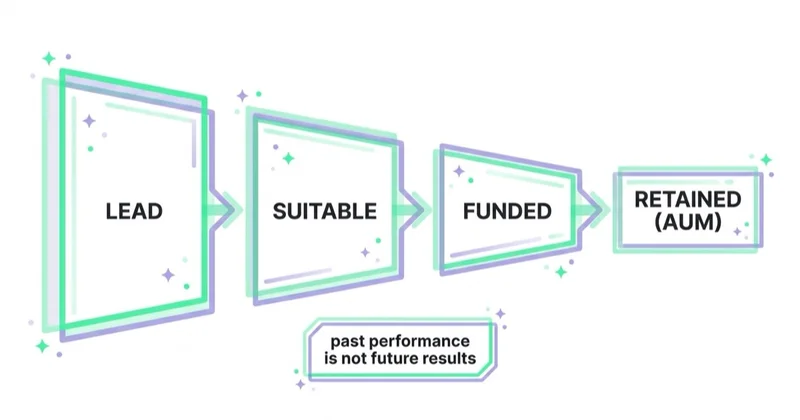
Channels follow the firm and decision process: search and expert content for wealth management, LinkedIn and intermediary communication for asset managers, and a scalable digital journey with required client assessments for brokerages and robo-advisers. Leveraged products use only the channels, audiences and wording permitted for the market. Performance marketing and lead generation are tools within this system. Campaigns are evaluated by clients who fit the service and build a durable relationship, not the lowest-cost leads.
Stop doing / Do instead
| Stop doing | Do instead |
|---|---|
| Implying certain or risk-free returns | State risk with equal prominence and never guarantee returns |
| Showing performance without disclaimers | Follow past-performance presentation rules on every figure |
| Marketing CFDs or complex products like an app | Apply retail restrictions, eligibility and mandatory wording |
| Optimising to cheap leads or account opens | Optimise to suitable, funded, retained clients and net new AUM |
| Ignoring target market and suitability | Reach only clients the product can responsibly serve |
| Using pressure and scarcity | Build trust with credibility, transparency and time |
| Sending portfolio or suitability data to ad tools | Share only approved, minimal marketing events |
FAQ
What is investment / wealth management marketing?
It includes the activities used to acquire and retain clients for wealth managers, asset managers, brokerages, robo-advisers and other investment-service providers. Those activities may include brand building, expert content, advertising, events, referrals and customer communication. Permitted channels and required information depend on the service, product, audience and jurisdiction.
How is it different from financial advisor marketing?
“Financial adviser” can cover planning and intermediation, while an investment firm provides a defined regulated service such as investment advice, portfolio management or execution. The service and instrument — rather than the label alone — determine permissions, risk information, performance presentation and client assessments.
Can you advertise investment products on Google and Meta?
Many investment services can be advertised, but platforms may require verification and apply product-specific restrictions. Some leveraged, speculative or cryptoasset products are limited or prohibited for retail audiences in particular markets. Both the law applicable to the product and the platform’s current policy need to be checked before launch.
What are the rules on risk warnings and past performance?
Marketing must not imply guaranteed returns or minimise material risk. When an investment firm shows past performance, applicable rules can govern the period, source, treatment of costs and the prominent warning that past results are not a reliable indicator of future results. The exact wording and format depend on the product, communication and jurisdiction.
What should investment firm marketing measure?
Measure clients who meet the service criteria, funded and retained relationships, and net new AUM — not only enquiries. Retention, complaints, total acquisition cost and client value should be assessed over a period that reflects the often lengthy investment decision.
How do you market a high-risk or leveraged trading platform compliantly?
First confirm whether the product can be offered and promoted to the intended audience in that market. For CFDs offered to retail clients, relevant measures include leverage limits, negative-balance protection, restrictions on incentives and standardised risk warnings. The campaign and landing page must be designed within those boundaries.
Key takeaways
- Investment and wealth marketing is governed by suitability, risk warnings and past-performance rules before any channel choice.
- Wealth managers, asset managers, brokerages, robo-advisors and CFD platforms are different businesses with different obligations.
- The most speculative products face explicit retail marketing restrictions — check the market first.
- The outcome is a suitable, funded, retained client (or net new AUM), measured over a long window.
- Credibility and transparency support a long investment decision; pressure and unsupported claims create exposure.
Sources and further reading
- ESMA — Product intervention on CFDs and binary options for retail clients
- FCA — Financial promotions on social media
- Google Ads Help — Financial products and services policy
- Google Ads Help — Expanded EEA financial-services verification from July 2026
- Meta — Prohibited financial products and services
Continue learning
- Marketing for financial services: compliant campaigns in a restricted category
- Financial advisor marketing: compliant lead gen on Google and Meta
- Fintech marketing: an acquisition playbook for regulated growth
- Performance marketing for regulated categories
- Lead generation for qualified sales enquiries
Continue reading
Consumer Lending and BNPL Marketing: Rules and Channels
Consumer lending and BNPL marketing requires clear information about the obligation, costs and terms. Campaigns should be judged by originated-loan quality — not application volume.

Bank Marketing: Acquisition and Campaigns for Retail and Business Banks
Bank marketing combines continuous customer acquisition with time-limited product and seasonal campaigns. Success is an active, funded customer relationship — not simply an account opening.
Fintech Marketing: An Acquisition Playbook for Regulated Growth
Fintech marketing starts with the entity, product, partner responsibilities and permitted markets. Build acquisition around approved claims, minimal data sharing and retained customer economics.