
A customer acquisition strategy is the operating plan for winning suitable new customers at an acceptable incremental return. It defines the target cohort, demand and buying triggers, offer, routes to market, capacity, economics, evidence and decision rights. It also states what the business will not pursue.
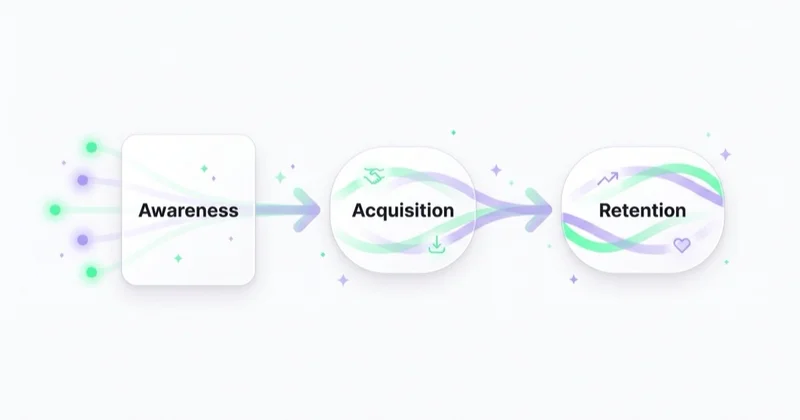
The plan begins by separating acquisition from the other growth levers: retention, expansion, pricing, product mix and new markets. Paid media, SEO, content, CRO, partnerships, CRM and sales are possible execution layers—not the strategy itself. More spend is justified only when the expected marginal contribution, cash exposure and operating capacity fit the company's objective and risk tolerance.
TL;DR
- Start with the growth objective and constraint. New customers are not always the highest-return route to growth.
- Economics need cohorts and ranges. Use contribution, fully loaded CAC, payback, cash timing and capacity—not forecast LTV alone.
- Channel roles are hypotheses. Search, social, SEO, partners and outbound behave differently by category, market and buying situation.
- Scaling means repeating a system under wider conditions. Conversion rate may change as spend reaches colder demand; marginal return decides whether expansion remains rational.
- Blended metrics need interpretation. MER, platform ROAS, CPA and pipeline can all move without proving incremental profit.
- CRO is part of acquisition. If the website cannot convert the right visitors, media buying only amplifies waste.
- Retention changes acquisition math. A business with repeat revenue can pay more to acquire a customer than a one-off transaction model.
- The strategy needs decision rights and learning gates. Match reviews to signal latency and cohort maturity rather than an arbitrary meeting calendar.
What a customer acquisition strategy includes
A practical customer acquisition strategy answers ten questions:
- Which company growth target belongs to new-customer acquisition?
- Which customer or account cohort produces suitable contribution and can be served well?
- What problem, buying situation or change creates demand?
- Which offer and evidence make the next step worthwhile?
- Which routes can reach that cohort lawfully and credibly?
- What fully loaded and marginal acquisition cost can the business fund?
- Which sales, inventory, onboarding or delivery constraints limit volume?
- Which leading and lagging outcomes govern scale, hold or stop decisions?
- What experiment or evidence will resolve the largest uncertainty?
- Who owns the decision and what happens after acquisition?
This is broader than performance marketing. PPC, Google Ads, Meta Ads, TikTok Ads, SEO, email and CRM are execution layers. The acquisition strategy decides how those layers work together.
Acquisition strategy vs channel strategy
| Question | Acquisition strategy | Channel strategy |
|---|---|---|
| Scope | Whole path to customer and payback | One channel or platform |
| Main decision | Which customer growth to fund and under what conditions | How to deliver one route's assigned role |
| Metrics | Incremental contribution, CAC, payback, cash, capacity | Delivery, attributed outcomes and route-specific quality |
| Time horizon | Months and quarters | Days and weeks |
| Risk | Scaling the wrong business model | Optimizing the wrong campaign |
A channel can look healthy while acquisition is weak. One platform may report strong attributed revenue while total contribution falls. Search leads may cost more but progress further. A technical guide may support evaluation without generating the first touch. These are hypotheses to verify with cohorts and experiments, not fixed channel truths.
The acquisition strategy defines which business outcome matters, how evidence from different systems is reconciled and which team may change budget, offer or capacity.
Use learning and release gates, not budget mythology
An annual budget should not be an unconditional release. Separate committed operating cost, proven acquisition, experiments and future options. The evidence required depends on the offer, cycle and risk—not on whether the company calls itself “early stage” or “mature.”
| Gate | Main objective | Release rule |
|---|---|---|
| Feasibility | Confirm reachable demand, offer, measurement and operating readiness | Fund the minimum credible learning design |
| Repeatability | Observe quality through a mature outcome window | Release against ranges, not one early average |
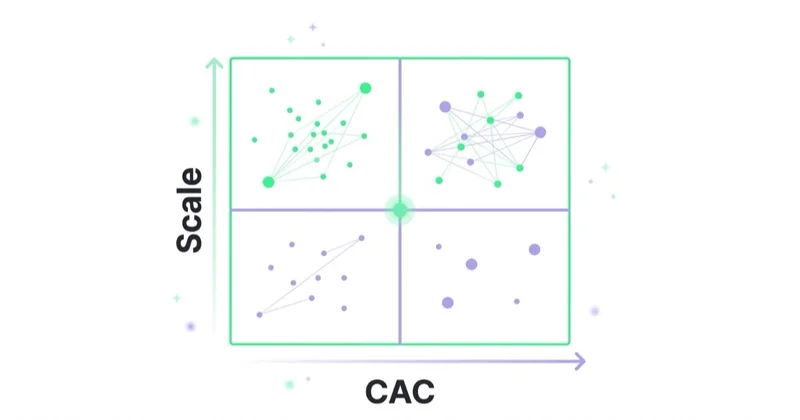
| Expansion | Test a new spend range, audience, market or route | Protect marginal contribution, cash and capacity |
| Portfolio | Reallocate across proven, learning and strategic roles | Use incremental evidence and reversibility |
Early conversions are often the easiest demand and the least mature cohort. Before each release, state the change being made, expected range, minimum detectable business effect where applicable, guardrails, observation period and rollback. Evidence may be accepted-to-won progression in B2B, fulfilled contribution in ecommerce, retained activation in SaaS or completed-job margin in local services. None should be replaced by a platform event alone.
A conversion rate does not need to remain numerically flat as spend rises. Broader reach may lower the rate while still adding profitable customers. The correct question is whether the next spend band produces acceptable incremental contribution and payback.
Start with acquisition economics
Before choosing channels, the business needs clear acquisition economics.
Core metrics:
- Fully loaded CAC — the agreed acquisition cost allocated to a new-customer cohort.
- Marginal CAC — incremental cost divided by incremental customers as spend changes.
- Realized contribution — collected revenue minus the variable and service costs in the agreed model.
- Forecast customer value — future contribution under stated retention, margin and discounting assumptions.
- Payback period — time until cumulative cohort contribution recovers acquisition cost.
- MER — total revenue divided by marketing spend; a blended revenue-efficiency ratio, not profit or incrementality.
- Pipeline — qualified potential value under defined stages and probabilities, not revenue.
- Sales capacity - the number of leads or opportunities sales can handle well.
Different businesses can tolerate different CAC.
| Business model | Acquisition constraint |
|---|---|
| E-commerce | margin, repeat purchase, return rate, stock and discounting |
| SaaS | payback period, activation, churn and expansion revenue |
| B2B services | sales capacity, deal size, close rate and delivery capacity |
| Local services | booking rate, job value, location and call handling |
| Luxury / premium brands | brand positioning, margin protection and selective reach |
If economics are uncertain, use downside, base and upside cases and release spend in stages. Do not attach full forecast lifetime value to every new lead or order. The companion CAC benchmark guide explains the required cost and cohort data contract.
Acquisition capacity also consumes cash before profit appears. Model payment terms, returns, inventory, commissions, implementation and sales-cycle lag. A cohort may look profitable in lifetime terms while creating a cash gap the company cannot safely fund.
Channel roles in customer acquisition
Each route should have a testable job. The labels below are common possibilities, not guarantees.
| Channel | Primary role | Useful when |
|---|---|---|
| Google Search | Reach expressed query intent | Relevant demand exists and query quality can be governed |
| Shopping / Performance Max | Promote eligible products across Google inventory | Feed, availability, values and exclusions are reliable |
| Meta Ads | Reach, creative testing, retargeting or conversion | The offer and evidence work in discovery environments |
| TikTok Ads | Reach and native video-led discovery | Creative supply and audience economics support testing |
| LinkedIn Ads | Reach defined professional members or accounts | Audience, offer and deal economics justify the cost |
| SEO | Earn discoverability for recurring buyer questions | The business can publish and maintain distinctive evidence |
| Email / CRM | Continue a permitted known-contact or customer journey | Identity, preference and lifecycle data are governed |
| Referral / partner | Build trust through existing relationships | Sales cycle depends on credibility |
This is why Google Ads vs SEO is not a simple either-or decision. Paid media can create faster controlled reach; SEO can build durable discovery but requires time and maintenance. CRM can improve follow-up only for known, permitted contacts. CRO can improve a journey but cannot repair irrelevant demand or weak unit economics.
For each route, write the audience, buying situation, offer, landing experience, primary outcome, guardrails, expected lag and evidence method. Without that brief, a “diversified channel mix” is simply a larger collection of dashboards.
How to avoid wasting ad spend
Not every losing experiment is waste; a well-designed test can purchase valuable evidence. Waste is spend with no credible business role, learning question or operational ability to act on the result.
Common waste patterns:
- campaigns optimize toward shallow conversion events;
- creative attracts curiosity but not buyers;
- the landing page does not match the ad promise;
- CRM follow-up is slow or inconsistent;
- sales rejects leads but the feedback never returns to marketing;
- product margin is ignored in ROAS targets;
- SEO pages bring traffic from the wrong intent;
- channels are judged separately while total CAC rises;
- location, schedule, inventory or eligibility controls do not match the offer;
- fraud, duplicates, existing customers or cancellations are rewarded as acquisition;
- privacy choices and suppression rules are ignored;
- tests run without a hypothesis, sample plan or stopping rule.
The response depends on the cause: narrow a service boundary, change the offer, repair the page, return deeper outcomes, improve response, hold out an audience or stop the route. Record the expected learning before launch and the decision after it; otherwise the same failed idea is likely to be purchased again.
Acquisition strategy for e-commerce
For e-commerce, customer acquisition strategy needs to connect media buying with margin, stock, product feed quality and retention.
Important decisions:
- which products can afford acquisition cost;
- which products should be excluded from aggressive scaling;
- whether new-customer acquisition is separated from remarketing;
- how discounts affect margin and repeat behavior;
- whether ROAS targets reflect gross margin or just revenue;
- how product feed titles, images, GTINs and availability affect Google Shopping;
- how email, SMS or loyalty improve repeat purchase.
Ecommerce teams often overfocus on attributed revenue ROAS. Connect cost to fulfilled contribution after discount, cost of goods, payment, shipping, returns and fraud. Separate verified new customers from existing customers and observe repeat behavior by cohort. Do not spend against assumed repeat value before it materializes.
Inventory and operations set the ceiling. Exclude products that are unavailable, legally restricted, unable to meet delivery promises or strategically unsuitable for paid acquisition. A campaign is not healthy if it depletes scarce stock that would have sold through a lower-cost route unless the incremental analysis supports it.
For fashion and premium retail examples, see our Philipp Plein success story, Plein Sport success story and Billionaire success story.
Acquisition strategy for B2B and services
For B2B and service businesses, acquisition strategy needs to connect marketing with sales outcomes.
Important decisions:
- what counts as a qualified lead;
- whether the offer should be an audit, demo, quote, consultation or assessment;
- how quickly sales follows up;
- which CRM stages should be sent back to ad platforms;
- which industries or company sizes should be excluded;
- whether paid media should target existing demand or create awareness first;
- how content supports sales conversations.
The B2B model should track mature cohorts from inquiry through acceptance, opportunity, win, implementation and realized contribution. Source and “influenced pipeline” are attribution rules, not causal proof. Sales response, available representatives and delivery capacity must be in the same plan. That is the core of B2B lead generation.
Acquisition strategy for SaaS
For SaaS, acquisition strategy depends on the sales motion.
| Sales motion | Acquisition focus |
|---|---|
| Self-serve | trial signup quality, activation and product usage |
| Sales-led | demo quality, opportunity rate and sales cycle |
| Product-led + sales assist | activation signals, expansion potential and handoff timing |
| Enterprise | account fit, buying committee, category education and trust |
SaaS teams should avoid judging acquisition only by signup volume. A trial that never activates is not equivalent to a trial that reaches product value quickly. A demo from a poor-fit company is not equivalent to a demo from the target ICP.
The acquisition plan should define the first conversion, retained activation, paid conversion, qualified account signal, gross-margin payback and churn horizon. Activation should be supported by cohort evidence, not chosen because it is easy to track. Account for free users, implementation, support, cloud usage and sales-assist cost. For channel examples, see SaaS paid acquisition.
Reporting for acquisition strategy
A customer acquisition strategy needs one reporting spine. Otherwise every channel defends its own numbers.
Useful acquisition dashboard sections:
| Section | Question |
|---|---|
| Spend and pacing | Is budget being used as planned? |
| Cohort economics | Do acquired cohorts produce contribution and repay cost? |
| Attributed outcome | Which touches receive credit under the chosen rules? |
| Incremental evidence | What additional outcome did an experiment estimate? |
| Conversion quality | Do leads, purchases or trials become value? |
| CRO | Where does the funnel leak? |
| CRM / sales | What happens after the conversion? |
| Retention | Does the customer return, expand or churn? |
| Capacity and quality | Can sales, stock, onboarding and delivery absorb the demand? |
| Data health | Are definitions, uploads, identities and delays reliable? |
| Next actions | What changes this week? |
GA4, ad platforms, CRM and finance do not have to show identical channel credit. Attribution model, identity, consent, lookback, modeled events and timing differ. Reconcile total outcomes, explain gaps and retain each system for the question it can answer. For the reporting layer, marketing reporting in 2026 explains how to build a decision view instead of a pile of exports.
Where volume permits, add controlled incrementality work. Google's Conversion Lift, for example, distinguishes attributed conversions from incremental conversions and supports user- or geography-based designs for eligible accounts. Feasibility, power, conversion lag and contamination still matter. A lift study is a decision instrument, not a badge that makes all future spend causal.
How Space Ads approaches this
We structure customer acquisition as the bridge between market choice, media and business economics. The first deliverable is a shared model of target cohorts, contribution, cash, capacity, events and decision rights—not a campaign structure.
The diagnostic separates traffic fit, journey performance and commercial outcome. It also checks the offer and operating constraint. This prevents paid media from being asked to solve an unsuitable product, inaccessible journey, missing sales process, unavailable inventory or unprofitable delivery model.
The acquisition decision matrix
| Situation | Likely issue | Better decision |
|---|---|---|
| Traffic is growing, revenue is flat | Wrong intent or weak conversion | Review query, audience and landing page match |
| Leads are cheap, sales rejects them | Shallow optimization event | Import qualified stages and improve form qualification |
| Attributed ROAS is high, margin is weak | Product mix, discount, returns or non-incremental demand | Optimize to fulfilled contribution and test lift |
| SEO traffic grows, leads do not | Informational intent without conversion path | Add comparison, CTA and service-page links |
| Paid spend rises, MER falls | Mix or marginal efficiency changed; causality is unknown | Review cohort contribution and incremental response |
| Sales wants more leads but cannot follow up fast | Capacity constraint | Fix routing and SLA before raising spend |
30-day customer acquisition strategy plan
Week 1: map economics and constraints
Separate the growth target into acquisition, retention, expansion, price and market effects. Define cohorts, fully loaded and marginal CAC, contribution, payback, cash, capacity and forecast assumptions. Use downside, base and upside ranges.
Week 2: audit channels and measurement
Review routes, campaign promises, GA4 key events, platform conversions, CRM or order stages, identity, attribution and current offline-data connections. Identify divergence from realized outcomes and any privacy or accessibility gap.
Week 3: fix the funnel
Fix the binding constraint: offer, eligibility, page, checkout, form, response, inventory, onboarding or measurement. Prioritize user harm and high-confidence defects before uncertain tests.
Week 4: scale with guardrails
Release one defined spend or market increment with an expected range, guardrails, maturity date and rollback. Do not call a 30-day setup proof of profitability when sales, retention or repeat cohorts mature later.
Common mistakes
| Mistake | Why it damages acquisition | Better approach |
|---|---|---|
| Starting with channel budget | Ignores growth objective, economics and capacity | Start with cohort contribution, payback and constraint |
| Optimizing every channel separately | Creates local wins and global waste | Report blended acquisition cost and contribution |
| Treating CRO as a prerequisite slogan | Assumes every constraint is on the page | Diagnose traffic, offer, product, operation and journey |
| Using one KPI for every business model | SaaS, services and e-commerce have different economics | Match KPIs to the revenue model |
| Spending against unproven retention | Overstates affordable CAC | Use mature cohort evidence and downside cases |
| Trusting only platform attribution | Overstates contribution when journeys cross channels | Reconcile with GA4, CRM and finance |
| Protecting or cutting “brand” by label | Ignores evidence and strategic role | Evaluate reach, hypothesis, reversibility and incremental evidence |
| Scaling from average CAC | Misses diminishing returns | Estimate marginal and incremental CAC by spend range |
FAQ
What is a customer acquisition strategy?
A customer acquisition strategy is an operating plan for winning defined new-customer cohorts under acceptable contribution, payback, cash, capacity and risk. It connects market choice, offer, routes, sales or transaction flow, delivery, measurement and decision rights.
How is customer acquisition strategy different from marketing strategy?
Marketing strategy is broader and includes market selection, positioning, brand, customer and product decisions. Acquisition strategy focuses on the part of growth expected from new customers and the system used to win them responsibly.
Which channels should a customer acquisition strategy include?
There is no required channel list. Select routes from how suitable buyers discover, evaluate and buy, plus the company's evidence, economics, permission and capability. Give each route a testable role, outcome, guardrails and review date.
How do businesses know when to scale ad spend?
Release the next spend band when measurement is decision-ready, the offer and operation can absorb demand, and downside-to-upside marginal economics fit the approved threshold. Define the cohort maturity date and stop or rollback signal before increasing spend.
Why does customer acquisition get more expensive over time?
Early spend often reaches the easiest demand. Later increments can expand into lower-intent audiences, more competitive auctions or harder markets. Mix and capacity also change. Model a response curve and marginal CAC rather than assuming the historical average will hold.
How does CRO fit into customer acquisition?
CRO can improve the value created from suitable traffic by reducing genuine friction and improving qualification. It is one acquisition lever, not a cure for weak demand, offer, margin, inventory or sales execution. Judge changes on downstream quality and contribution.
Key takeaways
A strong customer acquisition strategy defines the new-customer growth objective, suitable cohort, economics, capacity, route hypotheses and evidence required for the next release. It makes uncertainty and trade-offs visible before spend changes.
The result is a repeatable decision system: attribution for operations, experiments for causal questions, finance for realized economics and cohort reviews at the pace outcomes mature.
Sources and further reading
- Google Ads Help - About conversion measurement
- Google Ads Help - About Conversion Lift and incrementality
- Google Ads Help - User-based Conversion Lift feasibility and power
- Google Analytics Help - About key events
- Google Analytics Help - Attribution settings and lookback windows
Continue learning
Continue reading
What Is Performance Marketing? (And How It Differs From Growth and Brand)
Performance marketing connects media investment with measurable business outcomes and improves those outcomes through continuous testing. Learn how it works, which channels it covers, how to measure it beyond platform ROAS and how it complements growth and brand marketing.
How to Increase Revenue: The Growth Levers a CEO Can Actually Pull
Revenue has only a handful of levers: more customers, higher conversion, higher average value, more frequency, and expansion. Most companies default to 'get more traffic' when a conversion, pricing or retention lever would move revenue faster and cheaper. Knowing which lever to pull is the CEO's job.
How a CEO Should Read the Marketing Numbers: A P&L View of Growth
A CEO needs a one-page decision view of marketing—not a platform scorecard. This guide connects revenue, contribution, CAC, cohort payback, pipeline, cash and marginal return while showing where blended ratios such as MER can mislead.


































